To avoid these ads, REGISTER NOW!

Mount compressor separate from tank

hotdogstand

Well-known member
Joined
Nov 1, 2014
Messages
114
Location
Norfolk, VA
I spent a bit of time searching and couldn't find what I was looking for, so I'll ask it here.

I want to pull the compressor and motor off my tank and mount them below the tank, maybe on some sort of wooden or metal frame to contain everything. The output of the compressor would T upwards into the bottom of the tank where the drain used to be, and down to a low point drain. My thinking is this will A) reduce harmful vibrations to the tank, and B) prevent water from ever accumulating inside the tank.

All the air for shop use would continue to be taken off the "normal" spot mid tank, as a safeguard to any residual tank "too"

Any thoughts about this before I get in too deep? Thanks!
 
To avoid these ads, REGISTER NOW!

xxaler

Well-known member
Joined
Nov 16, 2014
Messages
239
Location
Sutton Ontario
Works fine. Doesn't really make any difference, motor and pump are mounted solid to the tank and meant to be on rubber feet so the vibrations only take their aggression out on the feet.

Just get some good rubber pucks to mount the motor/pump skid on. Google Vibrabobbins. We have custom pieces made to mount our water pump/motor skids for our boilers, and I've ordered a few odd ones when we need to mount an air compressor head/motor separate from the tank on mobile boilers.
 

larry_g

Well-known member
Joined
Apr 28, 2007
Messages
16,858
Location
oregon
A. I would not worry about vibrations ruining the tank. There are millions of small compressors out there that prove this is not an issue to worry about.

B. Water enters the tank entrained in the hot air and condenses out on the cold walls of the receiver so where the tank is in relation to the pump is not going to prevent this.

You can remote the compressor from the receiver if you want but neither of the reasons you give are valid in my mind. I would only consider separating them if I got a great deal on a compressor and had problems finding a place to put it as an assembly.

lg
no neat sig line
 

RECox286

Well-known member
Joined
Apr 11, 2012
Messages
1,399
Location
South Joisey (yeah, that is part of the USA)
Your thinking may be somewhat flawed by reason.

Do not use the drain to introduce air into the tank.

Water will stay in between the compressor and the

tank, exactly where it will be impossible to drain the

water out, and most likely will flood the head of the

compressor, and if the valves don't keep it from filling

the cylinder(s) of the compressor, you will be in line

for a small amount of hydraulics until the head is clear

from running the compressor long enough. Not exactly

the way they engineer them at the factory. It is OK

to cut the cradle off the tank, and set them up as a

separate set up, but leave the drain as is, and keep

the air entering the tank exactly as it was set up at

the factory (use a longer pipe/hose) and you will be

fine. I have done this myself, and while it really makes

no sense, engineering wise, or space wise, I wanted to

put the machine in a space where that was my only

option (under the basement steps) and it worked out

just fine...still using it that way 35 years later !

Uncle Bob
 

404

Well-known member
Joined
Aug 23, 2014
Messages
3,463
Location
Mass
Agree with what RECox286 says.

Don't go into the drain, that is where all the rust and **** collect, don't want that trying to get into the check valve. If you put a long run of copper pipe between the tank and compressor a lot of the unwanted heat will go away too.
 

DangerousDan55

Well-known member
Joined
Jan 11, 2013
Messages
180
Location
Hockley, TeXas
I repiped my 60 gallon compressor. I have my old 20 gal tank with a bad compressor. So, I ran tubing from the 60 gal compressor, to the 20 gal tank, then from the 20 gal tank to the 60 gal tank at its middle port. Then out of the top of the 60 gal tank to the air header. All in hoping I could drop out more moisture. Didn't work!!! I still get moist air.
I now aquired an AC condenser which I plan to add to the system in trying to condense out more moisture.
May take me a few months to get around to it.
I will post the results then.....
 

akdiesel

Well-known member
Joined
Aug 8, 2008
Messages
2,617
Location
Wasilla, AK
I repiped my 60 gallon compressor. I have my old 20 gal tank with a bad compressor. So, I ran tubing from the 60 gal compressor, to the 20 gal tank, then from the 20 gal tank to the 60 gal tank at its middle port. Then out of the top of the 60 gal tank to the air header. All in hoping I could drop out more moisture. Didn't work!!! I still get moist air.
I now aquired an AC condenser which I plan to add to the system in trying to condense out more moisture.
May take me a few months to get around to it.
I will post the results then.....

You will need to have a smaller inlet then the outlet. This will create the JT you need to help drop the air temp thus creating liquid.
 

404

Well-known member
Joined
Aug 23, 2014
Messages
3,463
Location
Mass
I repiped my 60 gallon compressor. I have my old 20 gal tank with a bad compressor. So, I ran tubing from the 60 gal compressor, to the 20 gal tank, then from the 20 gal tank to the 60 gal tank at its middle port. Then out of the top of the 60 gal tank to the air header. All in hoping I could drop out more moisture. Didn't work!!! I still get moist air.
I now aquired an AC condenser which I plan to add to the system in trying to condense out more moisture.
May take me a few months to get around to it.
I will post the results then.....

You probably know to put a strong fan or blower thru the condenser.. right?
 

Tarnished

Well-known member
Joined
Feb 8, 2012
Messages
721
Location
SW Ohio
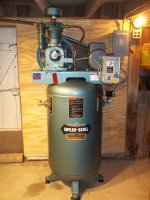
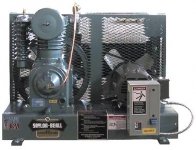
Considered doing something like this myself. Wanted to use this base mounted Saylor Beall and put it on the 2nd floor where upright compressor wouldn't fit. Sweet unit!
basemounted compressor w-aftercooler.jpg
While working on this solution my salesman came up with this 18mo old unit in excellent condition for a price that I couldn't pass up. :beer:
1  Just fit.JPG
 

CNGsaves

Well-known member
Joined
Sep 26, 2012
Messages
13,233
Location
KS and OK
^ ^ +1 with Sberry on this one . . . why screw with it ???

Compressors are setup like they are for a reason. OP line of thinking is bassackwards. Never pipe inflow of air into drain of compressor tank.

OP . . Is there "need" for shorter compressor for your hotdog stand ??
 

Oldb

Active member
Joined
Jul 22, 2010
Messages
44
Location
Walla Walla, Wa
When we were dairy farming we needed a second compressor for a back up during high demand. I wanted the tank down in the shop so we separated the two, and ran a underground line down to the shop from the two compressors in the barn. I had an 80 gallon tank @ 160 psi in the shop with no noise which was great, plus the 250' underground run cooled the air so it was easy to get the moisture out of it. The down side was the motor and compressor (5 hp. two stage) vibrated so bad we had to make a new base filled with concrete. That solved the vibration, and we ran it for a decade or so several hours a day. But really a lot of work just to free up some space.

B
 

justme-

Well-known member
Joined
May 24, 2014
Messages
787
Location
Boston suburbs
One of our shops has a compressor issue I'm thinking split mounting might solve. Currently have 3 80 gallon vertical units in a corner all plumbed in. The original is just a tank and the service unit next to it which decided to ventilate it's crankcase in August. An emergency replacement was borrowed and stands there as well. We have a much larger pump that we're going to work on using going from a 5hp single stage to a 2 stage 8HP setup. Issue seems to be mounting space since the vertical tanks were not designed to mount such a large compressor.
Aside from welding both together at the top mount plate and putting motor on one and compressor on the other, I'm thinking about a simple steel box frame for the motor/compressor and putting it on the floor next to the tanks.

good reading from that perspective. I agree not plumbing into the drain, but I'm not sure an evap setup is needed in 90% of applications. 1 shop we have a 3 or 4 inch out from the main tank in black iron pipe to a vertical 10 feet up from there to the ceiling leaving a moisture trap just like gas lines. Unless tank draining is massively ignored no water makes it to the tools from all the pipe. When I did notice water coming out shortly after I started there it turned out no one knew the last time the tanks were drained and the main (120 ish gal) had a little over 5gal of rusty water in it and the secondary tank up on the 2nd floor in line has no water at all.
A quick valve opening of the main tank and the trap in the pipe every other day solved that.
 

RickP

Well-known member
Joined
Jan 15, 2013
Messages
1,547
Location
Annapolis, MD
When I did notice water coming out shortly after I started there it turned out no one knew the last time the tanks were drained and the main (120 ish gal) had a little over 5gal of rusty water in it and the secondary tank up on the 2nd floor in line has no water at all.

Holy cow - that's a lot of water! I'm not happy when I forget to drain the tank and I end up with a few ounces on the floor. But draining a few gallons? I can't even imagine...
 
To avoid these ads, REGISTER NOW!

kbs2244

Well-known member
Joined
Nov 11, 2006
Messages
14,065
My pump is up on the top shelf where it is out of the way.
My tank is buried in the corner under my bench.
In a spot that is wasted space outherwise.
Vibration was a problem until I came up with best combination of insulation.
Condensation is taken care of by a 3 inch down pipe with a drain at the bottom.
The large dia. slows down the airflow so moisture has a chance to condense and run down the sides of the pipe.
I use a hose from the pump to the down pipe to take care of any vibration.
The down pipe drain uses a ball valve and a hose the goesthrough the wall.
I turn the valve with a long handle sliding through eye bolts screwed into the bottom of the workbench.
 
Last edited:
OP
H

hotdogstand

Well-known member
Joined
Nov 1, 2014
Messages
114
Location
Norfolk, VA
Okay, had a hard time tracking this back down.

I have read from a lot of people that the tanks can develop stress fractures from vibration of the motor and pump. I don't use mine for line work, so I expect mine will last a fairly long time anyway, but I'm always looking for a good project.

The idea with mounting everything below the tank is to prevent the assembly from being top heavy, in addition to providing a low point for water to collect that is outside of the tank and replaceable. I only have 7 foot ceilings in my shop and the compressor is located under a shelf, so headroom is limited.

The idea was that air would be piped in through a 12" pipe vertical from the drain. Air supply would be at a 90 degree angle to the pipe so that water would collect below that and be bled out, probably with an auto-drain kit from HF as I have heard good things about them.

It was only an idea, and a good excuse to weld up a frame and some pipe.
 

RickP

Well-known member
Joined
Jan 15, 2013
Messages
1,547
Location
Annapolis, MD
The idea was that air would be piped in through a 12" pipe vertical from the drain. Air supply would be at a 90 degree angle to the pipe so that water would collect below that and be bled out, probably with an auto-drain kit from HF as I have heard good things about them.

It was only an idea, and a good excuse to weld up a frame and some pipe.

It's not a bad idea for a project if you want to do it - but I'd seriously recommend piping the air in/out of the top of the tank. Previous posts talked about the water, oil and rust flakes that are going to come out of the drain at the bottom of the tank, and your drip leg won't get rid of all of that junk. But the CFM of your air flow will suffer too, because the tank drains are usually 1/4 inch. You should be able to use 1/2 inch pipe at the top of the tank and it's really not that hard to install the extra pipe.

I'm working on a similar setup right now:

IMG_20150112_134723_zps9a3e95e2.jpg


That's an old tank that I'm putting in my basement, fed by a compressor in the garage. The vertical pipe will be the inlet and outlet for the air, and it will have a drip leg at the bottom of it.

Copper or black pipe would work well for you, and it would add a little extra cooling after the pump, before the air enters the tank. If you can't thread the black pipe, Home Depot will do it for you if you buy it there.
 
Last edited:

Woody325

Member
Joined
Sep 15, 2019
Messages
23
Location
PA
Resurrecting this old thread to hopefully get some good intel & feedback.

I have a Kobalt 2 stage vertical 30 gallon compressor that does a fine job and I'm completely happy with except that I wish it were horizontal so that I could mount it up and out of the floor space. i researched horizontal compressors but the majority have smaller tanks, are single stage, or cost a mint!

So I'm thinking I could 'remote' the compressor and mount the tank up in the rafters vertically to clear the space it requires, and then just deal with mounting the compressor close to the ceiling.

The tank could be up to 15' away from the compressor. The drain valve would still be accessible (will likely plumb to a convenient location), and I'd plan to have a remote pressure control, filter, etc. closer to my work bench (another 15'?).

What issues am I facing and what type of plumbing are we talking about? I could certainly adds some serious draining options, and it would increase my 30 gallons too.

looks like it can be done with standard NPT hardware, some flexible hoses, and a lot of copper pipe & valves.

Thanks in advance!!
 
Last edited:

nadogail

Well-known member
Joined
Jan 23, 2009
Messages
31,894
Location
Coronado, CA
I have found that common good quality steel pipe fitting have easily handled the air pressure used in workshops.

Warm Moist Air, as it cools, leaves behind moisture. Drain it from the low points of the system. If you have trouble remembering to purge the water from your air tanks consider investing in an automatic "Spit Valve".
 
Last edited:

Woody325

Member
Joined
Sep 15, 2019
Messages
23
Location
PA
Thanks nadogail. I was planning to use copper because I have a lot of it salvaged from my old garage. Other than the hassle of sweating the joints I've never had any issues with leakage or pressure.
 

nadogail

Well-known member
Joined
Jan 23, 2009
Messages
31,894
Location
Coronado, CA
Any information or advice you take from me is guaranteed to be worth exactly what I charged you for it.

That is a "Full Money Back" Guarantee.
 

Woody325

Member
Joined
Sep 15, 2019
Messages
23
Location
PA
I took apart my compressor apart and ran into a little wrinkle with my plan. My compressor has two ports at the top - I have a 1/2" threaded inlet coming from the pump, and a 1/4" threaded outlet going to the pressure switch, gauge, output. These ports are about 8" apart at the top.

The pressure switch is mounted to the output and has a a small 8" bleed off hose connecting it to a fitting with a pressure valve of sorts that goes in the top of the 1/2" tank input from the compressor.

So, my options as I seem it are:

1- Extend the 8" bleed off hose some 15' and mount the pressure switch with the motor.

2- Lengthen the wire leads the same 15' between the pressure switch and motor.

3- Mount the pressure switch with the motor while maintaining the 8" bleed off hose and mount that in a vertical piece of 2" black pipe piece that is plumbed from the top of the tank 15' away (probably run 3/4" over the distance and transition to 2" near the motor/compressor).

Option 2 seems the most straightforward, but option 3 is intriguing. I just don't know how the pressure valve works, and it's been a long time since i took fluid mechanics.

Anybody got any ideas?
 

The Cobbler

Super Moderator
Staff member
Joined
Oct 24, 2013
Messages
25,802
Location
Niagara Region, Ontario, Canada
the 1/4" line goes to the unloader valve in the pressure switch . when the pressure is reached and shuts off, it bleeds off air in the compressor line to the tank check valve so when it starts it isin't starting against compression.
snap some pics of your set up
 

Woody325

Member
Joined
Sep 15, 2019
Messages
23
Location
PA
giLn9Xo


This unloader swith / check valve is giving me some fits. It's a 1/2" FPT to the tank, but then what I think is 7/16" compression to a hard line hose to the pump. That hardline hose is what I'm trying to replace, but how do I transition from 7/16" (?) male compression to anything other than a compression fitting?

Gahh! I can't seem to upload an image ...
 

keesak

New member
Joined
Dec 27, 2019
Messages
1
Location
TX
I’m working on the same thing right now. My choice was closest to your #3 except wire up a N/O electric solenoid at the pump to unload instead of trying to run anything besides the supply line between the pump and the tank. Plus, 15 feet of bleed every time it cycles might get annoying
 

QwikKotaTx

Well-known member
Joined
Aug 10, 2013
Messages
967
Location
Seabrook, TX
I plumbed a small Makita compressor to a larger tank just to have a little more capacity but the pump and motor are still mounted to the original tank. It helps with the duty cycle a little bit.

Sent from my moto g(7) play using Tapatalk
 
To avoid these ads, REGISTER NOW!
Top Bottom