To avoid these ads, REGISTER NOW!

Moving a dryer outlet. Would this be within code?

Saburai

Member
Joined
Aug 28, 2020
Messages
13
Location
Ocala Florida
Hi Gang!
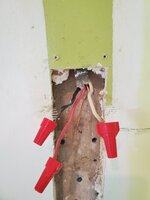
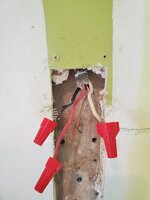
Long time lurker here. We're renovating a small early 80's house here in North Central Florida. It's mostly block construction. The poblem I'm facing is moving a 220v electric outlet for the dryer. Previously, it seems that the house had a vertically stacked washer/dryer and as such the receptacle is above the hight of the Speed queen that I'll be installing. It's a block wall with 1/2" furring strips and sheet foam insulation. I'd like to **** splice solder or crimp with glue filled heat shrink over the individual wires as well as the bundle. This way I'll be able to extend the circuit down to where it needs to be. There's no room for a junction box w/o knocking out clearance in the block. I've attached some pictures to clarify exactly what I'm wanting to do. Opinions, suggestions and ideas would be greatly appreciated!
 

Attachments

  • 20240820_092155.jpg
    20240820_092155.jpg
    434.5 KB · Views: 115
  • 20240820_092236.jpg
    20240820_092236.jpg
    220.9 KB · Views: 107
  • 20240820_092220.jpg
    20240820_092220.jpg
    210.6 KB · Views: 111
  • 20240820_092155.jpg
    20240820_092155.jpg
    434.5 KB · Views: 112
To avoid these ads, REGISTER NOW!

mike93lx

ALLIANCE MEMBER
Joined
Dec 9, 2013
Messages
37,383
Location
Richmond, VA
Soldering is for fine stranded wire. You can use wire nuts, but it needs to be in an accessible junction box, no way around that other than running a whole new feed

I would just let the receptacle be above the dryer and move on
 

PCustoms

Well-known member
Joined
Jul 23, 2011
Messages
22,320
Location
VT
You have to have a junction box (and that box has to be accessible).

The other option would be a listed/approved in-wall splice, though some frown on these, and I'm not sure on your wire size.
 

MovingAlong

Well-known member
Joined
Aug 17, 2013
Messages
1,197
I'd like to **** splice solder or crimp with glue filled heat shrink over the individual wires as well as the bundle. This way I'll be able to extend the circuit down to where it needs to be.

"Would this be within code?" No.

There's no room for a junction box w/o knocking out clearance in the block. I've attached some pictures to clarify exactly what I'm wanting to do. Opinions, suggestions and ideas would be greatly appreciated!

What's the issue with knocking out the block and putting in a properly sized junction box? Don't bury it behind the drywall either...
 
OP
S

Saburai

Member
Joined
Aug 28, 2020
Messages
13
Location
Ocala Florida
Is that UF cable even 10 awg? Looks like 12/3 UF, if that is the case need a new feed, 20A wire on a 30A circuit is a no go.
Yes, your correct. It's 12/3 UF.
A new feed is non starter. Unfortunately, piss poor planning on my part would make this extremely difficult. The attic has been completely sprayed with foam and to make matters worse, the new ridgid A/C ductwork is directly over where (I assume) the existing feed runs.
OTOH, I do understand that it is not up to current code it has been functioning W/O event for 40+ years. I do understand the insurance liability if I were to add a junction box and run it as is. I'm pretty certain that this is not the only thing that's not in compliance with current standards.

ETA Had I known that this were the case, I certainly would have addressed it before completing the other work...
 

Norcal

Well-known member
Joined
Mar 16, 2008
Messages
13,752
Yes, your correct. It's 12/3 UF.
A new feed is non starter. Unfortunately, piss poor planning on my part would make this extremely difficult. The attic has been completely sprayed with foam and to make matters worse, the new ridgid A/C ductwork is directly over where (I assume) the existing feed runs.
OTOH, I do understand that it is not up to current code it has been functioning W/O event for 40+ years. I do understand the insurance liability if I were to add a junction box and run it as is. I'm pretty certain that this is not the only thing that's not in compliance with current standards.
20 ampere wire with a 24 ampere load.
 

RegeSullivan

Well-known member
Joined
Mar 30, 2014
Messages
695
Location
Canonsburg Pennsylvania (South of Pittsburgh)
No... definitely not within NEC code. I would also add that if the wire 12/3 wire is encased in the spray foam insulation you might have additional risk of overheating already overburdened conductors. If it were me I'd find a solution to running a properly sized wire or find an alterative to the electric dryer.
 

rlitman

Well-known member
Joined
Oct 18, 2010
Messages
24,579
Location
Long Island
Yes, your correct. It's 12/3 UF.
...
OTOH, I do understand that it is not up to current code it has been functioning W/O event for 40+ years...
It was NEVER up to code. Not now, not in the past, not ever. 30A on 12AWG wire was pushing your luck from the get go.

That fact that it's 40+ year old UF isn't helping your case either. Modern UF-B has insulation rated for 90C, while old UF is only rated for 60C, so it's even less tolerant of overcurrent.

That being said, a 20A breaker should keep it safe, and given the relatively short cycles dryers use, my guess is you wouldn't get nuisance trips unless run back-to-back (perhaps more than once). It's a thermal averages question. Even if the dryer element+motor pulls 24A, it isn't doing that continuously, and a 20A breaker will easily deliver 24A for at least a few minutes (probably half an hour or more). But the element is going to cycle, which keeps both the breaker and the wires cooler, so I'd figure you would get through a load without tripping a 20A breaker.
 
OP
S

Saburai

Member
Joined
Aug 28, 2020
Messages
13
Location
Ocala Florida
It was NEVER up to code. Not now, not in the past, not ever. 30A on 12AWG wire was pushing your luck from the get go.

That fact that it's 40+ year old UF isn't helping your case either. Modern UF-B has insulation rated for 90C, while old UF is only rated for 60C, so it's even less tolerant of overcurrent.

That being said, a 20A breaker should keep it safe, and given the relatively short cycles dryers use, my guess is you wouldn't get nuisance trips unless run back-to-back (perhaps more than once). It's a thermal averages question. Even if the dryer element+motor pulls 24A, it isn't doing that continuously, and a 20A breaker will easily deliver 24A for at least a few minutes (probably half an hour or more). But the element is going to cycle, which keeps both the breaker and the wires cooler, so I'd figure you would get through a load without tripping a 20A breaker.
Thanks for the thoughtful response. I was just discussing this with my wife and we agreed that of course safety comes first, but having the dryer trip the breaker with any frequency would sure be a PIA. Phase two of the restoration( in a year or so) includes moving the service panel. At that time I could run a new line. Do you really think that the dryer would be serviceable with the 20 amp breaker?
 

Copymutt

Well-known member
Joined
Sep 3, 2016
Messages
3,383
Location
Colorado
Can you not pull 10 gauge using the existing 12 run as the pull? My understanding is there is nothin wrong w/ using multistrand instead of solid. Multistrand snakes easier, but you pay the price.
 

rlitman

Well-known member
Joined
Oct 18, 2010
Messages
24,579
Location
Long Island
... Do you really think that the dryer would be serviceable with the 20 amp breaker?
Likely yes, and more importantly, if it does trip the 20A breaker, it means you're risking heating the wire into potentially dangerous territory on a larger breaker. On a 20A breaker, it's not really possible to dangerously overload 12AWG wire. That's why we call out for 20A breakers.

Who makes the breaker panel, and/or what kind of breakers are in it? We can look up the trip curves, and also knowing the nameplate rating of the dryer, we can tell you exactly how many pounds of **** you're trying to shove into your 5lb bag.

Can you not pull 10 gauge using the existing 12 run as the pull?
One staple's going to ruin your plans of that.
 
To avoid these ads, REGISTER NOW!

Copymutt

Well-known member
Joined
Sep 3, 2016
Messages
3,383
Location
Colorado
Likely yes, and more importantly, if it does trip the 20A breaker, it means you're risking heating the wire into potentially dangerous territory on a larger breaker. On a 20A breaker, it's not really possible to dangerously overload 12AWG wire. That's why we call out for 20A breakers.

Who makes the breaker panel, and/or what kind of breakers are in it? We can look up the trip curves, and also knowing the nameplate rating of the dryer, we can tell you exactly how many pounds of **** you're trying to shove into your 5lb bag.


One staple's going to ruin your plans of that.
Much about the current run is iffy. Good chance no staples or loose enough to rip out especially if they are only near the feed and outlet. Can certainly try to pull a single solid B4 any 10 gauge. Minimal investment.
 

bronc076

Well-known member
Joined
Jul 17, 2023
Messages
190
Location
Ozarks
Saburai,

There are times when we/us(?) homeowners skirt the rules, translate the code, or just plain do it wrong because it is either convenient or we are cheap, or both.

Wire gauge and breaker value is not one of those times. Forget normal operation of the dryer, suppose it has some sort of an internal failure, and the wire becomes the fuse. You really want your house to burn down?

If leaving that wire in place put in a 20 amp breaker. I see it is 12-3 with ground. So at least you have a neutral assuming it's all wired correctly at the panel.

Plan on installing a new run in the future.

Or put up a clothesline.
 

tvand13

Well-known member
Joined
Aug 20, 2015
Messages
76
Location
Northern Virginia
If you are going to continue risking a house fire perhaps at least check the actual amps each side of that 220 line is drawing to better evaluate the risk. You might be surprised that one side or the other is more than the other.
What? It's a 240V load, same current on both legs. Even if it's 4-wire with a neutral and a 120V control panel there's going be be hardly anything on a 120V leg compared to the heater.
 

RegeSullivan

Well-known member
Joined
Mar 30, 2014
Messages
695
Location
Canonsburg Pennsylvania (South of Pittsburgh)
What? It's a 240V load, same current on both legs. Even if it's 4-wire with a neutral and a 120V control panel there's going be be hardly anything on a 120V leg compared to the heater.
Educate me. Are you saying that all electric dryer motors are 220... or are you saying if a 120v motor and 220 heating element are used together that some how balances both sides?
 
OP
S

Saburai

Member
Joined
Aug 28, 2020
Messages
13
Location
Ocala Florida
Saburai,

There are times when we/us(?) homeowners skirt the rules, translate the code, or just plain do it wrong because it is either convenient or we are cheap, or both.

Wire gauge and breaker value is not one of those times. Forget normal operation of the dryer, suppose it has some sort of an internal failure, and the wire becomes the fuse. You really want your house to burn down?

If leaving that wire in place put in a 20 amp breaker. I see it is 12-3 with ground. So at least you have a neutral assuming it's all wired correctly at the panel.

Plan on installing a new run in the future.

Or put up a clothesline.
Already got one a dem(clothes line). It's a bit more complicated than "braking out the bread knife". If that were all that was needed, it'd be done already. The house was originally a 500 sq ft flat roof CBS building, now there's a double roof amongst other things to contend with... I appreciate the sentiment, but you know what they say about assumption...
In any case, I'm going to start cutting into the sheet rock and drill up through the flat roof and see if I can't pull a new line. Getting down to the existing panel will be the challenge...
 

Norcal

Well-known member
Joined
Mar 16, 2008
Messages
13,752
Years a local builder of cheap homes used a certain electrical contractor to wire their projects, always had Sylvania (Zinsco) panels, but they used aluminum 10/3 NM sheathed cable to supply the dryers, houses are still standing & the electrical contractor is out of business so no go back either but it's been better then 40 years now since Zinsco/Sylvania has been obsolete.
 

mike93lx

ALLIANCE MEMBER
Joined
Dec 9, 2013
Messages
37,383
Location
Richmond, VA
I’ve not researched. 10 gauge is required. Looks like 3 or 4 conductor acceptable.
Needs to be 4 conductor for a new install

The only "multistrand" that will work for this is stranded thhn-2 or xhhw in conduit and installing that conduit will be a lot more work than running a cable assembly.

You can't run rubber cordage, like soow, for a permanent install and Nm-b (romex) doesn't come stranded in #10
 
Last edited:

dscheidt

Well-known member
Joined
Apr 26, 2017
Messages
2,881
along with what other people have said, changing anything material about that outlet will require updating it to meet current code, which requires a four wire circuit.
 

PCustoms

Well-known member
Joined
Jul 23, 2011
Messages
22,320
Location
VT
along with what other people have said, changing anything material about that outlet will require updating it to meet current code, which requires a four wire circuit.

It already has 4 wires....
 

PCustoms

Well-known member
Joined
Jul 23, 2011
Messages
22,320
Location
VT
Years a local builder of cheap homes used a certain electrical contractor to wire their projects, always had Sylvania (Zinsco) panels, but they used aluminum 10/3 NM sheathed cable to supply the dryers, houses are still standing & the electrical contractor is out of business so no go back either but it's been better then 40 years now since Zinsco/Sylvania has been obsolete.
What does this have to do with the thread?
 

The Bean

Well-known member
Joined
Dec 24, 2021
Messages
1,809
Location
Delaware Valley (SE PA)
Maybe you should use this existing 12/3 circuit for a new standard 120v receptacle, reconnect it in the panel to some other lightly used breaker, then run a new 240v 4-wire circuit to your newly placed 30A receptacle being the dryer. Find a way to run it to bypass the ductwork and other shenanigans you have there.
 
To avoid these ads, REGISTER NOW!
Top Bottom