Not really a garage question, but I am thinking about adding a tall cabinet to the end of my kitchen cabinet run. I would have to get some fillers because the granite countertop overhangs the adjoining base cabinet by about an inch. That would be no problem. The problem is there is a double light switch plate right where the cabinet will go. I would need to move these switches about 18 inches to the right. I might be able to pull the cables back down through my basement and run then up the next stud cavity, but probably not. So, if I need to just extend the wires off the current switches, how do I maintain "Accessibility" to what will become a junction box behind the new cabinet?

You are using an out of date browser. It may not display this or other websites correctly.
You should upgrade or use an alternative browser.
You should upgrade or use an alternative browser.
Moving a wall switch
- Thread starter Skooterj
- Start date
pattenp
Well-known member
Cut a hole in the back of the cabinet for access.
Cardboard Man
Well-known member
Pull the wire down to the basement, place your work box down there, and then add the new longer wire from the work box up to the new location.
CraigStu
Well-known member
I may be misunderstanding but why not just go across old location to new location. I am imagining the new location is just 6 inches or so beyond the edge of the new cabinet. So you can remove drywall that will be behind the new cabinet to have good access to the old blue box. I have installed several new boxes and just cut a hole in the drywall large enough for the box to slip into place. I predrill 2 holes in the side of the box maybe 3/4 inch in and then run 2 screws through and into the stud. First time I did a box I used one w/ the little wings that rotate into place to grab the back of the drywall. My 2 screws is sturdier especially if I use a metal box. Before installing the new box open up a couple of the romex windows. Once the new box is in position, push your romex through the new box toward the old box
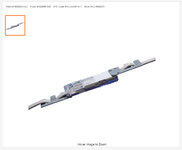
They make these just for what you want to do. 'Best Case' would be to run a new wire, but if you can't, these 'splices' should be able to do what you need and they are approved. Cut out the old junction box, add the splices, run your wires and patch the old hole in the wall... So, if I need to just extend the wires off the current switches, how do I maintain "Accessibility" to what will become a junction box behind the new cabinet?
Home Depot or Lowes usually has them.
Last edited:
pattenp
Well-known member
Those splicers can't be used when concealed to extend a circuit, only to repair a damaged circuit per the NEC. It's NEC 334.40(b)
Last edited:
do it right
Is the basement open ceiling or finished?
There hasn't been a wall I can't get into from a basement if it is an open ceiling (assuming wood framing, not masonry walls, but I am pretty good at those too)
You may be patching some holes, it is easier to open a wall for access to do it right than mickey mouse it
Measuring tape, stud finder, good drill bits, knowing what is already in the cavity/stud bay and how to avoid it is key
Splices in walls are an absolute no no
junction boxes behind finished ceilings are a no no
I use one of these to get down walls with blocking/firestops
Is the basement open ceiling or finished?
There hasn't been a wall I can't get into from a basement if it is an open ceiling (assuming wood framing, not masonry walls, but I am pretty good at those too)
You may be patching some holes, it is easier to open a wall for access to do it right than mickey mouse it
Measuring tape, stud finder, good drill bits, knowing what is already in the cavity/stud bay and how to avoid it is key
Splices in walls are an absolute no no
junction boxes behind finished ceilings are a no no
I use one of these to get down walls with blocking/firestops
This is the best suggestion so far. If these are light switches in a kitchen, there are probably wires going up from the box to the ceiling fixtures that OP will not be able to pull through from the basement.Cut a hole in the back of the cabinet for access.
Mount the new box, bridge over to it, cut a hole in the back of the cabinet, and put a blank plate over the old box, using a box extender to bring it flush with the cabinet back.
niget2002
Well-known member
If you do like the guy in my last house... you don't 
***** just ran new wires to the old box, wire-nutted the wires, then hung the cabinet in front of the open box.
***** just ran new wires to the old box, wire-nutted the wires, then hung the cabinet in front of the open box.
I have used these in the past. Also, they actually make a T splice which I have used to run another outlet. I have no problem using these and I believe they meet 'code'Those splicers can't be used when concealed to extend a circuit, only to repair a damaged circuit per the NEC. It's NEC 334.40(b)
Mike Holt electrical forum thread:
334.40(B) NM cable interconnector devices?
It has been mentioned on this forum in the past that NM cable interconnector devices (like the Tyco romex splice kits or molex connectors) are often used to connect sections of modular housing wiring together. I am not convinced that NEC 334.40(B) permits that use if the interconnect device is...
forums.mikeholt.com
"2017 and 2020 NEC 334.40(B) and 300.15(H). These are listed and are also approved by code to be concealed anywhere you can use non-metallic sheathed cable. I’ve used lots of them but I always tape the **** out of them for good measure. Overkill as they are listed. Also the guys name that owns this board Mike Holt says they meet code also. Just watch his latest Mike Holt Live videos where he’s asked this question specifically and gives explanation with code to back it up."
From Home Depot
"Tyco Electronic's Non-metallic splice and tap kits provide a fast and reliable method for splicing or tapping 2 wire w/ ground and splicing 3 wire w/ground non-metallic cables up to 300 volts. They are designed and approved for use in rework within existing structures. Splice and Tap Kits also eliminate wire nuts for installation and replace the conventional method for adding a splice or tap for non-metallic cable without the need for exposed and unsightly junction boxes. NEC approved Article 334-40b."

"Oops, I damaged the wire with the recipe saw while trying to loosen the box. Guess I can use this splice to repair it"Those splicers can't be used when concealed to extend a circuit, only to repair a damaged circuit per the NEC. It's NEC 334.40(b)
Yes, they control 2 different ceiling light sets. They both have 3 way switches, and I assume they run up to the attic after being fed from the unfinished for now basement. I have no desire to ever go into my attic, as I have over 2 feet of cellulose insulation up there. I will just cut a hole in the back of the cabinet.
This is the best suggestion so far. If these are light switches in a kitchen, there are probably wires going up from the box to the ceiling fixtures that OP will not be able to pull through from the basement.
Mount the new box, bridge over to it, cut a hole in the back of the cabinet, and put a blank plate over the old box, using a box extender to bring it flush with the cabinet back.
Shiftless
Well-known member
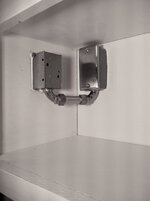
I built a set of shelves over an old light switch and put a new box with a switch through the side of the “cabinet” and wired with conduit. No new hole in the wall. My new shelves are right next to a door to enter the attached garage so I didn’t have wall space for a switch anyway.
I used a box extension over the old switch box.
I used a box extension over the old switch box.
Attachments
Last edited:
LeonardY
Well-known member
Can you mount a shallow box under the uppers? Do your splice there. I did that when I was adding under cabinet lights. The trim at the bottom of the cabinet hides it. Unless your a 5 year old then you look up under the cabinets. But they are mostly are really just interested in the cookie jar on the counter.
BTW. I gave up on wire nuts and use WAGO connectors now. You can mix stranded and solid wire easily.
BTW. I gave up on wire nuts and use WAGO connectors now. You can mix stranded and solid wire easily.
Can you explain the appeal of those? Is it speed? It can't be cost or size. As far as I can tell, they cost three to five times what a wire nut would cost, and the space they take up varies from slightly smaller than a wire nut to slightly larger, depending on how many wires you're connecting. (2-wire Wago is slightly smaller volume than a wire nut, 3-wire is about equal to a wire nut, anything above 3 is larger.)BTW. I gave up on wire nuts and use WAGO connectors now. You can mix stranded and solid wire easily.
I'm sort of skeptical of the mechanism. They seem not too different from backstab wiring, no?
I'm in the cut the box in the back of the cabinet camp and put a blank plate, unless you can pull the easily wires into the basement & run new up.
LeonardY
Well-known member
I find them to be a more solid connection especially if you have a mix of stranded and solid wire. Yes, they are more expensive. I found they fit in a tighter space and I could arrange them easier. They are faster for me.Can you explain the appeal of those? Is it speed? It can't be cost or size. As far as I can tell, they cost three to five times what a wire nut would cost, and the space they take up varies from slightly smaller than a wire nut to slightly larger, depending on how many wires you're connecting. (2-wire Wago is slightly smaller volume than a wire nut, 3-wire is about equal to a wire nut, anything above 3 is larger.)
I'm sort of skeptical of the mechanism. They seem not too different from backstab wiring, no?
I also find if you are trying to different gauge wire together, it is easier.
I had a small connection box that was thin. The wire nut was too large, height wise. WAGO worked perfectly.
I've only had to use 2 and 3 connection versions.
Backstabbing doesn't work well with stranded wire. The WAGO is a lever and locks down on the wire.
CraigStu
Well-known member
To be clear my recommendation is to do the spices inside the old box, cap that box and run the wires to the new box and wire the switches the same as any other box. I also like Shiftless's idea of putting the new box on the side of the cabinet
onsail
Well-known member
An option you may not have considered is using a Lutron Caseta switch, leaving it where it is behind the cabinet and adding a Lutron Pico switch.
The Pico is a wireless switch that pairs with the wired switch. It has a 10 year battery that you can put anywhere that’s convenient. It can be mounted to the wall, put onto a stand or just left on a counter somewhere.
Lutron Pico
The Pico is a wireless switch that pairs with the wired switch. It has a 10 year battery that you can put anywhere that’s convenient. It can be mounted to the wall, put onto a stand or just left on a counter somewhere.
Lutron Pico
But what if that cabinet is not the spice cabinet?To be clear my recommendation is to do the spices inside the old box...
Those look interesting, but all my switches are Bronze, and they don't make a bronze. I'd have to cut out the back of the cabinet either way, since the switches protrude from the wall and would keep the cabinet from being truly flush.An option you may not have considered is using a Lutron Caseta switch, leaving it where it is behind the cabinet and adding a Lutron Pico switch.
The Pico is a wireless switch that pairs with the wired switch. It has a 10 year battery that you can put anywhere that’s convenient. It can be mounted to the wall, put onto a stand or just left on a counter somewhere.
Lutron Pico