To avoid these ads, REGISTER NOW!

Mr. Cool 36K Mini Split Rodent Wire Damage

Rickochet

Well-known member
Joined
Feb 19, 2008
Messages
247
Location
In the Boonies Near Marion, INDIANA
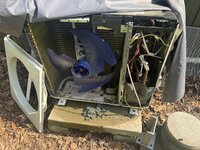
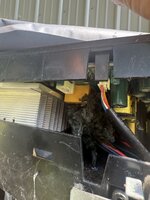
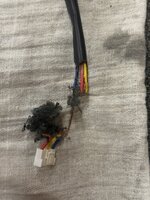
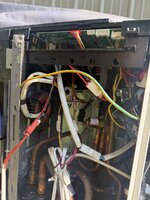
My 4 year old DIY Mr. Cool has worked perfectly through 104-degree heat and sub-zero cold without any issues. However, today I went out to my shop and noticed it was unusually warm and an F5 error code was evident on the inside unit. I went outside to see what the condenser unit was doing and heard the fan trying to run, but it made a growling noise and even attempted to run backwards. I checked the voltage to the unit, and it was 244 volts, so I figured it was something going on within the condenser unit. I checked online, and sure enough, the F5 error code indicated a condenser fan operation issue. I disassembled the enclosure a measured the resistance of the fan motor, and it was perfect. I noticed that there was some evidence of critter damage with chewing on the insulation surrounding the compressor. To facilitate further inspection, I removed the control board, and there it was! The fan wiring at the plug that connects to the PC board had been chewed in two. Only one power wire barely remained attached, and the other two wires were completely separated due to the critters' attempts to file down their teeth by using the copper wires. It's going to be a simple fix! Some solder and heat shrink will have the trusty Mr. Cool back in operation first thing in the morning!

The moral of the story is to spend some time diagnosing any issue before calling the high-dollar professionals out to service it. Why spend the big bucks when you can do it yourself?
 

Attachments

  • IMG_9202.jpeg
    IMG_9202.jpeg
    669.7 KB · Views: 38
  • IMG_9203.jpeg
    IMG_9203.jpeg
    1.1 MB · Views: 38
  • IMG_9204.jpeg
    IMG_9204.jpeg
    568.4 KB · Views: 39
  • IMG_9205.jpeg
    IMG_9205.jpeg
    1.1 MB · Views: 39
To avoid these ads, REGISTER NOW!

ericm

Well-known member
Joined
Apr 17, 2016
Messages
1,963
Location
Southern Oregon
This is the second case of rodent damage of ground mounted mini split condensers that I have seen on this site. Maybe an argument for mounting them on the wall.

I'll have to periodically check the ground mounted ones I'll have at the new place.
 

manwithtools

ALLIANCE MEMBER
Joined
Aug 24, 2015
Messages
14,251
Location
Lebanon, TN
This is the second case of rodent damage of ground mounted mini split condensers that I have seen on this site. Maybe an argument for mounting them on the wall.

I'll have to periodically check the ground mounted ones I'll have at the new place.
Yep, it's convinced me to mount mine at 36" off the ground. Should make any future maintenance easier as well.
 

Jackfre

Well-known member
Joined
Dec 26, 2010
Messages
4,418
Location
N CA
I speak with experience here. I represented Fujitsu in the six New England States for 15 years. While this type of problem is not common repairing units that have seen this intrusion is a real pain. Snakes especially get up on boards, get hit with voltage and roll. They can take out multiple boards until they cool off. I had several customers over the years attempt this repair. The time, effort and cost in time and parts absolutely led to the conclusion that it is just better to get a new condenser. You may luck out and thread the repair needle or it will be the most frustrating thing you’ve been involved in. I will not ground mount a unit for exactly the reason you are facing now. Also, because the unit stays cleaner which protects the efficiency and your investment.
 

bonneyman

Well-known member
Joined
Apr 22, 2010
Messages
8,857
Location
Desert SW
I had a mouse take up occupancy in my condenser until a snake went in after him……… Didn’t work out well for either one. This was crime scene clean up!
IMG_1427.jpeg
Nice photos!
I've seen it with wasps, too. They seem to have metallic-like bodies, and if they're walking across a live capacitor they will short out! And they love to build nests in control compartments.

Rodents seem to gravitate toward condensing units because the warmth of the crankcase heater will help them survive the winter. And all of the new wiring insulation seems to attract them - maybe it's made with something that is edible?
 
To avoid these ads, REGISTER NOW!

shaggyant

Well-known member
Joined
Oct 10, 2011
Messages
201
Location
North Idaho
Nice photos!
I've seen it with wasps, too. They seem to have metallic-like bodies, and if they're walking across a live capacitor they will short out! And they love to build nests in control compartments.

Rodents seem to gravitate toward condensing units because the warmth of the crankcase heater will help them survive the winter. And all of the new wiring insulation seems to attract them - maybe it's made with something that is edible?
I know that auto manufacturers have largely adopted wiring with soy based insulation rather than PVC. There are numerous claims that this new coating is more attractive to rodents for chewing. Not sure if this new insulation is becoming more widely used in the name of eco-friendliness.


dscheidt

Well-known member
Joined
Apr 26, 2017
Messages
2,912
I know that auto manufacturers have largely adopted wiring with soy based insulation rather than PVC. There are numerous claims that this new coating is more attractive to rodents for chewing. Not sure if this new insulation is becoming more widely used in the name of eco-friendliness.


I don't buy it, Rodents chew everything. Modern stuff has more wires, so more chances for rodents to nibble, and modern vehicles have smaller gauge wires, which are more subject to damage. Computer signaling is also more sensitive to damaged wires -- a wire that has some intermittent short or open would cause a light bulb to go out briefly, and the driver might not notice. The same failure on a signal from a sensor or to an injector would cause a failure, and could cause the computer to turn that system off. Most people notice when one cylinder goes away and the MIL comes on....
 

bonneyman

Well-known member
Joined
Apr 22, 2010
Messages
8,857
Location
Desert SW
I don't buy it, Rodents chew everything. Modern stuff has more wires, so more chances for rodents to nibble, and modern vehicles have smaller gauge wires, which are more subject to damage. Computer signaling is also more sensitive to damaged wires -- a wire that has some intermittent short or open would cause a light bulb to go out briefly, and the driver might not notice. The same failure on a signal from a sensor or to an injector would cause a failure, and could cause the computer to turn that system off. Most people notice when one cylinder goes away and the MIL comes on....
10-4 We use 4 inch ABS pipe for wire chases - to get the t-stat wire bundle between the indoor air handler and outside condensing unit. Problem is packrats are always using the chases to get inside. And they chew the wiring as they go. Tried for years to seal up the outside end to keep them out. We'd stuff fiberglass insulation, concrete, expanding foam - they'd get through it all.
Last thing we used was steel wool. They'd cut their lips on the sharp fibers while attempting to chew through it. It would eventually rust and they could dig through that, so we'd have to check and re-pack the opening over the years. Was about to only thing that at least slowed them down.
 
  • Like
Reactions: red

manwithtools

ALLIANCE MEMBER
Joined
Aug 24, 2015
Messages
14,251
Location
Lebanon, TN
I know that auto manufacturers have largely adopted wiring with soy based insulation rather than PVC. There are numerous claims that this new coating is more attractive to rodents for chewing. Not sure if this new insulation is becoming more widely used in the name of eco-friendliness.

This is msotly hybolyle, rodents have to chew to keep their teeth from growing to long. They happen to love engine compartments because they are protected from the elements. Once there they will chew on anything they can. Wire just happens to be something they can easily wrap their mouth around. The process of making plastic insulation from soy, does not pass any "flavor" to the insulation. Rodents have been chewing wire insulation since its invention.
 
To avoid these ads, REGISTER NOW!
Top Bottom