To avoid these ads, REGISTER NOW!

Mr Heater Exhaust vent

Joedirt08

Member
Joined
Jan 4, 2021
Messages
9
Location
House
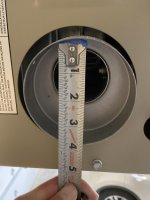
Guys need some help with my exhaust vent, the house I live in had the garage exhaust vent plumed from the drywall through the attic out to the roof, I just need to connect from my mr heater 50k to the stub sticking out of the ceiling. Trying to make sure I use the right piping. The OD on the back of the mr heater looks to be 4” , measures close to 3.75” id does that sound right. And then the piece stubbed out of the ceiling is about the same. Would this flexible piece work for this connection and is it acceptable if I got it in 4” or am I going to need some adapter. Any help would be greatly appreciated. The piece I am referring to is a double wall flexible with b type male and female connections. If you google item # RFAHDFC you will see what I am referencing.
Thanks,
Joe
 
To avoid these ads, REGISTER NOW!

Gizzi

Well-known member
Joined
Oct 25, 2015
Messages
68
You can usually buy adapters that go from the heater exhaust outlet which is single wall to double wall. Codes in my area dictate category 3 piping, which is stainless. Can't post links due to my post count, but the Duravent FSA-DWSW4 may be what you need.
 

allinon72

Well-known member
Joined
Jul 5, 2010
Messages
3,305
Location
Indianapolis
Coming off the heater, you need what's called a draft hood. This will make your transition to the double wall b-vent. From there, in theory you could connect your flexible piece to it and it would work, but it's kind of not the right way to do it. After the draft hood piece, most use a tee or at the very least an elbow, then go up through the ceiling, using a fire stop piece as a support. The purpose of the tee is to allow for a way to inspect the vent and to collect any condensation that may form.

Is the flexible b-vent just going through the ceiling, then transitioning to rigid vent material?
 
OP
J

Joedirt08

Member
Joined
Jan 4, 2021
Messages
9
Location
House
I was just going to connect it to the piece that is stubbed out of the ceiling, I saw where it talks about a tee but from what I read in the manual it is only required on commercial installs. I have attached a picture of what it looks like.
Thanks,
Joe
 

Attachments

  • 54171D96-5313-4D18-B5BF-7DC712EB8E6B.jpg
    54171D96-5313-4D18-B5BF-7DC712EB8E6B.jpg
    100.8 KB · Views: 87

brewchief

Well-known member
Joined
Sep 20, 2008
Messages
2,370
Location
Michigan
You will need a tee or elbow, the b-vent flex connector won't make a sharp enough 90. You also need an appliance adapter for yhe heater end, you can probably then make it work with another 90 and whatever length of pipe is needed, most likely you will need an adjustable length and a fixed length piece to get the length right. If a flex connector is available in the right length it would be ok as well but honestly I find it easier to do with hard pipe.

Sent from my SM-T510 using Tapatalk
 
OP
J

Joedirt08

Member
Joined
Jan 4, 2021
Messages
9
Location
House
What type of pipe do I need to use and when connecting pieces do I need to use screws to hold them together I know on the back of the heater there are two screw holes for the connection there but it talks about not penetrating all the way through what length screws should I used then.
Thanks,
Joe
 

Gizzi

Well-known member
Joined
Oct 25, 2015
Messages
68
What type of pipe do I need to use and when connecting pieces do I need to use screws to hold them together I know on the back of the heater there are two screw holes for the connection there but it talks about not penetrating all the way through what length screws should I used then.
Thanks,
Joe

Typically venting of positive pressure exhausts (forced draft, like your heater) doesn't allow for screws to penetrate the flue/exhaust pipe in residential applications. Normally it's a twist locking type connection or pipe clamp and locking tabs. Looking at the picture, I can't tell what vent pipe that is exactly. Looks kind of like Z vent, but I could wrong.
 
OP
J

Joedirt08

Member
Joined
Jan 4, 2021
Messages
9
Location
House
Typically venting of positive pressure exhausts (forced draft, like your heater) doesn't allow for screws to penetrate the flue/exhaust pipe in residential applications. Normally it's a twist locking type connection or pipe clamp and locking tabs. Looking at the picture, I can't tell what vent pipe that is exactly. Looks kind of like Z vent, but I could wrong.

If I get a picture of the ceiling pipe will you be able to help?
Thanks,
Joe
 

Gizzi

Well-known member
Joined
Oct 25, 2015
Messages
68
If I get a picture of the ceiling pipe will you be able to help?
Thanks,
Joe

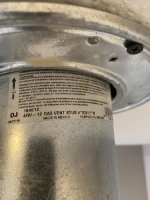
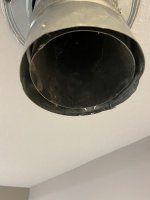
Sure, I can give it a shot. Take a picture of that white tag on the existing pipe and picture of the inside of the pipe.
 
OP
J

Joedirt08

Member
Joined
Jan 4, 2021
Messages
9
Location
House
See pictures I included two of the stub out of the ceiling and one of the back of the heater. Any help with size and type of pipes I need will really help. Greatly appreciate it.
Thanks,
Joe
 

Attachments

  • 51CB3C11-2535-4C9F-8133-E38D14FEF803.jpg
    51CB3C11-2535-4C9F-8133-E38D14FEF803.jpg
    98.7 KB · Views: 57
  • 55470AD0-9911-4B2D-A7C3-616D378597A8.jpg
    55470AD0-9911-4B2D-A7C3-616D378597A8.jpg
    44.6 KB · Views: 51
  • A139A78C-BC6E-4FF3-8339-30E391CB7FD8.jpg
    A139A78C-BC6E-4FF3-8339-30E391CB7FD8.jpg
    62 KB · Views: 50
To avoid these ads, REGISTER NOW!

Gizzi

Well-known member
Joined
Oct 25, 2015
Messages
68
You have a Selkirk brand of "B" vent piping. In order to keep from having to replace all the vent piping, you're likely stuck using Selkirk brand vent pipe, as inter-joining different brands like Duravent might be a pain in this case. Looks like you'll need Selkirk #4RV-DH from the heater exhaust vent outlet to the existing vent. It transitions the single wall at the heater to the double wall vent pipe. Using sheet metal screws to hold the single wall portion of the transition piece to the heater shouldn't be a problem. The Selkirk brand uses locking tabs to fasten the vent together, shouldn't really need sheet metal screws through the outer tube of the double wall vent pipe. If you look at the Selkirk B vent catalog, you should be able to find everything you need after the transition piece.
 
Last edited:
OP
J

Joedirt08

Member
Joined
Jan 4, 2021
Messages
9
Location
House
Can you look at screenshot and see if these three items should cover what I need. I was going to use the 90 right out of the ceiling, then the flexible piece and then the hood vent connector from the heater. Or will I need two of those hood vent connectors one on each side? I assume the 4" is what I need. What length screws are they okay to go all the way through? I really appreciate your help.
Thanks,
Joe
 

Attachments

  • Garage Heater.jpg
    Garage Heater.jpg
    17.5 KB · Views: 54

Gizzi

Well-known member
Joined
Oct 25, 2015
Messages
68
If you choose to use the flex pipe (part number 4EFC3), one end of it has the connection you need to go directly from exhaust of the heater, negating the need for part 4RV-DH. Instead of an elbow, I would personally use a tee fitting (with cap on the bottom of tee) to join the horizontal and vertical vents (4RV-TS, 4RV-TC). Reason being it gives your vent a drip leg and the ability to inspect for obstructions (i.e. dead bird, debris, collapsed vent cap) without having to get on the roof.
Typically 1/4" self-tapping screws are used, as to not pierce the inner wall.
So basically, one end of the flex vent has a connection meant for the heater exhaust, the other end would go to your tee or elbow, then to the existing vent. Only place the self tappers should be needed are at the exhaust of the heater. Not sure how much length you need for you horizontal run, so measure it first.
 
Last edited:
OP
J

Joedirt08

Member
Joined
Jan 4, 2021
Messages
9
Location
House
Okay so draft hood vent, then tee with cap, and then I could use the flexible pipe from the tee to the ceiling connection. That flexible pipe from what I read is single wall besides the fittings on the end is that acceptable. With where my heater is in relation to the ceiling vent it will be a lot easier to use flexible pipe. Do I need to wrap the duct pipe connections with any tape? Where can I find 1/4” length screws not seeing them that short online. The outlet on my heater is 4” right I see some post where the 50k heater is 3” but based off the measurements I attached prior it seems to be 4”.
Thanks,
Joe
 

Gizzi

Well-known member
Joined
Oct 25, 2015
Messages
68
Looking at your pics, it appears you should only need the flex pipe, tee and cap to make it work. The flex pipe has one end that already has the 'draft hood' connection, the other end should connect to your tee so long as the horizontal run is under 2.75 ft. Flex vent would be your horizontal connection off the heater exhaust, the tee would connect directly to your your existing vertical vent, then just connect them per manufacturers instructions using the built in tab locks. No need to tape the connections as long as you have properly adjoined the vent pieces. All the B vent is UL listed, should all be fine for the application.
Just go to your local hardware store and find the shortest self tapping/drilling sheet metal screws that will bite into both pieces at the heater connection.
 
OP
J

Joedirt08

Member
Joined
Jan 4, 2021
Messages
9
Location
House
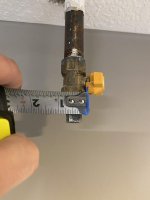
The tee will connect in and will have the tab to use for the stub sticking out of the ceiling ? Also what about the cap at the bottom of the tee do I need to seal that somehow since there aren’t any tabs? Quick question on my gas line stub I believe it is considered 3/4” but wanted to ask for clarification. I have attached a picture.
Thanks,
Joe
 

Attachments

  • F577CE9C-F11F-467B-8F13-78140F831C96.jpg
    F577CE9C-F11F-467B-8F13-78140F831C96.jpg
    50.3 KB · Views: 54

Gizzi

Well-known member
Joined
Oct 25, 2015
Messages
68
Tee should connect right in with your existing piping. The Selkirk B vent catalog shows exactly how to connect it with the lock tabs. B vent doesn't technically need to be air tight, but red high temp silicon on the cap won't hurt anything. Cap should press or be tapped in with a mallet without too much issue. Looks like you have 1/2 inch gas pipe. The outside diameter of the black pipe stubbed from the ceiling by your heater should measure just under 7/8", which would make it half inch gas pipe.
 
OP
J

Joedirt08

Member
Joined
Jan 4, 2021
Messages
9
Location
House
Okay perfect can I use the yellow flexible line or do I need to use stainless steel flex line. I know I need to add a drip leg but then I should be able to just connect it up right?
Thanks,
Joe
 
To avoid these ads, REGISTER NOW!
Top Bottom