To avoid these ads, REGISTER NOW!

Mr.Heater Maxx 45k propane heater install

tarbellb

Well-known member
Joined
Apr 17, 2011
Messages
5,805
Location
Oregon
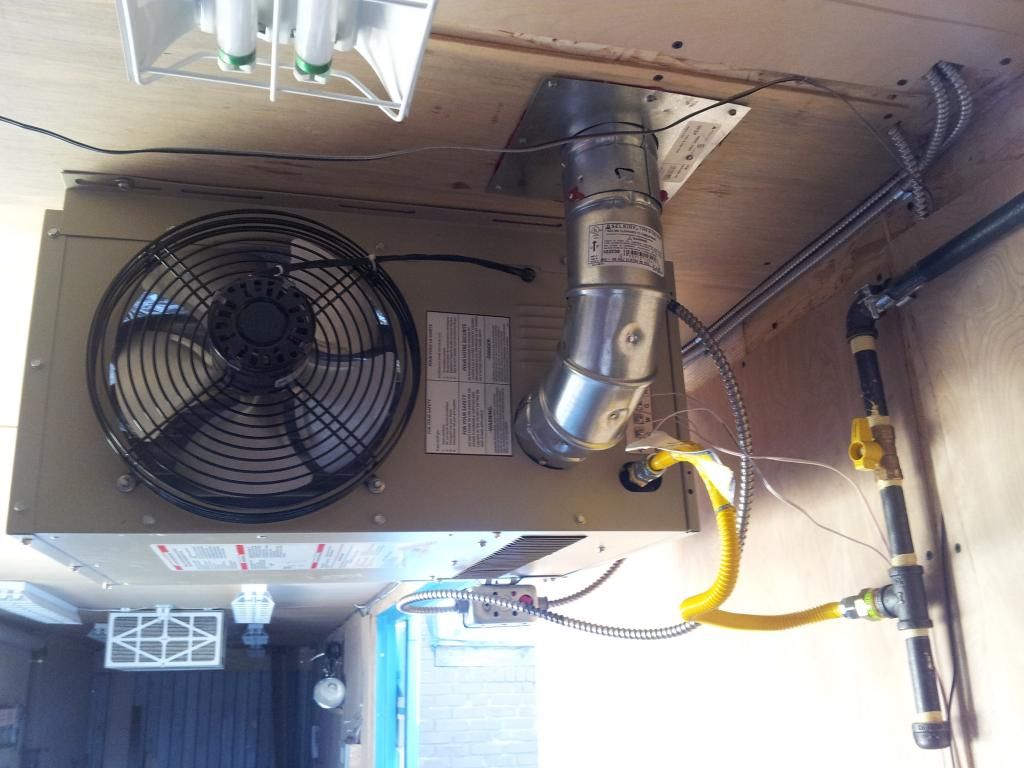
Hey there guys, first wanted to say thanks for anybody who has posted install pics and responses in the forum. You all provided a lot of info before I got started and took the guess work out of some of it.

Also, this is my first install incorporating propane lines and B venting. Of course with the all the concerns that it comes with I was a bit reluctant to do this. But luckily I had a good friend and experienced installer help me with my house hot water heater right before this install and took some tips from him as well.

The situation:

Denver Colorado
Shop = 40' Hi Cube shipping container
Insulation = 2" Polyiso R-14, 14g steel shell, 1/4" ply wood wall material

The install:
45k Propane Mr.Heater Maxx forced air (purchased from Northern Tools)
1/2" black pipe (appx 11-12')
100lbs tank (bought used, came with regulator)
Pressure guage - got some questions about this!
3" B pipe venting to code (I think?)
Fuse + Switch electrical connection to 15amp fuse
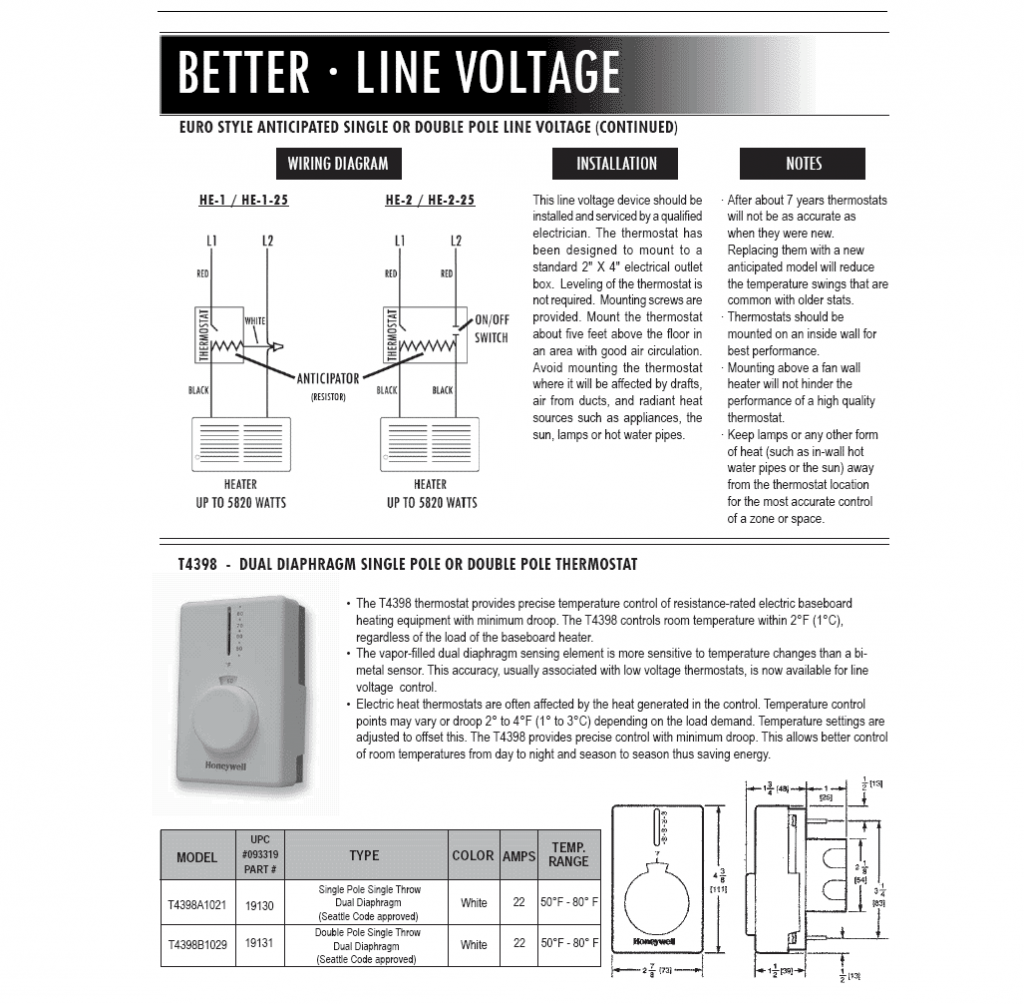
King brand off/45-90 double pole thermostat - got questions about this!

Enjoy the pics, but please also chime in if see something or have questions.

Also, two questions:
1) what type/ pressure gauge should I be using, the one I got from my research doesnt seem to be working? Is the gauge wrong or the install location? Link me where to purchase exactly what I need please.....

2) can someone tell me in simple terms what colors hook up to what on my thermostat? I think I have it right but would like to double check.

Thermostat has L1, L2,
20121117_152722.jpg


20121117_152710.jpg


20121117_152729.jpg


20121116_132032.jpg


20121117_152802.jpg


20121120_120855.jpg


thermostat wiring diagram DOUBLE POLE INSTALL
Picture2-1.png

Mr.Heater Maxx diagram
Picture3.png


Cheers,
 
To avoid these ads, REGISTER NOW!

ForceFed70

Well-known member
Joined
Apr 27, 2010
Messages
3,441
Location
BC, Canada
Looks good! I'm not a big fan of using the flexible appliance connector hoses at the heater side, but I'm sure it will be fine.

The pressure at where your gage is located should be less than 1psi. It's hard to tell but that looks like a 200PSI gage so it won't hardly register. To be of any value you'll want to move that gage so it's before the regulator.

What you have there is a line level thermostat. It's ment for electric heaters where all of the power goes through the thermostat and then to the heater. The good news is that I think it will still work for you. Try hooking it to the R and W terminals on your unit heater. It shouldn't matter which way you wire the thermostat side (ie: R can go to either L1 or L2)
 
Last edited:

dave67fd

Well-known member
Joined
Apr 25, 2011
Messages
872
Location
Southern NH
First off your using the wrong thermostat. The one shown is to control AC powered heaters. You need a 24V one.

The Big Maxx requires a 1" top clearance to combustables. Yours has "0".

Why do you need the gauge? Should only be used for leak test. Line pressure is really too low to use for monitoring.
Consider a tank gauge (some are built into reg.) so you know when you getting low.

Looks good! I'm not a big fan of using the flexible appliance connector hoses at the heater side, but I'm sure it will be fine.

Ok to use as long as it's properly installed per manuf. installation.
 
Last edited:

ForceFed70

Well-known member
Joined
Apr 27, 2010
Messages
3,441
Location
BC, Canada
First off your using the wrong thermostat. The one shown is to control AC powered heaters. You need a 24V one.

The Big Maxx requires a 1" top clearance to combustables. Yours has "0".

Why do you need the gauge? Should only be used for leak test. Line pressure is really too low to use for monitoring.
Consider a tank gauge (some are built into reg.) so you know when you getting low.


Ok to use as long as it's properly installed per manuf. installation.

I'm pretty sure the thermostat he has will work. All it needs to do is short the R and W terminals together to call for heat which it will do. The fact that his thermostat is likely rated for 240V instead of 24V won't be a problem. Would be tho if it was the other way around.

There is 1" of clearance. The clearance ratings are from the heater body not the mounting bracket.

Yes, I know it's OK to use the flex line. Hence why I said "I'm not a fan....but I'm sure it will be fine"
 

cowboyjosh

Well-known member
Joined
Mar 11, 2010
Messages
1,066
I'm pretty sure the thermostat he has will work. All it needs to do is short the R and W terminals together to call for heat which it will do. The fact that his thermostat is likely rated for 240V instead of 24V won't be a problem. Would be tho if it was the other way around.

There is 1" of clearance. The clearance ratings are from the heater body not the mounting bracket.

Yes, I know it's OK to use the flex line. Hence why I said "I'm not a fan....but I'm sure it will be fine"

Actually the appliance flex connector is code in Denver and in most of Colorado. Its gives the gas line some flexibility from vibrations of the appliance when running and in areas like Highlands Ranch where bentonite / expansive soil is a huge problem is a basement floor heaves and the appliance is completely hard piped, you can run the risk of the hard pipe straining and fracturing causing a leak.

That said you cannot run a flex line thru a furnace cabinet, you must go from hard pipe to flex, then run a piece of iron thru the furnace cabinet to attach the flex to. The OP's heater has a ****** to connect the flex to, so it looks like he's good.
 
Last edited:
OP
T

tarbellb

Well-known member
Joined
Apr 17, 2011
Messages
5,805
Location
Oregon
Hey thanks for the quick replies guys.

To answer a few comments/ questions:

The brackets provided with the kit give 1" of clearance, so I should be good on that.

The gauge used is indeed a 300 psi! Ha, so my research was way off for tank/line pressure. Can somebody link me to a tank gauge that will provide accurate readings for fuel remaining?

I believe cowboyjosh is correct, CO code is hard pipe through the housing but flex to your hard pipe.

Flex conduit or MC cable im pretty sure is ok in this case as well.

I may start a new thread to find out some noise issues with the heater. Both my Induced Fan Motor (part 16) and Fan Assembly (part 32) make a TON of NOISE.
Does anybody else have this issue. They have already sent a replacement for the Fan Assembly as I know this is faulty, but any issues or ideas on the Induced Fan Motor ie the squirrel cage pushing the heat exchanger air?
 

RIVERWEST AUTO

Well-known member
Joined
Oct 2, 2009
Messages
108
Location
milwaukee
Actually the appliance flex connector is code in Denver and in most of Colorado. Its gives the gas line some flexibility from vibrations of the appliance when running and in areas like Highlands Ranch where bentonite / expansive soil is a huge problem is a basement floor heaves and the appliance is completely hard piped, you can run the risk of the hard pipe straining and fracturing causing a leak.

That said you cannot run a flex line thru a furnace cabinet, you must go from hard pipe to flex, then run a piece of iron thru the furnace cabinet to attach the flex to. The OP's heater has a ****** to connect the flex to, so it looks like he's good.

ok so the appliance code is fine but the propane tank with a nylon strap plumbed into a cargo container. really....codes?

it looks good i just installed the same heater in my shop. heats me fine and very safe, externally vented.:rocker:
 
To avoid these ads, REGISTER NOW!
OP
T

tarbellb

Well-known member
Joined
Apr 17, 2011
Messages
5,805
Location
Oregon
ok so the appliance code is fine but the propane tank with a nylon strap plumbed into a cargo container. really....codes?

Ha, right. Im well within most codes that I know about. And hey, ive got a steel reinforced wall between me and my tank. What do you or most people have?

Seriously though, any suggestions on how to properly secure the tank?

Oh, and I also know where id be if things went zombie status or earthquake:willy_nil
 

ForceFed70

Well-known member
Joined
Apr 27, 2010
Messages
3,441
Location
BC, Canada
Actually the appliance flex connector is code in Denver and in most of Colorado. Its gives the gas line some flexibility from vibrations of the appliance when running and in areas like Highlands Ranch where bentonite / expansive soil is a huge problem is a basement floor heaves and the appliance is completely hard piped, you can run the risk of the hard pipe straining and fracturing causing a leak.

That said you cannot run a flex line thru a furnace cabinet, you must go from hard pipe to flex, then run a piece of iron thru the furnace cabinet to attach the flex to. The OP's heater has a ****** to connect the flex to, so it looks like he's good.

Thanks. I did not know it is a requirement in some areas. Although floor movement wouldn't be an issue in this case.

My inspector was very much against a flexible appliance connector when I asked him about it. He said he wouldn't fail me for it, but that he greatly prefers all hard-pipe and that an appliance connector hose WILL start to leak at some point.
 

Tim The Tool Man

Well-known member
Joined
Mar 1, 2012
Messages
1,520
Location
Lehigh Valley, PA
There are some glaring errors with your install that need immediate attention. I hate being critical because Lord knows that I can build things far from perfect or code compliant! It is just that you have a couple issues that are potential hazards. First the thermostat you are using will lead to premature heat exchanger failure and possible carbon monoxide poisoning. By using a line thermostat you are cutting power to your heater as soon as your shop hits the appropriate temperature. This prevents your heater from going through its cool down cycle which can lead to a cracked heat exchanger.

The other issue is the flexible gas line at your tank. Those lines are not meant to be used in that manor nor outdoors and it will fail fairly quickly. You can get yourself a reinforced rubber line anyplace they sell propane grill accessories that is made for being handled as a disconnect.

Also if you want that gauge to read anything other than 11 psi move it to the tank side of your regulator.
 

nehog

Well-known member
Joined
Jan 2, 2010
Messages
7,935
Location
Jaffrey, NH
There are some glaring errors with your install that need immediate attention. I hate being critical because Lord knows that I can build things far from perfect or code compliant! It is just that you have a couple issues that are potential hazards. First the thermostat you are using will lead to premature heat exchanger failure and possible carbon monoxide poisoning. By using a line thermostat you are cutting power to your heater as soon as your shop hits the appropriate temperature. This prevents your heater from going through its cool down cycle which can lead to a cracked heat exchanger...

I think you will find that the cool down cycle is controlled by the heater not by the thermostat. So there is no problem there--the thermostat would work well with only one (non-hazardous exception) problem, in that it will not have a working heat anticipator so the temperature will tend to overshoot the thermostat setting.

But that thermostat won't damage the heater.

I can't comment on the tank installation other that to echo the "gauge in the wrong place" so it won't reflect the contents of the tank.
 

Tim The Tool Man

Well-known member
Joined
Mar 1, 2012
Messages
1,520
Location
Lehigh Valley, PA
I think you will find that the cool down cycle is controlled by the heater not by the thermostat. So there is no problem there--the thermostat would work well with only one (non-hazardous exception) problem, in that it will not have a working heat anticipator so the temperature will tend to overshoot the thermostat setting.

But that thermostat won't damage the heater.

I can't comment on the tank installation other that to echo the "gauge in the wrong place" so it won't reflect the contents of the tank.

He is using a line thermostat which cuts all power to the unit when temp is reached therefor there is no opportunity for the heater to go into cool down because there is no power reaching the unit.
 

brewchief

Well-known member
Joined
Sep 20, 2008
Messages
2,372
Location
Michigan
He is using a line thermostat which cuts all power to the unit when temp is reached therefor there is no opportunity for the heater to go into cool down because there is no power reaching the unit.

He has a line voltage stat but it is wired to the low voltage side, I would use a simple low voltage stat if it were me but a line voltage one should work.

I would chain the tank instead of straps and use an approved hose rather then the flex connector outside.

A pressure gauge won't show how much propane is remaining, it won't drop at all until all the liquid is gone, a simple bathroom scale would tell how many pounds are left in the tank if you know the empty weight of the tank.
 
Last edited:
OP
T

tarbellb

Well-known member
Joined
Apr 17, 2011
Messages
5,805
Location
Oregon
Concerning the cool down cycle and thermostat, I believe the heater does still indeed run the cycle. It does a 3-5 min fan only shutdown after every heating, is this what you are referring to?
Thanks for the heads up on the flex connector not being built for outdoor use. I will be looking into switching that out.
As for the gauge, I'm still tossing around what is my best option. Clearly what I have now is not it. The house scale seems like most accurate system but with oblivious faults (being outdoors).
Thanks for the heads up!
 

ForceFed70

Well-known member
Joined
Apr 27, 2010
Messages
3,441
Location
BC, Canada
He is using a line thermostat which cuts all power to the unit when temp is reached therefor there is no opportunity for the heater to go into cool down because there is no power reaching the unit.

As others have mentioned, you need to look at the pictures again.

The line level thermostat is not cutting power to the unit. It is connected the same way you would connect a regular 24V thermostat. And the cool down cycle is controlled by the unit not the thermostat.

Also, Inches of water column is not the same as PSI. The pressure at that gage isn't even 1 PSI. But this has already been pointed out to the OP a few times.
 
Last edited:

cowboyjosh

Well-known member
Joined
Mar 11, 2010
Messages
1,066
Thanks. I did not know it is a requirement in some areas. Although floor movement wouldn't be an issue in this case.

My inspector was very much against a flexible appliance connector when I asked him about it. He said he wouldn't fail me for it, but that he greatly prefers all hard-pipe and that an appliance connector hose WILL start to leak at some point.

the flex accounts for any kind of movement in the structure. We do quite a few things different in Colorado to account for shifty soil to minimize damage to the building. Even in gas fireplaces where CSST or black pipe is stubbed, there is a flex that connects to the gas valve of the appliance. Never have seen a flex leak, unless its the old copper / brass flexes from pre 1980 that had a safety bulletin issued on them back in 1997. Now you can't unhook and re-install the flex connector as the OP used too much, but by and large a leak in the flex is about as unlikely as a leak in black iron union or in a csst connection; not very if its installed according to manufacturers instructions. I do agree the OP needs a outdoor rated flex for his outdoor tank. Im surprised propane tanks are allowed in Denver proper. In many suburban Denver neighborhoods any kind of permanently installed fuel tanks are prohibited.
 
To avoid these ads, REGISTER NOW!
Top Bottom