To avoid these ads, REGISTER NOW!

Multimeter suggestion?

Chaznsc

Well-known member
Joined
Apr 9, 2013
Messages
6,529
Location
SC
I understand probably as much about electricity as the squirrels in my yard. I am looking for a MM to do basic around the house stuff, testing the car battery, etc.. I have the HF model but the leads keep snapping off them. Are there any under $50 models that are any good?

Thank you for reading.
 
Last edited:
To avoid these ads, REGISTER NOW!

visionguru

Well-known member
Joined
Jan 2, 2017
Messages
1,233
Location
Chicago
Do you mean the leads actually break off? Then you are pressing too hard. You can either replace the leads or fix them. I have 2 MM from Harbor Freight, all under $5, one of them is analog, still work after 15 years, except the wire broke and I had to solder. Of course, I only use pro quality ones when doing electronics work.

Anything on the market is good enough for home use. If you want to step up the game, looking for models with more features, such as auto ranging, true RMS,....

https://www.sears.com/craftsman-pro...lerId=Sears&prdNo=13&blockNo=13&blockType=G13
 
Last edited:

Andy8430

Well-known member
Joined
Dec 15, 2014
Messages
224
Location
Iowa
buy a used Fluke 117 from Ebay that will last you forever. You could get a used Extech cheap. here was a quick Ebay search. I used a Extech near daily fo 15 years no issue.

https://www.ebay.com/itm/Nice-Fluke...885381?hash=item3b39265ac5:g:QpkAAOSwfZRdgDI6

https://www.ebay.com/itm/Extech-Mul...353888?hash=item3b3857e160:g:ZeEAAOSwjm5dbVAl


I’ll second these comments. Fluke is my personal preference, however ExTech makes high quality meters with a lot of features for less money. Southwire is a newer company, in the meter market, that’s very comparable.


Sent from my iPhone using Tapatalk Pro
 

budmur

Well-known member
Joined
Jul 21, 2014
Messages
70
Location
Athens, TN
I like the Uni-T UT210E for home game use. All the current measurement is done through the clamp, so there's no way to hook the probes up wrong. It's a lot of meter for the money.
 

dogdog

Well-known member
Joined
Nov 15, 2011
Messages
12,711
I am not much of a brand person... ie Snap-on or die hard Fluke... for your home needs, probably any $20-ish meter would do.. Something that can do voltage ACDC / Reasonable resistance range / Capacitance range / maybe does frequency PWM if you are working on sensors... standard stuff...

Edit:

I would get that sears one from post #3 perfect price function... I have the older model that I paid almost $150 for it years ago.... have been happy with it... I think they are rebrand of ExTech.. Only complain was changing the fuse... but hey just don't try to measure voltage in Amp setting and you are all fine :)


Yea those $5 HF meters are just something I throw in corner of remote sites like my parent's home... so in case I forgot to bring in a pinch. I would use them deals... means, don't get those....
 
Last edited:

PureLeaf

Well-known member
Joined
Jul 25, 2014
Messages
1,417
If you're breaking leads off multimeters, you may be handling them too hard. If you have little knowledge of electrical and just want around house stuff as others have said; any multimeter will do you, especially if you're hard on them.

If you ever have any plans to do any trouble shooting on household electronics, computers etc make sure it has a milliamp setting. Something the Fluke 117 for instance does not have. If I knew nothing about electrical and was just using it for basic house stuff, I'd just buy a cheap 20 dollar meter from wherever you want. Amazon, Sears, etc. You'd also be well served on house hold wiring with things like a non contact voltage tester to show if lines are powered and a GCFI outlet tester.
 

Citation

Well-known member
Joined
Jan 20, 2016
Messages
3,211
Location
Indy
If you're breaking leads off multimeters, you may be handling them too hard. If you have little knowledge of electrical and just want around house stuff as others have said; any multimeter will do you, especially if you're hard on them.

If you ever have any plans to do any trouble shooting on household electronics, computers etc make sure it has a milliamp setting. Something the Fluke 117 for instance does not have. If I knew nothing about electrical and was just using it for basic house stuff, I'd just buy a cheap 20 dollar meter from wherever you want. Amazon, Sears, etc. You'd also be well served on house hold wiring with things like a non contact voltage tester to show if lines are powered and a GCFI outlet tester.

The HF freebie meters have very poor quality leads. No surprise they are breaking.

The Uni-T ut291e (make sure you get the 'e' model) is a good option. The ut-139c is also a good option as it has temperature measurements.

For safety reasons I do not like the Innova 3320 suggested above.
 

jasonphelps

Well-known member
Joined
Dec 9, 2018
Messages
130
Location
Amarillo, Texas
Ebay - Klein MM2000 used/like new condition
Made in Korea by Fine Instruments. Other Kleins are made by CEM in China and are decent.

Or Uni-T UT210E since it measures DC current via induction it's nice for automotive, etc. Kinda cheap but works ok.

Or Brymen BM27s also rebadged as Amprobe PM-55A.
Very nice compact DMM

All should be $50 or below
 

Bert_

Well-known member
Joined
Dec 24, 2016
Messages
9,699
Location
NW Iowa
Any of the USA made Flukes with the large dial. Mine is a 77-4 and it's awesome.

And you can buy that Fluke for under $50??

Yes, just have to look for used.

A used fluke is still better than a lot of the other meters new. I have a couple of fluke meters that are 20+ years old and get used daily and ride around in a service truck. Still working great.
 

unslow1

Well-known member
Joined
Mar 3, 2012
Messages
7,879
Location
Illinois
I have Fluke, Extech, Southwire, Craftsman and several cheap ones. Honestly I use the $20 Craftsman and HF ones more than anything else. You can toss them in the trunk and kitchen drawer/ inside toolbox and not worry about it. Play around with a cheaper one then buy a more expense model when you know what features are important for your use. Then toss the cheap one in the tool bag in the car. They are great for quick battery/alternator checks.
 

Davefr

Well-known member
Joined
Jan 7, 2010
Messages
11,817
Location
OR
Yes, just have to look for used.

A used fluke is still better than a lot of the other meters new. I have a couple of fluke meters that are 20+ years old and get used daily and ride around in a service truck. Still working great.

Not necessarily. Many older Flukes had the fading LCD connector problems.

They also lack some really nice features like NCV, Temp, Capacitance, etc, etc.

buy a used Fluke 117 from Ebay that will last you forever.


The OP said $50 was his limit. Used Fluke 117's go for >$100
 
Last edited:
To avoid these ads, REGISTER NOW!

mikehaugen

Well-known member
Joined
Sep 18, 2014
Messages
398
Location
Northern IL
I use fluke for the most part, but have handled the extechs and they have a pretty rugged feel for the price. I recently bought a klein (not sure who actually makes it) clamp meter and am thoroughly impressed. I would buy another for non-work use.

Sent from my SM-G930V using The Garage Journal mobile app
 

2ndGearRubber

Well-known member
Joined
Mar 24, 2014
Messages
14,185
Location
Pittsburgh
For DIY stuff, just pick a meter with decent reviews on amazon - I highly recommend auto-ranging, so you just need to choose a measurement type, and go. No worrying about setting voltage ranges or that stuff.

This is basic volts DC for car batteries and charging systems, and volts AC for "is this outlet still live". Add resistance, and most DIY is covered.


I don't understand the fluke obsession. It's a multimeter for super basic home use. It will likely become junk when the battery inside leaks and eats up the terminals 10 years after OP buys it. Reliable? Aren't most brands reliable in the $25+ range? Super accurate? It's ac/dc volts. And if you want actual precision in volts DC, you would use a lab scope anyways. Resistance is a range of X to Y typically as a spec. Volts AC could be off 10 volts and it wouldn't matter, go/no-go is what most people are looking for.
 

visionguru

Well-known member
Joined
Jan 2, 2017
Messages
1,233
Location
Chicago
For DIY stuff, just pick a meter with decent reviews on amazon - I highly recommend auto-ranging, so you just need to choose a measurement type, and go. No worrying about setting voltage ranges or that stuff.

This is basic volts DC for car batteries and charging systems, and volts AC for "is this outlet still live". Add resistance, and most DIY is covered.


I don't understand the fluke obsession. It's a multimeter for super basic home use. It will likely become junk when the battery inside leaks and eats up the terminals 10 years after OP buys it. Reliable? Aren't most brands reliable in the $25+ range? Super accurate? It's ac/dc volts. And if you want actual precision in volts DC, you would use a lab scope anyways. Resistance is a range of X to Y typically as a spec. Volts AC could be off 10 volts and it wouldn't matter, go/no-go is what most people are looking for.

Exactly! A $50 multimeter nowadays will make a $300 Fluke look like a toy.
 

mikehaugen

Well-known member
Joined
Sep 18, 2014
Messages
398
Location
Northern IL
I don't understand the fluke obsession. It's a multimeter for super basic home use.

This is a very valid point, a fluke is not necessary for his intended uses. I use a fluke daily at work on industrial equipment and probably wouldn't buy anything else for this use.

Exactly! A $50 multimeter nowadays will make a $300 Fluke look like a toy.

I have no idea how you have come to this conclusion. Can a $50 meter have comparable specs to a $300 fluke? Absolutely. That is far from "making it look like a toy."
 

giants

Banned
Joined
Feb 15, 2019
Messages
605
Location
California
For DIY stuff, just pick a meter with decent reviews on amazon - I highly recommend auto-ranging, so you just need to choose a measurement type, and go. No worrying about setting voltage ranges or that stuff.

This is basic volts DC for car batteries and charging systems, and volts AC for "is this outlet still live". Add resistance, and most DIY is covered.

I don't understand the fluke obsession. It's a multimeter for super basic home use. It will likely become junk when the battery inside leaks and eats up the terminals 10 years after OP buys it. Reliable? Aren't most brands reliable in the $25+ range? Super accurate? It's ac/dc volts. And if you want actual precision in volts DC, you would use a lab scope anyways. Resistance is a range of X to Y typically as a spec. Volts AC could be off 10 volts and it wouldn't matter, go/no-go is what most people are looking for.

But some measurements of resistance need to be accurate within 1 Ohm, such as fuel injectors.
 

dogdog

Well-known member
Joined
Nov 15, 2011
Messages
12,711
Do you mean the leads actually break off? Then you are pressing too hard. You can either replace the leads or fix them. I have 2 MM from Harbor Freight, all under $5, one of them is analog, still work after 15 years, except the wire broke and I had to solder. Of course, I only use pro quality ones when doing electronics work.

Anything on the market is good enough for home use. If you want to step up the game, looking for models with more features, such as auto ranging, true RMS,....

https://www.sears.com/craftsman-pro...lerId=Sears&prdNo=13&blockNo=13&blockType=G13

ordered myself one :) as backup.


Order Summary
Merchandise Subtotal$46.94
Points You've Redeemed
-$0.08
Pre-Tax Subtotal$46.86
Sales Tax$4.16
Order Total $51.02
Your points are pending. Please check back later
Payment Information
PayPal : $51.02
 

dogdog

Well-known member
Joined
Nov 15, 2011
Messages
12,711
But some measurements of resistance need to be accurate within 1 Ohm, such as fuel injectors.

Not sure how injectors are measured... if that is the case, probably OP needed a certified and calibrated meter and neither the $20 or that fluke 117 would do.

but I think the tolerances are close enough at least between the fluke and the Craftsman one which I am pretty sure it's a ExTech... Extech is owned by FLir I think.


Page 21, accuracy of 0.9% @600 ohm lowest setting 600*0.009 = 5.4 that is +/- 5.4 ohm....


http://assets.fluke.com/manuals/115C117Cumeng0100.pdf

vs

page 19 accuracy of 1.2% @400 Ohm range lowest setting... 400*0.012 = 4.8 that is +/- 4.8 ohm in that range max

https://fccid.io/WIGDT9660TBT/User-Manual/User-Manual-3483730


Maybe my math is way way off but anyways... I think the OP will do fine with $20 or $50 meters for what he needs, still smarter than the squirrel he is comparing himself to... save $100 for nuts too..

:beer:
 

unslow1

Well-known member
Joined
Mar 3, 2012
Messages
7,879
Location
Illinois

seagull369

Well-known member
Joined
Jan 16, 2013
Messages
227
Some Flukes apparently have had issues with their screens dimming. In fact if you do a ebay search on it, you'll find repair kits available which claim to fix the problem. One thing I like about Flukes, is that the information they provide on their meters' specs are quite exhaustive. Tons of information on it's features, accuracy, ranges, resolutions, sample rates, blah, blah, blah. You're lucky if you get a fraction of that information from other companies.

I have not personally had the best luck with Craftsman meters, esp. their clamp meters. Owned a couple of them years ago and often found myself fighting with the machine to get it to go into the mode I wanted it to. Also had problems with dimming displays. That said, Sears has a sale going on one of their AC/DC clamp meters for a very good price which might be worth the risk. It's model DT362T (item # 03419741000) and is only $28 online, which is a practically unheard of price for a meter that can measure amps via it's clamp AND has RMS. Reviews aren't encouraging, but they aren't always the full story. If you purchase any Craftsman meter, esp. at nickle and dime-ing Sears, make sure you find out what the return policy is on it prior to opening the package up as they may try to hit you with a restocking fee (as they tried with me once).

By the way, most multi-meters aren't able to 'test' a car battery in the way I think you mean. Taking a simple voltage reading with one doesn't really give you much info regarding a batteries state of charge. It also can't give you information on what the actual capacity is compared to what's stated on the label (Amp/hour). In order to find that information out you would need something called a load tester or a conductance meter.
 

slimpickins

Well-known member
Joined
Mar 27, 2011
Messages
2,404
Location
Canada
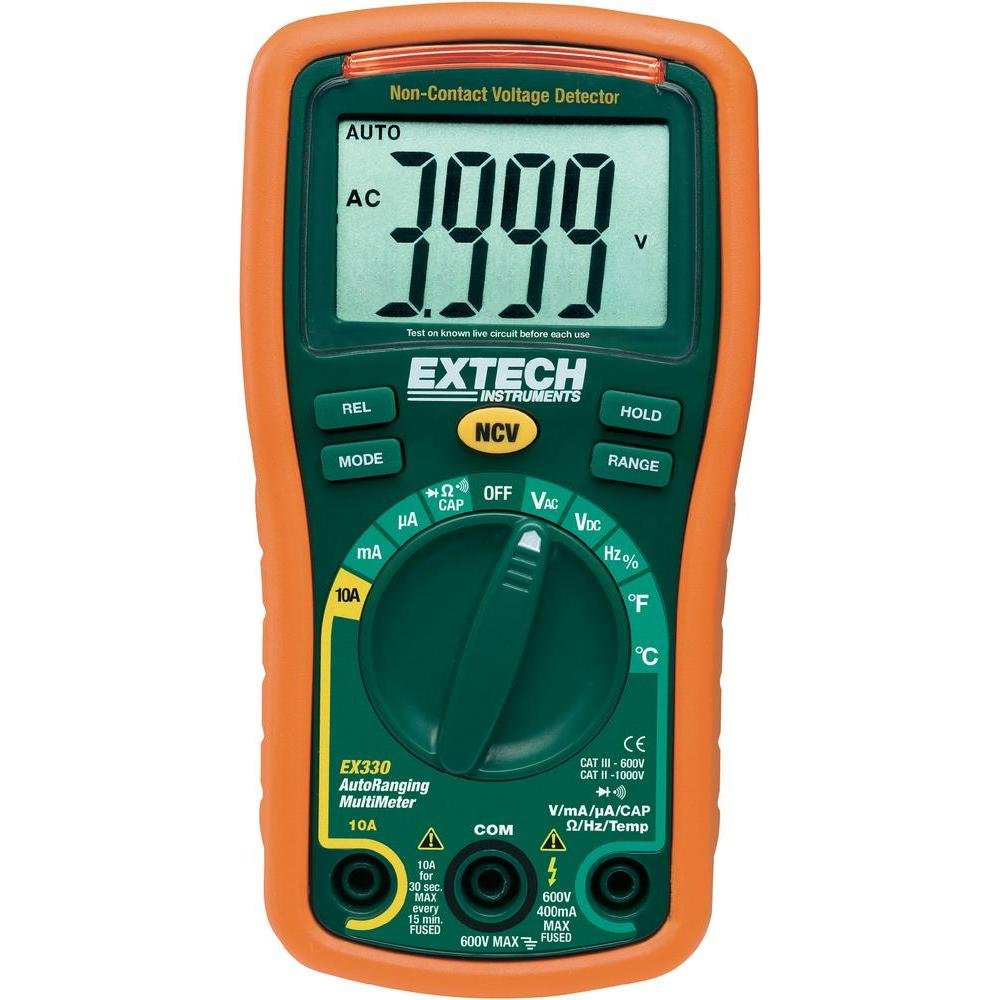
One of the best all round meters I've ever used or owned.
Only $50 and in addition to the standard mm functions it has a temperature probe included and even has a non-contact voltage detector built in as well.
The built-in stand in the case is super useful too!
https://www.amazon.com/Extech-EX330-Autoranging-Multimeter-Temperature/dp/B000EX0AE4/ref=sxin_3_ac_d_rm?ac_md=0-0-ZXh0ZWNoIG11bHRpbWV0ZXI%3D-ac_d_rm&keywords=extech+multimeter&pd_rd_i=B000EX0AE4&pd_rd_r=a56cae4d-46c7-4b32-8657-34155b82f4dd&pd_rd_w=AmFL8&pd_rd_wg=ytw7v&pf_rd_p=404c4843-2c96-4d0d-a5fe-2b0598693e61&pf_rd_r=WNBY4TB2H8NASF45JAA7&qid=1568878017
61TU1Xm8xLL._SL1000_.jpg
 

2ndGearRubber

Well-known member
Joined
Mar 24, 2014
Messages
14,185
Location
Pittsburgh
But some measurements of resistance need to be accurate within 1 Ohm, such as fuel injectors.


Every injector spec I've ever seen has a 3-5 ohm range based on temperature.

I cant remember the last time a failed injector also failed the ohm test. I usually check out of curiosity. Ohm testing is talked about quite frequently but rarely has any use in the real world.
 

Nineeightyone

Well-known member
Joined
Mar 21, 2018
Messages
393
Location
Pennsylvania
https://www.harborfreight.com/dm600-compact-digital-multimeter-64014.html
https://www.harborfreight.com/Electrical-Receptacle-Tester-with-GFCI-Diagnosis-63929.html

I've used Fluke meters in an electronics repair facility, and they're real nice. However when it came to home use, I didn't want to spend that kind of money, particularly considering I didn't need the same level of accuracy.

The Ames meter has been good for my needs, the leads definitely seem to be better than the ones that come with the freebie meters. I'm also a big fan of having a receptacle tester in general, and if you're going to be at HF anyway why not just pick one up?
 
To avoid these ads, REGISTER NOW!
Top Bottom