
To avoid these ads, REGISTER NOW!

Multimeter / what's the deal with them?

BMack37

Well-known member
Joined
Aug 28, 2015
Messages
1,091
I'd be interested to hear how you define "accurate" and under what kind of usage? ie are you measuring voltage? Current? Resistance? etc...


Sgt Lumpy

Not the person you asked but I left my meter at home one day and had to use the "backup" Tenma meter. I was testing resistance and it would randomly show a dead short where there wasn't a short. Leads are good, battery was new...it's just a piece of junk. The Tenma also takes forever for the screen to update, if there's pulsing voltage, it catches about half the readings. This is why I bought the Milwaukee as a backup and have been looking for a good deal on a used Fluke. Even the Milwaukee doesn't update quite as fast as my Fluke 12, which is an entry level model.
 
To avoid these ads, REGISTER NOW!

guy48065

Well-known member
Joined
Aug 12, 2012
Messages
637
Location
Calibration Lab
Sears 82003 best DC accuracy = ±1.2% + 2 digits
Fluke 87 best DC accuracy = ±.1% + 1 digit

It won't matter to everyone...Just saying...
 

cdods

Well-known member
Joined
May 7, 2009
Messages
159
As a hobbyist who has being playing with electricity for close to 40 years. A cheap meter works just fine for 99.9% of what you'll do. Checking for continuity or voltage will cover 95% of what you'll ever do. Most of rest of the remaining 5% is actually measuring resistance or voltage.

Unless you are getting into electronics (and potentially some automotive sensors), any meter will have enough accuracy. Getting a good set of test leads (with lots of different end types) will be much better value than a better meter.

What I miss on my cheap meter - a current clamp, faster readings & display & some automotive specific functions like tach, duty cycle and graphing.

However, having looked at getting a replacement, it seems you have to jump to Fluke to really get much better specs and at that price a used scope starts be a better option.

I should add - a few things my cheap meter has that I'd look for. Hold (Auto Min and Max would also be useful), continuity buzzer, auto ranging.
 
Last edited:

Karl_B

Well-known member
Joined
Oct 13, 2013
Messages
428
Location
Killeen, TX
I've picked up cheap meters over the years, and some I'm sure I overpaid for. I can tell you right now that a GOOD set of leads makes a world of difference even on the HF freebies. I think I have three different Craftsman multimeters in my toolbox and a some random cheepies laying about. I did buy one of the Craftsman meters new, but the meters were all in the $0-15 range. For my purposes, they all work. 12v DC and 110-220 AC single phase are what I normally mess with.

The next time I buy a new one, it will be a Fluke. Do they make a model with an oscilloscope? That would kill two birds with one stone for me.
 

ovrrdrive

Well-known member
Joined
Sep 13, 2015
Messages
642
Location
Central Florida
I have a crappy meter that i got at walmart about 20 years ago that has done everything I have ever needed it to do. For the average user you don't even need very good accuracy to still have a useful meter.

When I check the batteries on my boat as long as I see around 12V on each one and around 24V in series I know they're both good. However, last month I saw 21V combined and then 12.2V on one and 9V on the other. Right away I knew one had a bad cell in it and went down and replaced it. I put it on audible a few months ago and figured out one of my son's battery terminals was so corroded it wasn't passing voltage so I replaced it. Then I ran down the fuses in his fusebox and found a blown 15A that was the reason his dome light wasn't coming on. About 3 months ago I wired in a few 230V outlets for my welder and compressor and was able to verify 115V on each side and 230V combined to verify I wired them correctly.

Get the idea?

It wouldn't have mattered for my use if the outlet read 229V instead of 230V or if the battery in the boat read 12.5 instead of 12.2V. It still worked perfectly for general use and helped me solve my problem. In my opinion the meters on Amazon and at Sears aren't any better than the one's at HF or Walmart. Find one with the features you need (most likely AC 110-240V, DC 0-200V, the ability to tone and possible read amp draw) at a price you like and buy it. The only meter I would pay more for is a fluke like I use at work. There are varying degrees of value and quality, but they are the only one's I would pay a premium for.

That is all just my opinion though and ymmv.
 

theoldwizard1

Well-known member
Joined
Feb 22, 2011
Messages
43,211
Location
SE MI
Sears 82003 best DC accuracy = ±1.2% + 2 digits
Fluke 87 best DC accuracy = ±.1% + 1 digit

It won't matter to everyone...Just saying...

And that is the bottom line ! What Diyer is going to care if it is off by a couple of mvolts !!!
 

Loscaldazar

Well-known member
Joined
Feb 23, 2013
Messages
2,385
The Milwaukee meters were just clearanced out at Home Depot, so they are appearing on eBay for $50+ dollars each. They are great professional grade multimeters. From talking to people who use these for a living, they don't like them as much as Flukes, but they are still great meters. They were $120 meters before Home Depot clearanced em out.

http://www.ebay.com/itm/New-Milwauk...at-III-600V-/171915152732?hash=item2806f10d5c

No relation to the listing I am posting
 

Brownsfan

Well-known member
Joined
Apr 16, 2012
Messages
5,975
Location
Cleveland Ohio
The Milwaukee meters were just clearanced out at Home Depot, so they are appearing on eBay for $50+ dollars each. They are great professional grade multimeters. From talking to people who use these for a living, they don't like them as much as Flukes, but they are still great meters. They were $120 meters before Home Depot clearanced em out.

http://www.ebay.com/itm/New-Milwauk...at-III-600V-/171915152732?hash=item2806f10d5c

No relation to the listing I am posting

I got one for $33. I tested it side by side to my buddies Fluke 115. Its every bit as fast and accurate as the Fluke. I wish the continuity beeper was louder but for $33 its awesome. Also the original price was 150. So its an even better deal at 50 on ebay.
 

Loscaldazar

Well-known member
Joined
Feb 23, 2013
Messages
2,385
I got one for $33. I tested it side by side to my buddies Fluke 115. Its every bit as fast and accurate as the Fluke. I wish the continuity beeper was louder but for $33 its awesome. Also the original price was 150. So its an even better deal at 50 on ebay.


Yeah, the $33 steal at Home Depot was a fantastic deal. I got a multimeter and a clamp meter for $66 total, which was about 20% of what they should have cost. I had been using those HF multimeters because I couldn't justify the money for a good meter until now. Such a steal for a professional grade tool.


Sent from my iPhone using Tapatalk
 

Mark in Indiana

Well-known member
Joined
Aug 11, 2010
Messages
3,057
Location
Southern Indiana
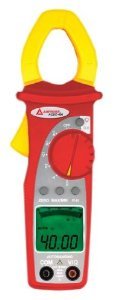
My Amprobe ACDC400 is pictured below. The AC clamp is a must have for troubleshooting HVAC and other problems where amperage is a symptom. I used to use the DC clamp for troubleshooting battery powered forklifts. It can also be used to troubleshoot high amperage problems in automobiles. But that may be overkill. It also features auto-ranging, AC/DC volts, resistance and continuity tone.
Whatever your needs are, please spend the extra money for a high quality multimeter. The top shelf brands (Amprobe, Fluke, Klein, etc.) will give you many more years of service than the cheapies. Electricity is too dangerous to cut corners.
 

Attachments

  • AMPROBE.jpg
    AMPROBE.jpg
    7.4 KB · Views: 18

Old Engineer

Well-known member
Joined
Jul 4, 2013
Messages
45
A few weeks ago, I subscribed to a new YouTube channel that is all about Multimeters. Just yesterday, a couple of videos were posted that address many of the questions on this thread. The guy is no nonsense, and just gets to the point. I really liked what I saw, which is why I subscribed. Here are links to some videos that address questions in this thread:

This one talks about accuracy:

This one talks about Auto vs Manual Ranging:

This one is about Min/Max:

There are a few more on there about NCVT's too. The channel seems to be only about a month old, and he is posting at least 1 video a week, so I'm expecting some good info on this. I would bet that he might even answer specific questions, since the site is so new.
 
Last edited:
Joined
Dec 4, 2012
Messages
11
I use that fluke on the right of that video at work. At home I have that center Klein one. I prefer the Klein. That volume ***** on the fluke!! Or there's a way to turn it up which I don't know about. I have to hold it between my ear and shoulder like an old house phone using it


Sent from my iPhone using Tapatalk
 

sometoyotaguy

Well-known member
Joined
Feb 10, 2012
Messages
885
Location
Southern Maine
I haven't had much luck with the cheap HF meters. The leads seem to be bad on everyone I've seen. The ones you were looking at are fine for most work. I actually prefer analog for troubleshooting, but those are getting hard to come by.
 

sometoyotaguy

Well-known member
Joined
Feb 10, 2012
Messages
885
Location
Southern Maine
So, somebody explain por favor, what FREQUENCY is and what DUTY CYCLE is on a multi meter.


Sgt Lumpy

frequency is how many cycles per second on a sine or square wave. US power is 60Hz or thereabouts. Overseas uses 50Hz.

Duty cycle is what part of a given amount of time that something is on.
Say a relay is on for 0.25 seconds and the time is 1 second, then it's a 25% duty cycle. You'll have to read the meter to determine what the time duration is
 
To avoid these ads, REGISTER NOW!

Will S.

Well-known member
Joined
Apr 15, 2010
Messages
446
Location
The First State
Almost as many opinions here as posts, so I'll throw my .02c in too. I have been using meters in my profession (Avionics bench technician; commercial two-way radio communications tech), from the mid-60' to present. Had Simpson 260 and other analog meters, and I have used many brands of digital meters. My preferred brand is and always has been Fluke.

I bought a Fluke 8024A back in 1970, and it is still in regular frequent use today. It has never failed, and remains as accurate as when new. I have other meters, for specific work, but my go-to in my truck tools is the Fluke. Good quality American-made used ones can be had for as little as the low quality chinese meters of today.
 

bczygan

Well-known member
Joined
Nov 4, 2009
Messages
22,002
Location
DETROIT! Arsenal of Scrappers
It was a fluke (Not a Fluke), that I got on GJ just in time to see a member offer the Milwaukee meters for cost plus shipping. He's sending me both.

Should be a bit better than the 15 HF ones floating around the house and yard.....

Bill
 

Mr. T

Well-known member
Joined
Sep 4, 2013
Messages
636
Location
Central PA
The next time I buy a new one, it will be a Fluke. Do they make a model with an oscilloscope? That would kill two birds with one stone for me.


If you've got $1500 to $5000 to burn, why yes they do.

Just google scopemeter.
 

LumpyMusic

Well-known member
Joined
May 2, 2012
Messages
492
Location
Phoenix Arizona USA
frequency is how many cycles per second on a sine or square wave. US power is 60Hz or thereabouts. Overseas uses 50Hz.

So outside of using my multi-meter to tell me if I'm in Phoenix or London, is there some use for FREQ measurement I can't conceive of? Portable generators? How high does it read? Enough to measure switching power supplies (not exactly sure why you'd want to)?


Sgt Lumpy
 

DWise

Well-known member
Joined
Apr 22, 2012
Messages
322
Location
Newark, Ohio
So outside of using my multi-meter to tell me if I'm in Phoenix or London, is there some use for FREQ measurement I can't conceive of? Portable generators? How high does it read? Enough to measure switching power supplies (not exactly sure why you'd want to)?


Sgt Lumpy

Yes on the generators, When we setup whole house natural gas or propane generators we set the rpm to produce 120 volts at 60 Hz. I use a Fluke 87.
 

HanShotFirst

Well-known member
Joined
Jun 29, 2015
Messages
846
Location
NW Nevada
I have a 15 year old Fluke 12 that has been fantastic. It cost me $100.00 15 years ago, but I don't regret spending the money for one minute. I think you can still get them and I think they're still around the same price. Buy a flack jacket/condom/protective thingy for it, and call it done for the rest of your life.
 

MikeF2316

Well-known member
Joined
Dec 29, 2012
Messages
9,605
Location
Thornhill, ON
So outside of using my multi-meter to tell me if I'm in Phoenix or London, is there some use for FREQ measurement I can't conceive of? Portable generators? How high does it read? Enough to measure switching power supplies (not exactly sure why you'd want to)?


Sgt Lumpy

How high they read depends on the meter. Making sure your portable generator is at the correct frequency is one use. You could also use it to check a tachometer, or measure small engine speed.
 

BMack37

Well-known member
Joined
Aug 28, 2015
Messages
1,091
I have a 15 year old Fluke 12 that has been fantastic. It cost me $100.00 15 years ago, but I don't regret spending the money for one minute. I think you can still get them and I think they're still around the same price. Buy a flack jacket/condom/protective thingy for it, and call it done for the rest of your life.

They don't make the Fluke 12 anymore, it is actually really sought after. It was a very good entry-level meter, basically you don't have to worry about having it set correctly. If you are on resistance but you're testing voltage, it will automatically switch to voltage. If you are trying to test DC voltage and are on AC, it will automatically switch to DC...that is VERY valuable for a new tech. It does have an issue, where you can be checking for a short and the capacitors are still charged, it will show the DC voltage and you can't get the resistance reading until you discharge the cap(s). Fantastic meter, don't let go of that one. :thumbup:
 

HanShotFirst

Well-known member
Joined
Jun 29, 2015
Messages
846
Location
NW Nevada
They don't make the Fluke 12 anymore, it is actually really sought after. It was a very good entry-level meter, basically you don't have to worry about having it set correctly. If you are on resistance but you're testing voltage, it will automatically switch to voltage. If you are trying to test DC voltage and are on AC, it will automatically switch to DC...that is VERY valuable for a new tech. It does have an issue, where you can be checking for a short and the capacitors are still charged, it will show the DC voltage and you can't get the resistance reading until you discharge the cap(s). Fantastic meter, don't let go of that one. :thumbup:
Wow, I didn't know it did that, I always had it on the right setting. It's a simple multimeter with just a couple of buttons.
 

Brownsfan

Well-known member
Joined
Apr 16, 2012
Messages
5,975
Location
Cleveland Ohio
The Fluke 113 is sort of like that. You just have to set it to voltage and it knows if it's AC or DC or continuity I have one as my home meter . I got it for $20 at Lowe's when they clearanced out all the good electrical tools for the **** Southwire.
 
Last edited:

Badasssapper67

Well-known member
Joined
Sep 24, 2012
Messages
322
Location
Molalla Oregon
My opinion is a little different. A horse will do everything you needed to do 120 years ago when people hardly traveled over 20 miles or they took a train. When it comes to automotive, get a GOOD automotive meter and you will find out that when you used to use the telephone to bug your mechanic friends you can now find stuff out on your own. Are your injectors plugged? does one have a bad coil? There's no flow in the upper radiator hose, is the t stat stuck, how hot is the engine? You may not know how valuable those features are since you've never made good use of them, but once you do you will never go back.
We have no idea what kind of electronic do dads cars will use in ten years but you can be sue the government is going to regulate more and more electronic controls. I bought an ES 595 and it not only did all I asked it to, it asked me if it could do more, and so I learned how to use the other features. With that meter I can measure the capacitance in start and run capacitors without buying them on line, waiting for three days and then replacing the old ones to find out it wasn't the capacitors.
To each his own of course, but I am so happy that I have learned to use the features on this meter and the doors it opens for me to go ahead and do things that before were beyond my reach.
 
To avoid these ads, REGISTER NOW!
Top Bottom