To avoid these ads, REGISTER NOW!

My dad's house OMG

AntonLargiader

Well-known member
Joined
Nov 20, 2016
Messages
1,372
Location
Charlottesville, VA
This morning I went up to reconnect his furnace which had supposedly been disconnected in order to connect something else. Turns out that wasn't exactly correct; what had happened is that he (via his handyman) had added baseboard electric heat in the basement last winter when the hot water baseboard circuit sprung a leak. One of those new heaters was connected in place of the pool, then disconnected in favor of the pool again in the spring. The furnace was actually connected at all times. In the end I simply swapped back to the heater but this isn't over yet.

Wow, was it ever a good idea to go up there. Here's the arrangement; the meter is basically on the other side of this wall:

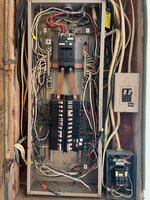
IMG_2796D.JPGIMG_2804D.JPG

Westinghouse panel. Yes, that's a note to "pull both" because separate breakers are used for a 240V circuit. Yes, that box is fed from the line side of the main breaker, and it feeds the other small box via doubled conductors on its line side (and there's no outside disconnect).

In separate news, the circuit for the pool (which is not on a GFCI) is zip-tied to the conduit running on the ground to the hot tub, and then turns and just goes into the concrete. They poured the hot tub slab around it. And BTW that isn't the only exposed UF-B.

IMG_2799.JPGIMG_2805.JPG

So I'm seeing at least the following violations:
  • Illegal feeder tap for small boxes (not in raceway)
  • No OCPD for small boxes
  • Wrong 240V breaker configuration for gray box
  • No clamp where UFB enters panel
  • Unprotected UF-B outside
I mentioned these things to my dad and he asked if we should just replace the panel. That would certainly let us bring it up to date in many other ways, such as an outside disconnect with 4-wire feeder, enough breakers for everything in one panel, and GFCI for the pool. The only alternative I see is buying a bunch of tandem breakers and then wiring the subpanels in properly, or MAYBE I can find a bus bar for that panel that has two more rows in it (because the enclosure and cover seem to have space for a larger bus bar), but I don't really want to go that way. I lean toward replacement, too.

Thoughts?
 
To avoid these ads, REGISTER NOW!

wyliesdiesels

Well-known member
Joined
Aug 14, 2012
Messages
20,022
Location
Modesto, CA
yeah the UF-b is no bueno.

The gray panel appears to have FPE- federal pacific electric stab lok breakers which should be replaced STAT. they dont trip when theyre supposed to. Since this is fed from the line side of the main panel, this could be a major fire hazard.

many of the neutral lugs are double tapped.

you can put 2 EGCs in a lug but only 1 neutral in a lug meaning each neutral needs its own lug....

The 2 tan panels are Eaton CH which are actually really good panels.
 

Mzungu

Well-known member
Joined
Sep 3, 2022
Messages
176
One more for the list
- grounds need to separated from the neutrals. separate grounding bars mechanically connected to the panel are necessary.
I would go for a full service upgrade on this one. Trying to deal with that incoming cable from the meter wont be easy.
 

wyliesdiesels

Well-known member
Joined
Aug 14, 2012
Messages
20,022
Location
Modesto, CA
One more for the list
- grounds need to separated from the neutrals. separate grounding bars mechanically connected to the panel are necessary.
I would go for a full service upgrade on this one. Trying to deal with that incoming cable from the meter wont be easy.
Actually if this is the main service panel the grounds can land on the neutral bar since it would be bonded
 

Mzungu

Well-known member
Joined
Sep 3, 2022
Messages
176
Actually if this is the main service panel the grounds can land on the neutral bar since it would be bonded
NEC must have different rules for you guys down south. Our CEC states otherwise. For our code all neutrals and grounds are separate after that main neutral ground bond.
 

wyliesdiesels

Well-known member
Joined
Aug 14, 2012
Messages
20,022
Location
Modesto, CA
NEC must have different rules for you guys down south. Our CEC states otherwise. For our code all neutrals and grounds are separate after that main neutral ground bond.
Read what i wrote again.

The neutral to grnd bond is installed in the main service panel. Thats why i stated MAIN SERVICE PANEL.
 

Norcal

Well-known member
Joined
Mar 16, 2008
Messages
13,758
The panel is a Cutler-Hammer CH, very early one, BTW. The gray one is a FPE. The twin breakers in the CH panel have no business there, it was not UL listed to use them & was decades later before Eaton introduced them to the market.
 

Mzungu

Well-known member
Joined
Sep 3, 2022
Messages
176
Read what i wrote again.

The neutral to grnd bond is installed in the main service panel. Thats why i stated MAIN SERVICE PANEL.
Pretty sure I understood you quite well. What I said is AFTER the MAIN NEUTRAL GROUND BOND. We are both looking at the same picture so I am referring to the same bonding point as you in the main service panel. After that main neutral/ground bonding is done, our code states Ground and Neutral shall be separate from each other. That includes that neutral bar in this picture where the grounds and neutrals are landed together. So for us that means having the brass screw or wire jumper bonding the panel enclosure where then the grounds would land on the ground bar attached to the enclosure. Since at least 1989 when I started all of our main service panels have a barrier installed separating the main breaker and the main Ground / Neutral bonding point from the rest of the panel. The main service panels all have separate bars for ground and neutral. An inspector up here finding grounds and neutrals from branch circuits landed together in any panel, main service or otherwise will fail the inspection.
 
OP
A

AntonLargiader

Well-known member
Joined
Nov 20, 2016
Messages
1,372
Location
Charlottesville, VA
I didn't see the FP label on the gray box!

So it seems the main box is good quality but simply undersized for the way the house is wired. The house was built in 1967 (A-frame with spiral staircase) and while I'm sure some circuits could be combined I have no idea what is what and we'd have to combine a LOT to get rid of the tandems and bring the other circuits in. Does anyone see a reasonable path forward with this box, possibly with a 30-space bus if there is one available? I count 37 spaces needed without using tandems, if the one mystery wire should actually be landed on a breaker.

I think a 40-space panel will fit; the existing one is 33.5" tall and a 40-space QO or Homeline is about 39". I'll have to check. I don't see anything commonly available between 30 and 40.

Question about the outside disconnects for the pool and hot tub: I think the pool dates from the '80s and the hot tub from 2001. Their line-of-sight disconnects (small breaker boxes) are outdoors; the one for the hot tub is on the house wall on the other side of the panel (right below the meter) and the pool one is about 30' from the house on a post by the pump. Are those considered subpanels that require grounding rods?
 

sparky 1971

Well-known member
Joined
Oct 9, 2018
Messages
7,973
Location
Central Iowa
Pretty sure I understood you quite well. What I said is AFTER the MAIN NEUTRAL GROUND BOND. We are both looking at the same picture so I am referring to the same bonding point as you in the main service panel. After that main neutral/ground bonding is done, our code states Ground and Neutral shall be separate from each other. That includes that neutral bar in this picture where the grounds and neutrals are landed together. So for us that means having the brass screw or wire jumper bonding the panel enclosure where then the grounds would land on the ground bar attached to the enclosure. Since at least 1989 when I started all of our main service panels have a barrier installed separating the main breaker and the main Ground / Neutral bonding point from the rest of the panel. The main service panels all have separate bars for ground and neutral. An inspector up here finding grounds and neutrals from branch circuits landed together in any panel, main service or otherwise will fail the inspection.
That is the main panel and the bonding should be done there unless there is a disconnect between there and the meter, which I doubt.. We don't have a barrier to separate the main from the branch circuit breakers in the U.S. Those little POS panels on the side should have the neutrals and grounds separated though and I'm willing to bet they aren't.

EDITED: Earlier I had this thread confused with the thread having the split bus panel.
 
Last edited:
OP
A

AntonLargiader

Well-known member
Joined
Nov 20, 2016
Messages
1,372
Location
Charlottesville, VA
My dad says there is about 44" available behind the wooden door, so a 39" panel will fit. May need to re-route the feed slightly but that's OK since I will be adding an outside disconnect anyway.

I saw some 36" options in QO main lug panels but that's a more expensive route (although I do still have a stack of QO breakers).

With an outside disconnect I could go with main lugs if it works out better, but the ML Homeline load centers don't go big enough and the convertible ones aren't really much cheaper. I actually have an unused 40-space Homeline panel here at work; it just needs a cover ($60 from Zoro) but it lacks PON.
 

wyliesdiesels

Well-known member
Joined
Aug 14, 2012
Messages
20,022
Location
Modesto, CA
Pretty sure I understood you quite well. What I said is AFTER the MAIN NEUTRAL GROUND BOND. We are both looking at the same picture so I am referring to the same bonding point as you in the main service panel. After that main neutral/ground bonding is done, our code states Ground and Neutral shall be separate from each other. That includes that neutral bar in this picture where the grounds and neutrals are landed together. So for us that means having the brass screw or wire jumper bonding the panel enclosure where then the grounds would land on the ground bar attached to the enclosure. Since at least 1989 when I started all of our main service panels have a barrier installed separating the main breaker and the main Ground / Neutral bonding point from the rest of the panel. The main service panels all have separate bars for ground and neutral. An inspector up here finding grounds and neutrals from branch circuits landed together in any panel, main service or otherwise will fail the inspection.
Yup then things are totally different here.

You can land neutrals and grounds on the same bar in the main service panel.

Quite common to do so here in California as majority of houses only have meter mains/no subpanels, so all neutrals and grounds are landed on same bar
 
OP
A

AntonLargiader

Well-known member
Joined
Nov 20, 2016
Messages
1,372
Location
Charlottesville, VA
There isn't really any next-to available. The bright area at the right of the pics (easily seen if you click on the first one) is a window, and the panel is in the corner so there's no more width available than what's shown. If there was a skinny one-column panel I could replace the two small ones with it.

I could, though, add a panel on the other side of the window and put the pool, baseboard and spa on it which would be nice since they are all on double breakers and come from that direction, as well as any 120V loads that come from that side. Hmm, that is tempting. I'd need to do some circuit inventory to see how well that would work out. It would sure be a lot less disruptive because I could move circuits over one at a time.
 

yatg

Well-known member
Joined
Aug 16, 2019
Messages
2,824
Location
Southern Oregon
If you separate the neutral and grounds in a new panel, any existing 120/240v 3 wire feeds, like a clothes dryer, stove, oven, also need to be upgraded to a 4 wire.

There's a clump of ground wires under the left bus bar bottom screw that needs to be untangled. And maybe some iffy joining of ground wires on the right side.
 
OP
A

AntonLargiader

Well-known member
Joined
Nov 20, 2016
Messages
1,372
Location
Charlottesville, VA
Ahhh.. thanks.. I think... for that and for reminding me that moved/altered circuits should be updated. Which means, I suppose, that I would need to run new 4-wire out to the pool pedestal because I think there's a 120V recep there which I guess is neutralled to the ground in the UF-B.

I'm not promising that the range, pool and dryer are going to get updated immediately. I want to get the dangerous stuff dealt with soon. But I will probably be up there again this coming weekend and I can assess the situation better with the benefit of everyone's comments here. Please keep them coming.
 

wyliesdiesels

Well-known member
Joined
Aug 14, 2012
Messages
20,022
Location
Modesto, CA
Ahhh.. thanks.. I think... for that and for reminding me that moved/altered circuits should be updated. Which means, I suppose, that I would need to run new 4-wire out to the pool pedestal because I think there's a 120V recep there which I guess is neutralled to the ground in the UF-B.

I'm not promising that the range, pool and dryer are going to get updated immediately. I want to get the dangerous stuff dealt with soon. But I will probably be up there again this coming weekend and I can assess the situation better with the benefit of everyone's comments here. Please keep them coming.
yeah if the pool feed is 3-wire, thats real dangerous. needs to be fixed right away

also the ground wire should be insulated and the ground wire in UF is not.
 
OP
A

AntonLargiader

Well-known member
Joined
Nov 20, 2016
Messages
1,372
Location
Charlottesville, VA
If you separate the neutral and grounds in a new panel, any existing 120/240v 3 wire feeds, like a clothes dryer, stove, oven, also need to be upgraded to a 4 wire.
Reading a few threads on MikeHolt it sounds like there are ways to have an outside disconnect that is not the service disconnect, so the bond still happens in the panel. I'm totally pro 4-wire but I don't want to tie fixing the major problems to updating everything that can be updated.

Virginia is on 2017 FWIW. Sounds like a lot of this changed for 2020.

I'm leaning toward properly adding a 12-20 space subpanel and losing the small boxes. Would like to add an outside disconnect but once the scary feeder tap is gone it won't be as big a deal.
 

wyliesdiesels

Well-known member
Joined
Aug 14, 2012
Messages
20,022
Location
Modesto, CA
That and take a real close look at the main red/black wires. It looks like they're wrapped with some sort of clear tape and the red taped wire looks like there's some aluminum strands showing through.
That is SEU cable and that is the wrap they put around the wires. Dont know what kind of wrap was used back then but nowadays its fiberglass paper...
 
To avoid these ads, REGISTER NOW!
OP
A

AntonLargiader

Well-known member
Joined
Nov 20, 2016
Messages
1,372
Location
Charlottesville, VA
Yeesh. I hadn't noticed that; thanks. I'll be up there again Sunday and can verify what that is. If I get too curious about that (and everything else I want to re-examine) I'll go up sooner. He's about a half hour north of me.

Want to look at:
- grounding
- what circuits would easily reach a new subpanel to the right
- that red feeder (yeah I'd look at both)
- where the other 240V loads run
- what other 240V circuits there may be

The 240s I can see are well pump, range, pool/baseboard and spa, which leaves dryer and the other baseboard heater unlabeled in the FP box but neither of the FP circuits look new enough to be the other baseboard heater.

Also at some point I need to trace and mark those 120V circuits. The labeling is worse than at my own house. :)

I see a lot of labels looking like they say Master Bedroom. It's a pretty small bedroom, but maybe there's a 240V AC recep up there or something.
 
OP
A

AntonLargiader

Well-known member
Joined
Nov 20, 2016
Messages
1,372
Location
Charlottesville, VA
That's the UF-B that goes to the pool. Runs through the wall with the wires to the spa and then is zip-tied to the spa conduit as I showed.

If bushings were required in 1967, then yes I suppose there should be a bushing there. If I add an outside disconnect, I will be replacing that section of cable anyway so I could add a bushing.
 

wyliesdiesels

Well-known member
Joined
Aug 14, 2012
Messages
20,022
Location
Modesto, CA
What else is coming in thru the bottom KO? The black/red/bare ground. Shouldn't there be a bushing at the top SE entrance?
yes there should be especially since its metal (probably rigid) conduit and the wire is right up against the sharp edge
 

wyliesdiesels

Well-known member
Joined
Aug 14, 2012
Messages
20,022
Location
Modesto, CA
That's the UF-B that goes to the pool. Runs through the wall with the wires to the spa and then is zip-tied to the spa conduit as I showed.

If bushings were required in 1967, then yes I suppose there should be a bushing there. If I add an outside disconnect, I will be replacing that section of cable anyway so I could add a bushing.
i think hes referring to the SEU

The UF doesnt need a bushing. not large enough
 
OP
A

AntonLargiader

Well-known member
Joined
Nov 20, 2016
Messages
1,372
Location
Charlottesville, VA
Just for clarity: “What else is coming in thru the bottom KO? The black/red/bare ground.” That is the UF-B for thepool. BTW there is also a white with the red/black/ground; those wires are the spa. They go through the wall into the disconnect and then through conduit to the spa. Seems to have been done reasonably well other than just running through a hole. It’s on a GFCI and uses conduit.

“Shouldn't there be a bushing at the top SE entrance?” If they were required in 1967, then probably yes.
 

Zeke

Well-known member
Joined
Aug 13, 2009
Messages
17,176
Location
Long Beach CA, the sewer by the sea.
So, reading this thread I'm picking up that it's OK to double tap the main breaker feed and have an out-of-panel breaker along side as well as having #8 wires exiting the panel and running in a wall (long or short run, doesn't matter) without being in conduit.

And a handwritten sign that says "Pull both" because they aren't tied.
 
OP
A

AntonLargiader

Well-known member
Joined
Nov 20, 2016
Messages
1,372
Location
Charlottesville, VA
... and UF-b sitting on the concrete patio, doubling and tripling neutrals and grounds on the bar, running a neutral on a ground, and stuff going in and out without clamps and bushings but yeah. What's the problem? Been working just fine all these years, right?

I have a list of stuff to investigate on my next visit!
 

Norcal

Well-known member
Joined
Mar 16, 2008
Messages
13,758
... and UF-b sitting on the concrete patio, doubling and tripling neutrals and grounds on the bar, running a neutral on a ground, and stuff going in and out without clamps and bushings but yeah. What's the problem? Been working just fine all these years, right?

I have a list of stuff to investigate on my next visit!
2 grounding conductors under one screw is fine as long as they are the same size & material, & if marked as allowed, 3 could be allowed also, just cannot have two neutrals, or a grounded (neutral) & grounding conductor under the same screw.
 
Last edited:

Zeke

Well-known member
Joined
Aug 13, 2009
Messages
17,176
Location
Long Beach CA, the sewer by the sea.
I think that's exactly what's being talked about. Anton, you're discussing this with one of the most respected electricians here or anywhere.

I count 10 bare copper grounds, 2 greens and some twisted bundles. I can see 28 neutral wires ties to the busses. I count 24 bus screws.

You've already pointed out several problems here so I suppose you expected some additional problems to be pointed out. I'm here to understand because I live in a historical district of mostly mid 1920's to the 30's houses, some of which are still knob and tube. Mine was before a complete revamp. I have worked in the electrical trade some and I'm a licensed GC. I am not certified to do residential in CA (which is required of every employee).

I consider it a hobby. But I like to do things right so I listen to some here (too many to list) that have between them probably 500+ years of experience.
 
OP
A

AntonLargiader

Well-known member
Joined
Nov 20, 2016
Messages
1,372
Location
Charlottesville, VA
You're misunderstanding me. I meant that we're not talking about all of those things he mentioned that are allowed... the stacked connections in that panel that are under discussion here are things like two different sized grounds and a neutral. Yes I realize some things are allowed to be doubled up, but they aren't the problem. I'm sorry I gave a different impression.

On that topic, one thing that occurs to me is that moving a bunch of double breakers to a different panel doesn't really help me in that area, as few of them have neutrals. If I want to lighten the load on the neutral bus I will probably have to move a few of them over to the new panel. I wish I could put longer bars for the existing panel. Does anyone think there is a legit retrofit for that panel? Eaton sells CH interiors, but I just don't know that much about it. The cover looks like it has openings for 30 breakers, while Eaton sells a 32-space interior. Dunno about the neutral and ground bars.
 

sparky 1971

Well-known member
Joined
Oct 9, 2018
Messages
7,973
Location
Central Iowa
On that topic, one thing that occurs to me is that moving a bunch of double breakers to a different panel doesn't really help me in that area, as few of them have neutrals. If I want to lighten the load on the neutral bus I will probably have to move a few of them over to the new panel. I wish I could put longer bars for the existing panel. Does anyone think there is a legit retrofit for that panel? Eaton sells CH interiors, but I just don't know that much about it. The cover looks like it has openings for 30 breakers, while Eaton sells a 32-space interior. Dunno about the neutral and ground bars.
Just buy some ground bars and mount them to the panel. There are probably tapped holes for them somewhere behind that mess, but I'm not very familiar with CH panels and only see one about every three years. Then move all of the grounds to the new bars and you will free up some neutral spaces. Then when you move circuits over to the sub panel, you should wind up ok.
 

wyliesdiesels

Well-known member
Joined
Aug 14, 2012
Messages
20,022
Location
Modesto, CA
I think that's exactly what's being talked about. Anton, you're discussing this with one of the most respected electricians here or anywhere.

I count 10 bare copper grounds, 2 greens and some twisted bundles. I can see 28 neutral wires ties to the busses. I count 24 bus screws.

You've already pointed out several problems here so I suppose you expected some additional problems to be pointed out. I'm here to understand because I live in a historical district of mostly mid 1920's to the 30's houses, some of which are still knob and tube. Mine was before a complete revamp. I have worked in the electrical trade some and I'm a licensed GC. I am not certified to do residential in CA (which is required of every employee).

I consider it a hobby. But I like to do things right so I listen to some here (too many to list) that have between them probably 500+ years of experience.
not quite... if there are 2 or more trades needed on a project then a GC can do all the work themselves including the electrical and no electrical journeyman card/cert is required....
 
OP
A

AntonLargiader

Well-known member
Joined
Nov 20, 2016
Messages
1,372
Location
Charlottesville, VA
Staying with the interior for a moment, there isn't a lot of info floating around regarding interior replacement. The following PDF from Eaton is the best I've found:

It indicates that my dad's panel is the first vintage, for which some parts are NLA. It seems to have no cover, only a deadfront. The deadfront supports would go away with the old interior, so I'd have to match a cover to it. And in that height box (33.5") it can go to 24 circuits (what it already has) in MB and 32 spaces in MLO. The next size up, size C, needs 34" and has 32/42 spaces. Size C would be worthwhile but I don't know if 33.5" is 34" for these purposes. But even then, these components are probably not stocked anywhere and wouldn't be cost-effective compared to the availability and cheapness of new load centers. Platt shows the most appropriate interior as being discontinued, and the matching cover and trim alone are $250. Maybe this is just a dead end. Does anyone have practical experience with these CH retrofit interiors?

Mostly I'm just trying to rule this in or out as an option for getting more spaces into that box. All it really achieves is saving the enclosure, which is a time savings for someone who is on the clock but not really that big a deal for me. There are other options.
 

sparky 1971

Well-known member
Joined
Oct 9, 2018
Messages
7,973
Location
Central Iowa
Staying with the interior for a moment, there isn't a lot of info floating around regarding interior replacement. The following PDF from Eaton is the best I've found:

It indicates that my dad's panel is the first vintage, for which some parts are NLA. It seems to have no cover, only a deadfront. The deadfront supports would go away with the old interior, so I'd have to match a cover to it. And in that height box (33.5") it can go to 24 circuits (what it already has) in MB and 32 spaces in MLO. The next size up, size C, needs 34" and has 32/42 spaces. Size C would be worthwhile but I don't know if 33.5" is 34" for these purposes. But even then, these components are probably not stocked anywhere and wouldn't be cost-effective compared to the availability and cheapness of new load centers. Platt shows the most appropriate interior as being discontinued, and the matching cover and trim alone are $250. Maybe this is just a dead end. Does anyone have practical experience with these CH retrofit interiors?

Mostly I'm just trying to rule this in or out as an option for getting more spaces into that box. All it really achieves is saving the enclosure, which is a time savings for someone who is on the clock but not really that big a deal for me. There are other options.
If the existing panel doesn't have a cover laying around somewhere you might as well start over with all new unless maybe you can find a panel cover on ebay or something like that.
I did get lucky a couple of weeks ago with a GE that was missing a cover. The new cover matched up perfectly except for the cut out for the main which was rotated 90° from what I had to work with. I was able to cut it out to match, then welded sheet metal in to fill in the gaps.
 

Zeke

Well-known member
Joined
Aug 13, 2009
Messages
17,176
Location
Long Beach CA, the sewer by the sea.
not quite... if there are 2 or more trades needed on a project then a GC can do all the work themselves including the electrical and no electrical journeyman card/cert is required....
AFAIK, after Home Depot vs. State of CA was decided in favor of HD, that made that so. Used to be 3 or more. And, yes, I knew that I could do electrical, and let's say patching walls, and call that qualifying to do the work.

Unless it was pretty damn simple, I did not take advantage of that provision and instead hired electricians. Here's the thing, being basically a carpenter means I need a lot of tools as it is. And with all the tools and supplies an electrician typically has on board, I'd need another truck, a trailer, or a huge van. It's not efficient. Same with plumbing. I could manage to carry enough hand tools to do basic plaster or drywall and even had a suction cup for glass. Lots of things overlap, but not so much for electrical when it boils down to having enough wire, conduit and fittings to not be running off to the supply house 2wice a day.

One more thing, having done my share of electrical work, I'd say that's one job more easily done by 2 or more workers. Unless, as I mentioned, it's a real simple repair. In those instances it was hard for me to find someone to come out.

Regarding this thread, I'm glad it finally came out that a sub panel is really the best way out of the mess. Me. I'd probably have asked an electrician to install a larger panel with more (enough) breaker slots. There's a lot of space wasted in that panel. For most guys around here that's one day's work. Quit thinking about it and just do it. Before you know, it's half finished. There seems to be enough wire length in most of the existing.
 
OP
A

AntonLargiader

Well-known member
Joined
Nov 20, 2016
Messages
1,372
Location
Charlottesville, VA
Regarding this thread, I'm glad it finally came out that a sub panel is really the best way out of the mess. Me. I'd probably have asked an electrician to install a larger panel with more (enough) breaker slots. There's a lot of space wasted in that panel. For most guys around here that's one day's work. Quit thinking about it and just do it. Before you know, it's half finished. There seems to be enough wire length in most of the existing.
I generally only have time to get up there on weekends, so I have all week to just think about it! If I lived there I could look around, trace circuits, and generally assess everything during these discussions, but it's not that easy when it's 30 minutes away. I will be there on Sunday and will probably decide between replacing the panel and adding a sub, based on the wire runs.

The Eaton CH CHP42B200X7 is a 42-space MB load center that's 37" tall. Looks like a good fit for replacement. Cover sold separately. No idea where I can get one, though (other than online).

The Eaton CH CHP24L125 is a 125A 24-space MLO that would be great as a sub. Bigger than I need but that's OK. Available at a relatively nearby Lowes. Easy to connect with 2-2-2-4 SER and a 90A breaker.

Subpanel, I could install it and even move some circuits over without pulling the meter. Then, pull it and clean up the feeder side of things, and we're back in business.
 
OP
A

AntonLargiader

Well-known member
Joined
Nov 20, 2016
Messages
1,372
Location
Charlottesville, VA
I went back up there this afternoon. The red feeder is not cracked; that is a very convincing reflection or something in the photo. The left feeder is wrapped in transparent red tape and the right feeder is wrapped in clear tape. Both have black insulation that seems intact. All of it is 55 years old as far as I know.

More sketchy stuff. I was inventorying the 240V circuits and had one marked for the well pump but none marked dryer. Turns out there is a wire coming out of the dryer outlet box with this clever rig for powering the well pump.

IMG_2822D.JPG

The 120V UF-B from the goldfish pond runs loose through a hole in the panel with no clamp and has the black wire doubled up under a breaker lug from some non-GFCI 240V circuit that isn't handle-tied and I have no idea what it is for. You can see it in the initial post, third down on the left.

This is by no means an extensive inventory of the issues, but some of it is just plain weirdness with switches that my dad has no idea about and abandoned circuits.

To the meat of it: I think the subpanel is the way to go and yes there is room. After removing the wooden frame and cover, and removing the two small boxes, there will be about 20" between the panel and the window trim where I can fit a subpanel. I can leave 3" on each side of the sub and still have room for a new box to cover it all up.

That also makes the outside disconnect a totally separate repair, as the sub will not require messing with the feeder (other than cutting the taps). There is an electrician friend who has done work for my dad (not any of what I've shown!) who I am going to consult. Maybe he'll just do all of it.

Inside view showing the space available, and outside showing the basic layout and the exposed UF-B.
IMG_2823.JPG IMG_2818.JPG
 
To avoid these ads, REGISTER NOW!
Top Bottom