To avoid these ads, REGISTER NOW!

My diy oilless compressor muffler/silencer

PWC Repair

Well-known member
Joined
Dec 27, 2012
Messages
3,179
Location
Arkansas
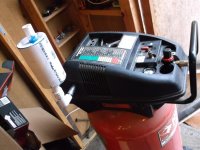
I had to repair a leak on my EXTREMELY noisy oilless air compressor so while I was at it I thought I'd build a muffler. Cost of parts would be about $12 but I already had most of this. I figured since they use sound wave cancellation on chambered car mufflers then it should work for the intake noise as well....right?

Parts list:

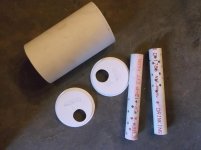
1 pc. 3" PVC pipe 6" long
2 pc 3/4 PVC cut 7" long
2 3" PVC test caps
1 3/4 slip x 1/2 MPT PVC adapter
1 1/2 FPTxFPT PVC 90
1 1/2x3 galvanized pipe fitting

Drill holes in a 4x3 pattern around only half of each 3/4" pipe. Cut out a 1" hole in each 3" cap. Glue the caps to the 3" PVC with the holes 180 degrees from each other. Slide the 3/4 pipe in (drilled hole half first) until it bottoms and mark it at the cap with a pencil. Pull it back out and put some glue on the end and around the 3/4 pipe just before your pencil mark. Now slide the 3/4" pipe back in and the end will be glued inside on the cap and also around the hole you inserted it through. Do the other side the same way. Let the glue set up good and install it onto your compressor intake. There is enough 3/4" pipe stubbed out to clamp on a small filter.
Here is a short vid showing the comparison.

It might not sound like much in the vid but there is about a 50% noise reduction in my little 12x18 shop. The remaining noise is of the compressor mechanicals and plastic rattling (also soon to be addressed). I can also tell you that with nothing on the intake energy is emitted as a loud, annoying humm. With my muffler the sound energy is cancelled and the energy can be felt "blowing" out of the muffler as pressure pulses in the air. The energy is still there but is not in the form of sound anymore....YAY!
 

Attachments

  • muffler 001.jpg
    muffler 001.jpg
    130.7 KB · Views: 298
  • muffler 003.jpg
    muffler 003.jpg
    126.7 KB · Views: 254
  • muffler 004.jpg
    muffler 004.jpg
    134.5 KB · Views: 330
To avoid these ads, REGISTER NOW!

navymech

Well-known member
Joined
Dec 8, 2013
Messages
106
Location
Norfolk, VA
In the video it sounds louder with the muffler on... :wtf:

Maybe not the best demonstration lol Pretty sweet ingenuity if it works in person though.
 
OP
P

PWC Repair

Well-known member
Joined
Dec 27, 2012
Messages
3,179
Location
Arkansas
The deeper drone sound is the intake. The rattling noise is the housing and that air nozzle vibrating. The noise from those doesn't get any louder, the overall sound just gets quieter so you notice the housing rattling more. Maybe I can take a vid from across the shop so the camera isn't right next to the rattling of the housing.
 

cheechi

Well-known member
Joined
Feb 29, 2012
Messages
4,384
Location
Triad, NC
I assume you will be attaching a filter to yours? I'd like to see/hear it with the filter, and if you link which you use that would be helpful too.

I'd be interested in a before/after times for this mod to see if it makes filling the tank take longer. I understand in this situation it wasn't an option due to the leaking.
 

gtg082y

Well-known member
Joined
Aug 31, 2013
Messages
54
Location
30076
Very interesting. I've though often of doing something similar. My compressor when new was the biggest 115v oilless unit sold at Sears and it is painfully loud.
 

LEVE

Well-known member
Joined
Jun 23, 2008
Messages
1,727
Location
On the Willapa
Use your (or someone else's) smartphone to take a before and after sound test with a DB app. I like the idea you've come up with. I think I'll try it.
 

airdale

Well-known member
Joined
Jun 27, 2009
Messages
349
Location
Oregon
So you know there's an actual science to this, right? Did you actually do the calculations to figure out chamber size, port diameter, port length, etc?

Wouldn't you need to know the frequencies + resonant frequencies of the pump to make those calculations worthwhile?

OP - I like your ingenuity. You could neck down the end pipe to add a cheap aftermarket filter/silencer. Don't know how much more it would quiet it though.

Edit: Or use some insulation batting in the chamber. Glass Packs :)
 
Last edited:
To avoid these ads, REGISTER NOW!

rice rocket

Well-known member
Joined
Mar 24, 2011
Messages
3,175
Wouldn't you need to know the frequencies + resonant frequencies of the pump to make those calculations worthwhile?

For sure, it all can all be measured with basic equipment though, which you can then plug into the equations.

Or have multiple mufflers of varying sizes for better effect. :)
 
OP
P

PWC Repair

Well-known member
Joined
Dec 27, 2012
Messages
3,179
Location
Arkansas
I did not use any sort of math. The only thing I took into account was that it had to breathe better than the 1/2" pipe inlet so I wouldn't restrict the airflow. Everything else was just a guess. It seems to fill in the same amount of time it always has..........slow, compared to my twin cylinder Speedaire Commercial Duty. I will find an app for db measurement and try that!

Yes, I'm adding a little clamp on filter I robbed off a Chinese ATV.
 
Last edited:

CHADD

Well-known member
Joined
Oct 21, 2009
Messages
57
Location
St Louis, MO
Nice setup. Ive seen ppl run the 3/4" pipe straight through the larger. Drill holes all the way around. Then fill the larger pipe with steel wool.

Sent from my SCH-I535 using Tapatalk
 
OP
P

PWC Repair

Well-known member
Joined
Dec 27, 2012
Messages
3,179
Location
Arkansas
OK put an App called "noise meter" on my wife's S4 and measured right at 4db reduction on the intake. BUT.....I don't know how accurate trying to measure sound pressure through a microphone is?? You can scream at it at the top of your lungs and it only reads 82db??

Anyway I feel like I'm working around a standard pushmower now instead of a 20hp riding mower as far as in shop noise goes.
 

bsaint

Well-known member
Joined
Apr 26, 2010
Messages
5,109
Location
Manchester, CT
OK put an App called "noise meter" on my wife's S4 and measured right at 4db reduction on the intake. BUT.....I don't know how accurate trying to measure sound pressure through a microphone is?? You can scream at it at the top of your lungs and it only reads 82db??

Anyway I feel like I'm working around a standard pushmower now instead of a 20hp riding mower as far as in shop noise goes.

Im pretty sure most smartphones have soundwave amplitude modulation for their mic and/or earpiece. If probably maxed out at 82db
 
To avoid these ads, REGISTER NOW!
Top Bottom