To avoid these ads, REGISTER NOW!

My first wall penetration - tips please

roc_on_the_rocks

Well-known member
Joined
Mar 14, 2010
Messages
1,554
Location
South central Indiana
Hey guys,

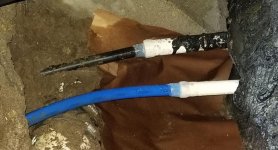
I need to pass a 3/4" PEX through a basement wall, hollow cement block, well below ground.

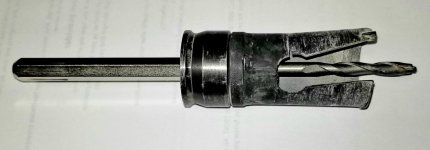
I believe I need to sleeve the PEX through the wall. I plan using a 1" Sch 40 PVC or 1" CPVC. I plan using a Spyder tungsten carbide-tipped hole saw to drill the wall.

A few questions please:
1) The 3/4" PEX is very loose inside the 1" PVC. Is this a problem? Should I calk the this gap to avoid eventual water intrusion in the basement? What if, instead of calking this gap, I warp a self-fusing silicone tape on the outside to seal that gap?

2) The 1" PCV is closely matched with the 1-3/8" hole saw. Can I calk the interface between the sleeve and the cement block with polyurethane calk, like Sika Sanded Paintable Polyurethane Caulk?

3) If the large gap between the 1" PVC and the 3/4" PEX is detrimental, I could use a 1" CPVC. The gap between the PEX and the pipe is around 1/16". Should I still calk it? With this combination, there's a larger gap between the CPVC sleeve and the hole saw diameter. Is it still OK to calk it with polyurethane calk, of cement (hydraulic?) is preferred? (it's messier).

I can buy either sleeve pipe, is there a preference or I'm overthinking it?

Thanks for any and all tips guys!
 
To avoid these ads, REGISTER NOW!

ForceFed70

Well-known member
Joined
Apr 27, 2010
Messages
3,441
Location
BC, Canada
I suspect you're overthinking this a little.

1) The gap is fine, some would say it's preferred.

2) That caulking would work fine. Do you really need it to be sanded? Typically sanded caulk is used for filling larger gaps.

3) N/A the gap is fine unless one side is below grade and you're trying to prevent water intrusion or something like that.
 

Jinks

Well-known member
Joined
Aug 28, 2012
Messages
2,885
Location
Daytona Beach
If you already own a concrete hole saw you can ignore this. If you don't, save your money. Since you have to get to the pipe once it's outside I'm going to assume you have a trench or pit to that depth. Concrete block is easy to open & very forgiving. Simply measure from a point identifiable on both sides of the wall, pick the block you're going through, & smack it with a hammer! Hit the same spot two or three times & you'll knock a hammer sized hole in that side of the block. Now go to the other side of the wall, pick the same block & cell, & repeat. You'll wind up with two holes through the sides of the block. You can enlarge either with a little chipping, & you're going to seal them up after you run the pipe through. Takes about 30 seconds on each side & produces an amazingly clean hole. Takes more time to walk from one side of the wall to the other than it does to create the penetration.
 

Kaizen

Well-known member
Joined
Jan 9, 2015
Messages
6,949
Location
New England
Like jinks says. Hammer will do the job. Easier too then drilling. I use a concrete hammer that has a chipping claw.
Regarding the water intrusion. What’s the pex doing when it gets through the wall?


Sent from my iPhone using Tapatalk
 

thewatusi

Well-known member
Joined
Dec 27, 2013
Messages
1,256
Location
Philly Burbs
I remember my first penetration. We went to Wendy's afterwards and giggled at each other the whole time. Then we went and did it again.
 
OP
R

roc_on_the_rocks

Well-known member
Joined
Mar 14, 2010
Messages
1,554
Location
South central Indiana
Hey guys, thanks for all replies.

I had bought the Spyder tungsten carbide-tipped hole saw a while ago, so I couldn't return it and opted to go ahead with it.

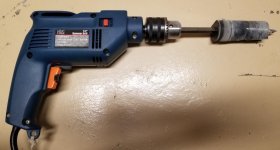
This is going south really quick... I drilled almost 3 inches of a pilot hole and the cinder block seems solid filled!! Progress is minimum, I only drilled about 1-1/4" deep so far with the whole saw. I'm using an old HF drill that is loosing power quickly... so I need to change plans (and tools).

I appreciate any suggestions. I have Menards within two miles.

PS.: On a good note, my dust collection system is working flawlessly.

:lol_hitti
I remember my first penetration. We went to Wendy's afterwards and giggled at each other the whole time. Then we went and did it again.
Did Wendy join the fun?
 

Attachments

  • Hole1.jpg
    Hole1.jpg
    81.5 KB · Views: 93
  • Hole2.jpg
    Hole2.jpg
    35.8 KB · Views: 94
  • HF drill.jpg
    HF drill.jpg
    108.2 KB · Views: 85

dogdog

Well-known member
Joined
Nov 15, 2011
Messages
12,711
Go get a hammer drill or SDS max drills... It'll be done in few minutes...That spyder hole saw is pretty gimmicky good for tiles and stuff... nothing for serious drilling. You got that from Lowes or something.

I did that for 2" Rigid metal conduits using a hammer core bit 2.** (don't remember the exact)" hole punched in a 24" thick very old concrete in 10 minutes or less.... the hole is about 30" below concrete...

when I dig the trench outside.... that area closer to the exterior I filled with gravel instead of soil... The gap I used the same self leveling polyurethane sealant... Except those self leveling are runny.... you'll needed some sort of masking tape to tape the thing and create a funnel to direct that polyurethane into the gap... no leak so far knock on wood... I would also fill outside too if I had a chance...or you can use hydraulic cement.


#####
If you still insist on using that spyder hole saw.... get a bottle spray water, and spray a lot as a lubricant and coolant. I mean A lot... those tungsten carbide will fall off if you don't
 
Last edited:

s14kev

Well-known member
Joined
Dec 12, 2008
Messages
245
Hey guys, thanks for all replies.

I had bought the Spyder tungsten carbide-tipped hole saw a while ago, so I couldn't return it and opted to go ahead with it.

This is going south really quick... I drilled almost 3 inches of a pilot hole and the cinder block seems solid filled!! Progress is minimum, I only drilled about 1-1/4" deep so far with the whole saw. I'm using an old HF drill that is loosing power quickly... so I need to change plans (and tools).

I appreciate any suggestions. I have Menards within two miles.

PS.: On a good note, my dust collection system is working flawlessly.

:lol_hitti

You are drilling so close to the edge of the block that you are hitting the side wall. It's going to be a royal PITA to keep going in that spot. You would have a much easier time if you were just 2 inches to the right. Why would you pick that spot of all the places you could choose?
 
To avoid these ads, REGISTER NOW!
OP
R

roc_on_the_rocks

Well-known member
Joined
Mar 14, 2010
Messages
1,554
Location
South central Indiana
Thanks a lot for the tips guys, I really appreciate them.

I'll search locally for a real concrete drill bit and a big hammer (or SDS) drill.

I realize I am drilling a bit close to the edge of the cinder block, but I thought I gave enough room to avoid its wall. The location chosen took in consideration stuff I wanted to dodge behind the wall.
 

Jinks

Well-known member
Joined
Aug 28, 2012
Messages
2,885
Location
Daytona Beach
Without seeing, or knowing the construction of the wall it's going to be difficult to give more advice on the web. From the location in the picture & the size of the hole you *could* be drilling a filled block. If you are, you have a good chance of finding some re-bar in that cell. A couple of hits with a hammer would have told you it was solid without doing much damage.

It's always "interesting" to follow posters that ask advice, & then follow up with an explanation of why they didn't follow it.........:dunno:
 
OP
R

roc_on_the_rocks

Well-known member
Joined
Mar 14, 2010
Messages
1,554
Location
South central Indiana
Jinks, I hear you man. Nonetheless, I'm really appreciative for your time and tips (and everyone else's).

While rushing through to get this hole drilled last night, with the tools that I had on hand, the result were compounding mistakes, with the biggest one being not trying a different location once the pilot hole didn't find a hollow spot in the cinder block.

I'll keep you guys posted.
 

Kaizen

Well-known member
Joined
Jan 9, 2015
Messages
6,949
Location
New England
Jinks, I hear you man. Nonetheless, I'm really appreciative for your time and tips (and everyone else's).


While rushing through to get this hole drilled last night, with the tools that I had on hand, the result were compounding mistakes, with the biggest one being not trying a different location once the pilot hole didn't find a hollow spot in the cinder block.


I'll keep you guys posted.


This is painful to watch. Did you rap the surrounding blocks to see if they are solid? You could be in a rebar filled section. Go get a ten inch drill bit and a chisel. It ain’t going to be pretty but it would be done by now.
What’s in the other side of this wall?


Sent from my iPhone using Tapatalk
 

Mr Ratchet

Well-known member
Joined
Mar 3, 2011
Messages
934
Location
Michigan
I've done quite a few. I just draw a circle on one side of the block that is the easiest to work on. I use my rotary hammer and a normal SDS bit and drill several holes along the circle. Then I knock the remaining pieces like a plug..

There are three hole and two hole core blocks. Would help to know which one you have to avoid any webs. Like some others have pointed out, some cores are filled with rebar and concrete. Modern block structures have this reinforcement every so many feet and usually at edge (window/door) and corners.

To seal all of mine I used a little expanding foam and then an extra thick bead of Black Jack type of roof sealer from a caulk gun on the outside.
 

rlitman

Well-known member
Joined
Oct 18, 2010
Messages
24,759
Location
Long Island
...If you still insist on using that spyder hole saw.... get a bottle spray water, and spray a lot as a lubricant and coolant. I mean A lot... those tungsten carbide will fall off if you don't

What I've found cutting wet (with diamonds; can't say I've tried with carbide) is that a little water cools the tips, but also turns the ground up cutting waste into a slurry that lubricates the cutting edge, preventing you from cutting. You end up with a gummy mess and grind to a halt.

OTOH, when you use a LOT of water, you can flush the grit out of the cut, and actually cut much faster. But we're talking about more water than I'd feel comfortable using with an electric drill.

Anyway, as pointed out above, coring through the web of that block was a bad move. Go fill up that hole with some hydraulic cement, and restart in a better spot.

And actually, you'll probably have an easier time by using a 1/4" hammer drill bit and making a swiss cheese hole that passes the sleeve through. Then fill in the mess around the sleeve with more hydraulic cement.

As for the gap between the sleeve and the pex, I'm not sure what the clearance is, but if it really is 1/16 all around, I think I'd try to borrow an o-ring from my kit and squeeze it in. And THEN use polyurethane caulk.
 

s14kev

Well-known member
Joined
Dec 12, 2008
Messages
245
I realize I am drilling a bit close to the edge of the cinder block, but I thought I gave enough room to avoid its wall. The location chosen took in consideration stuff I wanted to dodge behind the wall.

Side wall on a CMU is inset. If it's a filled core it usually is every 2nd or 3rd one.
 

Attachments

  • th.jpg
    th.jpg
    12.2 KB · Views: 27
OP
R

roc_on_the_rocks

Well-known member
Joined
Mar 14, 2010
Messages
1,554
Location
South central Indiana
Job is done. Thanks a lot for all the replies.

It was pretty effortless, once I corrected two major mistakes:

1) Drilled on the hollow portion of the cinder block.
2) Upgraded the drill: Harbor Freight 1/2 in. Heavy Duty Variable Speed Reversible Hammer Drill $34.99

I did use the 1-3/8" Spyder tungsten carbide-tipped hole saw, which performed satisfactory, but the carbide tip is pretty dull by now.

I also drilled a pilot hole on the exterior side, from inside (1/4" x 13" masonry drill bit), but I'll only hole saw that side tomorrow.

Thanks again each one of you!
 

Attachments

  • Hole3.jpg
    Hole3.jpg
    98.2 KB · Views: 61
To avoid these ads, REGISTER NOW!
Top Bottom