To avoid these ads, REGISTER NOW!

My gas line project

arohde

Member
Joined
Aug 31, 2015
Messages
21
Location
Minnesota
Hi Everyone,
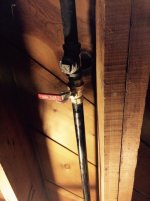
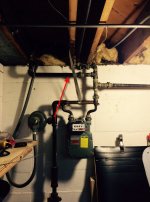
I'm currently doing a project where I'm running a gas line out to my detached garage. I'm not a plumber so it's fairly new to me. I have sized the pipe and looked quite a bit at the codes to make sure I will be able to pass inspection. So far I have the pipe laid in the ground but I don't have any attachments to the garage. (i will have that done soon). I'm just curious to get peoples feedback and to see if anyone can spot any major problems that I have maybe overlooked. I haven't done any pressure tests but I will do that very soon also. In particular I'm curious about if my riser will be ok. Right now it's just a PVC pipe (2") that is encapsulating my 1inch csst pipe. I tapped off the main meter with 1 inch black pipe. Went directly outside, (I put a valve on the new line, a union and also a T inside. Once outside I did another valve, union, and adapter to transition from the black pipe to the Csst. I also haven't painted the black pipe outside yet, but I will. The pictures should spell things out pretty well to show my progress up to this point. Once again, I haven't done any pressure tests, but that will be one of the next things I do. Just looking for feedback or things I have missed or done incorrectly. Thanks.
 

Attachments

  • riser and valve assembly.jpg
    riser and valve assembly.jpg
    153.8 KB · Views: 226
  • New Line off meter.jpg
    New Line off meter.jpg
    93.5 KB · Views: 198
  • 1inch pipe running along floor joists.jpg
    1inch pipe running along floor joists.jpg
    130.8 KB · Views: 183
  • run line outside.jpg
    run line outside.jpg
    157.3 KB · Views: 182
To avoid these ads, REGISTER NOW!
OP
A

arohde

Member
Joined
Aug 31, 2015
Messages
21
Location
Minnesota
Oops, in the picture with the meter, the red arrow is pointed to the NEW line. It runs along side my floor joists and goes outside.
 

Stuff

Well-known member
Joined
Aug 31, 2013
Messages
572
How is the CSST bonded?

Since you have the trench dug, how about adding a network cable?
 
OP
A

arohde

Member
Joined
Aug 31, 2015
Messages
21
Location
Minnesota
I will be adding another leg of electricity and yes, I may do a network cable. At the point it seems stupid not to. Bonded? I have an adapter that you can see in the first picture. The adapter is directly below the union on the black pipe. Otherwise, there are no seams in the Csst underground. Is the adapter what you mean by bonded?
 
OP
A

arohde

Member
Joined
Aug 31, 2015
Messages
21
Location
Minnesota
Ok, Yeah I didn't do that. Is that just for a better seal? I saw something showing grounding at that same intersection (where Iron meets Csst). That they use a clamp and obviously a wire too. Is what you are referring to similar? Or something different?
 

Mike007

Well-known member
Joined
Dec 4, 2010
Messages
2,601
I'm curious why you chose CSST inside of PVC? Did you check if it's code compliant? Ive never seen it done.
 

vekster

Well-known member
Joined
Sep 26, 2013
Messages
405
Location
Ontario, Canada
im not a gas guy, but i was told by a gas guy once you cant use plugs in gas lines.
it may just be Canada but in your tee you have a plug.
i was told it has to be a stub of pipe with a cap on it!
 

The Cobbler

Super Moderator
Staff member
Joined
Oct 24, 2013
Messages
25,873
Location
Niagara Region, Ontario, Canada
Ok, Yeah I didn't do that. Is that just for a better seal? I saw something showing grounding at that same intersection (where Iron meets Csst). That they use a clamp and obviously a wire too. Is what you are referring to similar? Or something different?
the csst is conductive, but the connectors are not because of the rubber seals etc., thus the bonding clamp & wire .
 

sammer

Active member
Joined
Jul 4, 2015
Messages
40
Location
Fernie, B.C.
I would add, you probably need a swing joint between your building and where it comes out from underground.
Frost will heave your gas line and cause damage to your line/house.
Also tracer wire?

sam
 

HoosierBuddy

Well-known member
Joined
May 9, 2006
Messages
2,920
Location
Southern Indiana
Read and understand page 28 and 29 of the instructions regarding bonding. You'll have to run a wire and bond this back to your homes electrical panel.

What's done is done, but I would have used PE gas line.

Phil
 

ishiboo

Well-known member
Joined
Oct 27, 2010
Messages
9,481
Location
Oshkosh, WI
Read and understand page 28 and 29 of the instructions regarding bonding. You'll have to run a wire and bond this back to your homes electrical panel.

What's done is done, but I would have used PE gas line.

Phil

Yeah, PE is the way to go for underground gas distribution. The stab fittings/risers seem to take a lot of the cost advantage away though on short runs.
 

bullnerd

Well-known member
Joined
Sep 17, 2012
Messages
5,690
Location
Jersey
I would add, you probably need a swing joint between your building and where it comes out from underground.
Frost will heave your gas line and cause damage to your line/house.
Also tracer wire?

sam

Can someone show an example of a swing joint?
 
To avoid these ads, REGISTER NOW!

HoosierBuddy

Well-known member
Joined
May 9, 2006
Messages
2,920
Location
Southern Indiana
Yeah, PE is the way to go for underground gas distribution. The stab fittings/risers seem to take a lot of the cost advantage away though on short runs.

If you're doing a lot of it, it's cheaper to get the heat fusion equipment. For 3/4" pipe, I much prefer socket fusion to **** fusion. 3/4" socket couplings are about $1 each in bulk. A McElroy heater and the right plates might set you back $500 or so used. Stab couplings are say $15 ish ...so the heater would pay for itself in 36 fittings m/l.

Phil
 
OP
A

arohde

Member
Joined
Aug 31, 2015
Messages
21
Location
Minnesota
If you're doing a lot of it, it's cheaper to get the heat fusion equipment. For 3/4" pipe, I much prefer socket fusion to **** fusion. 3/4" socket couplings are about $1 each in bulk. A McElroy heater and the right plates might set you back $500 or so used. Stab couplings are say $15 ish ...so the heater would pay for itself in 36 fittings m/l.

Phil

Yeah, realizing that now. Not sure if it would be worth pulling it all up and doing over or not. This was the product they had at Menards. Seemed like the only product they had for underground gas, but I should of looked more.

Seems like it's still an ok solution but I definitely payed too much for it. Not sure how it will go over with the inspector either....

Anyways, hopefully someone will LEARN FROM MY MISTAKES! USE PE NOT CSST!!! If nothing else it will save you the pain of trying to run it through the PVC conduit.
 

Spudland_Dave

Well-known member
Joined
Mar 12, 2010
Messages
3,025
Location
Maine
Nice work....
I'm doing an interior gas line myself right now, REALLY Debated long & hard going with CSST...it would have allowed me to do a much easier install (I'd be done now instead of only 1/2 done :wtf:) . BUT with all the questions and "insecurity" surrounding the Bonding and all the other do's & dont's with CSST...I just said F-It, play it safe...running good ol black pipe from end to end so I can sleep at night. :)

My personal take on the whole CSST thing is while I think its a great product, its still new, too new...still some learning curve with it, and some details need to be firmed up and such. Reminds me of PEX 15+ Years ago...back then plumbers dismissed it as junk for homeowners, etc...today they all prefer it.
 
Last edited:

soj

Well-known member
Joined
Dec 3, 2007
Messages
729
Location
North Georgia
What's done is done, but I would have used PE gas line.

Phil

Yeah, PE is the way to go for underground gas distribution. The stab fittings/risers seem to take a lot of the cost advantage away though on short runs.

Yeah, realizing that now. Not sure if it would be worth pulling it all up and doing over or not. This was the product they had at Menards. Seemed like the only product they had for underground gas, but I should of looked more.

Seems like it's still an ok solution but I definitely payed too much for it. Not sure how it will go over with the inspector either....

Anyways, hopefully someone will LEARN FROM MY MISTAKES! USE PE NOT CSST!!! If nothing else it will save you the pain of trying to run it through the PVC conduit.

I ran almost 200' of PE a couple of years ago. You won't find it at a box store, I got mine from a plumbing supply house. They gave me the names of several plumbers who they knew worked with gas lines. Only one of them had a fusion heater, the others used crimp on fittings that are as expensive as the stab on kind. I dug the trenches, laid the line in and had all the risers and fittings in place and ready to go. The plumber came out and we worked together to do the splices (I held the pipe, he held the heater and the couplings). Three risers and one tee for $100, and he stayed for a pressure test. He offered me a job when we got through, and I gave him the left over pipe.

The crimp on or the stab fittings (three unions and a tee) would have been more than $100. The fusion fittings and the PE pipe are almost as cheep as the dirt in the trench. The risers are a different story.
jp
 

D45

Well-known member
Joined
Mar 21, 2014
Messages
4,834
Location
NW INDIANA
Nice work....
I'm doing an interior gas line myself right now, REALLY Debated long & hard going with CSST...it would have allowed me to do a much easier install (I'd be done now instead of only 1/2 done :wtf:) . BUT with all the questions and "insecurity" surrounding the Bonding and all the other do's & dont's with CSST...I just said F-It, play it safe...running good ol black pipe from end to end so I can sleep at night. :)

My personal take on the whole CSST thing is while I think its a great product, its still new, too new...still some learning curve with it, and some details need to be firmed up and such. Reminds me of PEX 15+ Years ago...back then plumbers dismissed it as junk for homeowners, etc...today they all prefer it.

I also read way too many issues with CSST and said noway am I using that

Can black pipe be used in underground, buried applications??

I need to run about 18 feet of something, just not sure what just yet
 

brewchief

Well-known member
Joined
Sep 20, 2008
Messages
2,370
Location
Michigan
Nice work....
I'm doing an interior gas line myself right now, REALLY Debated long & hard going with CSST...it would have allowed me to do a much easier install (I'd be done now instead of only 1/2 done :wtf:) . BUT with all the questions and "insecurity" surrounding the Bonding and all the other do's & dont's with CSST...I just said F-It, play it safe...running good ol black pipe from end to end so I can sleep at night. :)

My personal take on the whole CSST thing is while I think its a great product, its still new, too new...still some learning curve with it, and some details need to be firmed up and such. Reminds me of PEX 15+ Years ago...back then plumbers dismissed it as junk for homeowners, etc...today they all prefer it.

We have been using CSST for close to 15 years now, like anything there some differences in how you use it but we have had very few problems with it. We see far more leaks in black pipe then CSST.

We still run some black pipe depending on application but CSST saves a lot of labor on many jobs and there are some that would be near impossible with black pipe.
 

Spudland_Dave

Well-known member
Joined
Mar 12, 2010
Messages
3,025
Location
Maine
We have been using CSST for close to 15 years now, like anything there some differences in how you use it but we have had very few problems with it. We see far more leaks in black pipe then CSST.

We still run some black pipe depending on application but CSST saves a lot of labor on many jobs and there are some that would be near impossible with black pipe.

That's good to hear...like I said, I think its a great product, I just didn't feel comfortable enough to run it. Specifically with the bonding requirements. If I knew someone who could have told me in plain English how & where to bond, I think I would have certainly used it.
 

HoosierBuddy

Well-known member
Joined
May 9, 2006
Messages
2,920
Location
Southern Indiana
Answering a couple of questions:

1. The issue with CSST nationally wasn't leaks per se. It was fires after lightning strikes. There were several instances where the CSST became energized by lightning, and due to its thin wall, it burned through. That caused a large gas leak and the hot CSST ignited the escaping gas. Black pipe has many times thicker walls, so this hasn't been a prominent issue. So, after the rash of house fires the industry instituted the bonding requirement. They say that makes it safe. It is approved under the fuel code IF it's installed to the manufacturer's specifications BY a competent person who has been trained for it's usage. One problem though is that too many people are buying it for "one off" jobs and don't read and understand the manual and install it anyway. Heck, I've seen plumbers that supposedly know better install it bonded improperly.

2. Black pipe can be successfully used underground, however it will eventually rust through. In the distant past, lots of natural gas distribution infrastructure was built of bare steel. It can last between 5 and 50 years depending on soil conditions. I don't recommend it. Heck, I hate to ever see underground threads period...but if you insist on doing it just keep one thing in mind. Although it is not intuitively obvious, bare steel lasts much longer than coated, non-cathodically protected steel. So, don't use coated pipe or put blackjack or such on it. If you must use underground steel, just put it in clean dirt and let it rust. See life above.

If you want to make it last forever, you have to use well coated steel AND supply cathodic current to the buried portion with an anode...not something you are likely to do for 18-feet of pipe. I've seen WAY too many people use coated steel underground without cathodic protection and it actually rusts through much faster than bare pipe. BTW...the typical "failure mode" for bare steel operated at "customer pressure" (7-9 inches w/c) is once the pipe pits all the way through, it will fill up with ground water and cease flowing gas.

Phil
 
Last edited:

D45

Well-known member
Joined
Mar 21, 2014
Messages
4,834
Location
NW INDIANA
Will using crushed gravel around the buried black pipe help increase the life?

I just like using black pipe, because it is easy to work with, is easily purchased and can easily be checked for leaks

Per my Lake County Building Department, black pipe is acceptable to be used for underground natural gas applications

As is, no special coating or wrap is needed........black ole black pipe
 
Last edited:

HoosierBuddy

Well-known member
Joined
May 9, 2006
Messages
2,920
Location
Southern Indiana
Will using crushed gravel around the buried black pipe help increase the life?

I just like using black pipe, because it is easy to work with, is easily purchased and can easily be checked for leaks

No. Sand might be a good idea, but crushed limestone (because of the lime) might make it rust faster.

Phil
 

Travo131

Well-known member
Joined
Oct 10, 2010
Messages
151
Location
Tomah,Wisconsin
Hi Everyone,
I'm currently doing a project where I'm running a gas line out to my detached garage. I'm not a plumber so it's fairly new to me. I have sized the pipe and looked quite a bit at the codes to make sure I will be able to pass inspection. So far I have the pipe laid in the ground but I don't have any attachments to the garage. (i will have that done soon). I'm just curious to get peoples feedback and to see if anyone can spot any major problems that I have maybe overlooked. I haven't done any pressure tests but I will do that very soon also. In particular I'm curious about if my riser will be ok. Right now it's just a PVC pipe (2") that is encapsulating my 1inch csst pipe. I tapped off the main meter with 1 inch black pipe. Went directly outside, (I put a valve on the new line, a union and also a T inside. Once outside I did another valve, union, and adapter to transition from the black pipe to the Csst. I also haven't painted the black pipe outside yet, but I will. The pictures should spell things out pretty well to show my progress up to this point. Once again, I haven't done any pressure tests, but that will be one of the next things I do. Just looking for feedback or things I have missed or done incorrectly. Thanks.

I work in the Lp industry so some things maybe a little different but look up x risers I will post a link to the training videos. I have never called it csst we call It poly tubing. Call your local coop and see if they will sell you 2 risers. You could just come off your black pipe with a 1/2 inch female flare fitting and tighten your riser right on. feel free to pm me if you have and questions.


CNGsaves

Well-known member
Joined
Sep 26, 2012
Messages
13,233
Location
KS and OK
I work in the Lp industry so some things maybe a little different but look up x risers I will post a link to the training videos. I have never called it csst we call It poly tubing. Call your local coop and see if they will sell you 2 risers. You could just come off your black pipe with a 1/2 inch female flare fitting and tighten your riser right on. feel free to pm me if you have and questions.


^ ^ ^ You're mixing apples with oranges. Your X Riser above is the newest method and PROPER method using yellow plastic polyethylene pipe with risers on each end to protect the pipe as it comes out of ground.

CSST is totally different animal . . . corrugated stainless steel tubing
It's basically a long flex pipe. As plumbing guru's above have noted, it's STEEL so not good idea for outdoor buried solution (even with bonding/ground) . . or indoor for that matter when improperly bonded/grounded or location has lots of lightning risk. See burned home from CSST:

That X Riser setup looks pretty simple as the protective outer covering is integrated with the "stab lock" connector. However, it requires that the yellow PE pipe be bent as it comes out of ground which is hard to do. The L risers are much better and more flexible.

Here is video of typical Stab Lock connector that connects yellow PE plastic pipe with the steel riser . . . this company calls it "ConStab" but it's same general idea to use Stab Lock connector between pipe and riser.

Plumbers and contractors who do yellow plastic PE pipe connections freqently often have a FUSE machine that actually melts the yellow plastic PE pipe in the connection to the riser.

To RECAP . . . 3 current mainstream methods of LPG/NG buried pipe
a) yellow plastic PE pipe FUSED between pipe and riser (contractor / plumber)
b) STAB LOCK connection between yellow plastic PE pipe and riser
c) X RISER which is variation of Stab Lock connection
 
Last edited:

CNGsaves

Well-known member
Joined
Sep 26, 2012
Messages
13,233
Location
KS and OK
Swing joint...


sam

Great solution for wicked cold climates (ie Canada) with lots of frost heave.

Around midwest USA, I've not seen those used however.

Curious if northern USA or east coast USA have requirement to use these swing joints for buried gas lines??
 
To avoid these ads, REGISTER NOW!
Top Bottom