To avoid these ads, REGISTER NOW!

My plumbing question

txusa03

Well-known member
Joined
Sep 16, 2011
Messages
479
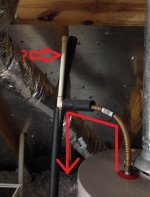
I have a water heater in my attic. When I look at the cold inlet and hot outlet, I see the plumber added an extra 2 feet in the pipe and capped it off. What is the reason for doing that? Is it to make future expansion easier or is it more technical?

If I was to move this unit to another area, do I need to replicate that type of pipe and add that extra pipe and cap it off? "?" mark in my photos.

TIA
 

Attachments

  • water1.jpg
    water1.jpg
    59.4 KB · Views: 262
  • water2.JPG
    water2.JPG
    107.5 KB · Views: 252
Last edited:
To avoid these ads, REGISTER NOW!
OP
T

txusa03

Well-known member
Joined
Sep 16, 2011
Messages
479
Thanks for your inputs and knowledge! I googled hammer arrestor since I have no clue. So it is just a chamber of air to help reduce water hammer, got it now. It should be clamp to a sturdy or solid object, no?
 

flat350

Well-known member
Joined
Jan 1, 2009
Messages
1,006
Location
illinois
I'd be more concerned about the corrugated connector,you may find that they sometimes don't last all that long.
If you want it done right hard pipe it in copper from the tank to the plastic,there's other things that I would add to the install but you'd be looking at repiping all of it do do that.
 
Last edited:

rluckie

Member
Joined
Sep 22, 2013
Messages
17
Location
Texas
Thanks for your inputs and knowledge! I googled hammer arrestor since I have no clue. So it is just a chamber of air to help reduce water hammer, got it now. It should be clamp to a sturdy or solid object, no?
I have never clamped them to a solid object.
 

kbs2244

Well-known member
Joined
Nov 11, 2006
Messages
14,065
Don't clamp it.
It needs to shake when hammer occurs.
If you clamp it you will be getting the vibration it was installed to isolate.

I would guess it is 2 feet long because that is what he had left over from the install.
It is hard to make them too big.
 
OP
T

txusa03

Well-known member
Joined
Sep 16, 2011
Messages
479
I'd be more concerned about the corrugated connector,you may find that they sometimes don't last all that long.
If you want it done right hard pipe it in copper from the tank to the plastic,there's other things that I would add to the install but you'd be looking at repiping all of it do do that.

Thank you for the warning. Messing with water is really not my fav task. Sweating copper is another task I have never done.

Regarding the length of the arrestor, I was just guessing the length.
 

Norcal

Well-known member
Joined
Mar 16, 2008
Messages
13,753
I'd be more concerned about the corrugated connector,you may find that they sometimes don't last all that long.
If you want it done right hard pipe it in copper from the tank to the plastic,there's other things that I would add to the install but you'd be looking at repiping all of it do do that.

Those waterflex connectors work quite well, & have a good record but not insulating them in a cold zone is asking for trouble, but hard copper does not fare well in freezing weather either.
 

Daedalus

Well-known member
Joined
Sep 28, 2009
Messages
5,991
Don't clamp it.
It needs to shake when hammer occurs.
If you clamp it you will be getting the vibration it was installed to isolate.

I would guess it is 2 feet long because that is what he had left over from the install.
It is hard to make them too big.
Not sure I agree with that. The arrestor is supposed to prevent the vibrations in the first place by offering up a compressible air chamber that will damp them out. I wouldn't want the pipes moving and causing cycle fatigue.

I leave a couple feet of pipe or more too if I have the room. Might be overkill, but remember that the extra length of pipe will be maybe 80% full of water just from the water pressure alone, at 60psi, so only 4 or 5" left of compressed air. The short 6" arrestors you can buy are fine and have a built in piston and I'm guessing a higher damping value than just an air cavity, which allows them to be that short.

Sweating copper has a bit of a learning curve to develop the knack for knowing where to heat and for how long, especially on the Tees. I think half of the first handful of joints I sweated in my 1st house leaked, but every joint since has been fine.
 

kbs2244

Well-known member
Joined
Nov 11, 2006
Messages
14,065
If you feel you have to clamp it, O K
But put the insulating foam on it and clamp lightly through it.
 
To avoid these ads, REGISTER NOW!

Firebrick43

Well-known member
Joined
May 12, 2015
Messages
14,022
Location
West central Indiana
Those home brew arrestors are really worthless. Without a schrader valve and constant recharging they become water logged and who's going to get into the attic every month or so to do that? The piston and bladder styles are much better
 

mygarageone

Well-known member
Joined
Oct 16, 2013
Messages
2,691
Location
Munising , Mich
Those home brew arrestors are really worthless. Without a schrader valve and constant recharging they become water logged and who's going to get into the attic every month or so to do that? The piston and bladder styles are much better


Exactly . State code no longer approves them .
 

Daedalus

Well-known member
Joined
Sep 28, 2009
Messages
5,991
If a capped vertical copper pipe is getting water logged then someone did a poor job and needs to go back and fix the leak. If the pipe is air tight then the air has nowhere to go, and it will always work, unlike seals and bladders, which do wear out. Of which, arrestors typically have one or the other, but not both.

Rest assured, if there's money to be made selling a product, the "codes" will try to find a way to require them. The people behind the codes are industry "experts" who never left the industry; i.e. they have a vested interest in seeing requirements get more and more onerous. And they lobby the **** out of municipalities to get them to adopt the codes.

I wish I could find the link, but I was surfing the local building codes one day and came across a letter from an executive at an electrical manufacturer, imploring the county code commissioner to adopt the latest codes, particularly the parts requiring AFCI breakers. And yes, those little Fbombs are required here, and add probably $1000 to the cost of every home built or remodeled.
 

Firebrick43

Well-known member
Joined
May 12, 2015
Messages
14,022
Location
West central Indiana
If a capped vertical copper pipe is getting water logged then someone did a poor job and needs to go back and fix the leak. If the pipe is air tight then the air has nowhere to go, and it will always work, unlike seals and bladders, which do wear out. Of which, arrestors typically have one or the other, but not both.

Rest assured, if there's money to be made selling a product, the "codes" will try to find a way to require them. The people behind the codes are industry "experts" who never left the industry; i.e. they have a vested interest in seeing requirements get more and more onerous. And they lobby the **** out of municipalities to get them to adopt the codes.

I wish I could find the link, but I was surfing the local building codes one day and came across a letter from an executive at an electrical manufacturer, imploring the county code commissioner to adopt the latest codes, particularly the parts requiring AFCI breakers. And yes, those little Fbombs are required here, and add probably $1000 to the cost of every home built or remodeled.

Umm, you do realize air is soluble in water right? Over time is absorbed and transported away. No need to have a leak and become water logged.
 

kbs2244

Well-known member
Joined
Nov 11, 2006
Messages
14,065
You get the same argument about well water storage tanks.
All the new ones have rubber bladders in them.
Before bladders there were "sniffers" that bled air into the tank.
I lived 30 years in a house with out either and with out any problems.

In this case it is at the high point of only the hot water side and is oversized.
It seems it has been problem free for years.

To he OP
If you move it, you can replicate it or modernize it.
Your choice..
 

6768rogues

Banned
Joined
Nov 28, 2007
Messages
4,524
Location
Western NY
Probably is a water hammer arrestor, to help prevent banging in the pipes when you shut off a faucet.

My thought exactly. The air will eventually be dissolved in water but being at the high point, any air dissolved in the water will tend to migrate up there.
 
Last edited:

Yamaguy

Well-known member
Joined
Apr 13, 2013
Messages
188
Location
Southwest Chicagoland
Those are house chambers (whole house water hammer arrestors) Usually 24" tall and installed on the highest floor of the system. You do not want any pipe to be able to move as this can cause fatigue, the air is all shock absorption needed. All air chambers will become waterlogged, they suggest you drain the system once a year to let them recharge. I think Illinois plumbing code no longer requires them, but I could be wrong. What state do you live in?
 
Last edited:

Moto

Well-known member
Joined
Dec 9, 2007
Messages
153
Rest assured, if there's money to be made selling a product, the "codes" will try to find a way to require them. The people behind the codes are industry "experts" who never left the industry; i.e. they have a vested interest in seeing requirements get more and more onerous. And they lobby the **** out of municipalities to get them to adopt the codes.

Oh yes, nowadays you need to have an expansion tank installed along side your water heater. That's to provide for cold water expanding when heated.

How did we ever manage before? Well, there wasn't a problem before we were required to have backflow preventers on the water main connection.

chaching chaching! Two-for-one special for the plumbing industry! :lol_hitti
 
OP
T

txusa03

Well-known member
Joined
Sep 16, 2011
Messages
479
Those are house chambers (whole house water hammer arrestors) Usually 24" tall and installed on the highest floor of the system. You do not want any pipe to be able to move as this can cause fatigue, the air is all shock absorption needed. All air chambers will become waterlogged, they suggest you drain the system once a year to let them recharge. I think Illinois plumbing code no longer requires them, but I could be wrong. What state do you live in?

Southeast Texas.
 
To avoid these ads, REGISTER NOW!
Top Bottom