Private Lugnutz
Well-known member
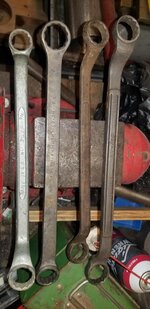
Nice set! (All the GMTK guys just clicked to expand the photo hoping to see a 3/4" end instead of an 11/16" end on the largest one!  )
)
) )
)Nice set! (All the GMTK guys just clicked to expand the photo hoping to see a 3/4" end instead of an 11/16" end on the largest one!


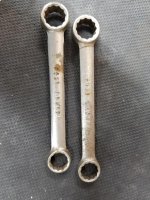
That is a crazy special purpose wrench. I assume when they didn't forge it to that shape but bent it afterwards. The jigging and thought behind making that is impressive.I just completed a long-distance trade with a Canadian GJ member who shall remain as nameless as he wants to be, and, knowing my affection for weird stuff and wartime stuff, threw in this double-whammy DBE wrench for good measure. It was quite a cool surprise.
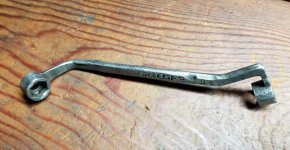
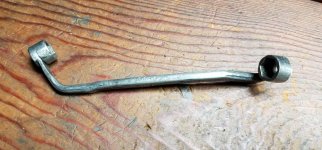
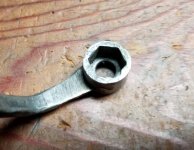
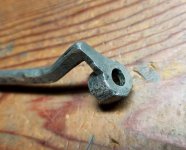
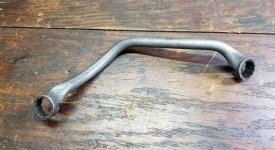
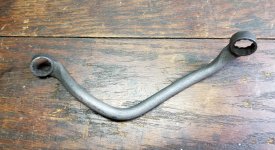
As you can see, that end with the Joe Theismann/Alex Smith/Dak Prescott-looking offset is actually double orthogonal, bent 180*, in parallel with the edge of the shank, with the service opening (3/8" hex) facing backwards. So it must have been used to get at something sunken behind a thin obstruction, like a sheath or guard, either by reaching it over from above or underneath. It has a small through hole. Typically with these kinds of twisters, like something in an aircraft engine compartment that is hard to reach.
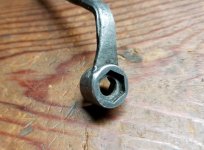
The other end is angled from the shank, not offset, at 45*, and it is bent in line with the flat of the shank. It also has a 3/8" hex service opening, and a through hole, with a much shallower 3/8" hex opening on the back side.
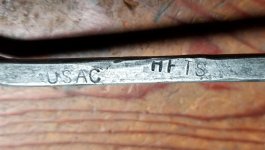
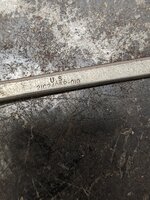
The wrench is marked with the opening sizes ("3/8"), what appears to be a part number ("5CB848") and what appears to be a logo. An "F" inside a triangle, like so: /F\.
On the flip side it's marked "USAC" (almost certainly United States Air Corp) and what may be either "AFTS" or "HFTS". Until research proves otherwise, I am going with HFTS and Helicopter Flight Training School.
Yeah, you can see a thin line on both ends.Interesting how the hex was added on so the nut could be captured.
I'm not sure what it started as originally, but the 6-point cups or "sockets" were not forged when the shank was forged, they were added, as Outlaw alluded to, and I'm not sure if that was bent or welded on like that. I haven't been able to make any headway on that part number, but I doubt it came out of the factory like that. It just looks and feels like a shop mod.That is a crazy special purpose wrench. I assume when they didn't forge it to that shape but bent it afterwards. The jigging and thought behind making that is impressive.

I love it. Helicopter Flight Training School could be a stretch. But I can't come up with another logical match for that acronym. The Army trains helicopter pilots at Ft Rucker now. During WWII I have a feeling it may have been at Wright Field in Dayton. That's where the first military helicopter of any kind, the XR-4, was flown from the Sikorsky plant in Connecticut in January 1941. Operations with helicopters were very limited and didn't start until very late in the war. In between, as more were being built, I can imaging anything to do with such as a nascent technology as the helicopter being centralized right there. But I plan to do more reading when I have time.I’m glad you like I think it is HTFS but I never could think what it stood for
I just completed a long-distance trade with a Canadian GJ member who shall remain as nameless as he wants to be, and, knowing my affection for weird stuff and wartime stuff, threw in this double-whammy DBE wrench for good measure. It was quite a cool surprise.
As you can see, that end with the Joe Theismann/Alex Smith/Dak Prescott-looking offset is actually double orthogonal, bent 180*, in parallel with the edge of the shank, with the service opening (3/8" hex) facing backwards. So it must have been used to get at something sunken behind a thin obstruction, like a sheath or guard, either by reaching it over from above or underneath. It has a small through hole. Typically with these kinds of twisters, like something in an aircraft engine compartment that is hard to reach.
The other end is angled from the shank, not offset, at 45*, and it is bent in line with the flat of the shank. It also has a 3/8" hex service opening, and a through hole, with a much shallower 3/8" hex opening on the back side.
The wrench is marked with the opening sizes ("3/8"), what appears to be a part number ("5CB848") and what appears to be a logo. An "F" inside a triangle, like so: /F\.
On the flip side it's marked "USAC" (almost certainly United States Air Corp) and what may be either "AFTS" or "HFTS". Until research proves otherwise, I am going with HFTS and Helicopter Flight Training School.
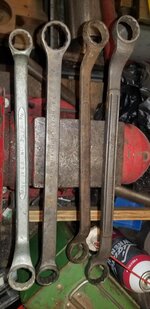
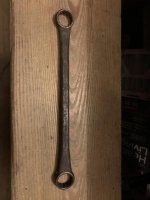
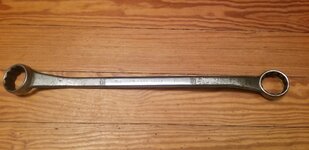


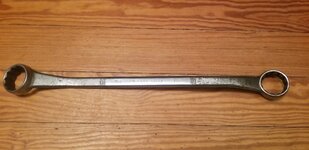
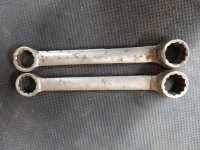
They were almost certainly made by the Gray-Bonney Tool Company, Ltd. (1933-1961), probably for a retailer such as an auto parts store, hence unbranded. Look late 40's or 50's to me.So, are these Canadian Bonney made or perhaps from another manufacturer under license? I had previously assumed they were made by Gray Canada but now not so sure.
Battery terminal wrenches are for the clamps that connect the battery posts.
Private [url said:https://www.garagejournal.com/forum/newreply.php?do=postreply&t=304752[/url] were almost certainly made by the Gray-Bonney Tool Company, Ltd. (1933-1961), probably for a retailer such as an auto parts store, hence unbranded. Look late 40's or 50's to me.
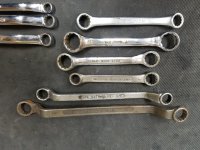
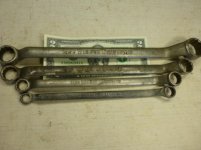
X,Based on a recent Plomb thread tangent ref. NAF tools I was motivated to pull out some DBE's.
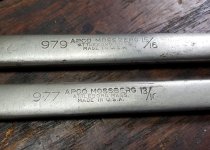
I found his APCO-Mossberg No. 977 13/16" twin hex single offset DBE at the flea market on Friday. Found my first one - a No. 979 15/16" back in 2019 (see post #2414 on page 121). There are nine (9) wrenches in the No. 970 set, from No. 971 (7/16") to No. 979 (15/16"). By my calculations, if I am onesy-twoseying my way into completing a complete set by finding one every other year, it will be the year 2035 when I am done, and I will be 75 years old!
* Check out BlueBomber's near-complete set in its case in post #1983 on page 100.
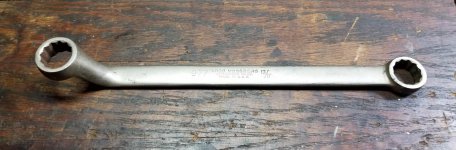
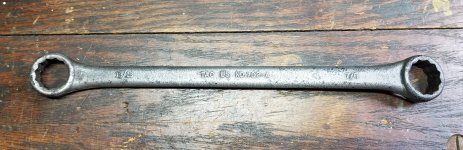
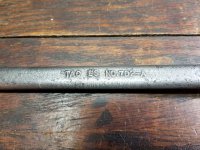
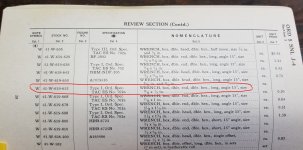
I picked up this wrench at the flea market this morning. TAC is an acronym for Tank-Automotive Center, which was established by the Ordnance Dept in Detroit after they assumed responsibility for all tracked and wheeled vehicles in 1943 from the QMC, which operated out of Camp Holabird in Baltimore, MD. ES is an acronym for Engineering Specification. See Pic 5 for the wrench's entry in the 1945 ORD 5 SNL J-4 catalog, which cites TAC ES No. 702a as the spec.
Haha. Normally I would take the self-deprecating or at least more modest approach on a question like this, but if only to accentuate the larger 'Picker's' point you are implying - the latter.Did all WWII surplus end up around one particular flea market in New Jersey or is this just your keenly calibrated eye picking the wartime wheat from the endless piles of non-WWII chaff?
First I have seen as well. I have searched the numbers over and over and nothing turns up. Even under KAYLOCK you don't get any wrenches. I find it strange that its got a Registered Trade mark symbol. The USPTO site doesn't show anything in a search for KAYLOCK. I'm not the best researcher by far, but doesn't make sense there's nothing out there on this. I noticed the broached ends seem to have that different pattern that looks more like a wheel lock for a automotive wheel than the regular pattern I usually see in wrenches.I've never heard of that name and I don't recognize even the format of those numbers, but I agree, they smack of military.
Maybe that's where the name comes from.I noticed the broached ends seem to have that different pattern that looks more like a wheel lock for a automotive wheel than the regular pattern I usually see in wrenches.