To avoid these ads, REGISTER NOW!

Mystery Champion Compressor

Kevski

Well-known member
Joined
Apr 19, 2010
Messages
62
Location
Seattle
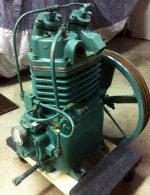
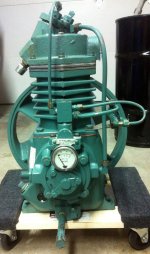
Guys, this one has me stumped. I've rebuilt my fair share of Champion air compressor pumps, but have never seen anything like this. Was told it came from a building that was torn down. The model number on the tank is HR3-6, so it should have had an R15B pump... except it didn't.

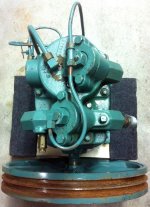
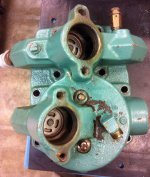
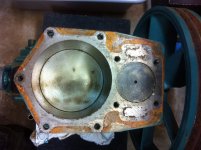
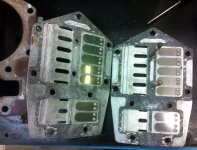
The pump in question appears to have the pressure-lubricated bottom end from a PL15 (less the spin-on oil filter), and the cylinder from a Centurion pump... but the head has a reed valve plate, two disc valves, and what looks like a pilot-pressure regulation system with pneumatically operated head unloaders.

Based on the S/N plate, (assuming it follows the same format Champion uses for other pumps), this is an HP15... which, as far as I can see, doesn't actually exist. Any ideas?
 

Attachments

  • IMG_4569.jpg
    IMG_4569.jpg
    144.4 KB · Views: 60
  • IMG_4570.jpg
    IMG_4570.jpg
    117.2 KB · Views: 57
  • IMG_4571.jpg
    IMG_4571.jpg
    114.8 KB · Views: 52
  • IMG_4572.jpg
    IMG_4572.jpg
    137.4 KB · Views: 55
  • IMG_4573.jpg
    IMG_4573.jpg
    143.1 KB · Views: 46
To avoid these ads, REGISTER NOW!

Bob C

Well-known member
Joined
Jul 17, 2012
Messages
572
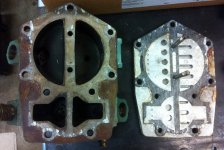
I'd like to tear that head off and have a close look at the valve plate. I've never had a champion apart that has FLAT pistons. It looks like a QUINCY pump painted green.
 

Trey T

Well-known member
Joined
Aug 3, 2011
Messages
3,749
Location
Houston, TX
Why do you say it has reed valve plate and discs valves? Shouldn't it be one or the other?

Regardless, any pressured lubricated is an awesome pump. What's the pulley size?
 
OP
K

Kevski

Well-known member
Joined
Apr 19, 2010
Messages
62
Location
Seattle
Indeed, it looks something like a Quincy, especially the valves and lines on the head; though an inspection of the crankcase shows it to be nearly the same as an R15. Flywheel (16.5") is also the same as an R15.

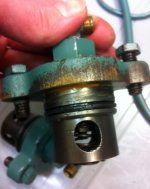
Valves should be one or the other... upon removing the head, it's clear what is going on. The compressor uses reed valves for basic operation; the disc valves are opened not by pressure directly, but rather by a piston and fork assembly (the units on top of the head with lines connected to them), which are actuated by pilot pressure from an external source. When actuated, the disc valves port pressure from the exhaust to the intake chamber of each cylinder, reducing the pressure ratio. I assume this is done to control the compressor discharge pressure directly, rather than letting the pressure switch shut the motor off at a set value.

So we know how it works... just need to figure out how fast to turn it, and find some reed plate gaskets. And it would be nice to find out exactly what it was used for.
 

Attachments

  • IMG_4592.jpg
    IMG_4592.jpg
    111.2 KB · Views: 24
  • IMG_4589.jpg
    IMG_4589.jpg
    144.5 KB · Views: 25
  • IMG_4587.jpg
    IMG_4587.jpg
    132.4 KB · Views: 24
  • IMG_4581.jpg
    IMG_4581.jpg
    131 KB · Views: 25
  • IMG_4593.jpg
    IMG_4593.jpg
    131.3 KB · Views: 25
To avoid these ads, REGISTER NOW!

Bob C

Well-known member
Joined
Jul 17, 2012
Messages
572
The assemblies on the top are called "Unloaders" this unit was designed for start/stop or continuous run operations. The only outside item you need for continuous run ability is an "OX Valve" or "Load Genie". The other function these unloader perform is to unload the head pressure when the unit shuts down. That way, your electric motor does not have to GRUNT as hard to get the pump up to speed when air is called for. The process for unloading during start/stop as shown in your picture functions exactly the same as a Quincy or LeRoi pump does that is pressure lubed. I can explain but out of time this morning. Will post more if you havent found out later today.
 
OP
K

Kevski

Well-known member
Joined
Apr 19, 2010
Messages
62
Location
Seattle
Thanks for the info, Bob. I had forgotten about the unloading function at start-up... there's an oil pressure actuated valve above the pressure gauge connected to the head unloaders, but I didn't think too much about it...
 
To avoid these ads, REGISTER NOW!
Top Bottom