To avoid these ads, REGISTER NOW!

Mystery Combination Tool

Provincial

Well-known member
Joined
Sep 21, 2011
Messages
6,874
Location
Near Salem, OR
Tool 1.jpg
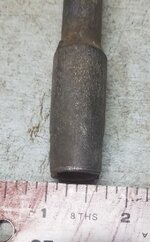
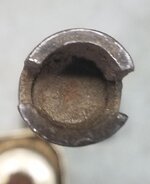
It is a wrench of the style popular in the 1920's, except that one end of the handle has a slotted tube welded to it. The "socket" end is 12 point, 13/16" and is about 2-1/8" tall overall. The handle is 1/2" diameter and the tool is about 10-1/2" long overall. The slotted tube end is 17/32" outside diameter, and 15/32" inside diameter, with a 1/4" wide slot that is 1/2" deep.

It seems to me that this tool is designed to work on something that has a 13/16" hex head, and also to fit on a wing fastener, petcock, or valve with a shaft 7/16" or less and a 3/16" or smaller cross pin. For this, it seems like a particular application.

I can find no markings anywhere on the tool. The finish has some black color, but there is also a deteriorated zinc or cadmium plating. The handle has been tweaked, and I'm sure it was originally straight.

Tool 2.jpgTool 3.jpgTool 4.jpgTool 5.jpgTool 6.jpg
 
To avoid these ads, REGISTER NOW!
OP
P

Provincial

Well-known member
Joined
Sep 21, 2011
Messages
6,874
Location
Near Salem, OR
I like the jack/lug wrench idea, but don't think it is home-made. The "socket" is solid on the closed end, and shows no sign of being modified. It is built just like the Walden tools of the 1920's.

The fork end has two well-done welds holding the fork tube to the solid bar handle. Perhaps someone modified an earlier tool by substituting the fork for a "socket" that was on that end. The problem with this theory is that there are no markings on the tool anywhere. Those 1920's tools were always marked, usually on the shaft.
 
To avoid these ads, REGISTER NOW!

Ricky Joe

Well-known member
Joined
Sep 15, 2013
Messages
2,452
Location
Roanoke, Va.
I like the jack/lug wrench idea, but don't think it is home-made. The "socket" is solid on the closed end, and shows no sign of being modified. It is built just like the Walden tools of the 1920's.

The fork end has two well-done welds holding the fork tube to the solid bar handle. Perhaps someone modified an earlier tool by substituting the fork for a "socket" that was on that end. The problem with this theory is that there are no markings on the tool anywhere. Those 1920's tools were always marked, usually on the shaft.
I disagree. They were often unmarked.
 

Private Lugnutz

Well-known member
Joined
Mar 30, 2012
Messages
30,675
Location
The Authentic Jersey Shore
I think the 12-point opening is kind of odd to begin with. I probably have a good dozen or so of these early hammer head type socket wrenches, single end ("peace pipes") and double-end (some having three and four openings), from Walden, Blackhawk, and Indestro, and I think they are all hex/6-point openings. I'd have to double-check.
 
OP
P

Provincial

Well-known member
Joined
Sep 21, 2011
Messages
6,874
Location
Near Salem, OR
After some thought about the lug wrench idea, I'm leaning against it. The amount of offset of the handle isn't large enough to clear a front hub or the rear hub of a floating axle.

The socket opening is sized for USS or American Standard 9/16" cap screws, or American Standard and Manufacturer's Standard 1/2" nuts. That size hex was common on lug nuts.

I do like the idea of it being a specialized tool. I am also thinking it could be later than the heyday of the "tomahawk" wrench. I agree that the 12-pt. opening is unusual, and that is one reason I think it could be later.
 
To avoid these ads, REGISTER NOW!
Top Bottom