To avoid these ads, REGISTER NOW!

Mystery Drywall Material...? Need help identifying please!

Model A Fan

Well-known member
Joined
Dec 1, 2011
Messages
1,223
Location
NW Washington
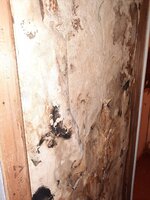
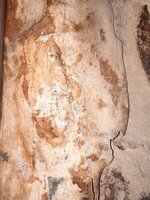
I have a room in my house that prior to me buying it apparently had a leak issue with the chimney flashing. Someone had paneled the entire upstairs in faux wood panels but behind the panels that surround the chimney there is what appears to be deteriorated drywall. I am renovating this room and need to address this stuff but I don't know what it is and before I tear into it, I want to know it's not asbestos. If it is, that opens a whole new can of worms.

Looking at the photos, is there any way to tell what this may be? The chimney flashing had a leak and it left black mold at the ceiling, so I'm assuming it is just "rotten" drywall. It appears to be sandy in texture or something, I'm not really sure. 20221008_201539.jpg20221008_201533.jpg20221008_201544.jpg20221008_201555.jpg20221008_201601.jpg20221008_201616.jpg20221008_201635.jpg20221008_201608.jpg
 
To avoid these ads, REGISTER NOW!

dogdog

Well-known member
Joined
Nov 15, 2011
Messages
12,711
Not sure about the asbestos part, but that looks like the plaster sand and type n mix from the old plaster lath days. Even if yours is wood boards instead of lath.
 

nolimits76

Well-known member
Joined
Jul 11, 2013
Messages
959
Location
Oklahoma
That stuff looks nasty. Sorry! It's pretty wreckless for people to just cover up a water leak w/o properly fixing the issue. :mad:

What year was the home built? Also did the prior homeowners disclose any repairs/remodels in their disclosures? How long ago did you purchase? What are statue of limitations where you live? When you have more info it may be worth talking with your real estate agent or a real estate attorney. I am thinking someone may be responsible for not disclosing this information. At the very least you have a mold problem.

I'm also thinking plaster and would echo the thoughts to test for asbestos. Make sure to use appropriate gear and close off this room so it doesn't create further contamination.
 
OP
M

Model A Fan

Well-known member
Joined
Dec 1, 2011
Messages
1,223
Location
NW Washington
I would guess that material is plaster. If in fact it is plaster is very likely it will contain asbestos. Get it tested before removal. You may require special disposal.
It's sitting exposed but I have done nothing to disturb it. I figure as long as no one disturbs it, it won't release fibers.
Not sure about the asbestos part, but that looks like the plaster sand and type n mix from the old plaster lath days. Even if yours is wood boards instead of lath.
The stuff was covered up by wood panels (1980s style pressed thin plywood with faux woodgrain).
That stuff looks nasty. Sorry! It's pretty wreckless for people to just cover up a water leak w/o properly fixing the issue. :mad:

What year was the home built? Also did the prior homeowners disclose any repairs/remodels in their disclosures? How long ago did you purchase? What are statue of limitations where you live? When you have more info it may be worth talking with your real estate agent or a real estate attorney. I am thinking someone may be responsible for not disclosing this information. At the very least you have a mold problem.

I'm also thinking plaster and would echo the thoughts to test for asbestos. Make sure to use appropriate gear and close off this room so it doesn't create further contamination.
I bought four years ago and the house was built in 1905. It's undergone several iterations of renovation over the years. It's frustrating because as I scratch the surface on each project, it becomes a larger project just to get it back to where it should have been. I think/assume the leak occurred after the paneling went up. Just judging by how it looks after the fact. The black mold at the top was exposed when I pulled some cheesy *** trim off that they used to cover the drywall joints instead of taping and mudding. They used 3x1 boards to look like "tudor" style trim.

Frankly I wish I never bought the place and wish I could go back in time and pass over this place. :cry:😞
 
To avoid these ads, REGISTER NOW!

dogdog

Well-known member
Joined
Nov 15, 2011
Messages
12,711
The stuff was covered up by wood panels (1980s style pressed thin plywood with faux woodgrain).
It’s probably fine, I have removed 8 truck load of these plaster And lath and replaced with dry wall. Ymmv of cause.. and I have patch these as well, which is the mix of plaster, type n cement, and sand. That is what I used.

Removing is easy I just used a flat crowbar and scrape it off the wood, with the exception where some repair was using chicken wires or mesh . That is just pita.

I got those 8” round ventilators and a soft duct to **** the dust out side. It was a hf thing now they discontinued it. Only Amazon have them.
 

nolimits76

Well-known member
Joined
Jul 11, 2013
Messages
959
Location
Oklahoma
During bridge removals, we sometimes have to remove asbestos based paint. It's not overly hard, it's just a tedious process. Right personal protective equipment. Sanders with HEPA vacuums. Proper containment. Paper work trail showing proper handling and disposal at an approved waste site. Landfill & hazardous waste disposal fees.

Of course, a bridge is a far cry from a home. Closest I got to that was a multi-story condo site. Installed drywall had gotten wet and had started developing mold. Complete removal of the sheetrock, PPE and disposal was required. Mold was minor and we was able to Kilz over the studs. Again, not hard work but tedious and scrutinized by all the involved parties.

Assuming your asbestos test comes back negative, I'd get some PPE and get the mold removed & disposed of as quickly as possible. Once you get the studs exposed you can make a determination how bad and far reaching it actually got and what steps you will have to take to remedy the situation. You may require some reframing depending on severity. I personally don't like the Kilz approach and would replace the affected framing in my own home if it was reasonably doable.

I am not familiar with the removal & disposal requirements for your location. You should investigate to ensure you do it right so it doesn't fall on you later. By chance, does your insurance policy have a rider for any such things? I seem to recall mine having something along this lines but I'd need to read the fine print.

In regards to your bigger problem -- a 1905 home is awesome in many ways. However, its 117 years old and has seen some wear & tear. Plus standards and codes have changed. It wouldn't surprise me that each time you do more than a simple cosmetic repair that you open a can of worms of some magnitude. Over that span of time you get a variety of homeowners with various budgets, skill levels and different mentalities about repairs. With home prices up, one solution might be to make these repairs and then get the house ready to sell and then repurchase a newer/different home.
 

dogdog

Well-known member
Joined
Nov 15, 2011
Messages
12,711
I would worry about those black spots also... as if it is some sort of black mold.

don't be cheap and probably needed to treat them with some mold armor (spray) , Concorbium and a cold fogger before demo. and fog the whole home after demo (yes they work) .
 

billconner

Well-known member
Joined
Jul 20, 2021
Messages
6,971
Location
Thousand Islands NYS
1905 I'd be pretty sure it was plaster. At the chimney, no lath, just troweled onto the bricks. I left bricks exposed in a pantry (a 1905 house also!)

I recommend saving as much of the plaster walls (not around chimney) as it's usually better looking than drywall and provides a lot of acoustical isolation compared to drywall. Plaster washers, injecting glue, and other techniques. Much less work and money.
 
OP
M

Model A Fan

Well-known member
Joined
Dec 1, 2011
Messages
1,223
Location
NW Washington
So I sent a sample to the testing facility for asbestos...NO ASBESTOS FOUND! So, I was greatly relieved. I tore all the old plaster off down to the bricks, cleaned it up, and then put foam panels up over the brick (it was not as pretty as I had hoped) and framed it with 2x4s. The mold was only surface mold, the wood above the drywall was stained but not rotten or molding thankfully. I'll have to post some photos later of how it looks now. I wired in a new switch for the lighting. The rest of the project involves new drywall, trim, fixtures, and flooring.

Thank you guys for the help on this!
 
To avoid these ads, REGISTER NOW!
Top Bottom