To avoid these ads, REGISTER NOW!

Nail gun for flooring and general use.

Kkmk

Active member
Joined
Dec 26, 2023
Messages
41
Hi All.

I’m chasing some knowledgw of nail guns. Specific project in mind is re-nailing the floorboars down in my house to stop squeaks. 20mm baltic pine boards into hardwood joists.

My builder recommends 40mm ring shanks in 2 or 2.5 diameter.

It would be handy to have a gun that is relatively useful for other wood joining stuff in future, nothing in particular. My existing gun is a hilti powder actuated DX. Not ideal.

What type of gun should I be looking for? Framer? Finisher? Coil?

I’m in Australia and have Ryobi 18v tools and Milwaukee 12v but an 18v charger as well. No compressor but am open to the option depending on cost.
 
To avoid these ads, REGISTER NOW!

dogdog

Well-known member
Joined
Nov 15, 2011
Messages
12,711
I used screw if I find joist... so far so good. like those #10 or #9 Torx construction / decking screws. not black drywall screws.

or a framing nailer with 3" full head nails.. dependents... at least here some local laws requires full head nails some don't care... but the framing nailer is full head or half (clipped head)... not interchangeable.

Both method I have used. no issues. if I have ripped down subfloor to joist... I also used construction glue... along with screws.
 
OP
K

Kkmk

Active member
Joined
Dec 26, 2023
Messages
41
Should have said exposed polished floorboards so less hole filling the better.
 

cgrutt

Well-known member
Joined
Mar 4, 2016
Messages
8,430
Is this a rustic house and do you want decorative nail heads exposed or are you filling or plugging and refinishing floors? How wide is the flooring? Is it being nailed into joists or subflooring?

Screwing with trim screws may best option to minimize squeaking. Traditional cut nails will look best if you are going for decorative look. There are also hardened flooring nails with small heads that can be set below surface and filled. Unfortunately this is a hand nailing job and you may need to predrill flooring to prevent splitting. Iron or steel can leave rust stains. See here

If you decide to use gun keep in mind some nails are not full round head if appearance matters, wire collated nails can leave wire protruding above surface which is obviously not good for flooring and larger coil/framing guns can leave splinters protruding above surface. I sometimes use a 15 ga finish nail gun to face nail along walls but more often than not pre-drill and nail by hand.
 
Last edited:
OP
K

Kkmk

Active member
Joined
Dec 26, 2023
Messages
41
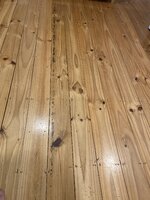
130mm wide boards. Directly onto joists. Some existing nails just arent tight any more after 70 odd years of movement and recent restumping. I just want to pound some fresh ones in, punch them below flush amd fill the holes with putty.

Sounds like a framer is not what I want due to the nail head, that didnt occur to me.

Some of the floor in the picture below has already been done by hand with bullet heads. Worked good, just slow.

This doesn’t need to look like a brand new showpiece. Its just a modest house with annoying creaky floors.
 

Attachments

  • IMG_5150.jpeg
    IMG_5150.jpeg
    932.3 KB · Views: 18
To avoid these ads, REGISTER NOW!

Renegade1LI

Well-known member
Joined
Mar 11, 2018
Messages
5,039
Location
long island ny
Honestly I would use screws, drill and plug to give it a more finished look. Also screws will pull the boards down and not loosen. Layout a neat pattern and drill away, see if you can can pre-made plugs to make it easier. It's more work but much nicer than nailing.
 

cgrutt

Well-known member
Joined
Mar 4, 2016
Messages
8,430
Beautiful floor. I'd still hand nail it probably with hardened round head spiral floor nails to match existing (looks like small round head nails in pic). Are you planning to nail one in center of existing? If you still want to use pneumatic I'd go with a 15 gauge finish nailer. It will probably leave rectangular hole you can round them off by setting with larger round nail set. Pneumatic finish nails will likely be smooth shank and you can get them in galvanized or stainless to prevent staining. I'd nail at angle alternating between joists.

One other thought are the floor joists exposed underneath? You may be able to caulk and/or glue and screw corner blocks in problem locations and avoid making more holes on face.
 

DGersic

Well-known member
Joined
Mar 12, 2017
Messages
6,433
Location
DeKalb, IL
About 30 years ago, before the new carpet went down, I nailed the plywood subfloor every three inches (overkill, yes) to the joists. With a hammer And a box of sinkers. I still remember how much my arm hurt from swinging a 20oz. framing hammer for a few evenings, but when I was done, the floor didn’t squeak any more.

This year, we are replacing the carpet, and there were a couple of places that developed a squeak. Found that the plywood edges, between the joists, were rubbing when the plywood flexed. Not much flex in 3/4” with 16” OC, but enough. Those spots got a 2x3 toe nailed between the joists below, and some 2” ring shanks from the top side. That was a lot easier to do with the framing nailer I bought 20 years ago when I built my shed.

Framing nailer doesn’t make pretty nailing. You’re doing something visible. I’d look at trim screws or something similar that won’t be ugly when you’re done.
 
To avoid these ads, REGISTER NOW!
Top Bottom