The native practice of taking scalps was derived from whites taking scalps for the bounty.^ As it has been historically for all of known history, and most likely prior to that as well.
As it should be.
The native Americans took scalps, which I always thought was really a more "personal" way of doing it.
We pretend we are more civilized now, so we take knives and guns.
Has absolutely nothing at all to do with "promoting" or "glorifying" the religious or political tenets of the defeated. It is 100% about "I kicked your *** and took your ****."
Personally, I myself would prefer scalps.
Many disagreeThe native practice of taking scalps was derived from whites taking scalps for the bounty.
My 82 year old neighbors best friend in high school is Jewish. His father fought in WW2 and was somehow able to get home seven mp40 sub machine guns. No idea how he did it?
Later each son and nephew got one. I replaced the bolt charging handle for him a few years ago and he thanked me by letting us shoot a box of ammo thru it.
He was proud as hell that his dad took the guns from those bastards.
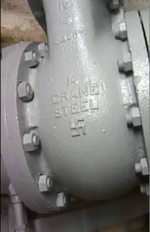
It used to be common- though maybe not so much up here in Alaska- to get gas cylinders with a Nazi eagle symbol. The Army brought back tons of them from Europe, and as they used similar specs as ours, a lot of them got into the exchange stream.
And as the steel cylinders essentially don't wear out, they could still be found well into the 80s and 90s. One of I think Fournier's early metalshaping books has a photo of one he'd "just gotten" (book written in the early 80s, as I recall) that had a "44" test date, and a eagle-and-******** stamp.

I personally took this pic in 2014.
I once was employed to keep a half-dozen critical analyzers on-line, so I was seemingly continuously changing out cylinders of varying lethality. After several hundred cylinders, you start noticing stuff.
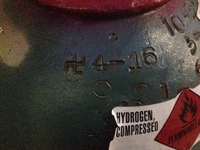
This cylinder had three columns of dates and the neck was shaped differently.
I would guess one out of twenty would have the “four pane window” stamp covering up the older ********. In this case, the ******** had not yet been acquired by the Germans, so it must have been a manufacturer’s stamp?
I've never seen a photo or a video of a cylinder that was a Nazi ********. It's hard for us to comprehend now, but it really was a symbol of good luck, adopted across many industries....so it must have been a manufacturer’s stamp?
In this case, the ******** had not yet been acquired by the Germans, so it must have been a manufacturer’s stamp?
It is.Isn't that oriented in the opposite direction?
In this case, the ******** had not yet been acquired by the Germans, so it must have been a manufacturer’s stamp?
Isn't that oriented in the opposite direction?
Yes, quite a good chance it was a bring back.There is a very good chance your V-Block came to America in a WWII veteran’s duffle bag; part on the booty/loot/war souvenirs all over this country - proper place, of course, is with the family as a memento to a valiant service the ‘Great Generation’ provided to the world; that value sorely fading.
It's hard for us to comprehend now, but it really was a symbol of good luck, adopted across many industries.
I was talking about the origins of the symbol and why it was so widely adopted across many industries as a symbol, logo, or marking, not it's literal functional purpose on the cylinder, Doc. (The word "********" in the original Sanskrit means "well-being".) My understanding is that it was used by a manufacturer or a service as a kind of verification or validation marking with the date for compliance, refill, etc, along with other kinds of markings and symbols. None of them decoration. But none of them Nazi, either.I have a hard time believing anyone would stamp a 'good luck charm' on a gas bottle. Or really, stamp anything that doesn't have to do with the tank ID.
My understanding is that it was used by a manufacturer or a service as a kind of verification or validation marking with the date for compliance, refill, etc.
Absolutely untrue.The native practice of taking scalps was derived from whites taking scalps for the bounty.
To hell with the symbol, what kind of fun (dangerous) can you have with a whole TANK of Hydrogen!?!?!?I personally took this pic in 2014.
I once was employed to keep a half-dozen critical analyzers on-line, so I was seemingly continuously changing out cylinders of varying lethality. After several hundred cylinders, you start noticing stuff.
This cylinder had three columns of dates and the neck was shaped differently.
I would guess one out of twenty would have the “four pane window” stamp covering up the older ********. In this case, the ******** had not yet been acquired by the Germans, so it must have been a manufacturer’s stamp?
Weld a lot of aluminum parts.To hell with the symbol, what kind of fun (dangerous) can you have with a whole TANK of Hydrogen!?!?!?![]()
Hydrogen???Weld a lot of aluminum parts.
Weld a lot of aluminum parts.
Hydrogen???
Yep, takes a different flux than normal and glasses/goggles with a special tint to cut the sodium flare.Hydrogen???
Its a hydrotest date, performed by the Linde corporation.I was talking about the origins of the symbol and why it was so widely adopted across many industries as a symbol, logo, or marking, not it's literal functional purpose on the cylinder, Doc. (The word "********" in the original Sanskrit means "well-being".) My understanding is that it was used by a manufacturer or a service as a kind of verification or validation marking with the date for compliance, refill, etc, along with other kinds of markings and symbols. None of them decoration. But none of them Nazi, either.
RIP Kent. What a loss.Yep, takes a different flux than normal and glasses/goggles with a special tint to cut the sodium flare.
Kent did a neat little demo on welding 5052 here:
Yep, takes a different flux than normal and glasses/goggles with a special tint to cut the sodium flare.
Kent did a neat little demo on welding 5052 here:
Those who who do not learn the lessons of history...Are you not aware that Nazi collectibles is a huge popular sub-segment of the WWII collectibles hobby? Or do you just think it's wrong?
If the latter, there's no need to argue. But the idea that anything needs to be made up or defended to explain it is as absurd as the idea that erasing the mark can somehow obliterate what it stood for from existence.
...is the same thing that happened to American emigre Robert Bosch's original magneto company! I summarized it here in a thread about "Fritz the Flyer" logo (and other) ignition wrenches down here on the Vintage Board......the American division of the Linde Corporation was confiscated from the germans in 1917 because of WW1 and given to Union Carbide.
Robert Bosch, a young German émigré, invented the magneto, and his Bosch Magneto Company made and sold them out of Springfield, Mass. with great success here in the US. The US government (Alien Property Custodian) seized the property and all its equipment in 1918 (think WWI!) and sold it. Seeking to take advantage of the popularity of a product they had absolutely no hand in creating, the buyers established American Bosch and put the fancified AB behind the same “Fritz the Flyer” guy. Robert Bosch continued innovating and making ignition systems and other electrical appliances out of his native Stuttgart. So, technically, not the same, but saying they’re not related conceals their intertwined (and somewhat dark) history.
Also used for underwater welding, where acetylene is explosive due to the pressure and arc... well, it's underwater.Technically you can gas weld aluminium with hydrogen gas. Not common but very old school technique. Helium as an inert gas in electric welding is also highly effective for aluminium welding.
If we do not know where we have been, we can not know where we are going.Those who who do not learn the lessons of history...
OTOH, if you don't much care where you're going, you're never lost.If we do not know where we have been, we can not know where we are going.