To avoid these ads, REGISTER NOW!

Neat Service Head

yeldogt

Well-known member
Joined
Jan 2, 2012
Messages
18,184
Do any service heads include the connection point for the support wire?

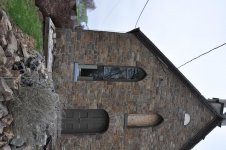
I'm trying to see what's the least offensive way to get power to my new build.

The underground feed from the other side of the street is going to be 10k before all said and done ... too much.

The current feed comes down the front of the building attached to the facia and then follows the roof to the back of the structure.

We are now going to burry the feed from the corner of the building (conduit) and burry it to the back of the building. I already have trenches for other work being done. Think I'm allowed to lower the feed on the building closer to the roof corner where the telco line is. It's up that high to avoid a tree that's out of the picture -- tree being removed.

Having the conduit come all the way up to the top with the service head would be the best way -- But I'm afraid it's going to be too visible. I also don't like the cable attached to the facia -- How do you work the dip leg when the service head is attached to a conduit?

EDIT: How do you rotate a picture? sorry
 

Attachments

  • DSC_0744.jpg
    DSC_0744.jpg
    148.7 KB · Views: 159
To avoid these ads, REGISTER NOW!

rlitman

Well-known member
Joined
Oct 18, 2010
Messages
24,638
Location
Long Island
I'm not sure how you'd manage a drip leg with a sideways building.

But the mast head should have connections to deal with the drip routing and cable tension.

Could you possibly disguise the vertical conduit as a downspout?
 
OP
Y

yeldogt

Well-known member
Joined
Jan 2, 2012
Messages
18,184
I'm not concerned about the conduit coming down the side of the building -- I'm trying to understand the different ways the support wire is attached. That's most visible.

I plan on painting the conduit to match the stone .... My thought is will the cable/ power wires closer to each other they will be visually reduced. The other wires in the picture are not mine.
 
OP
Y

yeldogt

Well-known member
Joined
Jan 2, 2012
Messages
18,184
To avoid these ads, REGISTER NOW!

braidmeister

Well-known member
Joined
Mar 31, 2011
Messages
589
They used a 4x4" steel angle on my out building to attach the mast to the 6x6 pole barn supports and carry it up above the roof. If I had to guess I'd say it was 10' long and the conduit nests inside the L of the angle. Got 400A of 3ph coming down it...You might be able to get away with a 3x3" L.
 

rlitman

Well-known member
Joined
Oct 18, 2010
Messages
24,638
Location
Long Island
steel 2" conduit properly supported with unistrut every 3-4 ft up the building with a weatherhead on the top. The tension wire (neutral) attaches to the steel conduit with an insulator like the one in the following link:
https://www.platt.com/platt-electri...n/PPC-Insulators/6912/product.aspx?zpid=50536

That's the right idea, though that particular insulator is for 1-1/4" and not 2" conduit. Also, to be clear, this requires hard pipe conduit, NOT EMT.

Unistrut is certainly not necessary. You could use conduit wall clamps attached with proper anchors:

3-conduit-clamps.jpg


Unistrut just makes it easier. If you go with the clamps, you've got to be very careful to have them aligned, and you need to deal with the issue of making a solid attachment point directly behind the pipe, where Unistrut would span to the nearest solid points.

Oh, and rigid conduit can have wider spacing than that.
http://www.cooperindustries.com/con...ing/strut_systems/rd-rigidsteelconduitimc.pdf
"Rigid and Intermediate Metal Conduit shall be supported at least every 10 feet (3.05 m) and within 3 feet (914 mm) of each
outlet box, junction box, cabinet, or fitting, except for straight runs of conduit connected with couplings which may be
supported in accordance with NEC Article 345 and 346, provided such supports prevent transmission of stresses to
termination where conduit is deflected between supports."


That table shows 16' spacing for 2" rigid conduit. So if your conduit clamps are well anchored, you can get away with just two. That makes the alignment issue easier too.
 
Last edited:
OP
Y

yeldogt

Well-known member
Joined
Jan 2, 2012
Messages
18,184
That's the right idea, though that particular insulator is for 1-1/4" and not 2" conduit. Also, to be clear, this requires hard pipe conduit, NOT EMT.

Unistrut is certainly not necessary. You could use conduit wall clamps attached with proper anchors:

3-conduit-clamps.jpg


Unistrut just makes it easier. If you go with the clamps, you've got to be very careful to have them aligned, and you need to deal with the issue of making a solid attachment point directly behind the pipe, where Unistrut would span to the nearest solid points.

Oh, and rigid conduit can have wider spacing than that.
http://www.cooperindustries.com/con...ing/strut_systems/rd-rigidsteelconduitimc.pdf
"Rigid and Intermediate Metal Conduit shall be supported at least every 10 feet (3.05 m) and within 3 feet (914 mm) of each
outlet box, junction box, cabinet, or fitting, except for straight runs of conduit connected with couplings which may be
supported in accordance with NEC Article 345 and 346, provided such supports prevent transmission of stresses to
termination where conduit is deflected between supports."


That table shows 16' spacing for 2" rigid conduit. So if your conduit clamps are well anchored, you can get away with just two. That makes the alignment issue easier too.

That's better ! I have an artist friend that can paint the pipe so it matches the stone ...

Ideally -- keeping the line on the side of the building would be the best ... just not sure if we are high enough.
 

rburke65

Well-known member
Joined
Nov 10, 2007
Messages
12,349
Location
Canfield, Ohio
The "drip" is achieved with long loop of cable. The service drop is attached to the 2" HW(hard wall) conduit below the weather head and it loops down a little then up to the service entrance cable. If it's a long drop the conduit my have to be supported by a guy wire to offset the weight.
 
To avoid these ads, REGISTER NOW!
Top Bottom