To avoid these ads, REGISTER NOW!

Need a subpanel - what did I buy?

BD1

Well-known member
Joined
Mar 18, 2007
Messages
4,602
Location
north side
Curious, if the romex is in the pvc why is it wrong ? It is buried but it is in
pvc ? :dunno:
 
To avoid these ads, REGISTER NOW!

sickjuice

Well-known member
Joined
Jun 12, 2012
Messages
143
Location
welfare provence
Curious, if the romex is in the pvc why is it wrong ? It is buried but it is in
pvc ? :dunno:

pvc underground is still a wet location. that pipe will still fill up with water eventually. I've never pulled wire out of an underground run and found it to be dry
 

BD1

Well-known member
Joined
Mar 18, 2007
Messages
4,602
Location
north side
Got it. I know THHN and THWN is suitable for wet locations. I never looked at the basic romex. I guess moisture will penetration it unless it is the
direct burial type. thanks
 

Norcal

Well-known member
Joined
Mar 16, 2008
Messages
13,769
Got it. I know THHN and THWN is suitable for wet locations. I never looked at the basic romex. I guess moisture will penetration it unless it is the
direct burial type. thanks

NM cable is permitted in dry locations only, any conduit outdoors or underground, is defined by the NEC as a wet location. THHN is also for dry locations only, dual rated THHN, THWN which most is, is OK for wet locations.
 

pattenp

Well-known member
Joined
Jun 4, 2008
Messages
10,175
Location
Virginia - USA
If the soil in your trench is clean, no rocks, then the sand is not really needed.

I don't believe you have to use conduit under the drive but you may want to in case of a future problem if you have to pull the wire out for a repair. The conduit will make life a lot easier getting wire back under the driveway.

Good information here guys, thanks very much! I just got off the horn with the local electrical supply store here and was convinced that some #4 6/3 with ground direct burial aluminum cable would work just fine.

So if I go with that, drop some sand in the trench and buy some schedule 80 plastic parts to for the above ground stuff I should be ok, right?

One last thing... there's a driveway invovled here and while it's dirt now it will be concrete later. Does code say I need a stretch of conduit here? If yes I assume I could just reuse a stretch of the 1" stuff I have now.
 
OP
S

scott45

Member
Joined
Jun 19, 2012
Messages
23
First off your panel is fine it is only a six circuit so you do not need a Main breaker panel.
You will be driving a ground rod at the garage no problem there.

PRH44 - I like hearing the panel I have is fine, but I'm bringing in two hots, a neutral and a ground, there's only three lugs in the panel and I understand I cannot connect the neutral and ground together in a subpanel. If I connect one wire per lug then do I just need to go buy a little grounding bar and screw that into the panel?
 

happy2rv

Well-known member
Joined
Apr 19, 2012
Messages
147
Location
Huntsville, AL
PRH44 - I like hearing the panel I have is fine, but I'm bringing in two hots, a neutral and a ground, there's only three lugs in the panel and I understand I cannot connect the neutral and ground together in a subpanel. If I connect one wire per lug then do I just need to go buy a little grounding bar and screw that into the panel?

Yes, you will need to purchase a ground bar, and depending on the size of your ground wire from the main panel, you may need a neutral lug kit. The kit contains the "lug" that usually comes installed on the neutral bus. See http://www.homedepot.com/h_d1/N-5yc1v/R-202276334/h_d2/ProductDisplay?catalogId=10053&langId=-1&keyword=neutral+lug&storeId=10051 for an example. This should be appropriate to the size of wire and brand of panel. I don't remember what brand of panel you have, if it was stated, but I believe the max wire size varies by manufacturer. It should say on the package.

The panel should have screw locations pre-tapped for the ground bar to screw in to one side or the other of the panel.

As others have already stated, in addition to the ground from the main panel, since this is a detached structure, you will need ground rods as well.
 

PRH44

Well-known member
Joined
Dec 25, 2009
Messages
563
Location
Indiana
Originally Posted by scott45
Good information here guys, thanks very much! I just got off the horn with the local electrical supply store here and was convinced that some #4 6/3 with ground direct burial aluminum cable would work just fine.

So if I go with that, drop some sand in the trench and buy some schedule 80 plastic parts to for the above ground stuff I should be ok, right?

One last thing... there's a driveway invovled here and while it's dirt now it will be concrete later. Does code say I need a stretch of conduit here? If yes I assume I could just reuse a stretch of the 1" stuff I have now.

pattenp is correct conduit is not required however it would be a good idea. Either way just be sure you are at least 18" below finished grade of the driveway.
 

pattenp

Well-known member
Joined
Jun 4, 2008
Messages
10,175
Location
Virginia - USA
The required depth is not the same either way. If you don't use conduit you should bury the cable 24 inches, in PVC conduit 18 inches, under at least 2" of concrete is 18" and 12" respectively.

pattenp is correct conduit is not required however it would be a good idea. Either way just be sure you are at least 18" below finished grade of the driveway.
 
OP
S

scott45

Member
Joined
Jun 19, 2012
Messages
23
I talked to the inspector himself and he told me to cover up the trench after I dropped the cable in so sounds like he's not too worried about how deep my wire is. Right near the garage where all those bends are there's a big 'ole piece of rock that's about 8" below current grade and my pickaxe just bounces off of it. Not much I can do there.

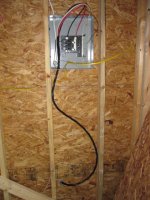
So I went out and got 100' of #4 aluminum direct burial cable and managed to put most of it into the conduit I already have. Seemed a shame to waste it since I had it. My only question at this point is what the NEC or general best practice says about bringing the wire in from the outside, up through the wall stud cavity and into the bottom of the sub panel.

Here's the pic again with the NM-B wire and it shows the path the aluminum cable feels like it wants to take but I'm not sure if the winding S-curve will pass inspection. It will be attached to the wall in two places no more than 8 inches from the panel and where it comes into the wall... I'm just not sure if I need to make the cable take a vertical path to the sub panel or if a serpentine route is ok. Keep in mind I'm using #4 aluminum so it doesn't bend like copper does.

Thanks!
 

Attachments

  • IMG_3926.JPG
    IMG_3926.JPG
    138.5 KB · Views: 48

PRH44

Well-known member
Joined
Dec 25, 2009
Messages
563
Location
Indiana
The required depth is not the same either way. If you don't use conduit you should bury the cable 24 inches, in PVC conduit 18 inches, under at least 2" of concrete is 18" and 12" respectively.

pattenp he would fall under 2011 NEC table 300.5 5th row
"One- and two-family dwelling
driveways and outdoor
parking areas, and used only
for dwelling-related purposes"
he is also non GFCI and over 20 amp OCPD
thus requiring 18" for PVC conduit.
 

PRH44

Well-known member
Joined
Dec 25, 2009
Messages
563
Location
Indiana
I talked to the inspector himself and he told me to cover up the trench after I dropped the cable in so sounds like he's not too worried about how deep my wire is. Right near the garage where all those bends are there's a big 'ole piece of rock that's about 8" below current grade and my pickaxe just bounces off of it. Not much I can do there.

So I went out and got 100' of #4 aluminum direct burial cable and managed to put most of it into the conduit I already have. Seemed a shame to waste it since I had it. My only question at this point is what the NEC or general best practice says about bringing the wire in from the outside, up through the wall stud cavity and into the bottom of the sub panel.

Here's the pic again with the NM-B wire and it shows the path the aluminum cable feels like it wants to take but I'm not sure if the winding S-curve will pass inspection. It will be attached to the wall in two places no more than 8 inches from the panel and where it comes into the wall... I'm just not sure if I need to make the cable take a vertical path to the sub panel or if a serpentine route is ok. Keep in mind I'm using #4 aluminum so it doesn't bend like copper does.

Thanks!

What type cable did you end up purchasing ? What is the letter designation on the wire its self?
 
To avoid these ads, REGISTER NOW!

pattenp

Well-known member
Joined
Jun 4, 2008
Messages
10,175
Location
Virginia - USA
You are correct. That's what I get for thinking my memory is correct without checking the book first.

pattenp he would fall under 2011 NEC table 300.5 5th row
"One- and two-family dwelling
driveways and outdoor
parking areas, and used only
for dwelling-related purposes"
he is also non GFCI and over 20 amp OCPD
thus requiring 18" for PVC conduit.
 
OP
S

scott45

Member
Joined
Jun 19, 2012
Messages
23
Here's what the cable says:

Southwire (UL) AWG 4AL TYPE USE-2 60 MILS XLP Insulation 600V

It's 3 4ga aluminum wires loosely twisted together.
 

pattenp

Well-known member
Joined
Jun 4, 2008
Messages
10,175
Location
Virginia - USA
Why did you get 3 conductor cable? You need 4 conductor for a feed. 2 hots, 1 neutral and 1 ground. Also that cable will need to be within conduit inside of the structures.

Here's what the cable says:

Southwire (UL) AWG 4AL TYPE USE-2 60 MILS XLP Insulation 600V

It's 3 4ga aluminum wires loosely twisted together.
 

pattenp

Well-known member
Joined
Jun 4, 2008
Messages
10,175
Location
Virginia - USA
If the wire you have is only rated at USE-2, I believe that it is not suited to be run within the structure because the insulation is not fire rated. It needs to also have a RHH or RHW-2 rating.
 

pattenp

Well-known member
Joined
Jun 4, 2008
Messages
10,175
Location
Virginia - USA
After some research the XLP insulation looks to be fire rated, so you're okay to install it inside, but it does need to be in conduit inside if this is what you got:

6422372.jpg
 

PRH44

Well-known member
Joined
Dec 25, 2009
Messages
563
Location
Indiana
You are correct. That's what I get for thinking my memory is correct without checking the book first.

pattenp your take on my comments are always welcome. I just wanted to be clear where I derived my information. My comment below is for under the driveway only. If no driveway or concrete and direct buried cable is used 24" depth would be required as pattenp stated

Originally Posted by PRH44
pattenp is correct conduit is not required however it would be a good idea. Either way just be sure you are at least 18" below finished grade of the driveway.
 
OP
S

scott45

Member
Joined
Jun 19, 2012
Messages
23
Let's say I find myself 2 feet short with the aluminum feeder and don't have enough to get to my main panel in the house. I've got a funny feeling but haven't confirmed it yet. Funny, because I cut off almost 3 feet in the garage after thinking I had plenty on the other end.

Since I've got all this extra NM-B laying around, would there be any major issue with using a j-box under the house and running my copper into my panel instead of my aluminum?

I would of course be using that grease stuff where the different metals touched.
 

ishiboo

Well-known member
Joined
Oct 27, 2010
Messages
9,481
Location
Oshkosh, WI
Let's say I find myself 2 feet short with the aluminum feeder and don't have enough to get to my main panel in the house. I've got a funny feeling but haven't confirmed it yet. Funny, because I cut off almost 3 feet in the garage after thinking I had plenty on the other end.

Since I've got all this extra NM-B laying around, would there be any major issue with using a j-box under the house and running my copper into my panel instead of my aluminum?

I would of course be using that grease stuff where the different metals touched.

I ran into this, because I had to repair the outside part of a service which had failed and wanted to temporarily keep the inside portion until the panel was relocated completely.

Yes, NEC allows a splice in the service entrance. I used one larger size junction box than I thought I needed which worked well - you want room to work. I used the set-screw style splices with heat shrink.

However, the NM-B I believe you have is way too small, I would just buy a little extra aluminum since it's so cheap by the foot and available by the foot and splice it in the jbox if necessary.
 
OP
S

scott45

Member
Joined
Jun 19, 2012
Messages
23
However, the NM-B I believe you have is way too small, I would just buy a little extra aluminum since it's so cheap by the foot and available by the foot and splice it in the jbox if necessary.

It's 6/3 which is rated for 55A... I'm putting it to a 50A breaker in my main panel so I should be fine.

Glad to hear it has been done before and that I'm not the only guy to find himself a tad short at the end of a run. :)
 

Aceman

Well-known member
Joined
Jan 28, 2007
Messages
2,513
Location
Eastern Oregon
I think you're approaching the point where it'd have been cheaper to hire an electrician.

If there isn't much to it at the house end, with the trench dug, myself and a helper would be less than a half day probably, maybe 3 hrs even. That's installing the panel, driving the rods, laying the pipe, pulling the wire and calling for ditch inspection. Done. Probably less than $4-500 in labor. And it'd be done the same day. No tear outs and do overs, or using the wrong parts or borrowing the neighbor, multiple trips back to HD, etc.

If you're doing this for the learning experience, than watch us work and learn how to do it yourself the next time. Properly.
 
OP
S

scott45

Member
Joined
Jun 19, 2012
Messages
23
I appreciate the input Aceman but my labor is free and I can count on exactly two fingers the number of times I've hired a contractor and DIDN'T say to myself afterwards, "I could have done that better AND cheaper." Once was the roof on this garage project and the other was when I hired a local flooring company to put down a kitchen floor for me.

A guy can pick any two - done fast, done right or done cheap. I'd wager most of us on this forum would go for the latter two, that's why we're here. :thumbup:
 

Aceman

Well-known member
Joined
Jan 28, 2007
Messages
2,513
Location
Eastern Oregon
I appreciate the input Aceman but my labor is free and I can count on exactly two fingers the number of times I've hired a contractor and DIDN'T say to myself afterwards, "I could have done that better AND cheaper." Once was the roof on this garage project and the other was when I hired a local flooring company to put down a kitchen floor for me.

A guy can pick any two - done fast, done right or done cheap. I'd wager most of us on this forum would go for the latter two, that's why we're here. :thumbup:

Fair enough.

I take pride in my work, so if a diy'er can come behind me and do "better" in his opinion than me, I must be in the wrong line of work. I'm not disagreeing with the cheaper, but better, you're going to have your work cut out for you!:thumbup:
 
To avoid these ads, REGISTER NOW!
Top Bottom