Where did you get 200A rating for the stab?
Post a clear pic of the panel label that shows all of the accessory part #'s/spec for the panel.
This is a theoretical number, as the picture attached is a newer panel, unknown origin

Where did you get 200A rating for the stab?
Post a clear pic of the panel label that shows all of the accessory part #'s/spec for the panel.
There are probably guys here can explain the exceptions better than I can but,,, it could even go so far as to say that it could be based on applied load in THEORY,,,, such as the breaker on a dedicated circuit being sized for short circuit and not thermal. ( again a disclaimer for theory) But the air conditioner that has an actual draw of 13 on a 30 and a dryer with actual of 21 on 30, maybe even motor circuits etc (air comp) where the fla is substantially lower than the ocpd.This restriction is not applied to all QO or HOMELINE panels. The
restrictions are applied only when we must limit the total amperage on a
stab to pass applicable UL heat rise tests.
Not exactly. If it had a 200 rating it would allow 100 across from each other. If it was 125 would allow 100 and a 20 on the other side, if it was 140 would allow 100 and up to 40.
The 2x40 is acceptable. 2x40 is putting 80 on a stab.
This is a theoretical number, as the picture attached is a newer panel, unknown origin
How about providing the actual info?
Stab clarification -
Most Square D QO or HOMELINE panels are supplied with "double row" bus
bar construction. This means that the bus bars will have branch circuit
breakers plugged onto the bus bars from the left and from the right.
The "bus stab", "bus finger" or even "connector finger" is the point on
the bus bar that the branch circuit breakers electrically connect to the
bus bar. For instance, a 40 space panel will have 20 "bus stabs". The
bus stabs accept circuit breakers from both sides, providing the
capability to plug on 40 1-pole circuit breakers.
If your panel is restricted to 125 ampere per bus stab, that means that
you cannot put two breakers onto that bus stab (one from each side)
that exceed 125 amperes between them. For instance, you could place two
60 ampere breakers (60A+60A=120A) across from one another on the same
bus stab(s), but you could not place two 70 ampere breakers
(70A+70A=140A) across from one another on the same bus stab(s).
This restriction is not applied to all QO or HOMELINE panels. The
restrictions are applied only when we must limit the total amperage on a
stab to pass applicable UL heat rise tests.
- Square D Company
so finish the math - given 20 stabs at 125A each, the theoretical max breaker load for that panel is - 2500A...
This crazy idea you were taught "2x the main breaker rating" is complete nonsense - is there any other reason you would like to upgrade the panels?
2x 200A panels are done all the time for residential "400A" service
The first upgrade that might make sense is to see if you can go to a 100A feed to the sub panel if you think the loads on the 60A panel are going up significantly, or upgrade panel 1 to 200A, then do it.
Many alternatives, but lets base them on real requirements.
I have to move the main panel because a bathroom is going there, which means both would need to be rewired anyway.
Before I dare say something incorrect again, what's the correct way to do a load calculation?
Right now I have about 30 breakers between the two panels, so you guys really think a single 200 would handle it?
Originally the home was a duplex, with 2 meters, 2 power boxes and was converted into a single family home. Now it has 1 set of feed wires going to 1 box, and that box has a 60A breaker feeding the other 100AMP panel on the other side of the wall. This is definitely not correct!
How long have you been doing electrical work?This isn't fine, the main panel is overloaded. Actual load is irrelevant because right now it's possible to overload the buss bars and possibly start a fire.
Right now the house isn't being fully utilized, so sure there aren't any issues, but as more stuff is added, this is going to become an issue.
I guess I should rephrase, I'm not looking for someone to tell me if the 2 x 100 amp panels in their current configure is fine. I'm looking to see if someone can give advice swapping to 2 x 200 amp panels
You'll never get that kind of a load in a house,put an amp meter on one leg of service coming into panel and turn on everything in the house.We realize what your intent is but we also want you to learn something along the way that helps with load sizing and capacity needs. If I could do the job with a single 200 I would be inclined to do it. If I was going to add hot tubs, new air conditioning, electric heat or water heaters then it effects all this.
The main isn't tripping, yes it could and its almost always possible to do it but it wont overload the buss,,, hence the main, it prevents this.
The actual load is the only thing that is relevant. An alarm clock or table lamp plugs in to a 20A circuit, you do not count the load as 20A because that's what the breaker is.
Lots of dedicated equipment like this, sump pump, 1/3 hp, air cond, lots of them on 30A circuits with a draw of 13.
Your comment is completely unnecessary
The simple version of a load calculation for a dwelling unit.
You need to determine what you have for electric appliances,
Stove, dryer, water heater, A/C, electric furnace, ect. The first two should use the value given in the code most of the time. Electric dryer 5KW, Stove 8KW. All others use the nameplate rating. If you have non coincidental loads, like A/C and electric heat you use only the larger of the two in your calculation.
Each kitchen small appliance circuit should be calulated at 1500VA
Each laundry circuit is calculated at 1500VA.
For general lighting and receptacle load use 3VA per sq/ft.

No his comment is perfect for the situation.
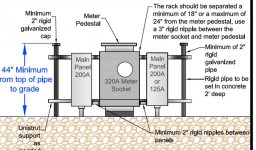
I have 2 x 200A panels on a single meter.
This was a "recommended configuration" by my power company. I wonder if you call yours (engineering department) and tell them you need to support 2 x 200A mains, they might be able to give you options.
In my case, the feed is rated for 320A continuous and splits at the meter to 2 x 200A main breakers.
I've attached the pedestal diagram.
How you swap in 2 x 200A panels in your situation depends on a lot of things... But yes, lesser capacity circuits CAN feed larger capacity panels if they are adequately overload-protected (just like your 60A circuit feeding a 100A panel).
Chances are the power company won't upgrade anything unless you are adding serious load. Most of the time when I do 200a upgrades the power company leaves the #4 overhead and ~15kva transformer. Shows how overkill many 200a services really are.
This doesn't mean it doesn't need to be replaced but,,, its obviously not tripping a 100A breaker. A general circuit can have several outlets, possibly hundreds of amps of connected equipment. If it pulls more than 20 the breaker trips, if 1 thing at a time is used its irrelevant how much is connected.
Changing breakers from 20 to 15 does not add capacity, only thing that does is removing actual load.
So,what is the actual load on each of those breakers/circuits?I was taught that the panel should never exceed double the breaker rating for reference. Meaning a 100 AMP panel should never exceed 200A worth of breakers.
A single 200A panel would mean I could put 400A worth of breakers in safely
Using 2 x 200A panels would mean I could put 800A worth of breakers in safely.
I would be below well 800 total breaker amps with two panels and combining a few low power circuits. Probably around 600-700
If you really wanted to know
 )
)
I was going through some of my old private messages earlier today and came across a couple from him talking about there only being so many astro Van's registered in the Omaha area,and to watch my back.
Then a couple others he sent me talking about unloading a gun into me.
Just was wondering if hes coming for christmas dinner,since he missed out on thanks giving here at my place.
Then a couple others he sent me talking about unloading a gun into me.