To avoid these ads, REGISTER NOW!

Need advice on stem wall to floor transition

q2quest

Member
Joined
Jan 9, 2019
Messages
9
Location
Santa Rosa, CA
Hello everyone,

I'm getting ready to put down a polyurea coating in my 23' x 23' garage and am trying to figure out how best to finish the floor at the wall. There is a stem wall all around the perimeter and where the floor meets the wall there is a 1/2" gap with fiberous board separating the two planes of concrete. It's soft and can be scraped out. I don't know anything about how a garage slab is poured, but they used this filler piece to keep the slab away from the wall and it looks terrible. I'm wondering if a vinyl cove product would be the least hassle. I was considering scraping out that material and then filling the gap with some product, but that's A LOT of work. Also, does anyone have any suggestions for what to use to fill the voids in the stem wall? I'd like to coat that as well. Thanks!

Paul
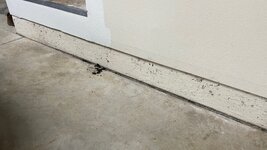
IMG_3217.jpgIMG_3218.jpgIMG_3219.jpg
 
To avoid these ads, REGISTER NOW!
OP
Q

q2quest

Member
Joined
Jan 9, 2019
Messages
9
Location
Santa Rosa, CA
You mean a baseboard tall enough to meet the drywall? Hmm, I hadn't considered that. That would have to be about 8 inches tall.
 
To avoid these ads, REGISTER NOW!

Rusted Nut

Well-known member
Joined
Dec 11, 2022
Messages
1,832
Location
Northern Arizona
Most floor coating system suppliers, sell a cove you can install and apply the floor coating over the cove and up the wall. Other option is to dig/grind it out, fill it with a floor system compatible sealant.
 

Fav Onefour

Well-known member
Joined
Jul 14, 2022
Messages
724
Location
MN cold and hot
Baseboard or cove is definitely doable. It will take some work to get a clean edge on the drywall and attach to concrete below.
I do quite a bit of trim work with PVC and the stuff is easy to work. In that situation you can rip it to width and router the top edge. I'm going back to the drywall comment though. I'm doubtful about the distance between concrete and drywall being consistent.
PVC board is soft. That's good and bad. It's easy to work and easy to damage.

The "fiberous board" is expansion joint material. Your version is asphalt saturated fiber board. It can be cut back with a sharp utility knife. You will need to change blades often because it gums them up pretty fast. I'm a little surprised they used the material inside between the slab and foundation. We use the stuff a lot between outside pads and foundation etc. The material usually starts breaking down on outside stuff in a few years. I usually replace and seal the material with something better suited for long term. I watch the joint for movement and use a plan according to that issue. If the joint is spreading, I pull out the old expansion material and jamb the joint with foam backer. If it is compressing, I like to cut back the top with the utility knife trick. I usually angle the knife and cut deep enough to create some void on top. Either way, the joint will probably move so plan on that happening. I like to top fill with a flexible joint repair. Sika stuff is fairly decent and easy to find around here. I'm sure other members have material they like.

I bet that joint won't move much. You could probably just spend some time cutting back the material and covering the void with a good filler that won't react to the asphalt residue. After that, go with whatever method you prefer on the concrete stem wall.
 
OP
Q

q2quest

Member
Joined
Jan 9, 2019
Messages
9
Location
Santa Rosa, CA
Baseboard or cove is definitely doable. It will take some work to get a clean edge on the drywall and attach to concrete below.
I do quite a bit of trim work with PVC and the stuff is easy to work. In that situation you can rip it to width and router the top edge. I'm going back to the drywall comment though. I'm doubtful about the distance between concrete and drywall being consistent.
PVC board is soft. That's good and bad. It's easy to work and easy to damage.

The "fiberous board" is expansion joint material. Your version is asphalt saturated fiber board. It can be cut back with a sharp utility knife. You will need to change blades often because it gums them up pretty fast. I'm a little surprised they used the material inside between the slab and foundation. We use the stuff a lot between outside pads and foundation etc. The material usually starts breaking down on outside stuff in a few years. I usually replace and seal the material with something better suited for long term. I watch the joint for movement and use a plan according to that issue. If the joint is spreading, I pull out the old expansion material and jamb the joint with foam backer. If it is compressing, I like to cut back the top with the utility knife trick. I usually angle the knife and cut deep enough to create some void on top. Either way, the joint will probably move so plan on that happening. I like to top fill with a flexible joint repair. Sika stuff is fairly decent and easy to find around here. I'm sure other members have material they like.

I bet that joint won't move much. You could probably just spend some time cutting back the material and covering the void with a good filler that won't react to the asphalt residue. After that, go with whatever method you prefer on the concrete stem wall.

Wow, thanks so much for the detailed reply!
 
To avoid these ads, REGISTER NOW!
Top Bottom