To avoid these ads, REGISTER NOW!

Need belt sizing help

Joined
Nov 14, 2021
Messages
11
Hello everyone,

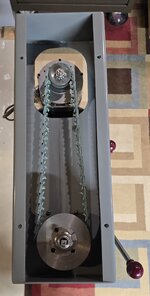
I need some help with belt sizing. This is a custom drill press I'm currently finishing up. The motor specs from the supplier:
"Comes standard with AK25 that is a 2.0 OD 1/2 inch wide pulley."
The sheave on the spindle is a Dodge Type 118302 Taper Lock sheave, which should accept an A or B section v-belt.
The belt is a Megadyne A-Link belt.
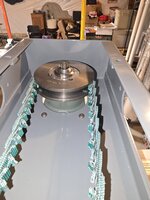
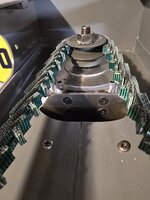
Does this belt look like it's riding too high in the 2" pulley?
 

Attachments

  • 20250925_120455.jpg
    20250925_120455.jpg
    393.5 KB · Views: 38
  • 20251023_203415.jpg
    20251023_203415.jpg
    594.5 KB · Views: 35
  • 20251023_202952.jpg
    20251023_202952.jpg
    673.6 KB · Views: 33
  • 20251023_200145.jpg
    20251023_200145.jpg
    612.9 KB · Views: 32
  • 20251023_200112.jpg
    20251023_200112.jpg
    978.8 KB · Views: 30
  • 20251023_200102.jpg
    20251023_200102.jpg
    704.1 KB · Views: 35
To avoid these ads, REGISTER NOW!

timgunn1962

Well-known member
Joined
Mar 31, 2018
Messages
159
Location
Lancashire, England
I'm not sure whether it's riding too high, as I'm not used to using link belts, though when I've seen them, they've looked a lot deeper than V- or wedge-belts, so presumable the outside will sit proud of the pulley grooves.

I'm wondering why you are using a link belt?

Link belts are usually used where one, or both, of the pulleys is on a shaft with bearings both sides, meaning that a continuous belt can't be fitted without extensive dismantling, or in maintenance situations where having a roll of link belting reduces inventory and allows a maintenance guy to get any belt drive up and running without needing specific-length belts. Power transmission ability is usually similar to that of the old-school V-belts, but way below that of a modern wedge-belt. Link belts are usually quite spendy.

In your case, I'd be looking to use a cogged (or "moulded notch") raw-edge wedge belt of the correct length. The cogs/notches don't engage on pulley teeth: they just allow the belts to wrap effectively round smaller pulleys/sheaves.

A conversation with your supplier would be a good idea. It would be worth a few minutes researching the difference between V-belts and wedge-belts first though.
 

seber

Well-known member
Joined
May 31, 2016
Messages
4,195
Location
Deep East Tx.
Linked belts reduce vibration. I use them for most applications for that reason. Yours looks like it is doing just fine.
 
To avoid these ads, REGISTER NOW!

OccupantRJ

Well-known member
Joined
May 15, 2009
Messages
10,977
Location
Eastern North Carolina
Looks a bit proud, but may work fine. You do not want the belt to ride in the bottom of the pulley groove. It needs to wedge into the pulley to drive properly. If there is an industrial supplier or old school hardware in your town with pulleys you could take the belt to see how it rides in a B groove width pulley. Also investigate this link for dimensions.
 

lund

Well-known member
Joined
Nov 2, 2019
Messages
765
Location
Michigan
I'm not sure whether it's riding too high, as I'm not used to using link belts, though when I've seen them, they've looked a lot deeper than V- or wedge-belts, so presumable the outside will sit proud of the pulley grooves.

I'm wondering why you are using a link belt?

Link belts are usually used where one, or both, of the pulleys is on a shaft with bearings both sides, meaning that a continuous belt can't be fitted without extensive dismantling, or in maintenance situations where having a roll of link belting reduces inventory and allows a maintenance guy to get any belt drive up and running without needing specific-length belts. Power transmission ability is usually similar to that of the old-school V-belts, but way below that of a modern wedge-belt. Link belts are usually quite spendy.

In your case, I'd be looking to use a cogged (or "moulded notch") raw-edge wedge belt of the correct length. The cogs/notches don't engage on pulley teeth: they just allow the belts to wrap effectively round smaller pulleys/sheaves.

A conversation with your supplier would be a good idea. It would be worth a few minutes researching the difference between V-belts and wedge-belts first though.
Someone already said this. But link belts are not just used to avoid disassembly for belt changes or resize. They are good to reduce vibrations in equipment. This is good for both woodworking and metalworking machines. The theory is the links allow some motion to help remove (no support) various vibrational modes. This helps precision of cutting etc and can reduce wear. A small bit of energy transfer efficiency may also be lost and they are more expensive.

I had the same issues as the OP when first using linkbelts: seemed like they rode higher than I thought they should within the pulley grooves they were stated to fit. This seemed to be the trend and they would seat a bit better with more use and adjustment. But they always looked a bit high to me though they worked ok insofar as I could discern. After a while I forgot about it. No slipping noted outside my drill press with a VFD 3 phase motor and a very wide range of speeds. Drill presses are kind of worst cases though.
 
OP
N
Joined
Nov 14, 2021
Messages
11
Thanks everyone. I was using a link belt for two reasons.
1. Convenience - I didn't know how to properly size the belt length, as this is a custom setup.
2. I've read online that they run quieter than regular v-belts.

I was having to set the belt tension fairly tight to avoid slipping with the link belt. Maybe it would have gotten better after some run time. I replaced the belt with an AX36 belt, and it seems to fit better on the 2" pulley and slip less. The link belt wasn't any quieter on this drill press, but it did make a difference on my other drill press.
 

Attachments

  • 20251025_104053.jpg
    20251025_104053.jpg
    612.6 KB · Views: 10
  • 20251025_104230.jpg
    20251025_104230.jpg
    537.7 KB · Views: 9
  • 20251025_110538.jpg
    20251025_110538.jpg
    1.3 MB · Views: 12
To avoid these ads, REGISTER NOW!
Top Bottom