To avoid these ads, REGISTER NOW!

Need help designing two story deck

SliderJack

Well-known member
Joined
Aug 17, 2015
Messages
62
Location
TN
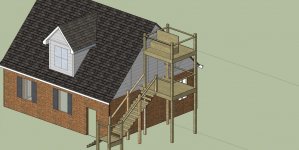
Building a 28x32 garage with 8x14 attic. I wanted to have steps in the back of the garage to the attic space. I know it's strange, but I also would like to have a second landing above the attic landing as kind of an observation deck. We're near the mountains and the second landing would be a nice place to just sit and watch the mountains.

I started with the basic idea of a deck mounting a ledger at the attic entrance and one 8' up for the second landing/deck with two 6x6 posts on the far side of the deck. The attic ledger shouldn't be difficult since the trusses are 2"x12" so there is something solid to bolt too. But I'm not sure how or if I should try and mount a ledger to the top of the truss for the second level deck. I could frame it inside and mount a 2x12 on the other side of the truss for support.

But now I'm thinking of self standing deck with four 6x6 posts. That way the 6x6 posts could extend all the way to the top deck and should be sturdy. That is however, we're talking 20' posts are the longest I can get I think--not long enough to extend up for the top railing. Walls are 10-1/2' tall.

Size of the deck isn't too important. 8x8, 10x10, or 12x12?

The top deck just needs to be big enough for a bench. I figured an opening for a ladder or stairs and a built in bench on the other half.

I'd like to build it to look similar to my existing deck on my house. So that means 2x12 outside framing of the deck sitting on notched 6x6 posts.

Questions.
  • 4 post best design?
  • Dig and pour footing and mount posts on top of level footings or bury posts?
  • Steps or ladder design? want to reduce space needed on deck for the stairs. Min width?
  • Joinery for mounting top railing posts?

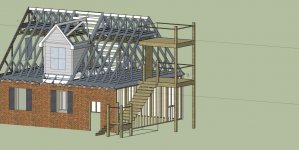
I put together two basic drawings.
 

Attachments
  • stairs_01.jpg
    stairs_01.jpg
    153.3 KB · Views: 103
  • stairs_02.jpg
    stairs_02.jpg
    148.9 KB · Views: 105
Last edited:
To avoid these ads, REGISTER NOW!

rsanter

Well-known member
Joined
Dec 22, 2007
Messages
18,489
Location
visalia ca
If it was me and I was going to be there long term I think I would use steel tube uprights sunk into concrete footings.
From there you can weld on the cross bracing and bolt the decking to it.

But then if it was me I think I would make it extra strong and mount a winch under the lower deck for picking up heavy things from the back of the truck. Which would then dictate the dimension of the deck.

If not that then I would build it as a storage shed on the bottom with the two decks above it

Bob
 
OP
S

SliderJack

Well-known member
Joined
Aug 17, 2015
Messages
62
Location
TN
Thanks Bob. I hadn't considered steel. The problem is I'd like it to look like the deck on my house.

I do however plan to store things under the lower deck as you suggested and I already have a hoist in the main garage tied to the over-engineered quadrupled 2x12 trusses around the dormer.
 

wssix99

Well-known member
Joined
Mar 2, 2011
Messages
5,155
Location
Chicago, IL
I know it's strange

It's super weird. Having that odd deck off the side of your building will trash your resale value. Engineering your trusses to handle the ledger will also be rough.

I've seen a lot of buildings in scenic locales (mountains, beaches, etc.) lately and I've seen a lot of new pitched roof houses with the top peak chopped off for a small flat roof at the very top. That might work out better for what you are looking to do.

Deck.jpg


3cus-house-plan-floorplan-3_jpg_650x864q85.jpg
 

wssix99

Well-known member
Joined
Mar 2, 2011
Messages
5,155
Location
Chicago, IL
I should have mentioned the oddity I mentioned above comes from the structural situation. The truss and wall beneath would need to be abnormally designed and the tall, slender tower will need lateral strength. (It will want to topple over.) Normally, a house will hold up a normal deck, but the middle of the roof trusses don't have that kind of strength. By the time your engineer is done with the tower, I'd expect that you'd need a lot of cross bracing between the pressure treated posts of your tower to keep it rigid.

If you can move your observation deck to the center of the roof, a lot of these issues get eliminated - you just trade them for having do deal with a small flat-ish section of roof. Since you can do this section of roof without any penetrations, hopefully that wouldn't be too bad.

You may also find that building interior stairs to be a lot less expensive than the exterior deck, if you can afford the space.
 
To avoid these ads, REGISTER NOW!
OP
S

SliderJack

Well-known member
Joined
Aug 17, 2015
Messages
62
Location
TN
Don't you have to adhere to your local building code?

Yes. I was asking for suggestions that would meet code. Are you saying it's not possible to build a free standing 20' deck that would meet code?

It's super weird. Having that odd deck off the side of your building will trash your resale value. Engineering your trusses to handle the ledger will also be rough.

Trusses are done and in place, so yeah, I agree, probably not a good idea to attach to the top of the trusses.

Reading on the forum a lot of people suggest building free-standing decks to reduce the amount of risk of rot where the deck meets the house. I'm not too concerned with that at the first level, but let's just say the garage doesn't exist. It's not possible to build a 20' (24' with hand rails) stand-alone two level deck? X bracing on the posts? X bracing below the decks?
 

theoldwizard1

Well-known member
Joined
Feb 22, 2011
Messages
43,077
Location
SE MI
I've seen a lot of buildings in scenic locales (mountains, beaches, etc.) lately and I've seen a lot of new pitched roof houses with the top peak chopped off for a small flat roof at the very top.
In some parts of the country, these are call a "widow's walk". As mentioned, these are common near the seashore.
 

wssix99

Well-known member
Joined
Mar 2, 2011
Messages
5,155
Location
Chicago, IL
Reading on the forum a lot of people suggest building free-standing decks to reduce the amount of risk of rot where the deck meets the house. I'm not too concerned with that at the first level, but let's just say the garage doesn't exist. It's not possible to build a 20' (24' with hand rails) stand-alone two level deck? X bracing on the posts? X bracing below the decks?

Yea. You'd just need more foundations, more posts, and cross bracing. (Like a fire tower in the mountains.) The other bummer is that the posts near the building will be in fill, so they will have to go down deep and match whatever level your building foundation is at.

With this additional structure, steel may become more cost competitive and could give you a much "lighter" look and feel to the tower.

I have a similar structure on the side of my house. Not by choice - but a solution to a code requirement that I have two stair cases. This is just temporary until we build the addition and then these will be replaced by another set of interior stairs. (So, essentially this is my fire escape.) It's really bulky. (Chicago also has ridiculous requirements that these hold 100 psf so the children of the gentry can have keggers on them and not get killed.)

photo1-vi.jpg
 
OP
S

SliderJack

Well-known member
Joined
Aug 17, 2015
Messages
62
Location
TN
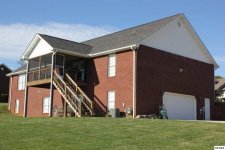
Thanks for the picture. What I'm looking to do is not all that different than a common patio like the attached photo. Instead of a gabled roof on top of the patio, I'd put decking and a railing.

I'm the first one to admin I'm not an expert and know what "code" allows. That's why I'm here asking the question. If I get some good ideas, then I'll put something together and talk to the inspector before I build it. But please don't just dismiss the idea because it's not something you've seen before so you assume it must not be allowed by building code. I've seen a lot of double and triple level decks here around the mountains.

I'm hesitant to support one side of the upper deck with the existing trusses so I think the free-standing, four-post design is probably stronger. But I would think attaching the second level to the garage could give both the garage and the deck more stability.

I had read installing the decking diagonally could increase rigidity as well. Agree?

As for resale value, if anything I think this option would be the least conspicuous as it is behind the garage with only the top railing partially visible. And this option would be the easiest to remove if a future homeowner didn't like it for some reason. Building a widows peak/walk on top of the dormer area would be much more prominent.

Thanks for the responses.
 

Attachments

  • stairs.jpg
    stairs.jpg
    84.4 KB · Views: 11

wssix99

Well-known member
Joined
Mar 2, 2011
Messages
5,155
Location
Chicago, IL
what "code" allows

Many municipalities adopt their own local codes for this type of thing. Your local city or county will likely have a deck or porch building guide that they can provide you with all of the details included.

(The greater proportion of wealthy children you have in your area killing themselves on decks, the stronger your deck will need to be and the tighter the railing balusters will need to be spaced!) Some municipalities require 40 psf decks. My city requires 100 psf (crazy) and there are municipalities all over that require strength's in between.


I'm hesitant to support one side of the upper deck with the existing trusses so I think the free-standing, four-post design is probably stronger.

In the end, your deck will be built to the same "strength," no matter what method you use. (Unless you purposefully design it to hold greater loads than your code requires.) Your levers beyond that are durability and economy.

Given the headaches you will have attaching ledgers to your truss areas, I'd assume that you are crossing the threshold where a four-post design would be economical for you.


But I would think attaching the second level to the garage could give both the garage and the deck more stability.

I expect that your municipality's deck guide will give you instruction for one method or the other. At the point where you have a 4-post deck with part of it attached to the house, you are getting in to a hybrid design. I would expect that that would require an engineer to do the design/calculations, which will throw of your economy of construction. (You'd have to see what your municipality provides you and go from there. You may have to get an engineer anyway for a 4-post design to work out all the diagonal bracing, etc.)


I had read installing the decking diagonally could increase rigidity as well. Agree?

For sure. Although, depending on the size of the deck and what type of decking/fastening system you use, it may not make that much of a difference. (Diagonal decking will cost you more in material and installation time.)
 
To avoid these ads, REGISTER NOW!
Top Bottom