To avoid these ads, REGISTER NOW!

Need help fitting garage into my budget

cstreit

Member
Joined
Sep 10, 2005
Messages
9
Location
Naperville, IL
I've been reading this forum for ideas on garage design for a few months now and need some help.

I am looking to build a detached garage on my property for my shop and to house my toys/racecar. I'm thinking of a 24 wide x 36 deep garage giving me room for 3 cars a small office, and a small storage room.

Problem is this would be at the rear of my property which is 200' deep and the extra costs of running gas/electric/driveway out there are killing my budget. I don't have the time to build it myself but I also don't want to screw myself in the long run by making it too small. I have a fair amount of automotive equipment and will be installing a 2-post lift so space is critical.

Any ideas on where I can look to save money without shortcutting the space in the garage?
 
To avoid these ads, REGISTER NOW!

trs900

Well-known member
Joined
Feb 26, 2006
Messages
46
Location
Georgia
Thats a tuff one..either you have to do some of it yourself or allow more in budget to complete, there are not many shortcuts worth taking as quality or quantity will suffer plus there is probably a building code you have to follow any how.. sorry but thats just my opinion..
 

BEECHFRONT

Active member
Joined
Jan 8, 2006
Messages
25
Location
NJ
i have a 38x34 2 story about 150 feet back, you can save alot by doing a stone driveway, renting a ditch wiitch and trenching the electric and gasline yourself
 
OP
C

cstreit

Member
Joined
Sep 10, 2005
Messages
9
Location
Naperville, IL
Thanks guys,

Unfortunately I only have 100AMP service at the house. In order fro me to run the line it would have to be from the house. If I have to upgrade the house it's a 100 foot run that the power company has to do.

It'll actually be shorter to do a seperate drop to the garage from the system. (Less than 75 feet) so I can't save there.

I am going to try and only do a stone driveway, if only because I park/drive an RV there and asphalt would sink within the first year anyway.

SO on top of the garage cost I have to estimate:

$1500 for the stone driveway
$1500 for the new service to the garage
$900 for the gas (could probably do this myself, but not sure it's worth that)

and then the last builder estimated over $1800 for the underground "connection box" and the panel in the garage....

All these extras add over $5500 to the build cost!
 

trainer

Well-known member
Joined
Nov 28, 2005
Messages
2,019
Location
Northern Ontario, Canada
It's probably time to talk to your banker and look at financing options.
It may make more sense to finance it longer than to try to cut back or upgrade later.
That $5500 worth of stuff today will probably be $7500 in two years.
Building codes always get stricter, materials and labour always go up.
 

automotive stud

Well-known member
Joined
Apr 3, 2006
Messages
83
Location
NJ
I agree with trainer that $5500 today will be $7500 in no time. My advice would be to do a little at a time though if your funds are short. Get the building up for now. Add electric, insulation, walls, and heat later on as time and money allow.

That's how I did mine. A neighbor is an electrician. He gave me some supplies and tips and sent me loose. I put lights where I wanted them, ran all the wires to the box, dug the trench and buried the tube from the house to the garage, all that good stuff. He came in, looked over my work, and tied it into the braker box in the garage, and tied that box into the box in the house. Saved a bundle that way. I've been buying insulation and putting it in as I have some extra money for it. Now I need to decide what kind of pegboard or paneling, or drywall I want to put up.
 

CruZer

Member
Joined
Apr 4, 2006
Messages
15
Location
ba'Boonies Windsor,Ma.
I agree. Getting the building up is the first priority. You can run gas ,electric, water later. Plus once the building is up,you'll have a place to save all the stuff you can scrounge to finish the job.
Like used heaters,air conditioners,cabinets,etc.
 

snorvet

Well-known member
Joined
Oct 29, 2005
Messages
777
Location
Northern Illinois
I agree also. build the garage now, then through in some gravel for the drive(probably larger stone for the base), then add electric and gas later. Hopefully the local codes will let you have a building with no electricity.

I didnt want to jack around with running electricity from my house to my detached garage, so I had the electric co install a new line from the transformer ( it was only 50' away) to the new garage. This route may be cheaper than upgrading your house panel and running service from the house to garage.
 

Tman

Well-known member
Joined
Jan 29, 2006
Messages
543
Location
Black Hills of South Dakota
Allow electrical PVC chases in the floor if you build it now. You can always fish wire later. Most locals will allow you to trench it yourself, just not hook it up.

If your house is only 100amp it might be worth it to upgrade the house as well. 100A isnt considered enough for todays homes/loads.
 
To avoid these ads, REGISTER NOW!
OP
C

cstreit

Member
Joined
Sep 10, 2005
Messages
9
Location
Naperville, IL
I'm going with 10' walls and a pitched celing basically. i've been working over some of the sales guys a bit now that I've narrowed it down to 2 builders.. Getting there but the racecar project has taken over my free time... Garage is on hold for a few weeks...
 

hotrod66paul

Banned
Joined
Oct 23, 2005
Messages
172
Location
INDIANAPOLIS
At my sons home that we inherited from my wife's parents the house had an old screw in fuse box that needed up-dated. The power came from a pole behind the garage so we had a 200amp service ran to the garage roof and split 100 amp off the box and through the garage and out the other end and underground to the new box in the house basement which was cheaper then running all the way from the pole to the house and then back to the garage. We did as Automotive Stud mentioned , wired up everything ourselves and then had an electrician friend check it before inspection.Saved a bundle and learned a lot along the way.
 

krooser

Well-known member
Joined
Jun 3, 2005
Messages
2,377
Location
Waupaca, Wisconsin
Driveway...Rent a bobcat for a weekend and scrape 12" of topsoil off of your driveway...order enuff "pit run" gravel (or whatever they call it in your area) to make a base and have the dump truck driver spread it for you. That will get you a solid drive...

Have a seperate 100 amp service for your garage...hire an electrician to put in the box and one outlet/lite. Get it inspected and do the rest yourself...you don't have to call in the inspector again. Hire an electrician apprentice to finish the wiring...lots cheaper if you don't want to tackle that alone. Hell, buy a book at Home depot and do it yourself.

Dig the trench yourself with a DitchWitch...run a propane furnace ( the propane guy will usually give you a tank as long as you keep buying from him)...convert the outfit to NG when you have the $$$.
 
Last edited:

mrtone

Well-known member
Joined
Apr 11, 2006
Messages
47
Location
Waynesboro, VA
Krooser has it right - that's what I did. I ditch witched for the gas and electric from my house. The electrician hooked up the panel, one 110 outlet and one 220. The plumber hooked up the gas furnace.
Wiring the building took some thought, it was a Steelmaster building so I used conduit to cross over and put outlets on the opposite side. Ran outlets about 4' high. Ran conduit to top for lighting.
A LOT of time, long nights after work - but a LOT of satisfaction and bragging rights!
 

Charles (in GA)

Well-known member
Joined
Jan 11, 2006
Messages
12,489
Location
50 mi south of Atlanta
Your estimates for electric service to the building seem way too high. If you only need to run 75 ft and plan on installing a meter on the building, the power company is going to be doing the work anyhow and probably charge a flat fee for up to a certain number of feet. Meter socket, disconnect, and panelboard are simply not that expensive. Do a minimum installation to get the permit closed out and later on add circuits. Do it to code, just do it yourself, slowly and carefully. You will spend a lot of time just contemplating the routing of wires, placement of switches, and outlets, etc. This will give you a chance to get it right the first time.

The following it the edited text from a post I recently made on another board when someone posted a question about new elect service for a pole building and workshop they were building.

The best thing you can do for starters if you are planning on doing any of the wiring yourself, is to buy the 2005 National Electric Code, and the illustrated guide to the National Electric Code by Charles Miller (which is excellent) and both are available from Amazon for $122 or so. While its alot, you have the code at hand and the best Illustrated guide around.

If you are planning on putting a meter on the outbuilding, your power company will handle the underground or overhead to the building (for a fee of course). If you want to tap off your house, the whole things changes. You would probably want to put a bigger meter on the house and dual disconnects, one for the house and one for the outbuilding, an expensive proposition in itself, plus run underground yourself to the building, also not cheap.

Given the price of panels, why would you bother to put in anything less than a 200 amp panel with 40 full size breaker slots? A Seimens unit runs about $120. You can buy the builder packs with breakers, but usually are smaller panels, 30 circuits or so, so you really don't get what you need or want.

I did an underground feed to a metal building with the panelboard on the inside and it came out real neat.

Some will say you don't want a second meter, but where I am, the second meter has a min charge of $14 and I generally have a total of less than $20 on it, so its no big deal. Real handy to have a second source of power when you want to do electrical work in the house and have to shut it down and need a drill or flo light. A couple of 12 gauge extensions will work wonders.

Buy the books, that way you wont have to ask or wonder if you got good info or just someones opinion. I'm glad I did.


Link to NEC 2005 and Illustrated Guide to NEC 2005 by Charles Miller

http://www.amazon.com/gp/product/0877656231/?tag=atomicindus08-20

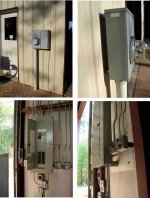
What follows is a post I added to the above, showing my shop's meter and panel installation. I thought it was pretty neat myself.

OK here are some pics of my elect panel installation on my metal building workshop.

From top left, going clockwise.

I has some wasted space between the man door and the 12wx14h glass garage door, so this was the perfect place for the meter outside and the panel inside.

Looking at the side of the meter socket, you can see it is spaced off the building. I used four 3/4 galvanized pipe couplings to act as spacers and ran bolts from inside the box thru the spacers, thru the wall, thru the insulation blanket inside, and placed a neatly cut piece of 3/4 plywood inside for the bolts to pass thru and tighen up to. On a metal building there is nothing solid to mount the meter can to, and I used the 3/4 plywood inside, edges rounded with a router to eliminate the sharp edges and placed reinforcing tape on the insulation blanket and squeezed it all together. It works well. The meter can has a 200 amp breaker disconnect in the RH half of it under an access door. This is a 200 amp Siemens meter socket/disconnect.

The 200A/40 circuit panelboard is mounted on a piece of superstrut running from a floor bracket to the 7 ft purlin and steadied with a piece of the thin superstrut running horizontally from one C channel column to the next. Behind the panelboard you can see the white painted plywood reinforcement on the insulation with the bolts/nuts in the corners, retaining the meter socket/disconnect outside, and the large grey PVC conduit connecting the two.

Here is the open panelboard. I used a main lug panel as the disconnect was only about two steps away outside. Had it been many feet away, I would have used a main breaker panel, but this is cheaper, and has more room in it to work. This is a Siemens 40 full space panel. The two devices in the upper left slots are surge suppressors with LED indicator lamps, the breaker just below it feeds a subpanel that the air compressor is connected to. I took advantage of the superstrut to install a 50 amp welder outlet, a 20 amp 240v outlet, a 20 amp/20 amp receptacle, and a double receptacle box. I have 9 20 amp breakers feeding 29 duplex receptacles throughout the building. The side by side receptacles, in all cases, are on different breakers, and I carried out individual neturals for each circuit though I didn't have to. The two circuits could share a netural if wired in a proper multi-wire circuit installation. The empty 4x4 boxes are for light switches, I haven't installed the overhead conduits yet. Presently the building (a 60x60 aircraft hangar in my back yard) is lit with two 500 watt quartz floods mounted on the 12 ft purlin on the west wall. Provides decent area lighting at nite.


Charles
 

Attachments

  • Elect_install.jpg
    Elect_install.jpg
    68.9 KB · Views: 6,265
Last edited:

ironroad 9c1

Banned
Joined
Sep 3, 2005
Messages
758
Location
Gum spring,VA
wow i only paid 215 bucks to the power company to install a seperate service and bury the line for mine ,had a run of maybe 75 feet i guess and the meterbase was free from the power company .
 

Charles (in GA)

Well-known member
Joined
Jan 11, 2006
Messages
12,489
Location
50 mi south of Atlanta
ironroad 9c1 said:
wow i only paid 215 bucks to the power company to install a seperate service and bury the line for mine ,had a run of maybe 75 feet i guess and the meterbase was free from the power company .

This is the kind of money I was alluding to in my post. I think in my case the power company charged $160 for up to 100 ft and a per foot after that. I had mine done for the $160.

Many local codes require a service disconnect outside the building (so fire dept can shut it off) but this is not required to be outside by the NEC. If you need or want a outside disconnect you are probably better off buying a combination meter socket/disconnect than using the power companies free one and having to then buy a disconnect and hardware to connect it all together. Been there, done that. I put new 200 amp panel and service on my parents house and power company insisted I had to use their new meter socket, and not a storebought one. Big pain connecting it all together and it wasn't that nice looking either. On my shop I bought the combo unit and have a nice looking, safe installation that I didn't have to waste any time building up, at only a little more $ than what the "free" meter socket and the required outside disconnect would have cost.

Charles
 
To avoid these ads, REGISTER NOW!
Top Bottom