need help fixing an heirloom Queen Anne(?) table

BTL-A4

Well-known member
Joined
Feb 28, 2018
Messages
1,252
Location
Santa Clarita
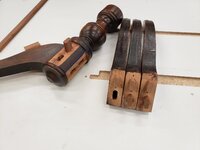
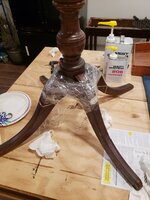
I got a buddy that has an old family heirloom dining table that he'd like to fix. It might be 100 years old, probably less. He's fine with me gluing it, but I'm not so sure I want to just glue it and be done. What type of wood is this (we think it's mahogany)? What type of stain (probably nothing available today)? Who made it? Is it worth enough money to worry about screwing it up with a crappy glue job? Some pictures with the only info I have:

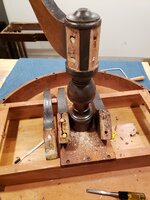
20250123_154226.jpgimage000000(18).jpgimage000001(5).jpg

We found info about the Jefferson Woodworking, but nothing about the table, just the roller slide mechanism.

Anyone got any ideas where I could look and find out more? Should I just go ahead and glue it carefully, wipe off the glue and call it a day? It appears the glue has just dried out due to age.

Thanks!
 
To avoid these ads, REGISTER NOW!

MikeK

Well-known member
Joined
Oct 6, 2020
Messages
414
Location
Germany
Unless there is a strong family attachment to this table, I would not bother. Based solely on the photos, I doubt the age of this table is anywhere near 100 years. The pedestal and legs are not made from single blocks of wood, but are laminated planks that are later machined to shape. It looks like some of the laminations on the legs have separated.

The legs appear to be attached to the pedestal with floating tenons and pinned into place with dowels and glue. This makes a very weak joint for this application and could explain why the joints are separating.

The "85.TABLE.GEN.MAH" stencil looks similar to the inventory nomenclature markings found on furniture from a Consolidated Furnishings Management Operations (CFMO) warehouse. Most large U.S. military installations have a CFMO warehouse that stores and issues furniture and household goods to familes living in military quarters.

The surface with the stenciling appears to be painted MDF instead of solid wood. This is common with CFMO furniture.
 

SaintPanzer

Active member
Joined
Jul 28, 2014
Messages
31
Unless there is a strong family attachment to this table, I would not bother. Based solely on the photos, I doubt the age of this table is anywhere near 100 years. The pedestal and legs are not made from single blocks of wood, but are laminated planks that are later machined to shape. It looks like some of the laminations on the legs have separated.

The legs appear to be attached to the pedestal with floating tenons and pinned into place with dowels and glue. This makes a very weak joint for this application and could explain why the joints are separating.

The "85.TABLE.GEN.MAH" stencil looks similar to the inventory nomenclature markings found on furniture from a Consolidated Furnishings Management Operations (CFMO) warehouse. Most large U.S. military installations have a CFMO warehouse that stores and issues furniture and household goods to familes living in military quarters.

The surface with the stenciling appears to be painted MDF instead of solid wood. This is common with CFMO furniture.
This is probably correct on the dating. I can see the lathe marks at the center of the pedestal. Of course, it still kind of surprises me that "100 years ago" was only 1925, but the 1980s were 40 years ago. I'm going to need a minute.

I found a site that mentioned the Jefferson Woodworking Company, who made the slides, was in business in the 1920s, but went out of business in the 1990s. They made the slides, but not the table itself

In any case, not sure on the floating tenons, and the dowels confuse me. Are they angled towards the pedestal at all? I can't see how they reinforce anything. How much "wiggle" in the joint? That leg appears to be three pieces, does that one "lower" piece slide? The "right" way to have attached that joint would have been a sliding dovetail, but we are way past that point now.

Not knowing the original glue makes it difficult. I might try epoxy like System3 or WEST System, with a little bit of colloidal silica. A Thixo type cartridge may be helpful, depending on how large that gap is. Can you clamp it once glue is added? I'm assuming a band clamp around the legs may pull things tight. If you can hand-cut a butterfly type key in afterwards, that will help reinforce it, but no promises on any of the above.

If the leg comes apart completely (without tearing any wood) a floating sliding dovetail would be possible, but difficult. We may be at "maximum effective range" with this one.
 

MikeK

Well-known member
Joined
Oct 6, 2020
Messages
414
Location
Germany
This is probably correct on the dating. I can see the lathe marks at the center of the pedestal. Of course, it still kind of surprises me that "100 years ago" was only 1925, but the 1980s were 40 years ago. I'm going to need a minute.
Yes, time does seem to slip by. I was thinking more of the 1970s for the table, but also had a short pause because that is 50 years ago.

In any case, not sure on the floating tenons, and the dowels confuse me. Are they angled towards the pedestal at all? I can't see how they reinforce anything. How much "wiggle" in the joint? That leg appears to be three pieces, does that one "lower" piece slide? The "right" way to have attached that joint would have been a sliding dovetail, but we are way past that point now.

I'm guessing on the floating tenons, and nothing is certain until you disassemble the pedestal. The dowels could be plugs concealing recessed screws, but I have no idea what the screws would be holding, unless they are angled into the opposing piece. As you wrote, a sliding dovetail is the preferred method of joining these types of legs to pedestals.

If I was going to use a floating tenon and dowels, I would draw bore one of the holes in the tenon so the dowel will force the joint to close as it is pounded into the hole. However, this method creates additional problems with the legs because there isn't much material on the leg to oppose the force of the dowel.

Not knowing the original glue makes it difficult. I might try epoxy like System3 or WEST System, with a little bit of colloidal silica. A Thixo type cartridge may be helpful, depending on how large that gap is. Can you clamp it once glue is added? I'm assuming a band clamp around the legs may pull things tight. If you can hand-cut a butterfly type key in afterwards, that will help reinforce it, but no promises on any of the above.

If the table was 100 years old, the glue would likely be hide glue, and that would be fine for the stresses of a dovetail joint, but I wouldn't trust it for this table. I would use the 2-part epoxy and do my best to reinforce the joint with solid wood tenons.

For the clamping challenge, I would glue one leg at a time. Clamp the leg in a workbench vice with the joining surface pointing up and the pedestal horizontal. After dry fitting the parts and put masking tape on all surfaces at the joints to control the effects of glue squeeze out. Then, apply the glue, attach the pedestal, and apply the clamps with one end on the upper side of the pedestal and the other end on the bottom of the workbench vice. This will take a longer time than gluing all three legs at once, but it makes the clamping and alignment process easier.

If the leg comes apart completely (without tearing any wood) a floating sliding dovetail would be possible, but difficult. We may be at "maximum effective range" with this one.

Yes, I think the sliding dovetail ship has sailed, unless you feel adventurous and want to try a double sliding dovetail (long butterfly key).
 

SaintPanzer

Active member
Joined
Jul 28, 2014
Messages
31
Yes, time does seem to slip by. I was thinking more of the 1970s for the table, but also had a short pause because that is 50 years ago.


I'm guessing on the floating tenons, and nothing is certain until you disassemble the pedestal. The dowels could be plugs concealing recessed screws, but I have no idea what the screws would be holding, unless they are angled into the opposing piece. As you wrote, a sliding dovetail is the preferred method of joining these types of legs to pedestals.

If I was going to use a floating tenon and dowels, I would draw bore one of the holes in the tenon so the dowel will force the joint to close as it is pounded into the hole. However, this method creates additional problems with the legs because there isn't much material on the leg to oppose the force of the dowel.


If the table was 100 years old, the glue would likely be hide glue, and that would be fine for the stresses of a dovetail joint, but I wouldn't trust it for this table. I would use the 2-part epoxy and do my best to reinforce the joint with solid wood tenons.

For the clamping challenge, I would glue one leg at a time. Clamp the leg in a workbench vice with the joining surface pointing up and the pedestal horizontal. After dry fitting the parts and put masking tape on all surfaces at the joints to control the effects of glue squeeze out. Then, apply the glue, attach the pedestal, and apply the clamps with one end on the upper side of the pedestal and the other end on the bottom of the workbench vice. This will take a longer time than gluing all three legs at once, but it makes the clamping and alignment process easier.


Yes, I think the sliding dovetail ship has sailed, unless you feel adventurous and want to try a double sliding dovetail (long butterfly key).
I came up with the 80s because the first two digits on that stencil are "85", but that's more "word association" than educated guess.

Hide glue would be easiest... but you're right, not probable. I was thinking things like PVA does not work well going over PVA.

Yes, a sliding butterfly key was what I was thinking of as a "floating sliding dovetail". If the legs "non-destructively" come off, a router might be able to do it, but it completely depends on comfort level and willingness to try. Although, now that I think on it, if you could cut that joint, a heavily thickened epoxy might be a way to go.... But I've never actually tried that. I think the pictures above of the domino joints is the way to go.
 
To avoid these ads, REGISTER NOW!

lolaetype

Well-known member
Joined
Dec 11, 2019
Messages
2,087
Location
North Western Arkansas
The style of the shaping of the parts you have shown initially suggested to me it's from the 20's to the start of WWII. But a quick look on google tells me Phillips head screws (if the ones shown in the picture are original) weren't widely used in furniture until the late 1930s. The inked number tells me it's a mass produced item. So I'm guessing 1950's to 1970. Probably not very valuable. But if it's a nice looking piece and can be repaired with a reasonable amount of effort, then why not. Is the top solid or laminated? I'm assuming it is rectangular with rounded ends and measures 96" overall with leafs.
 
Last edited:
OP
B

BTL-A4

Well-known member
Joined
Feb 28, 2018
Messages
1,252
Location
Santa Clarita
I got some more info.

My buddy thinks his parents bought it sometime in the late 1930's or early 40's. It is most definitely NOT from any later than 1950's, since his grandparent had it before his parents had it. His grandparents died in the late 1960's and would not have bought furniture that late.

The Phillips head screws referred to above are from another person's table, not the one I'm asking about.

It is veneer over solid wood. He pointed out that this was in humid Houston, Texas for many years and probably got dried out when he brought it to California.

I think we'll just glue it together carefully. It's got sentimental value only at this point. I'm pretty sure my buddy's kids won't care about it, so it only needs to last another 30 years or so.
 

RTM

Well-known member
Joined
May 13, 2019
Messages
13,160
Location
SF Bay Area
Hide glue is the preservationist’s answer to vintage to antique furniture repair. It’s reversible, period correct, etc, and won’t do damage if things fail. PVA glue is often stronger than the wood, so if things break again, the wood will be damaged, but your glue line may still hold together. Not sure if that’s a positive or negative to you. West Epoxy scares me around old furniture.


Based on the Gen. MAH, I’d guess it’s supposed to be a mahogany looking finish. Whether real mahogany, mahogany Verneer, or just mahogany paint over poplar, no idea.
.

Rather than just squirting glue into the cracks and clamping the heck out of it, I’d look at a gentle disassembly, forensics, and reassemble it. You really want to get the old glue off the mating surfaces for best adhesion (not sure about epoxy) from New glue to wood.

The fact that the leg delaminated should be addressed similarly.

I do agree that the dovetail is the right build technique for a real period correct table, and disassembly might give you clues as to age. When were dowel popular, vs floating tenons?

What are the dowels going parallel to the center support doing? Reminds me of something where the dowel was used like a drawbored pin into some weird protrusion of

I have / had some older furniture with painted labels, but not as brutalist as that one, so the painted on bit isn’t concerning, just what it says, regarding age.
 

StillTooManyHobbies

Well-known member
Joined
Jul 4, 2014
Messages
528
Location
Port Tobacco, MD
As far as the finish goes. if refinishing is more trouble than necessary, I might suggest some Howard's Restore-a-finish in mahogany, applied with 0000 steel wool, followed by a coat of wax, such as Briwax, available from many sources.
 

MoonRise

Well-known member
Joined
Nov 5, 2010
Messages
4,028
Location
NJ
Step 1: Careful disassembly and diagnostics.

Find out how it was assembled and try to figure out why it failed.

Then come up with a plan or two as to how to fix it.

I tend to agree that the table is in the ~50+ year old range but not in the 100 year old range. And not an actual Queen Anne era heirloom antique (wrong style, wrong construction, not ~300 years old).

To me, just putting 'glue' (unless it's actually hide glue, you are using an adhesive) everywhere and maybe clamping it and calling it 'done' is NOT fixing it. 🤔

Sometimes that is OK, but usually there are more 'elegant' ways to fix or repair something. Takes more time and some level of craftsmanship, but that is often more satisfying than just slapping glue on it and saying 'done'.

Disassemble first and see what is going on and how it was assembled and why it failed.

Then reglue the separation of the leg boards. Then come up with a reattachment method and way to connect the legs to the center post.

Modern woodworking glues (TiteBond type) are usually stronger than the wood itself with proper prep and application. The wood itself will fail before the glue joint does. Epoxy is usually not needed for most furniture IMHO, but sometimes it is appropriate.

No matter what, you usually have to remove the old glue and get to 'fresh' wood for the adhesives to properly bond to the wood.
 

My Old Tools

Well-known member
Joined
Jun 4, 2014
Messages
5,437
Location
Hamrick Lake, TX
The table is mahogany. It is from the 1920's through maybe 1940. Millions were made, very common. That area is always a weak spot with the angles and limited glue surface. Some were actually assembled with a sliding dovetail joint. Hide glue was original and should be used in the repair, so it can be disassembled and repaired again. Hide glue is plenty strong. Almost all stringed instruments of any quality are assembled with it and they have much higher stresses. The finish is likely shellac. See it alcohol softens it. Hide glue joints come apart with hot water.
 
To avoid these ads, REGISTER NOW!
Top Bottom