To avoid these ads, REGISTER NOW!

Need help identifying these Craftsman tools

Big Game

New member
Joined
Aug 3, 2022
Messages
2
Hi all, new member here.

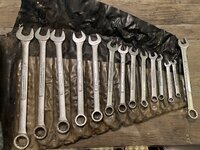
Yesterday I purchased this complete set of Craftsman wrenches from the original owner for $50. I don't really use standard, but thought it was such a cool set that I just had to have it. I'm trying to learn as much as I can about them but can't seem to find too much on the internet.

The gentleman I purchased from said he believes he bought them from Sears in 1970. From the research I've done, they appear to be manufactured prior to 1969 based on the =V= tag and absence of a model number. Is there any way to determine more specifically? So far this is all I've been able to figure out. Any other details would be greatly appreciated.

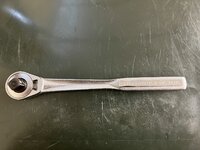
Also, I found this ratchet buried in the back of my tool box. It also appears to be a few decades old. It was locked up so I took it apart and covered the internals in Super Lube. Works like a champ now. Is there a resource that matches model numbers with production years?

Many thanks,
Big Game
 

Attachments

  • IMG_6839.JPG
    IMG_6839.JPG
    477.7 KB · Views: 102
  • IMG_6840.JPG
    IMG_6840.JPG
    439.5 KB · Views: 101
  • IMG_6841.JPG
    IMG_6841.JPG
    372.2 KB · Views: 99
  • IMG_6842.JPG
    IMG_6842.JPG
    330.7 KB · Views: 94
To avoid these ads, REGISTER NOW!

LNKMK8

Well-known member
Joined
Feb 6, 2013
Messages
1,183
Location
Overland Park, KS
You won't find a specific year like with Snap-on, but rather a range of years. Looking through the old catalogs is a great place to start, there are many available online. I believe they started putting the catalog numbers on tools around 1964. The generation of wrenches prior to what you have just had "Forged in USA" on the back, without the =V=. That change would have occurred somewhere in the 1950's, as the prior generation would have had the "Long C" logo. I would guess your wrenches are early 1960's.

If you really want to dig into Craftsman ratchets, I'd reccomend this video:
 

Lesserstore

Well-known member
Joined
Mar 18, 2020
Messages
863
Location
Texas
The combo wrenches would've been made late 1960s and possibly into 1970. Sometime in the late 60s Moore Drop Forge widened the beams, which is what you have.
 

Ricky Joe

Well-known member
Joined
Sep 15, 2013
Messages
2,452
Location
Roanoke, Va.
The combo wrenches would've been made late 1960s and possibly into 1970. Sometime in the late 60s Moore Drop Forge widened the beams, which is what you have.
Reminds me of a job I did about forty years ago, tearing down and eventually removing and replacing the engine in a late 1950s B model Mack dump truck. Removing the fenders with a thin Craftsman wrench and a pipe bent the wrench around. This was in the field. It held, the bolt held, but the wrench became an involuntary obstruction wrench.
 
To avoid these ads, REGISTER NOW!

DadsTools

Well-known member
Joined
Jul 27, 2017
Messages
1,852
It's often difficult to obtain an exact year of manufacture with Craftsman wrenches, but in the case of your combo set, we're fortunate to be able to narrow it down quite a bit because of the markings. As Lesserstore mentioned, the wide beams are one indication. Research has established that the stamping of model numbers on the wrenches began right around 1970. It was at this very same time when the V embedded in double lines (or as we say, =V=) changed to a V with just a small dash delineater on either side of the V (or what we call -V-). The transition from the pointed-top A in the Craftsman name on the wrenches to the flat-top A (to bring the marking in line with the way the logo was rendered in the catalogs) occurred around 1968. All this places your wrench set squarely in 1968-69. :thumbup:

The ratchet is a little trickier, but with several details we can narrow it down. The model number stamping places the ratchet at least from 1970 onward. But during the early 1970s Sears began to remove the double lines of the old logo on the drive tools like ratchets, creating a 'no-lines' logo. This may have been motivated by the thought to keep the obverse panel consistent with the reverse panel on which the double lines were eliminated with the introduction of the model numbers, but that's speculation. We believe the elimination of the double lines on the teardrop ratchets began around 1972, although occasional examples of the double-line can still be found. Then in 1976, Sears celebrated the 50-year anniversary of the classic Craftsman logo (according to their reckoning, although I suspect the celebration was meant to coincide more with the bi-centennial than an exact count of years). It was at this time that Sears restored the double-line logo on the obverse panel on all the drive tools, which if I recall correctly, was maintained at least through the end of the single-V (-V-) era ending in 1986.

Another clue is the quick-release 'plunger' at the top of the stud. Because of the lawsuit over the Roberts QR patent, Sears introduced the Type 2 quick release early in 1981 based on the Sardo patent, which had a 'blind' stud having no opening at the end for a plunger. This places your ratchet before the 1981 Sardo version.

The final clue is the plunger itself. Sometime around 1977, Sears reduced the diameter of the plunger on the 1/2 and 3/8 ratchets. We've only been able to speculate as to why--among the possible reasons may have been to somehow reduce production cost or to make the stud stronger by having a greater amount of solid metal around the plunger hole. Your ratchet has the 'small plunger' variation.

All these details allow us to confidently date your ratchet circa 1977-1980.:thumbup:

To find out more about the Craftsman V-era ratchets, you may want to check out the several essays I wrote for the RHFT ratchet study. https://www.garagejournal.com/forum/threads/craftsman-rhft-ratchet-type-study-1968-2009.455802/
 
OP
B

Big Game

New member
Joined
Aug 3, 2022
Messages
2
It's often difficult to obtain an exact year of manufacture with Craftsman wrenches, but in the case of your combo set, we're fortunate to be able to narrow it down quite a bit because of the markings. As Lesserstore mentioned, the wide beams are one indication. Research has established that the stamping of model numbers on the wrenches began right around 1970. It was at this very same time when the V embedded in double lines (or as we say, =V=) changed to a V with just a small dash delineater on either side of the V (or what we call -V-). The transition from the pointed-top A in the Craftsman name on the wrenches to the flat-top A (to bring the marking in line with the way the logo was rendered in the catalogs) occurred around 1968. All this places your wrench set squarely in 1968-69. :thumbup:

The ratchet is a little trickier, but with several details we can narrow it down. The model number stamping places the ratchet at least from 1970 onward. But during the early 1970s Sears began to remove the double lines of the old logo on the drive tools like ratchets, creating a 'no-lines' logo. This may have been motivated by the thought to keep the obverse panel consistent with the reverse panel on which the double lines were eliminated with the introduction of the model numbers, but that's speculation. We believe the elimination of the double lines on the teardrop ratchets began around 1972, although occasional examples of the double-line can still be found. Then in 1976, Sears celebrated the 50-year anniversary of the classic Craftsman logo (according to their reckoning, although I suspect the celebration was meant to coincide more with the bi-centennial than an exact count of years). It was at this time that Sears restored the double-line logo on the obverse panel on all the drive tools, which if I recall correctly, was maintained at least through the end of the single-V (-V-) era ending in 1986.

Another clue is the quick-release 'plunger' at the top of the stud. Because of the lawsuit over the Roberts QR patent, Sears introduced the Type 2 quick release early in 1981 based on the Sardo patent, which had a 'blind' stud having no opening at the end for a plunger. This places your ratchet before the 1981 Sardo version.

The final clue is the plunger itself. Sometime around 1977, Sears reduced the diameter of the plunger on the 1/2 and 3/8 ratchets. We've only been able to speculate as to why--among the possible reasons may have been to somehow reduce production cost or to make the stud stronger by having a greater amount of solid metal around the plunger hole. Your ratchet has the 'small plunger' variation.

All these details allow us to confidently date your ratchet circa 1977-1980.:thumbup:

To find out more about the Craftsman V-era ratchets, you may want to check out the several essays I wrote for the RHFT ratchet study. https://www.garagejournal.com/forum/threads/craftsman-rhft-ratchet-type-study-1968-2009.455802/
Wow! Thank you so much for taking the time to write all of this. Your Craftsman knowledge is next level. This is has been most helpful and I am thrilled to know more about my tools. I will definitely check out your essays on the V-era ratchets. 😁
 

Lesserstore

Well-known member
Joined
Mar 18, 2020
Messages
863
Location
Texas
It's often difficult to obtain an exact year of manufacture with Craftsman wrenches, but in the case of your combo set, we're fortunate to be able to narrow it down quite a bit because of the markings. As Lesserstore mentioned, the wide beams are one indication. Research has established that the stamping of model numbers on the wrenches began right around 1970. It was at this very same time when the V embedded in double lines (or as we say, =V=) changed to a V with just a small dash delineater on either side of the V (or what we call -V-). The transition from the pointed-top A in the Craftsman name on the wrenches to the flat-top A (to bring the marking in line with the way the logo was rendered in the catalogs) occurred around 1968. All this places your wrench set squarely in 1968-69. :thumbup:

The ratchet is a little trickier, but with several details we can narrow it down. The model number stamping places the ratchet at least from 1970 onward. But during the early 1970s Sears began to remove the double lines of the old logo on the drive tools like ratchets, creating a 'no-lines' logo. This may have been motivated by the thought to keep the obverse panel consistent with the reverse panel on which the double lines were eliminated with the introduction of the model numbers, but that's speculation. We believe the elimination of the double lines on the teardrop ratchets began around 1972, although occasional examples of the double-line can still be found. Then in 1976, Sears celebrated the 50-year anniversary of the classic Craftsman logo (according to their reckoning, although I suspect the celebration was meant to coincide more with the bi-centennial than an exact count of years). It was at this time that Sears restored the double-line logo on the obverse panel on all the drive tools, which if I recall correctly, was maintained at least through the end of the single-V (-V-) era ending in 1986.

Another clue is the quick-release 'plunger' at the top of the stud. Because of the lawsuit over the Roberts QR patent, Sears introduced the Type 2 quick release early in 1981 based on the Sardo patent, which had a 'blind' stud having no opening at the end for a plunger. This places your ratchet before the 1981 Sardo version.

The final clue is the plunger itself. Sometime around 1977, Sears reduced the diameter of the plunger on the 1/2 and 3/8 ratchets. We've only been able to speculate as to why--among the possible reasons may have been to somehow reduce production cost or to make the stud stronger by having a greater amount of solid metal around the plunger hole. Your ratchet has the 'small plunger' variation.

All these details allow us to confidently date your ratchet circa 1977-1980.:thumbup:

To find out more about the Craftsman V-era ratchets, you may want to check out the several essays I wrote for the RHFT ratchet study. https://www.garagejournal.com/forum/threads/craftsman-rhft-ratchet-type-study-1968-2009.455802/
I never even noticed the flat top A's.
 

DadsTools

Well-known member
Joined
Jul 27, 2017
Messages
1,852
Wow! Thank you so much for taking the time to write all of this. Your Craftsman knowledge is next level. This is has been most helpful and I am thrilled to know more about my tools. I will definitely check out your essays on the V-era ratchets. 😁
The story behind the RHFT type study is interesting. Member b.well was seeking info on the RHFT ratchets and I happened to start researching it, only to discover there wasn't a lot of solid information available. The more I looked into it, the more I realized that someone needed to take the time to do a proper study having specific, useful details. That set me on the project, which took about 3 weeks or so of focused work.

What I discovered was that the RHFT was unique because of the many patent numbers that show up on these ratchets in rapid sequence. I was able to put together an accurate typing by checking the USPTO records for exact dates of each type. This not only allowed me (perhaps for the fist time in any Craftsman type study) to almost completely ignore the catalogs. The patent dating also revealed how inaccurate the catalogs were--any study relying primarily on Craftsman catalogs and the associated graphics (which were all artist rendered by hand) was inherently flawed.

Then came the information relating to the long legal battle between Roberts and Sears over Robert's QR patent. The court documents revealed all kinds of behind-the-scenes info about Sears Craftsman hand tools oi the day that could not have been discovered without the court documents. I doubt that any other previous type studies had the advantage of this plethora of information.

Once the RHFT study was completed, we found that the typing and dating could be directly applied to other Craftsman mechanics tools. For example, we were now able to state with certainty precisely what years the changeover occurred from pointed-A to flat-A and when model numbers began to appear on the wrenches, all because we could precisely date the patent numbers on the RHFT ratchets that displayed these changes in markings. The uncertainty in the Craftsman collecting community surrounding the dating of these events was finally resolved.

As it turned out, the RHFT type study evolved into a kind of Rosetta Stone for these period Craftsman wrenches that provided 'translations' for numerous details on their other hard line hand tools that had previously been hazy. I never dreamed that it would ever result in being this kind of standard that shed light on many other period Craftsman puzzles.
 
To avoid these ads, REGISTER NOW!
Top Bottom