To avoid these ads, REGISTER NOW!

Need help inserting self tapping screw in metal

bw77

Well-known member
Joined
Jul 10, 2009
Messages
1,316
Location
Upstate NY
I am trying to put together a metal fence post that has a metal end cap.
Company provides a self-tapping screw. I have been drilling a starter hole
in the side of the end cap, and also through the pole it goes on. Then using
a phillips screwdriver to turn them in by hand.

I tried using a drill with a phillips bit, but could not get it to penetrate the
metal without first drilling a hole. And it was hard to hold the screw.

Is there a screw holding sleeve I should be using on the drill that would make
this job much easier?

Should I expect to be able to get the screw in without first drilling a hole?

Thanks.
 

Attachments

  • IMG_1636.JPG
    IMG_1636.JPG
    39 KB · Views: 100
To avoid these ads, REGISTER NOW!

gt40mkii

Banned
Joined
Apr 13, 2011
Messages
323
there are screw-holding sleeves. I have one made by DeWalt that I use for drywall screws and such. However, if you don't already have one, then I'd just enlarge your pilot hole to the same diameter as the starter tip of the screw (since its job is to drill a hole anyway,) and then screw the screw in using your drill (MUCH easier than doing it by hand.)
 

rlitman

Well-known member
Joined
Oct 18, 2010
Messages
24,582
Location
Long Island
I've put those through 3/16" steel. They don't ****, BUT you only get one shot at using them, and you need to put them in with a real drill.
 

Marty256

Well-known member
Joined
Aug 26, 2007
Messages
170
Location
Central NJ
Those things are made for sheet metal not the thicker guage stuff like post caps and rails. You'll need to drill pilot holes like mentioned above.
 
OP
B

bw77

Well-known member
Joined
Jul 10, 2009
Messages
1,316
Location
Upstate NY
there are screw-holding sleeves. I have one made by DeWalt that I use for drywall screws and such. However, if you don't already have one, then I'd just enlarge your pilot hole to the same diameter as the starter tip of the screw (since its job is to drill a hole anyway,) and then screw the screw in using your drill (MUCH easier than doing it by hand.)


A drive guide like this one?

http://www.amazon.com/dp/B0000225P8/?tag=atomicindus08-20
 

kbs2244

Well-known member
Joined
Nov 11, 2006
Messages
14,065
You are doing it correctly.
But.
You wil never do it by hand.
Get a power screwdriver.
Don't use your drill.
It will spin too fast.
 

Bmwrider

New member
Joined
Jan 6, 2012
Messages
1
Drill a hole smaller than the screw and then use a drill or driver to put the screw into the post. Most of the fence caps I have used I used metal screws and drilled the hole. I did not use the self tapping screws. Those work great for metal buildings.
 
OP
B

bw77

Well-known member
Joined
Jul 10, 2009
Messages
1,316
Location
Upstate NY
You are doing it correctly.
But.
You wil never do it by hand.
Get a power screwdriver.
Don't use your drill.
It will spin too fast.


What rpm should I be using?
Typical drill/driver on low speed, 0-500?
 
Last edited:
OP
B

bw77

Well-known member
Joined
Jul 10, 2009
Messages
1,316
Location
Upstate NY
Drill a hole smaller than the screw and then use a drill or driver to put the screw into the post. Most of the fence caps I have used I used metal screws and drilled the hole. I did not use the self tapping screws. Those work great for metal buildings.

You used the metal screws with the sharp point?
 

MoonRise

Well-known member
Joined
Nov 5, 2010
Messages
4,028
Location
NJ
i am trying to put together a metal fence post that has a metal end cap.
Company provides a self-tapping screw. I have been drilling a starter hole
in the side of the end cap, and also through the pole it goes on. Then using
a phillips screwdriver to turn them in by hand.

I tried using a drill with a phillips bit, but could not get it to penetrate the
metal without first drilling a hole. And it was hard to hold the screw.

Is there a screw holding sleeve i should be using on the drill that would make
this job much easier?

Should i expect to be able to get the screw in without first drilling a hole?

Through sheetmetal, sure. Through thicker metal, like a pipe, maybe or maybe not. Some self-tapping screws are just "self-tapping sheetmetal screws". Some may be made to self-drill and self-tap thicker metal.

Sure-fire way is to drill a clearance hole through the cap, then drill and tap the threads in the pipe sidewall. Depending on if the screw threads are a standard tap size or not.

You may or may not be able to 'get by' with drilling a clearance hole in the cap and then an appropriate diameter starter hole in the pipe sidewall and running that 'self-tapping' screw in there.

Yes, use the 'low-speed' range on the drill/driver. Cause you really don't have too much control trying to self-drill and self-tap a screw at 2000 rpm (excepting a drywall screw and drywall screw gun, those things scream along at like 4000 rpm. And if you don't apply a goodly amount of push/thrust when trying to install those drywall screws that fast, you pretty much instantly strip the head recess.) :lol_hitti


thanks.

YMMV. :beer:
 

slickgt1

Well-known member
Joined
Oct 11, 2010
Messages
1,674
I don't know. Maybe the screws I use are stronger, but I put them through pretty much anything. Yea sometimes I burn them, but I usually never have pilot drill anything. If I do, I use one of the screws. Get a real screw driver and go to work. Make sure the bit fits well, or the screw will wobble, and that is probably why you are having such a rough time with it. Screw gun, right bit, pressure, press trigger, drive it in. Move on.
 

drmarkr

ALLIANCE MEMBER
Joined
Feb 5, 2006
Messages
4,202
Location
Tucson
What rpm should I be using?
Typical drill/driver on low speed, 0-500?

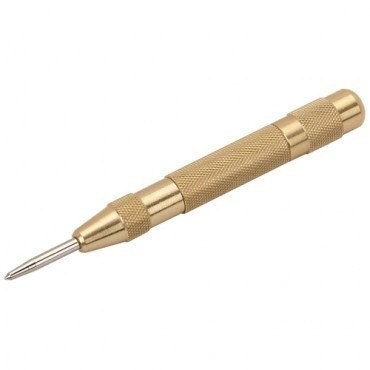
Absolutely the slower speed. Get an auto center punch like this:

il_570xN.188726413.jpg


and it will be MUCH easier...maybe preclude the need for a pilot hole.

Better idea would be to throw the screws away and buy some of these:

auto-part-stainless-steel-hexagon-flange-self-drilling-self-tapping-screw.jpg
 
To avoid these ads, REGISTER NOW!

Torque1st

MEMBER EMERITUS
Joined
Sep 14, 2008
Messages
5,668
Location
KC Metro, Kansas
You really don't need to drill and screw those top rail end caps on. Cut the pipe to the correct length and slip the cap on. Bolt the rail in place. Once you tension the fabric they are not going anywhere.
 

1948

Well-known member
Joined
Oct 14, 2011
Messages
569
Location
IL WI border
i use the bolt head type all the time to put brake line clamps on frames. they will go through 1/4 inch steel no problem. you need a quick and powerful drill, i dont know about all this slow talk.... you gotta push it into the metal kinda hard.
 

Northstar

Well-known member
Joined
Nov 27, 2011
Messages
304
Location
Minneapolis, MN
Absolutely the slower speed. Get an auto center punch like this:

il_570xN.188726413.jpg


and it will be MUCH easier...maybe preclude the need for a pilot hole.

Better idea would be to throw the screws away and buy some of these:

auto-part-stainless-steel-hexagon-flange-self-drilling-self-tapping-screw.jpg

Everything he said!

I use hex head ones, MUCH easier to be held by a socket. You can get 1/4" drive socket bits for your drill/driver, or I have a bit with a 1/4" end so I can swap different sockets w/o changing the whole bit.

Also, on rounded or heavily painted surfaces, a good sharp blow on a point will keep the bit's tip from wandering.
 

KnurledNut

Well-known member
Joined
Jan 28, 2011
Messages
8,098
Location
n/a
Those self drilling screws are great! Use em all the time. Run them in at 2000 rpm (any more will burn the tip up) and use a magnetic bit holder with a good philips. There is nothing wrong with those screws but you gotta finesse them in and keep your drill straight.
 

jhelrey

Well-known member
Joined
Sep 15, 2010
Messages
7,242
Location
MN
I used to install fences professionally. I have never ever used a self taping screw on a fence. The top rail should fit in tight. When you stretch the fabric (fence itself), it will pull the terminal posts in tight against the top rail. When you tie the fabric, the fence isn't going anywhere.

Toss the screws!
 

DIYKiah

Well-known member
Joined
Mar 15, 2012
Messages
255
Location
Harnett County, North Carolina
Self tappers usually go in pretty easy... if you can't seem to get it to go in I would suggest using something to hold the screw. Someone above mentioned "sleeves" that help hold screws while to screw them in. These work pretty great. I would suggest screwing it in slowly until the screw begins to work a groove in the metal and then it should take in no time.
 

Northstar

Well-known member
Joined
Nov 27, 2011
Messages
304
Location
Minneapolis, MN
I used to install fences professionally. I have never ever used a self taping screw on a fence. The top rail should fit in tight. When you stretch the fabric (fence itself), it will pull the terminal posts in tight against the top rail. When you tie the fabric, the fence isn't going anywhere.

Toss the screws!

How are the caps he posted a pic of held in then? Aren't those just decorative and not otherwise attached?

I've even used those screws into older vehicle frame rails.
 

K13

Well-known member
Joined
Oct 24, 2007
Messages
2,223
Location
St. Albert, AB Canada
How are the caps he posted a pic of held in then? Aren't those just decorative and not otherwise attached?

I've even used those screws into older vehicle frame rails.

The top rail bolts to them (caps) and then you attach the fencing material to the top rail and vertical posts. If done correctly every thing is tight and not going anywhere.
 

MrMark

Well-known member
Joined
Jan 25, 2010
Messages
4,626
Location
Southern Cal.
You have to go as slow as possible, like 200 rpm, and apply a good deal of pressure. If you go fast at all the screw point loses its temper and it is done. It helps to use the hex head self tappers to be able to apply good pressure. I learned this the hard way. Speed kills on self-tappers.
 
Last edited:
OP
B

bw77

Well-known member
Joined
Jul 10, 2009
Messages
1,316
Location
Upstate NY
The top rail bolts to them (caps) and then you attach the fencing material to the top rail and vertical posts. If done correctly every thing is tight and not going anywhere.

There is no top rail on this fence. It's a plastic mesh cat fence. The end
cap has a tie wrap going through it that attaches the mesh.
 
Last edited:

jhelrey

Well-known member
Joined
Sep 15, 2010
Messages
7,242
Location
MN
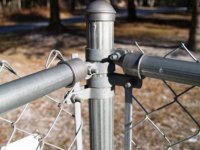
Stole the pic from the internet.... Top rail is not needed if you are doing a fence like you say, therefor the cups are not needed. You can stretch wire instead.
 

Attachments

  • fence.JPG
    fence.JPG
    48.7 KB · Views: 10

jhelrey

Well-known member
Joined
Sep 15, 2010
Messages
7,242
Location
MN
I am still lost at what you are trying to do. I've installed more linear feet of fence than I care to remember... other than it pays really well!
 
OP
B

bw77

Well-known member
Joined
Jul 10, 2009
Messages
1,316
Location
Upstate NY
You can see the fence on kittyfence.com

I am now able to push in the self-tapping screws. The trick is using a
magnetic bit holder, low rpms, push hard. And a ***** punch to mark the
hole location.

I first tried using the mag bit holder that comes in the Milwaukee Shockwave
set, it wobbled too much. Then I used the Dewalt mentioned above and it
worked great.

Thanks to everyone for the advice.
 

jhelrey

Well-known member
Joined
Sep 15, 2010
Messages
7,242
Location
MN
I get it!!!! They have posts that look like an upside down fish hook. The top rail cup goes on the end and a wire is fed through the hole where the bolt usually goes. Which holds up the netting.

It's to keep cats in the yard... although I find that impossible.
 
To avoid these ads, REGISTER NOW!
Top Bottom