To avoid these ads, REGISTER NOW!

Need help with 220v oven wiring

Joe From NY

Well-known member
Joined
Feb 25, 2010
Messages
527
Location
NY
My church just had an electric stove and oven put in the basement. When they turned it on, something smoked and burned up. I looked at the receipt I already today and checked the voltages across wires. This is what I got. Any idea why I got around 25 volts from neutral to ground?
6dd18f4478263f533f87aaefd4a959ef.jpg


Sent from my iPhone using Tapatalk
 

Attachments

  • 6dd18f4478263f533f87aaefd4a959ef.jpg
    6dd18f4478263f533f87aaefd4a959ef.jpg
    377.6 KB · Views: 0
To avoid these ads, REGISTER NOW!

californiaHank

Well-known member
Joined
Nov 20, 2015
Messages
487
Overloaded neutral? Bad ground connection somewhere?
Definitely dangerous, whatever the cause.
 

wyliesdiesels

Well-known member
Joined
Aug 14, 2012
Messages
20,014
Location
Modesto, CA
Looks like you have a bad neutral.

Did you try metering voltages at the panel?

Also, how many wires do you have feeding tbat outlet?

Thats an old non grounded outlet. If you have 4-wires should change it to a 4-wire outlet.
 

chew

Member
Joined
Sep 28, 2009
Messages
22
I'm an electrician. You have a bad connection on the neutral/white.

Sent from my moto g(6) play using Tapatalk
 

Bretny

Well-known member
Joined
Jul 31, 2017
Messages
3,918
Location
Dutchess county NY
Your in NY..we dont have 220v. Low voltage on one power leg usualy means the breaker is off or you have a burnt connection.
 
OP
J

Joe From NY

Well-known member
Joined
Feb 25, 2010
Messages
527
Location
NY
I'm an electrician. You have a bad connection on the neutral/white.

Sent from my moto g(6) play using Tapatalk


Could you describe what kind of bad connection?

I checked it at the panel, all is good there. Neutral and ground are bonded. All combinations check out ok. 120 v from black to white and to green. Same for red
240v from red to black.. But it is BX entering panel, but Romex at the receptacle. So somebody put a junction box either in the ceiling or behind a tile wall somewhere. What should I look for?


Sent from my iPhone using Tapatalk
 
OP
J

Joe From NY

Well-known member
Joined
Feb 25, 2010
Messages
527
Location
NY
Your in NY..we dont have 220v. Low voltage on one power leg usualy means the breaker is off or you have a burnt connection.


Breaker is good. It is a breaker that grabs two hots, hence the 240 volts. I thought about swapping the green wire and the white wire in the receptacle, but I didn’t want to send return voltage from the 120 volt components of the oven back through the ground line.


Sent from my iPhone using Tapatalk
 

79firebird

Well-known member
Joined
Aug 19, 2008
Messages
385
Location
Victoria bc
Sounds like a bad connection check them all try pulling the outlet ant check right at the wire as ive had a bad outlet befor. is it on 3 phase ? as ive seen it cause power probs before in anouther place thru work
 

chew

Member
Joined
Sep 28, 2009
Messages
22
Could you describe what kind of bad connection?

I checked it at the panel, all is good there. Neutral and ground are bonded. All combinations check out ok. 120 v from black to white and to green. Same for red
240v from red to black.. But it is BX entering panel, but Romex at the receptacle. So somebody put a junction box either in the ceiling or behind a tile wall somewhere. What should I look for?


Sent from my iPhone using Tapatalk
When you say you checked it at the panel and everything is good that's a good sign but also confuses things a little more. In the photo where you show the odd voltages you have, were they taken from the outlet with the unit unplugged, or taken from the back of the unit with it still plugged in.

I asked because one thing you should have for sure is 0 volts or very close to it between the ground and the neutral / white. You're getting odd voltages between phase and the neutral because the neutral it's not a solid connection back to the panel. The ground is a solid connection back to the panel and you're getting the 120 volts phase to ground. My next step would be like someone has already mentioned pull the plug and check the wires themselves if it's still an issue there's most likely a junction box nearby and that's what your problem is.

FYI single phase will give you 240 volts between the phases. Three phase generally gives you 208 volts between phases. If you get 480 volts or 600, stop and call electrician.

Sent from my moto g(6) play using Tapatalk
 
OP
J

Joe From NY

Well-known member
Joined
Feb 25, 2010
Messages
527
Location
NY
I backprobed the receptacle wiring to get those voltages with nothing plugged in.

Then, At the panel, I checked voltage between each of both hot wires and the green wire and the white wire. Around 120 volts, as I remember. Of course, No voltage between the white and green inside the panel box, since they are both bonded together in the same block.


Sent from my iPhone using Tapatalk
 

wyliesdiesels

Well-known member
Joined
Aug 14, 2012
Messages
20,014
Location
Modesto, CA
Could you describe what kind of bad connection?

I checked it at the panel, all is good there. Neutral and ground are bonded. All combinations check out ok. 120 v from black to white and to green. Same for red
240v from red to black.. But it is BX entering panel, but Romex at the receptacle. So somebody put a junction box either in the ceiling or behind a tile wall somewhere. What should I look for?


Sent from my iPhone using Tapatalk

the voltages at the outlet are way off.

I cannot even think of how you would get 140v with the other side being 92.

IF you had an open neutral that had a common connection elsewhere, then you would see 104 and 140 to add up to 244.

but 92 and 140= 232v.

since theres 2 different wiring methods, then there is a junction somewhere that you will have to find.

hopefully not buried in the wall.
 

SGKent

Banned
Joined
Feb 12, 2010
Messages
1,959
Location
Citrus Heights CA
regardless the cause, there is a potential here for someone to get killed if that circuit has shorted to something along the way. I think at this point I would turn the circuit off until all the wiring can be inspected. I can't see how you can get the voltages you did. It is like the neutral is leaking to one of the supply legs thru something. Regardless it pulls the voltage down enough to be a fire hazard. Maybe a rat chewed the wires and you are slowly cooking him before he bursts in to flames.
 
OP
J

Joe From NY

Well-known member
Joined
Feb 25, 2010
Messages
527
Location
NY
Could I just pull a new neutral white wire from the panel through the basement, and into the receptical ? That looks like the wire with the issue.


Sent from my iPhone using Tapatalk
 

wyliesdiesels

Well-known member
Joined
Aug 14, 2012
Messages
20,014
Location
Modesto, CA
Nope.

All circuit wires must be ran together with the exception of retrofitted EGCs for older 2 wire systems.

And the issue could be more than just the neutral.

You could have bad splices in a buried box and the neutral was just the first to show symptoms.

Fix the neutral and then you may have really bad issues with the ungrounded conductors. Such as a fire.

You really need to either A) verify all connections/splices on the circuit or B) abandoned the wire and pull a new one with wire such as 6/3 NM-b or 6-6-6-10 THHN in pipe.
 

strutaeng

Well-known member
Joined
Dec 12, 2011
Messages
2,271
Location
Dallas, TX
Nope.

All circuit wires must be ran together with the exception of retrofitted EGCs for older 2 wire systems.

And the issue could be more than just the neutral.

You could have bad splices in a buried box and the neutral was just the first to show symptoms.


Fix the neutral and then you may have really bad issues with the ungrounded conductors. Such as a fire.

You really need to either A) verify all connections/splices on the circuit or B) abandoned the wire and pull a new one with wire such as 6/3 NM-b or 6-6-6-10 THHN in pipe.

Yes, follow this advice. I have a temporary circuit for a welder/air compressor that has a splice between NM-B and THHN in a metal junction box. It's a temporary circuit and splice is with wire nuts. #6 wire.

Anyways, one day I turned on my air compressor and it seemed like the breaker popped, but it didn't. I checked voltages at the breaker and it was fine. At the outlet I got 120V on one leg, and something like 25V at the other. It was the wirenut connection.

The fact that voltages are right at the breaker only leaves the wire as suspect. That's more likely your problem.

You may have a jbox or splice somewhere buried in a wall. Either find it, or just run new wire.
 

chew

Member
Joined
Sep 28, 2009
Messages
22
Okay so it looks like there's definitely a bad neutral connection. Along with that it also looks like your neutral wire has started to melt into your black phase. That's why you're only seeing 92v phase to neutral, and that's where your 25 volts neutral to ground is coming from. At this point 100% do not use this plug for anything. Turn off the breaker unless for troubleshooting.

If you wanted to take the investigation one step further I assume there's a basement or lower level below where this plug is. The most likely place for a junction box would be within 3 feet of the plug and in the floor space / ceiling space from underneath, if it's accessible great! If you hire anyone they're going to probably cut a hole or just recommend pulling a new line.

Sent from my moto g(6) play using Tapatalk
 

Bretny

Well-known member
Joined
Jul 31, 2017
Messages
3,918
Location
Dutchess county NY
Could I just pull a new neutral white wire from the panel through the basement, and into the receptical ? That looks like the wire with the issue.


Sent from my iPhone using Tapatalk
If your going to pull any new wire just replace the whole wire breaker to outlet.

Being that its BK at the pannel and romex at the outlet you would need to find this junction. Personaly if its easy enough i would just run new wire. This circuit has alreaty been rigged up.
 

wanderer

Well-known member
Joined
Jan 29, 2010
Messages
2,698
It’s the neutral wire. Check connections at both ends in the box, but otherwise it’s time for new wire.
 
OP
J

Joe From NY

Well-known member
Joined
Feb 25, 2010
Messages
527
Location
NY
The oven is in the church basement. It’s a drop ceiling all the way to the panel at the other end of the building. It’s easy enough to look every few tiles. It’s just the cost of 60 feet of the proper guage wire is more than running a new single neutral.
Could the receptical outlet be bad? I backprobed the wires without unscrewing the outlet and removing it. I might try that first.


Sent from my iPhone using Tapatalk
 

wyliesdiesels

Well-known member
Joined
Aug 14, 2012
Messages
20,014
Location
Modesto, CA
Its anyones guess where the problem is.

No one on here can wave a magic wand and tell you where it is.

You just need to get into the thick of it and find it.

Also, since the box is grounded, i would suggest changing the outlet to 4-wire, changing the stove whip to 4-wire and unbonding the neutral terminal on the stove terminal block. This way, if you loose the neutral again, the frame will not be a shock potential.
 
To avoid these ads, REGISTER NOW!

Wrench97

Well-known member
Joined
Jun 23, 2018
Messages
12,099
Location
Southeastern Pa
I see it more of a fire/shock hazard then anything else who knows what else it's hooked to or how it's hooked together.
 
OP
J

Joe From NY

Well-known member
Joined
Feb 25, 2010
Messages
527
Location
NY
It was wired by an old 75 year old guy from Jamaica when they redid the basement two years ago. He is a real craftsman when it comes to wood. He’s not great with electric.

For the past year there was an electric stove, with a blown out circuit board on the backsplash part. The electric burners worked but the oven didn’t. They put in a new stove recently and they said something burned up as soon as they turned it on.

The old timer Jamaican guy was being chased by some young girl for child support, so he dropped off the radar, and nobody knows how to reach him to ask where he put the junction box, and what else he has on that branch.

I can see now why the old stove circuit board was burnt up.


Sent from my iPhone using Tapatalk
 
Last edited:

AntonLargiader

Well-known member
Joined
Nov 20, 2016
Messages
1,372
Location
Charlottesville, VA
A fried circuit board is way cheaper than a fried person. In an institutional environment, there is no defense for bad wiring when someone gets hurt. I don't see how you would want to do anything other than pull new 4-wire from the panel to a new (15-30?) recep.
 

Norcal

Well-known member
Joined
Mar 16, 2008
Messages
13,754
Its anyones guess where the problem is.

No one on here can wave a magic wand and tell you where it is.

You just need to get into the thick of it and find it.

Also, since the box is grounded, i would suggest changing the outlet to 4-wire, changing the stove whip to 4-wire and unbonding the neutral terminal on the stove terminal block. This way, if you loose the neutral again, the frame will not be a shock potential.

If the range circuit was extended or added recently, as the OP states the 3-wire circuit is not code compliant anyway, since it is only allowed for existing installations & it cannot be extended. The only option is a new circuit.

Being a church, that would mean a place of assembly, meaning NM cable would not be allowed.
 
OP
J

Joe From NY

Well-known member
Joined
Feb 25, 2010
Messages
527
Location
NY
Yeah. I’m going to poke my head up in there this week. I found the orange sheathed cable where is exits from behind the ceramic wall tiles and goes up into the ceiling. I will just follow it from the kitchen all the way back to the panel box to find where he joined it to the BX cable. I’ll take it from there.


Sent from my iPhone using Tapatalk
 

wyliesdiesels

Well-known member
Joined
Aug 14, 2012
Messages
20,014
Location
Modesto, CA
A fried circuit board is way cheaper than a fried person. In an institutional environment, there is no defense for bad wiring when someone gets hurt. I don't see how you would want to do anything other than pull new 4-wire from the panel to a new (15-30?) recep.

Proper recep would be 14-50...

Yeah. I’m going to poke my head up in there this week. I found the orange sheathed cable where is exits from behind the ceramic wall tiles and goes up into the ceiling. I will just follow it from the kitchen all the way back to the panel box to find where he joined it to the BX cable. I’ll take it from there.


Sent from my iPhone using Tapatalk

Awww the plot thickens

Orange NM-b is #10 which is limited to 30a. Most stove circuits are 50a with a few being 40a.

This means the orange NM-b is too small.

What size breaker feeds this?

Also, NM-b is not permitted in drop ceilings.

Nor is NM-b permitted in places of assembly as Norcal pointed out.

Time to pull a new circuit with MC.
 
OP
J

Joe From NY

Well-known member
Joined
Feb 25, 2010
Messages
527
Location
NY
Yes. Thanks to all. There’s alot of knowledge and experience on this board.


Sent from my iPhone using Tapatalk
 
OP
J

Joe From NY

Well-known member
Joined
Feb 25, 2010
Messages
527
Location
NY
I never even looked at the breaker size. I assumed it was sized correctly for the wire. But I now realize that I can make no assumptions at that site.


Sent from my iPhone using Tapatalk
 

Bretny

Well-known member
Joined
Jul 31, 2017
Messages
3,918
Location
Dutchess county NY
It prob fried because its wired as 240v only and needs 4 conductor to be 240/120. Was the plug changed on the new stove from a 4 wire to 3 wire? Alot of stoves now have components that are 120v and 240v. By having this they need both 120v legs, a neutral and a ground.

Prob why all the burners still worked, because there 240v.
 

Bert_

Well-known member
Joined
Dec 24, 2016
Messages
9,732
Location
NW Iowa
It prob fried because its wired as 240v only and needs 4 conductor to be 240/120. Was the plug changed on the new stove from a 4 wire to 3 wire? Alot of stoves now have components that are 120v and 240v. By having this they need both 120v legs, a neutral and a ground.

Prob why all the burners still worked, because there 240v.

All stoves have and need a neutral connection, always have. The 10-50 three wire recepacle has a neutral but not a ground. Please keep the facts straight.
 

wyliesdiesels

Well-known member
Joined
Aug 14, 2012
Messages
20,014
Location
Modesto, CA
It prob fried because its wired as 240v only and needs 4 conductor to be 240/120. Was the plug changed on the new stove from a 4 wire to 3 wire? Alot of stoves now have components that are 120v and 240v. By having this they need both 120v legs, a neutral and a ground.

Prob why all the burners still worked, because there 240v.

incorrect.

A neutral is present which allows for 120v operation.

youre just muddying the water here with info that doesnt make sense.
 

wyliesdiesels

Well-known member
Joined
Aug 14, 2012
Messages
20,014
Location
Modesto, CA
Does the correct information matter when coming to electricity?

Of course it does.

The wrong information could kill someone.

But apparently it doesnt matter to you.
 

SGKent

Banned
Joined
Feb 12, 2010
Messages
1,959
Location
Citrus Heights CA
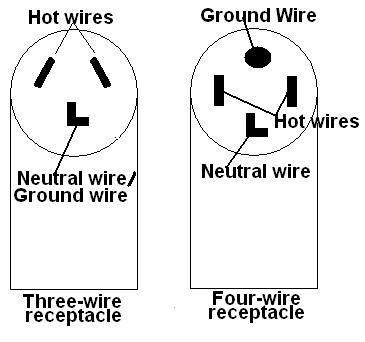
this question has probably been addressed here 1000 times but reading the posts in this thread it is a good time to ask again.

In a 3 wire 240V system, some diagrams - even on the same site I've just found show the 3rd wire sometimes called a ground, sometimes a neutral and sometimes it shows both tied together in the 3rd position. I have 2 compressors from the mid-90's and early 2000's. The UL approved 240V wiring harnesses for them have only 3 wires - 2 hots and a ground that screws to the compressor body. I can see why the industry would move to a 4 conductor from a 3 conductor. Can someone explain, without starting a he done it, why the industry is confused on this. I realize NEMA has the final say but in some of the pictorials they all quote NEMA as their source for the wiring diagram. It would seem to me that a receptacle doesn't know what will be plugged into it so the 3rd wire should be totally standard wiring for at least the last 30 years. Anyone want to share why in some diagrams it shows the 3rd wire as a ground wire (green) and in others neutral (white), and in others tied together (white and green together). Again - 3 wire plugs and receptacles only. Even wiring diagrams for UL approved electric dryers show sometimes a green labeled ground, and sometimes a white labeled neutral in the third position attaching to the dryer. How did this discrepancy evolve is a better way of asking it. Why one UL approved dryer says attach the ground here, and another calls it a neutral. That would mean an electrician would need to be clairvoyant as to every dryer model that would be plugged into a 3 wire socket he/she wired.
 
Last edited:

exranger06

Well-known member
Joined
Aug 9, 2015
Messages
1,686
Location
CT
The reason the diagrams show it as a neutral sometimes and a ground other times is because sometimes the 3rd wire IS a neutral and there is no ground (such as a 3 wire stove), and sometimes the 3rd wire IS a ground with no neutral (such as the compressor). Appliances/machines that only run on 240v don't need or use a neutral. A stove is actually a 120/240v appliance: the heating elements are 240v, but the light in the oven, the clock/timer and other electronics run on 120v. Anything that runs on 120v needs a neutral. A compressor just has a motor that runs on 240v and nothing else. It doesn't need a neutral, only a ground. I'm not sure why stoves didn't have a ground back in the day, but now they do. Code now requires stoves to be wired up with 4-prong outlets and cords- 2 hots, a neutral, and a separate ground.
Same applies to clothes driers- they use both 120v and 240v. They used to not have a ground, now they're wired 4-prong.
 
Last edited:

SGKent

Banned
Joined
Feb 12, 2010
Messages
1,959
Location
Citrus Heights CA
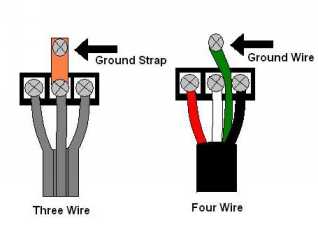
Ok, makes sense. Thank you. Some dryer manufacturers show the 3rd wire in a 3 wire as a ground. Some show it as a neutral. Some call it either. Some call it both combined. All these manufacturers make UL approved devices. All run on 240/120. How would the receptacle know whether to run the neutral wire or the ground to the 3rd wire? Sounds to me like the appliance industry considered the neutral and ground the same for some period of time. Of course the good news is that now 4-wire will resolve that and eventually 3-wire will attrition out.

Example:
xfourwire.jpg.jpg.pagespeed.ic.MPaJU86SV8.jpg

xcordwiring2.jpg.pagespeed.ic.3_Ib7sxAml.jpg
 
Last edited:

exranger06

Well-known member
Joined
Aug 9, 2015
Messages
1,686
Location
CT
All appliances wired with 3-prong plugs have a bonding strip that bonds neutral to the case/body of the appliance, as shown in your picture. So the grounding is provided via the neutral wire and the neutral and ground are kind of the same thing. So both terms were used interchangeably in that scenario. All new stoves and driers still have the bonding strap installed at the factory, just in case they're installed in homes that still have 3-wire receptacles. If you're installing a new appliance and using a 4-prong cord and receptacle (or converting an existing installation from 3-prong to 4-prong), you need to remove the bonding strap so neutral and ground are separated.
 
Last edited:

SGKent

Banned
Joined
Feb 12, 2010
Messages
1,959
Location
Citrus Heights CA
so historically on the 3 wire where did the 3rd wire go to in the panel? The ground buss or the neutral buss. Do you find them both ways?

Historically on a NEMA 6-20 240V where the device is using the 3rd wire as a ground like a compressor - where does the 3rd wire go to in the panel? Is the 3rd prong wired as a ground with the ground wire, or is it wired as a neutral?
 
To avoid these ads, REGISTER NOW!
Top Bottom