
You are using an out of date browser. It may not display this or other websites correctly.
You should upgrade or use an alternative browser.
You should upgrade or use an alternative browser.
Need help with 220v oven wiring
- Thread starter Joe From NY
- Start date
wyliesdiesels
Well-known member
I believe the conduit is metallic and hopefully rigid if in the pour. It also has a metallic bushing on it.
If it were pvc, then it's AFU. They would have needed to pull an egc.
Looks like the conduit passes thru a concentric ko. It should have a bonding bushing on it.
I thought bonding bushings were only required on 480v and above.
I thought bonding bushings were only required on 480v and above.
Your right not needed on this conduit b/c it's only 120v to ground. Double locknut good enough. I think it is 250 or 277v to grd when that kicks in.
But bonding bushings are needed when conduits containing service entrance conductors pass thru concentric/eccentric ko's, 480v and lower.
OP
Joe From NY
Well-known member
I snapped a couple of shots of the service entering the building from under the street.


Then it goes through this disconnect on the right, then up to the panel.

The other disconnect goes to a panel box on the main floor.
Sent from my iPhone using Tapatalk
Then it goes through this disconnect on the right, then up to the panel.
The other disconnect goes to a panel box on the main floor.
Sent from my iPhone using Tapatalk
ard
Well-known member
Let’s face it most churches get electrical work done by good church members. They might not be the most qualified but think they are.
Their heart is in the right place.
That, and the big man has their back I guess....

Last edited:
OK, so the panel first pictured in this thread is a sub-panel. It is fed from a disconnect below it, which in turn is fed from a CT enclosure.
The CT enclosure is where the neutral and grd are bonded.
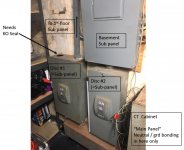
As best I tell:
Disc #1 and #2 are required to shut off all power to bldg.
Disc #1 and Panel #1 are 3 phase (assume 4 wire)
Disc #2 and Panel #2 are 1 phase
Disc #1 and Panel #1 should not have neutrals bonded/shared with grds
Disc #2 and Panel #2 should not have neutrals bonded/shared with grds
(Pics of these are needed to be certain what is in them)
Panel #2 (at least) needs grd blocks added and grds removed from the neutral blocks.
Add a ko seal in Disc #1. Keeps out critters and dropping stuff into enclosure.
You should stay out of the CT cabinet. It should be locked. There is too much exposed buss work waiting for deadly contact. Call POCO and have them lock it.
Now back to the original problem..............
Did you do what ARD suggested in post 49?
When you measured the original voltages, was the stove disconnected from recept?
Did you ever measure the voltage between neutral block and enclosure (grd) at the panel?
The CT enclosure is where the neutral and grd are bonded.
As best I tell:
Disc #1 and #2 are required to shut off all power to bldg.
Disc #1 and Panel #1 are 3 phase (assume 4 wire)
Disc #2 and Panel #2 are 1 phase
Disc #1 and Panel #1 should not have neutrals bonded/shared with grds
Disc #2 and Panel #2 should not have neutrals bonded/shared with grds
(Pics of these are needed to be certain what is in them)
Panel #2 (at least) needs grd blocks added and grds removed from the neutral blocks.
Add a ko seal in Disc #1. Keeps out critters and dropping stuff into enclosure.
You should stay out of the CT cabinet. It should be locked. There is too much exposed buss work waiting for deadly contact. Call POCO and have them lock it.
Now back to the original problem..............
Did you do what ARD suggested in post 49?
When you measured the original voltages, was the stove disconnected from recept?
Did you ever measure the voltage between neutral block and enclosure (grd) at the panel?
Last edited:
OP
Joe From NY
Well-known member
OK, so the panel first pictured in this thread is a sub-panel. It is fed from a disconnect below it, which in turn is fed from a CT enclosure.
The CT enclosure is where the neutral and grd are bonded.
As best I tell:
Disc #1 and #2 are required to shut off all power to bldg.
Correct
Now back to the original problem..............
Did you do what ARD suggested in post 49?
No. I didn’t try that.
When you measured the original voltages, was the stove disconnected from recept?
disconnected. I backprobed each wire where it was screwed into the receptical.
Did you ever measure the voltage between neutral block and enclosure (grd) at the panel?
No. I measured between each wire in the panel, but not to the panel itself.
Sent from my iPhone using Tapatalk
Last edited:
alfredeneuman
Well-known member
I'm pretty amazed when a thread runs 88 posts with numerous photos, 27 responses from full time electrical contractors ..... and doesn't heed their advice
ard
Well-known member
No. I didn’t try that.
Would be useful....
SGKent
Banned
call a licensed electrician. Too many questions here for the danger.
I snapped a couple of shots of the service entering the building from under the street.
If you had to start this thread you have no business in that cabinet.
Go back and read the thread, the solution (s) have been posted. Better yet call and electrician, maybe you can get one to donate the labor.
wyliesdiesels
Well-known member
If you had to start this thread you have no business in that cabinet.
Go back and read the thread, the solution (s) have been posted. Better yet call and electrician, maybe you can get one to donate the labor.
Agreed!
Lots of energy in that 3phase cabinet with unknown amounts of fault current.

Also most PoCos have those locked/sealed to deter electricity theft.
One note about that cabinet- its odd to see paralleled conductors on the top phase leg that are different sizes. Should be the same size.
One note about that cabinet- its odd to see paralleled conductors on the top phase leg that are different sizes. Should be the same size.
I noted that too, then noticed the bottom phase isn't parelleled. I assume this is the "goes outta" side and they are taps?
But I only know enough to be dangerous, and when to bow out.
Seriously though OP, 3 phase/higher voltages can be extremely dangerous and isn't the place to learn as you go. Call a pro before you get hurt please.
Last edited:
wyliesdiesels
Well-known member
The red leg is most likely the stinger leg and would have only 240v single and 3-phase loads on it so paralleling may not be necessary.
The other 2 legs would have all the single phase 120v loads on it in addition to any 3 phase loads.
The other 2 legs would have all the single phase 120v loads on it in addition to any 3 phase loads.
One note about that cabinet- its odd to see paralleled conductors on the top phase leg that are different sizes. Should be the same size.
I don't think they are paralleled. Two disconnects are fed from the CT cab. One three phase and one single. One of the disconnects may have smaller fuses. That would explain why one set of wires is smaller.
Possibly a 200a single and 150a three phase. Just guessing of course.
alfredeneuman
Well-known member
Let’s face it most churches get electrical work done by good church members. They might not be the most qualified but think they are.
Not necessarily
My old company did a church with wood studs and MC cable.
The volunteers took care of the drywall, and used 3" #8 screws to hang 5/8 on every 2x4 wall in the place.
We had to replace all but 1 piece of the cable, and it was necessary to tear out all the bottom sheets of drywall on 1 side of the wall

OP
Joe From NY
Well-known member
The building was a flooring and rug store for years before the church got it cheap. That’s why the overkill on the electrical supply.
I didn’t get anything else done there yet because I didn’t have the time to meet anyone there and spend the day. The oven is not a priority for them, so I didn’t make time to get it straightened out.
I figured I could just probe around with my Fluke meter in that supply cabinet until I find the right voltage and tap right into the lugs there.
Sent from my iPhone using Tapatalk
I didn’t get anything else done there yet because I didn’t have the time to meet anyone there and spend the day. The oven is not a priority for them, so I didn’t make time to get it straightened out.
I figured I could just probe around with my Fluke meter in that supply cabinet until I find the right voltage and tap right into the lugs there.
Sent from my iPhone using Tapatalk
alfredeneuman
Well-known member
That's the exact reason why you had no business opening it up in the first place.I figured I could just probe around with my Fluke meter in that supply cabinet until I find the right voltage and tap right into the lugs there.
The building was a flooring and rug store for years before the church got it cheap. That’s why the overkill on the electrical supply.
I didn’t get anything else done there yet because I didn’t have the time to meet anyone there and spend the day. The oven is not a priority for them, so I didn’t make time to get it straightened out.
I figured I could just probe around with my Fluke meter in that supply cabinet until I find the right voltage and tap right into the lugs there.
Sent from my iPhone using Tapatalk
I'm not really a big safety guy. Most of the time I say just use your brain.
That said you need to stay out of that CT cabinet. The wires and lugs in there have no over current protection. That means if you short something out in that box there is no fuse or breaker to trip. It will arc and burn until the metal is gone.
Look up arc flash if you need a visual...
wyliesdiesels
Well-known member
The building was a flooring and rug store for years before the church got it cheap. That’s why the overkill on the electrical supply.
I didn’t get anything else done there yet because I didn’t have the time to meet anyone there and spend the day. The oven is not a priority for them, so I didn’t make time to get it straightened out.
I figured I could just probe around with my Fluke meter in that supply cabinet until I find the right voltage and tap right into the lugs there.
Sent from my iPhone using Tapatalk
This is EXACTLY why you have no business being in that CT cabinet.
As said above, there is no overcurrent protection.
One wrong move could mean deadly results.
Also, most PoCos seal/lock those cabinets to deter electricity theft. Bypassing or cutting seals and locks to gain access to CT cabinets and meter pans can result in stiff fines and penalties from the PoCo if and when they find out.
Also, based on your previous voltage measurements, you have a 240/120 delta service which has a 208v stinger leg. Hooking up a 120v device or utilization euqipment between the stinger leg and neutral will result in the magic smoke being let out.
OP
Joe From NY
Well-known member
Come on brothers, I thought it would be pretty clear that I was joking with that last post about poking around in that three phase cabinet with my DVM.
I am grateful for everyone’s input on this thread. I appreciate your insightful advice.
Sent from my iPhone using Tapatalk
I am grateful for everyone’s input on this thread. I appreciate your insightful advice.
Sent from my iPhone using Tapatalk
Last edited:
AntonLargiader
Well-known member
I did get that you were joking. But I also think that it's time someone licensed and insured got involved. You don't want this mess on your back.
Not necessarily
My old company did a church with wood studs and MC cable.
The volunteers took care of the drywall, and used 3" #8 screws to hang 5/8 on every 2x4 wall in the place.
We had to replace all but 1 piece of the cable, and it was necessary to tear out all the bottom sheets of drywall on 1 side of the wall
But the screws were donated!
Come on brothers, I thought it would be pretty clear that I was joking with that last post about poking around in that three phase cabinet with my DVM.
I am grateful for everyone’s input on this thread. I appreciate your insightful advice.
Sent from my iPhone using Tapatalk
If arc flash doesn't motivate you, google: notre dame.
You've gained enough knowledge here to now properly explain the problem(s) to an electrician. This job has grown way to big in scope and danger for you.
OP
Joe From NY
Well-known member
If arc flash doesn't motivate you, google: notre dame.
You've gained enough knowledge here to now properly explain the problem(s) to an electrician. This job has grown way to big in scope and danger for you.
Yes sir
Sent from my iPhone using Tapatalk
SGKent
Banned
Joe - you did a great job of determining it was time to call an electrician.