To avoid these ads, REGISTER NOW!

Need help with hardwiring EV charger

k98shooter

New member
Joined
Feb 28, 2024
Messages
4
My first post, greetings to everyone!
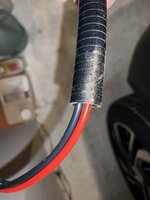
My goal is to hardwire EV charger to the panel without splicing wires. The EVSE has 1” OD whip with 6 ga wires. They will go to 60 amp breaker. The panel is flush to the wall. I want to route wires through drywall to the right side or bottom of the panel. I can’t figure out how to make 90 degree angle of the wires to drywall. Please have a look to pictures of garage. Do I need to route wires through a conduit all the way to the panel, or is it OK to run them without conduit? What should I buy to run the wires through drywall at 90 degrees?
 

Attachments

  • IMG_2857.jpeg
    IMG_2857.jpeg
    605.8 KB · Views: 156
  • IMG_2856.jpeg
    IMG_2856.jpeg
    778.3 KB · Views: 157
  • IMG_2859.jpeg
    IMG_2859.jpeg
    710.9 KB · Views: 157
  • IMG_2858.jpeg
    IMG_2858.jpeg
    507.4 KB · Views: 158
To avoid these ads, REGISTER NOW!

nadogail

Well-known member
Joined
Jan 23, 2009
Messages
32,154
Location
Coronado, CA
Welcome to the Forum from Southwestern California. Your local area is an important factor in giving you the best answers to your questions.
That is because not very community has adopted the same versions of the Electrical Code.
Electrical Wiring is not a "Hobby" for beginners. Your local building department can give you the contact information for an Electrical Inspector who serves your area.
 

mike93lx

ALLIANCE MEMBER
Joined
Dec 9, 2013
Messages
38,398
Location
Richmond, VA
Individual conductors can not be run outside of conduit. You need to either transition to a sheathed cable (like nm-b, aka romex) in a junction box or bring them into the panel with conduit.

You could cut a hole in the wall below for a 2 gang box, connect that via conduit to the panel and then hookup the evse feed to that box with a cover plate
 

wyliesdiesels

Well-known member
Joined
Aug 14, 2012
Messages
20,143
Location
Modesto, CA
Is this the whip thats hardwired to the charger?

What is the type of insulation on those wires? What gauge are they? Why is there no ground wire?

Why do you have black liquid tite? Did that come with the unit? Typically chargers have a cord and plug.

As said above, individual conductors cannot go in the wall.
 

sparky 1971

Well-known member
Joined
Oct 9, 2018
Messages
8,095
Location
Central Iowa
I can see a little bit of green on the bottom left of pic 3, and behind and between the red and black and again in the middle of the wires on pic 4. But that's on my desktop after I blow it up. Ain't no way I could see that on a phone though.
I've seen the black sealtite on modular office furniture.

OP, the easiest thing to do is something you don't want to do: Fish a NM-B out of the bottom of the panel into a surface mounted 4X4 box and hook your whip up to that, or the way described in post #4. Or cut the **** out of the wall so you can get the flex into a knockout in the bottom of the panel, then look at a notch in the wall every time you go into the garage.
 
Last edited:
OP
K

k98shooter

New member
Joined
Feb 28, 2024
Messages
4
Is this the whip thats hardwired to the charger?

What is the type of insulation on those wires? What gauge are they? Why is there no ground wire?

Why do you have black liquid tite? Did that come with the unit? Typically chargers have a cord and plug.

As said above, individual conductors cannot go in the wall.
They are 6 ga THHN red and black and 8 ga green. Sorry for confusing pics. Green is ground and all wires have same length.
 

mm08822

Well-known member
Joined
Jan 13, 2012
Messages
6,161
Location
NJ
The install manual picture does not show any provisions for entry into the back of the unit and the mounting bracket runs the entire height of the unit so you are stuck with the bottom whip.

I would come out of the bottom of the panel with 6-2 nmb and poke through the sheet rock next to the right hand stud and surface mount a 4x4x2-1/8 box catching the stud. Run the whip into the right side of the 4x4 box. If the whip is too short replace with the needed length.
 

mm08822

Well-known member
Joined
Jan 13, 2012
Messages
6,161
Location
NJ
Is this the whip thats hardwired to the charger?

What is the type of insulation on those wires? What gauge are they? Why is there no ground wire?

Why do you have black liquid tite? Did that come with the unit? Typically chargers have a cord and plug.

As said above, individual conductors cannot go in the wall.
They are being sold both ways, but I have yet to see one offered with a 60A plug. He would have to feed that recept with 6-3 nm-b as the 15-60 plug/recept is only available as 4 wire. The whip would have to change to cordage.
 
To avoid these ads, REGISTER NOW!

jmdirk

Well-known member
Joined
May 4, 2015
Messages
713
They are being sold both ways, but I have yet to see one offered with a 60A plug. He would have to feed that recept with 6-3 nm-b as the 15-60 plug/recept is only available as 4 wire. The whip would have to change to cordage.

Most with a cable and plug that I've seen are a 14-50P, even chargers that are rated at 48A.
 

dcg9381

Well-known member
Joined
Jun 20, 2018
Messages
11,928
Location
Austin, TX
They are being sold both ways, but I have yet to see one offered with a 60A plug. He would have to feed that recept with 6-3 nm-b as the 15-60 plug/recept is only available as 4 wire. The whip would have to change to cordage.
That's because the standard plug is 14-50R, which is good for 50A peak and makes the circuit limit 40A continuous. Hardwiring gets you to 60A and 48A continuous.

Pay attention to your charger... Not all of them have a 48A continuous setting. If they're on a 14-50R outlet, they should not be set for 48A continuous, they should be set to 40A.

IMHO, if this was my residence, I'd rather be able to unplug the charger and take it with me (or replace it) than have it hard wired. The charging difference is nominal. I have done a bunch of these.. Both hard wired and plug.
 

mm08822

Well-known member
Joined
Jan 13, 2012
Messages
6,161
Location
NJ
That's because the standard plug is 14-50R, which is good for 50A peak and makes the circuit limit 40A continuous. Hardwiring gets you to 60A and 48A continuous.

Pay attention to your charger... Not all of them have a 48A continuous setting. If they're on a 14-50R outlet, they should not be set for 48A continuous, they should be set to 40A.

IMHO, if this was my residence, I'd rather be able to unplug the charger and take it with me (or replace it) than have it hard wired. The charging difference is nominal. I have done a bunch of these.. Both hard wired and plug.
All of that is understood. If you want the ability for portability, then you need to align to the prevailing "standard" plug/recept.
 

428PI

Well-known member
Joined
Jul 14, 2018
Messages
1,976
Location
Peabody, KS
When I installed mine I had to run my 6-3 wire through a 2x4 stud and angle right up into the breaker box. Wasn't the easiest thing to do with the osb wall still there.
 
OP
K

k98shooter

New member
Joined
Feb 28, 2024
Messages
4
I can see a little bit of green on the bottom left of pic 3, and behind and between the red and black and again in the middle of the wires on pic 4. But that's on my desktop after I blow it up. Ain't no way I could see that on a phone though.
I've seen the black sealtite on modular office furniture.

OP, the easiest thing to do is something you don't want to do: Fish a NM-B out of the bottom of the panel into a surface mounted 4X4 box and hook your whip up to that, or the way described in post #4. Or cut the **** out of the wall so you can get the flex into a knockout in the bottom of the panel, then look at a notch in the wall every time you go into the garage.
“… Fish a NM-B out of the bottom of the panel into a surface mounted 4X4 box and hook your whip up to that.”
Do you mean to splice in J box NM-B wires that will be hooked up to the panel, and THHN wires from the EV charger? Thank you
 

sparky 1971

Well-known member
Joined
Oct 9, 2018
Messages
8,095
Location
Central Iowa
“… Fish a NM-B out of the bottom of the panel into a surface mounted 4X4 box and hook your whip up to that.”
Do you mean to splice in J box NM-B wires that will be hooked up to the panel, and THHN wires from the EV charger? Thank you
Yes. You will need a short piece of 6/2 with ground romex. Push it out of the bottom of the panel, turn a tight corner and out of a hole in the wall right next to the stud. Go into the back of a 4X4 box, screw the box to the stud. Connect charger whip to the 4X4 box and splice the wires.
 

scfoxman

Active member
Joined
Jul 10, 2008
Messages
25
Location
Philippines
Hey there!

I've hardwired an EV charger myself, and I can offer some tips. For a clean 90-degree angle through drywall, you'll want to use conduit to protect and guide your wires. Flexible metal conduit (FMC) or liquid-tight flexible non-metallic conduit are great choices. They provide the protection needed and can be easily bent to achieve the right angle. Make sure to use appropriate fittings to secure the conduit to your breaker panel and junction boxes.

Last year, I had similar issues when installing my Tesla charger. I needed a professional to help, and I learned that proper installation is crucial to avoid any electric problems. My friend recommended a great company with electricians who are available 24/7, which was a lifesaver. To find out more information, check out Tesla charger installers . They made sure everything was up to code and safe. Good luck with your installation!
 
Last edited:

gtae07

Well-known member
Joined
Mar 6, 2015
Messages
3,002
Location
Fayetteville, GA
Does anyone know if there exists a type of wire that can both (a) be run in conduit outdoors and (b) be run without conduit indoors?

Got a friend looking to put a charger on the outside wall of his garage and it would make running power a lot easier if we don't need to run conduit on the 90% of the run that's indoors (up from panel to attic, across attic, conduit down out of eave to charger).
 

mike93lx

ALLIANCE MEMBER
Joined
Dec 9, 2013
Messages
38,398
Location
Richmond, VA
Does anyone know if there exists a type of wire that can both (a) be run in conduit outdoors and (b) be run without conduit indoors?

Got a friend looking to put a charger on the outside wall of his garage and it would make running power a lot easier if we don't need to run conduit on the 90% of the run that's indoors (up from panel to attic, across attic, conduit down out of eave to charger).
UF-B. Indoors, it needs to be protected from damage still. Could be location, behind drywall, etc. You can also sleeve it in a piece of conduit as protection without having to do the whole run
 
Last edited:

gtae07

Well-known member
Joined
Mar 6, 2015
Messages
3,002
Location
Fayetteville, GA
UF-B. Indoors, it needs to be protected from damage still. Could be location, behind drywall, etc. You can also sleeve it in a piece of conduit as protection without having to do the whole run
Great! Yeah that sounds like it might work. I guess basically what I was looking for was "NM-B that can go outside (in conduit) too". Thanks!
 

wyliesdiesels

Well-known member
Joined
Aug 14, 2012
Messages
20,143
Location
Modesto, CA
Does anyone know if there exists a type of wire that can both (a) be run in conduit outdoors and (b) be run without conduit indoors?

Got a friend looking to put a charger on the outside wall of his garage and it would make running power a lot easier if we don't need to run conduit on the 90% of the run that's indoors (up from panel to attic, across attic, conduit down out of eave to charger).
SER
 
To avoid these ads, REGISTER NOW!
Top Bottom