To avoid these ads, REGISTER NOW!

Need help with load bearing capacities please.

jhall0712

Well-known member
Joined
Aug 24, 2013
Messages
143
Hello GJ! I need someone to help me with a general idea of the load bearing capabilities of my garage trusses. I didn't build my garage, it was built by someone else way before we bought the house. It has a single car side, and an extra large double car side that is about 24x30. The bigger side has metal trusses that span 24'. They are 24" on center. The trusses themselves are about 14" high. Now, our garage does have an upstair area. The floor of that area is ontop of the trusses. Nothing really up there right now But I have plans of a gam room or something along that line.

My question is, how much weight can the trusses hold? I don't really have anything in mind that I want it to hold, but if I put say a 1 ton chain hoist off one of them, could it hold that much weight? The most I would probably lift is an engine into the back of a truck or something like that.

Here is a picture of some of the trusses.

http://i.imgur.com/NVZbYOr.png

When I get it in some type of better order I will share more pictures of it. Lol

Anyway, thanks for any help!
 
Last edited:
To avoid these ads, REGISTER NOW!

soapii

Well-known member
Joined
Nov 29, 2011
Messages
342
Location
SE Michigan
To be honest, no one here will know what they will hold. We would need a LOT more specific info on the trusses then you could input the data to software and it will tell you what live and dead loads the trusses could support.

--Joe
 
OP
J

jhall0712

Well-known member
Joined
Aug 24, 2013
Messages
143
Yeah I figured, I just thought someone might have an idea. I really don't know anything about them though. Walls seem to be pretty standard construction. 2x4s on 16" centers.
 

Charles (in GA)

Well-known member
Joined
Jan 11, 2006
Messages
12,489
Location
50 mi south of Atlanta
Those are known as bar joists. Go to a fast food place or almost any business that does not have a ceiling and look up, you will see ceiling fans, A/C dusts, elect conduit, AND bar joists. They are light weight usually only supporting the roof, but heavier ones can be speced out to support floors. Tack weld corrugated tin to the top of them, and you pour concrete on top, provided they are rated for it.

A structural engineer, with info on the joists, such as the thickness of the bar and angle material, distance between the supports on the ends and spacing of them, probably can give you a good guess of what they can support, expect to pay them for their professional services.

The strength of the supporting walls may be as much an issue as the joists are.

Charles

This will keep you busy for a while.

http://faculty.ivytech.edu/~bl-desn/dsn208/assignments/KSeries7.pdf

http://academics.triton.edu/faculty/fheitzman/STEEL JOIST MANUAL VULCRAFT.pdf

https://engineering.purdue.edu/~jliu/courses/CE479/extras/CE479_Joists_PartI_12.pdf

http://steeljoist.org/index
 
Last edited:

readhead

Well-known member
Joined
Dec 8, 2012
Messages
6,177
Location
Durango, Co.
That is a pretty typical bar joist for a floor system. They are not designed to carry any load from the bottom cord. You will see conduit and lights hanging from them but that is all that is allowed.
 
OP
J

jhall0712

Well-known member
Joined
Aug 24, 2013
Messages
143
If thats the case that is fine. Like I said, I don't really have anything in mind, just wanted to know for future reference. Should I be worried about the floor on top of it?
 
OP
J

jhall0712

Well-known member
Joined
Aug 24, 2013
Messages
143
I see the links you added in Charles. Great info! Looks like the live load is way less than I would have ever guessed. If I'm reading the tables correctly. I really appreciate the help!
 

LX-Markham

Well-known member
Joined
Apr 27, 2013
Messages
2,929
Location
Markham, Ont.
Open steel joists are generally designed and manufactured to safely carry the exact design load. They are optimized to minimize material.

To make a long answer short: no, those joists likely don't have any additional capacity to carry the weight of a 1-ton chain hoist.

That being said, they are easily reinforced (to an extent).
My advice would be to go to the City and get a copy of the permit plans. You might get lucky and get the design drawings for the joists. Then take that to a structural engineer and you'll get all the info you'd ever want.
 
Last edited:
OP
J

jhall0712

Well-known member
Joined
Aug 24, 2013
Messages
143
Yeah... I live in the county, and there are no building permits. Kinda works against you in cases like this. :dunno:
 

readhead

Well-known member
Joined
Dec 8, 2012
Messages
6,177
Location
Durango, Co.
They are fine for the floor load which they were designed for. Where you located? I don't often see bar joists in residential work.
 
OP
J

jhall0712

Well-known member
Joined
Aug 24, 2013
Messages
143
I'm in East Texas. I'm told the original owner of our house was a home builder. I suspect the joists were left over from some construction job he had.

Edited to add that I say that because the rest of the garage is wood construction.
 
Last edited:

scw1991

Well-known member
Joined
Mar 28, 2010
Messages
506
As a kid, we had garage about 20' deep with a standard truss design on 24" centers. I believe the pitch of the roof was about a 4/12. My father mounted a 1/2-ton hoist and pulled numerous small block/big block engines. At the center of the trusses, he rigged up a wood beam consisting of Qty-2 2"x6"'s about 96" long that spanned about 4 trusses. This allowed for distribution of load across all four trusses. The hoist was mounted in the center. I think he also added some additional triangular plywood bracing on the truss to increase overall strength. Think of it this way, if a 250lb man can hang from a truss and the truss has minimal deflection under load, then Qty-4 250lb men each hanging from their own truss would equate to a total 1000lb load.
 
Last edited:
To avoid these ads, REGISTER NOW!

LX-Markham

Well-known member
Joined
Apr 27, 2013
Messages
2,929
Location
Markham, Ont.
So double that and you have the 1-ton hoist he suggested he wanted to hang from the joists. LOL

span 24'. They are 24" on center. The trusses themselves are about 14" high.
was just thinking about this some more. A 14" joist is pretty small for a 24' span. Looking through my joist catalog, that's about as small a joist as feasible for that span.
 
OP
J

jhall0712

Well-known member
Joined
Aug 24, 2013
Messages
143
Yeah thats kinda what I gathered from the tables. No biggie. As long as the floor above is good I just won't hang stuff off of it! The only thing up there now is my kayak, and it's not even attached to the joists, but the floor above.
 

Punchwood

Well-known member
Joined
Sep 7, 2013
Messages
332
Location
Western NY
Those joists can probably support a lot more weight than the top plate that they're resting on. I'd be peeking up there and seeing how they fastened the seats to the plate, and I notice that there's no bridging visible in your pic. Interesting.
 

OccupantRJ

Well-known member
Joined
May 15, 2009
Messages
11,055
Location
Eastern North Carolina
Measure from a bar joist to the floor. Get five or six men to go upstairs and stand over the same area, then measure again while they are up there. This will give you the deflection. If the floor will hold the 1000 lbs of men, it will hold an engine and transmission. You may want to cut a hole through the floor into the upper area and lay a stout wood beam across the floor to attach the hoist to help spread the load across multiple joists. This would put your load ABOVE the bar joists. As a teenager, I pulled engines using an old driveshaft laid across several joists in an old garage owned by an older friend of mine. With a little creative thinking, a small door could be installed in the floor to act as a medallion or centerpiece in a finished floor of a rec room. Setup the beam system as needed. A "balance beam" could even be incorporated as part of a rec room. That's my brainstorm for tonight.
 
Last edited:
OP
J

jhall0712

Well-known member
Joined
Aug 24, 2013
Messages
143
Those are only to support the floor above. They arnt carrying any roof loads.

Yeah, and that's fine. I just wanted to know before something ever came up. I didn't know the term bar joist so my google fu wasn't too good, which is why I asked.

I do have more questions about the 'room' upstairs. I will have to start a new thread about it soon..
 

cyamaha2007

Well-known member
Joined
Apr 20, 2009
Messages
2,001
Location
St.Charles MO
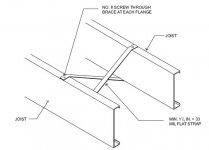
If you have time post some specs of the joist like span and material thickness we may be able to help more. Im surprised that there is not bracing between the joists. Normally we use metal strapping between the joists to keep them from twisting or leaning under load.
 

Attachments

  • ICODA2009061607401603374.jpg
    ICODA2009061607401603374.jpg
    20.3 KB · Views: 3

Mike in Ohio

Well-known member
Joined
Sep 27, 2008
Messages
2,405
Location
Canton,Ohio
I am no engineer or even a contractor, but I would think that if you ran a piece of 2 or 3 inch iron pipe across 5 or 6 of those bar joists it would handle a hoist like you are planning.

Again I am no engineer just a guy who sometimes pulls some stupid stunts to get the job done, and has lived to tell the stories so far.
 
OP
J

jhall0712

Well-known member
Joined
Aug 24, 2013
Messages
143
If you have time post some specs of the joist like span and material thickness we may be able to help more. Im surprised that there is not bracing between the joists. Normally we use metal strapping between the joists to keep them from twisting or leaning under load.

Will do. There is a span of 2x4s that runs across the very center of the joists. They are bolted to the bottom of the joists.
 

LX-Markham

Well-known member
Joined
Apr 27, 2013
Messages
2,929
Location
Markham, Ont.
Normally we use metal strapping between the joists to keep them from twisting or leaning under load.
x-bridging is to share the load between joists so they deflect in unison. Bottom chord bridging is to brace the joist for uplift forces when the bottom chord goes into compression/bending.
 

bczygan

Well-known member
Joined
Nov 4, 2009
Messages
22,002
Location
DETROIT! Arsenal of Scrappers
Typically, structures (especially residential) are designed to accommodate the loads that are appropriate for their initial use. In other words, while a safety factor is involved, no extra capacity is designed in for future uses. While you might get away with limited loads, if you spread the load among numerous joists, you might get drywall cracking or nail pops in adjoining finished areas. And if they are steel bar joists, as has been said before, the bottom chords are in tension. Attach your new beam as close to, and suspended from, the top chord as possible. Your best bet is a crane rail system or a mobile or fixed crane of some type.
 
To avoid these ads, REGISTER NOW!
Top Bottom