Smarthomes.Cal
Well-known member
I need a little help with understanding how the neutral wire and ground wire work in a sub panel connected to 240volt circuits....

Thank you.... also, what function does the ground wire play as far as current carrying in a 240 volt circuit...in a sub panel, the ground & neutral are isolated . a 240 volt circuit doesn't use a neutral.
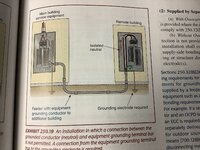
Thank you...Maybe this will help
I know the neutral wire is not used in a 240 volt circuit I was wondering if the ground played any roll in carrying current back to the main...Thank you...
For faultsI know the neutral wire is not used in a 240 volt circuit I was wondering if the ground played any roll in carrying current back to the main...
Thank you....For faults
Show us a picture of what you're trying to do..I need a little help with understanding how the neutral wire and ground wire work in a sub panel connected to 240volt circuits....
The shop is closed right now but Monday I can....Show us a picture of what you're trying to do..
The guy wired this shop before I got there has the neutral coming from the main to the sub connected to the grounding bus bar....and there is absolutely no ground coming from the main....all the welders have grounds and they are connected to both grounding bus bar and the neutral bus bar......The neutral coming from the main also has a jumper wire to the ground bus bar ....The welders work... However I feel its all jacked up...and dangerous....what do you think...it's not real clear on what you're asking
but, a 240 volt circuit is 2 hots coming from different legs on the panel . the ground is just a return path in the event of a fault.
a 240 volt circuit doesn't use a neutral. however a 240/120 circuit like a stove or drier does uses a neutral to provide the 120 volts
This sub panel does not have a ground wire even coming from the main panel....Just 2 hots and a neutral wire that is connected to the grounding bus in the sub ...Then jumped to the grounding bus, and all the welders are grounded to both buses....last week I had a post here about a 240 v electric heater I recently bought that was using the neutral wire instead of the ground wire . the previous owner was using 10/3 wire where he could have used 10/2 . I'm not sure how the other end was wired , if he wired the neutral to ground or to the neutral . but it should have been to the ground using the ground wire
That's what I was thinking....Thank you very much for your help.....no that's not correct. the sub panel needs to have the neutral & ground separated . there needs to be a ground between the main & sub panel, also you may need ground rods on the sub panel
it sounds like you have a dangerous set up , the professional sparkies will chime in I'm sure .
this is something that needs to be addressed sooner than later .
Not when it's the same structure.That's what I was thinking....Thank you very much for your help.....
It's been very helpful....
Oh yea , do I need to have grounding roods in the sub panel when the sub is in the same building, about 30 feet away....
It does have 5 welders...tweco 211i 3in1 ....
No sir, the feeder wire is not in a pipe.....and the neutral from the main to the sub is connected to the grounding bus bar.....with a jumper to the neutral bar....then all the welders are connected to both bars in the subs....Not when it's the same structure.
I'm not sure what's going on with the neutral, but if the feeder is in metal conduit the entire distance from panel to panel, the pipe is the ground. A ground wire would not be needed.
In the sub... not subs....sorryNo sir, the feeder wire is not in a pipe.....and the neutral from the main to the sub is connected to the grounding bus bar.....with a jumper to the neutral bar....then all the welders are connected to both bars in the subs....
Good Morning...They have I believe the same S.E. Cable used to wire the main, I couldn't see the size but I think its 2/0 ...I will send you a pic. a.s.a.p. Monday afternoon hopefully.....Thank you...You need a 4-wire feed for that panel.
What you have is dangerous…
What kind of wire did they use to feed the subpanel?
Also you will need to unbond the neutral bar and a ground bar.
Post pics when u can
You need a 4-wire feed for that panel.
Thank You....Here is my concern...You did say (2) hots & a Ground....If all this subpanel feeds is welders, then the only issue is the color of the wire.
For 240 volt only circuits you could wire a sub panel with two hots and a ground only.
Not when it's in the same structure. In the same building has always required a separate ground afaik.Isn't that dependant on when it was installed (and what code cycle was in effect)?
Thank you for explaining this to me very simple like that....it's not real clear on what you're asking
but, a 240 volt circuit is 2- 120v hots coming from different legs on the panel . the ground is just a return path in the event of a fault.
a 240 volt circuit doesn't use a neutral. however a 240/120 circuit like a stove or drier does uses a neutral to provide the 120 volts
Thank You....Here is my concern...You did say (2) hots & a Ground....
The actual ground is the neutral wire that's been directly connected to the neutral lug on the main panel....
"There is no actual Ground"
Sir, this is my issue with the sub panel....I'm picturing SE cable for the feeder. If there are no 120 loads in the sub, move the bare wire from the neutral to the ground, label the panel 240 volt only, and that will take care of the sub panel. The main panel sounds like a bigger mess. That's gonna require some pictures.
also, there is no earth ground at all in the main panel..."AT ALL"...Sir, this is my issue with the sub panel....
There is "No" bare wire ground coming from the main....
The actual wire coming from the main "that would be used for fault" , is the actual neutral wire fed from the neutral lug from the main panel.....
I have several guys Monday hoping I get this figured out this weekend, and that's why I'm asking the pro's...also, there is no earth ground at all in the main panel..."AT ALL"...
You're going to need to post pictures.I have several guys Monday hoping I get this figured out this weekend, and that's why I'm asking the pro's...
Oh yea , do I need to have grounding roods in the sub panel when the sub is in the same building, about 30 feet away....
If your main panel is wired properly the neutral and ground are bonded like in the pic in post #5.Thank You....Here is my concern...You did say (2) hots & a Ground....
The actual ground is the neutral wire that's been directly connected to the neutral lug on the main panel....
"There is no actual Ground"
Yes sir..The sub is in the same building....However, the neutral wire from the main panel is connected to the grounding bus in the sub...You're going to need to post pictures.
Based the terminology you are using, this could be perfectly fine.
First, is the sub in the same building or not? Apologies if I missed that earlier EDIT: seems like same building
oh yea, there is absolutely no earth ground in the main panel.... or a fourth wire from the main supporting a ground....Yes sir..The sub is in the same building....However, the neutral wire from the main panel is connected to the grounding bus in the sub...
Then jumped over to the neutral with a jumper wire....
all of the welders are connected to both the neutral bus and the grounding bus through the ground wires for the circuit...
Is this safe....
You have A wire from the main panel neutral/ground, the neutral bar serves both purposes in that panel.Thank You....Here is my concern...You did say (2) hots & a Ground....
The actual ground is the neutral wire that's been directly connected to the neutral lug on the main panel....
"There is no actual Ground"
Thank you very much sir....I am responsible for making sure this is safe and functioning properly....The information you gave me was tremendous value.....You have A wire from the main panel neutral/ground, the neutral bar serves both purposes in that panel.
That wire then terminates to the ground bar in the sub panel, correct? It may also terminate to the neutral bar in the sub panel and be fine since you have no neutral load.
If all that is true, then the only issue is the color of the wire. While it should be green or bare it will function just the same.
The only time you would need a neutral is if there are 120 loads. If there aren't, don't add any. Just make a label for the panel that says 240 volt only. You could also add "no neutral" to the label.Thank you very much sir....I am responsible for making sure this is safe and functioning properly....The information you gave me was tremendous value.....
May I ask one more question....If no Neutral loads are ever connected, should I still fun that (4th.) wire the actual ground from the main or should I just leave it as it is
If you don't have ground at the main panel, add it. If there is a metal water pipe serving the building, it should be there as well as two ground rods, but that should be done at the main and what you are calling the main panel may not really be the main. Between this thread and the PM's you've sent me, I'm starting to get confused. I believe that the panel you are calling the main doesn't have a main breaker and the feed for it as well as the feeder to what you are calling the sub panel are stuck under the same lugs. If that is correct, there is more that needs to be addressed. Your main could very well be elsewhere, whether there is a disconnect inside or outside, or a main breaker somewhere else, another panel, main breaker/meter combo...???. That's why pictures are needed. I understand that you can't get them till Monday, but between now and then, everything is just speculation......And do you recommend me going ahead and putting an earth ground in for the main .....
Yes sir you are correct...The main I am calling main does not have a connect....The only time you would need a neutral is if there are 120 loads. If there aren't, don't add any. Just make a label for the panel that says 240 volt only. You could also add "no neutral" to the label.
If you don't have ground at the main panel, add it. If there is a metal water pipe serving the building, it should be there as well as two ground rods, but that should be done at the main and what you are calling the main panel may not really be the main. Between this thread and the PM's you've sent me, I'm starting to get confused. I believe that the panel you are calling the main doesn't have a main breaker and the feed for it as well as the feeder to what you are calling the sub panel are stuck under the same lugs. If that is correct, there is more that needs to be addressed. Your main could very well be elsewhere, whether there is a disconnect inside or outside, or a main breaker somewhere else, another panel, main breaker/meter combo...???. That's why pictures are needed. I understand that you can't get them till Monday, but between now and then, everything is just speculation.
This is a long shot and I've never seen it done...but if your main panel has less than six breakers in it, it's fine. It's called the six throw rule, meaning that everything can be shut off with six or fewer throws of handles. The sub panel needs a breaker, so if you currently have six breakers, that seventh will put you over. I can't see a main panel getting installed like that, that's why I stated it's a long shot, but anything is possible. Like I stated earlier, everything is speculation until pictures are up.Yes sir you are correct...The main I am calling main does not have a connect....
I followed the lines and they lead directly to a meter with no disconnect between them, and also no earth ground....
Yes sir the sub and the feeder wires are both shoved under the lugs together....along with the neutral wire coming from the meter...shoved under the lug sharing room for the sub panel wire as well.....with no disconnect anywhere....
This is what had me confused.....
If there was a fault...that would mean that it would go back through the neutral wire instead of the ground ( Which Ain't there", and from there back to the meter instead of the ground where it should go....
This is where I am or was maybe still confused about....What happens to the fault current now that there is no ground....