To avoid these ads, REGISTER NOW!

Need shop heat

VC-Racing

Well-known member
Joined
Mar 28, 2009
Messages
156
Location
Coastal SC on The Edisto River
I've been looking at adding some heat to my 900 sq ft with shop because the 40,0000 btu salamander heater I'm using is just barley enough not to mention its loud. The "Heating a combustible materials closet" thread got me to thinking about what type of propane heating unit I may need. I do some wrenching, wood working and sometimes just go out to watch TV and enjoy the peaceful bliss and solitude . So sometimes its going to be dusty and when wrenching, there may be volatile vapors/ fumes floating around. So, I come to the GJ collective for knowledge and advice. What say ye?
 
To avoid these ads, REGISTER NOW!

Charles (in GA)

Well-known member
Joined
Jan 11, 2006
Messages
12,489
Location
50 mi south of Atlanta
Questions............

Do you have natural gas? propane? neither (total electric)?

What kind of heat do you want nat gas/propane/electric? (based on what is cheapest to consume?)

Is the building insulated? does it have a ceiling? or open rafters? how high is the ceiling?

Tight new construction? or loose older construction?

Attached to the house? detached?

How much electricity do you have available (amp capacity of the subfeed to the building if detached)?

Do you want to keep it warm all the time? or leave it cold (ambient) until you come out to the shop to work?

Do you have attic space?

You said "what type of propane unit I may need" but 900 sq ft is not very large and could be heated several different ways depending on the building and construction.

Generally, propane is a heavy gas and settles to the floor if it leaks. Gasoline is the same way, most over flammables are too. If you were to install a horizontal furnace in the attic, you would eliminate most problems with fumes. The furnace burner would be taking in air from the attic for combustion, and taking in air from the garage to be heated. A vertical furnace mounted well off the floor would work also. It would be especially desirable if you could get one that had a dedicated fresh air supply from outside for the combustion, thought that should not be a deal breaker. There are other options such as the hanging shop heater, and the radiant tube heater, but more info about the shop layout, shape, what you really will be using it for, etc., would help .

Charles
 

krooser

Well-known member
Joined
Jun 3, 2005
Messages
2,377
Location
Waupaca, Wisconsin
A gas fired radiant tube heater can be easily installed using outside air... hanging from the ceiling it is very safe. They generally need 4" of clearance to a combusible ceiling so guys like me hang 'em on a 45 between the wall and ceiling... they work well, no noise and no drafts.

35-40K would do good if you have any kind of insulation.

A small Modine-style heater would also work.

BTW... when I heated my garages with a salamander heater I would cut a sheet of plywood to fit the door opening, cut a round hole in the plywood and put the heater outside with the nose sticking in the shop. That quiets it down quite a bit and helps keep the heater from using all the oxygen from the shop.
 
OP
V

VC-Racing

Well-known member
Joined
Mar 28, 2009
Messages
156
Location
Coastal SC on The Edisto River
questions............

Do you have natural gas? Propane? Neither (total electric)?


propane


what kind of heat do you want nat gas/propane/electric? (based on what is cheapest to consume?)

see above

is the building insulated? Does it have a ceiling? Or open rafters? How high is the ceiling?


insulated with "double bubble" insulation .


tight new construction? Or loose older construction?


its not too tight.


Attached to the house? Detached?


detached pole building


how much electricity do you have available (amp capacity of the subfeed to the building if detached)?


200amp


do you want to keep it warm all the time? Or leave it cold (ambient) until you come out to the shop to work?


probably keep it above the freezing mark when unattended and prob around 50-60 degrees when working.


do you have attic space?

no, open truss aprox. 20ft tall. Floor to bottom of trusses is 13'6" and add aprox. 6 ft for truss height.


you said "what type of propane unit i may need" but 900 sq ft is not very large and could be heated several different ways depending on the building and construction.

Generally, propane is a heavy gas and settles to the floor if it leaks. Gasoline is the same way, most over flammables are too. If you were to install a horizontal furnace in the attic, you would eliminate most problems with fumes. The furnace burner would be taking in air from the attic for combustion, and taking in air from the garage to be heated. A vertical furnace mounted well off the floor would work also. It would be especially desirable if you could get one that had a dedicated fresh air supply from outside for the combustion, thought that should not be a deal breaker. There are other options such as the hanging shop heater, and the radiant tube heater, but more info about the shop layout, shape, what you really will be using it for, etc., would help .

Charles

I'm also considering a packaged gas pack, but my concern with this is filtration. It would be nice to have the ability to cool the workspace in the summer, but its not necessary. I have a large portable fan I built and its more than adequate for summer work.
 
OP
V

VC-Racing

Well-known member
Joined
Mar 28, 2009
Messages
156
Location
Coastal SC on The Edisto River
Are you figureing any of that attic space in your square footage number or is it just your working area?


Work area only. I would think the total cubic volume would be some where around 15,300 cubic ft. I have a open truss ceiling.

I know that a package unit is based on 600sq.ft per ton, so technically a 2 ton package would be sufficient. I do not know the formula for just heating units only. I'm guessing I may need a 60,000 btu unit. I would prefer to oversize the unit so it can run shorter periods and heat the area quicker.
 

Gary S

Well-known member
Joined
Dec 27, 2008
Messages
2,972
Location
Bismarck, ND
40,000btu in 900 sq ft should be plenty. It sounds like you have an insulation problem, not a heat problem. I have a 1150 sq ft garage and I am comfortable in there with 30,000btu. I'm doing it with good insulation and nice clean electric heat. I don't know where you live, but I do OK up here in the cold north where it dropped to -44 last winter, and last week already it was -20.
My garage walls are R20 and my ceiling is R40. Consider spending some cash and time on insulation and you should find that heating gets easy.
 
OP
V

VC-Racing

Well-known member
Joined
Mar 28, 2009
Messages
156
Location
Coastal SC on The Edisto River
40,000btu in 900 sq ft should be plenty. It sounds like you have an insulation problem, not a heat problem. I have a 1150 sq ft garage and I am comfortable in there with 30,000btu. I'm doing it with good insulation and nice clean electric heat. I don't know where you live, but I do OK up here in the cold north where it dropped to -44 last winter, and last week already it was -20.
My garage walls are R20 and my ceiling is R40. Consider spending some cash and time on insulation and you should find that heating gets easy.


I'm in SC, As far as insulation, I feel its sufficient enough, however it could be better, it is a pole building. Its the almost 20ft of ceiling space that's eating up all the heat first and closing up the ceiling to 13'6 is not a option , due to overhead space requirements I have.

I can make it comfortable with the 40k btu salamander, but it has to run for several hours to get to a reasonable temp. The reason I said 60k btu was just a guess, it may take less or more. I don't have the formula to figure btu requirements for the cubic space I have for a single heating unit. I know I said that " a package unit has a formula of 1tn for every 600 sq ft" , but what I found out is that is for 8 ft ceilings with the proper residential insulation requirements :(, so my original assessment was incorrect. :headscrat Not that it matters, but I'm not working with a residential space.

My objective it to heat the area quicker and have it run on shorter cycles to maintain the temp inside, plus if is possible have a unit that's not going to be difficult to maintain and cause a dust or vapor explosion when operating, with the latter being the most important.

I've been soliciting bids from some local HVAC contractors and have only found one who understand what I'm looking for and he's so overpriced its not funny, that's why I came here to try to research what other's had used and possibly find a formula for heating the volume of space , so I can just solicit bids on specific units only .
 
Last edited:
To avoid these ads, REGISTER NOW!

texasOFT

Well-known member
Joined
Dec 1, 2009
Messages
158
Location
Texas Panhandle
I understand you have concerns about dust explosions? Have you considered putting a forced air furnace outside that pulls air from the building, heats it and returns it into the building while using outside air for combustion. We had a similar setup on a chemical storage building due to combustible fumes. Worked very well.
 
OP
V

VC-Racing

Well-known member
Joined
Mar 28, 2009
Messages
156
Location
Coastal SC on The Edisto River
I understand you have concerns about dust explosions? Have you considered putting a forced air furnace outside that pulls air from the building, heats it and returns it into the building while using outside air for combustion. We had a similar setup on a chemical storage building due to combustible fumes. Worked very well.

Yes, I have considered this as a option, however my concern is being able to filter the incoming air properly to prevent problems inside the forced air system.
 

Stuart in MN

Well-known member
Joined
Sep 8, 2005
Messages
23,013
Location
Minneapolis
Another vote for an overhead, gas fired radiant tube heater. They work well with high ceilings like yours. They'll heat you and the things down on the floor, while a forced air heater will end up heating the space up in the rafters. In any case, if you closed off the truss space and insulated it you'd greatly reduce the heating requirements.
 
OP
V

VC-Racing

Well-known member
Joined
Mar 28, 2009
Messages
156
Location
Coastal SC on The Edisto River
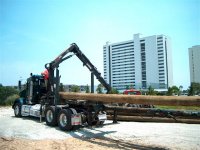
I have to be able to unfold this crane inside the building. Its 12' tall and takes a minimum of 15' overhead clearance to be able to properly unfold it so I can preform maintenance . If I have to stretch it out, It takes about 28' overhead to stand it straight up to close the grapple and attach it to the latching hook so it can be folded into the stored position. Here is a shot of me at work. HPIM1097 (Small).JPG Its a Hiab 144 knuckle boom crane.

So as you can see, I need all the space overhead I can get.

I'm aware I may need more insulation, unfortunately Its going to be this spring before it happens. I've got several projects going and acquiring heat in this building is at the top of the list so I can get thru the winter.
 
Last edited:
To avoid these ads, REGISTER NOW!
Top Bottom