To avoid these ads, REGISTER NOW!

Need some electrical advise

Youngfd

Well-known member
Joined
Dec 9, 2014
Messages
189
Location
Maltby, WA
I have a 50 amp breaker in my house panel that originally fed our hot tub. The wires come right out of the back of the breaker box to an outside wall so easy access. I would like hang a RV outlet box with a 30 AMP RV plug and a 20 amp GFI outlet on the wall and wire in. I am thinking this will work, but I want to run a conduit down from that and feed to a little cabin we built in the back yard 50 feet away. It has a 20 amp breaker to feed a 1000W wall heater, one 15 amp breaker for a few lights and another 15 for a few outlets. (cabin is only 12" by 12') What are my power requirements? I have two 200 AMP service panels in the house and another 200 AMP in the shop. Thanks, Jim
 
To avoid these ads, REGISTER NOW!

pattenp

Well-known member
Joined
Jun 4, 2008
Messages
10,175
Location
Virginia - USA
You should not wire 30A and 20A outlets directly off of a 50A protected circuit. The circuit protection needs to be no larger than the smallest amp rated device that's connected which will be the 20A outlet. You need to put a small sub-panel off the 50A and put in breakers sized to the outlets/circuits.
 
OP
Y

Youngfd

Well-known member
Joined
Dec 9, 2014
Messages
189
Location
Maltby, WA
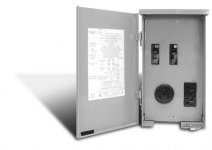
This is the box I was thinking of using which has breaker protection.
 

Attachments

  • RV box.jpg
    RV box.jpg
    11.6 KB · Views: 34

ard

Well-known member
Joined
Feb 16, 2015
Messages
4,391
Location
Sierra Foothills... California
I have a 50 amp breaker in my house panel that originally fed our hot tub. The wires come right out of the back of the breaker box to an outside wall so easy access. I would like hang a RV outlet box with a 30 AMP RV plug and a 20 amp GFI outlet on the wall and wire in.

That panel pic you posted should do that fine. 50A rated, with a sub breaker for the one 30A plug and the 20A plugs. Good


I am thinking this will work, but I want to run a conduit down from that and feed to a little cabin we built in the back yard 50 feet away.

Not sure that subpanel with the plugs will ALSO supply a circuit past that point.


It has a 20 amp breaker to feed a 1000W wall heater, one 15 amp breaker for a few lights and another 15 for a few outlets. (cabin is only 12" by 12')

So there is another subpanel in the cabin??? With 4 breakers? 1 20 and 'a few' 15s?

You need a ciurcuit to power that sub. The 50A breaker would do it.

But I dont think you can have that one 50A breaker tied to two panels, or daisy chain the circuit throught the first and on to the cabin.

Pick one.
 

Slowgsr

Well-known member
Joined
Nov 14, 2014
Messages
610
Location
Southern ontario
Ditch the hot tub box.
Run a 30a Receptacle for your rv. Needs to be on a GFCI breaker since it's outdoors. Then run a 20a circuit for your tslot GFCI receptacle

That parts done next for your shed, burry some 6/3 teck fed from a 2pole 50 that used to feed your hot tub. Put a small 12cct sub with a main breaker in your shed and wire your branch circuits from that.
 

alfredeneuman

Well-known member
Joined
Mar 3, 2011
Messages
4,580
Location
Fullerton, CA
Run a 30a Receptacle for your rv. Needs to be on a GFCI breaker since it's outdoors.
That parts done next for your shed, burry some 6/3 teck

You're wrong on the GFI.

210.8
(A) Dwelling Units. All 125-volt, single-phase, 15- and 20-
ampere receptacles
installed in the locations specified in
210.8(A)(1) through (8) shall have ground-fault circuit interrupter
protection for personnel

And teck cable isn't even available in the US. It's purely a Canadian product.
 
Last edited:

InterpreDemon

Active member
Joined
May 12, 2015
Messages
27
FWIW, regardless how you end up re sub-panels and daisy chaining, make sure you do NOT bond the neutral to the ground inside any of them where you have a ground going "up stream" to a "mother" panel. For good measure down at the shed I would add a good earth ground and, if you want to save some money on the run, you could just run your 120/240 plus a neutral down there without a ground (save copper) and bond the shed ground system to the neutral in that panel. I would also check to see that your existing three 200A panels and service connection(s) have been wired to local code and assure no improper currents are running on fault conductors. I've seen lots of dangerous stuff when folks attempt to tree out their distribution using legacy circuits.
 
To avoid these ads, REGISTER NOW!

wyliesdiesels

Well-known member
Joined
Aug 14, 2012
Messages
19,991
Location
Modesto, CA
FWIW, regardless how you end up re sub-panels and daisy chaining, make sure you do NOT bond the neutral to the ground inside any of them where you have a ground going "up stream" to a "mother" panel. For good measure down at the shed I would add a good earth ground and, if you want to save some money on the run, you could just run your 120/240 plus a neutral down there without a ground (save copper) and bond the shed ground system to the neutral in that panel. I would also check to see that your existing three 200A panels and service connection(s) have been wired to local code and assure no improper currents are running on fault conductors. I've seen lots of dangerous stuff when folks attempt to tree out their distribution using legacy circuits.

Wrong wrong wrong! All detached structures ARE required to have grounding electrodes. And 3-wire feeders are no longer allowed as of 2008 code cycle so a 4-wire feeder is required as well. The neutral needs to be isolated from the enclosure and EGC/ground bar.

BTW what u said doesnt make sense because u need a neutral for 120v/240v....

A grounding electrode doesnt replace an EGC...
 
Last edited:

InterpreDemon

Active member
Joined
May 12, 2015
Messages
27
Having retired long before '08 I appreciate the update, however I fail to see how recommending an electrode at the shed regardless ("for good measure") would be "wrong, wrong, wrong". What I perceive in the code change is that they now require the ground on the sub feed in addition to the electrode and such structures can longer be wired in a separately derived manner. In any event, I presume you would agree with my other advice to make sure all the legacy stuff is up to code, or does "wrong" apply to any of my recommendations?
 

wyliesdiesels

Well-known member
Joined
Aug 14, 2012
Messages
19,991
Location
Modesto, CA
Having retired long before '08 I appreciate the update, however I fail to see how recommending an electrode at the shed regardless ("for good measure") would be "wrong, wrong, wrong". What I perceive in the code change is that they now require the ground on the sub feed in addition to the electrode and such structures can longer be wired in a separately derived manner. In any event, I presume you would agree with my other advice to make sure all the legacy stuff is up to code, or does "wrong" apply to any of my recommendations?

U recommended an electrode. Thats whats wrong. Recommending something 'for good measure' implies that its not required by code. Electrodes ARE required!

And actually 2 rods are required unless u can prove u have 25ohms or less of resistance!

And no i dont agree with that as code doesnt require upgrading all previous wiring or as u call it 'legacy stuff' unless it wasnt upto the then current code. Its called grandfathering. Im sure u mustve heard of it! Grandfathering is just the reason why existing 3-wire feeds are ok.
 

InterpreDemon

Active member
Joined
May 12, 2015
Messages
27
That is, if anything running 120 was energized, but since you bonded the neutral to ground and you grounded that system via a good earth ground electrode, fault currents would still trigger the interrupts, and for the 120 return on the ground system (with your loss of the neutral feed) your body would have to present a better path to earth ground than your electrode(s), the same risk as if you lost the messenger/ground strung out to the utility pole. All the same, I don't have a problem with un-bonding and extending the main building ground system to the out-building, though over a long distance I would be leery of it's ability to quickly or effectively clear faults. Without the bonding, you're talking about a fault clearing path that is several times the distance it would otherwise be... from L1 or 2 at the bonded main service, through the sub-feed, through the remote breaker, through the heater bar or light fixture short, then back through the feeder ground to the main service panel. I assume they also changed the code to require a larger ground conductor cross section percentage than previously?

The other issue that arises is you can now have a potential between the shed neutral and shed ground that is proportional to any imbalanced 120v load, and the longer the run the greater it is... anyway, these debates have gone on for decades, my own favorite solution is to make it separately derived and just stick a transformer out there.

Since the OP said this structure already exists and already is wired, and to my knowledge has not told us how long ago for either, I'm happy to defer to your genius since it is obvious to me that you enjoy this type of conflict and have a need to be the the smartest and most informed in any forum, regardless of experience.

Here's a typical cat fight about sub-feeds I just dug up that involves your '08 changes that you might want to go over and join:

http://www.nachi.org/forum/f19/3-wire-feeds-existing-detached-buildings-56130/

I suppose that in the not too distant future the lawyers will have to take over Code interpretation just as they have for everything else from taxes to hung chads on paper ballots.
 
Last edited:

alfredeneuman

Well-known member
Joined
Mar 3, 2011
Messages
4,580
Location
Fullerton, CA
That's a Home Inspector website you linked to. Home Inspectors are notorious for no knowing anything electrically. I know the site well. They're one of the worst.

It's hardly typical.
 

alfredeneuman

Well-known member
Joined
Mar 3, 2011
Messages
4,580
Location
Fullerton, CA
If you bonded the shed to neutral, and the earth ground to the shed, you'd be grounding the neutral in 2 locations, at the service and at the shed.

All this :argue: accomplishes absolutely nothing .... It was long ago in the past.

Earth grounds are required now not done for good measure, and 3 wire feeds are prohibited

Things are done differently now. I hope you can accept that.
 
Last edited:

InterpreDemon

Active member
Joined
May 12, 2015
Messages
27
"you'd be grounding the neutral in 2 locations, at the service and at the shed." ...which in the past was not deemed a problem as long as there was no continuous metallic ground connection or conductor between the two structures, since any improper current through the ground path would be as insignificant as the parallel current presently running from your service entrance electrode out to the nearest utility pole.

What it really comes down to is whether you are more concerned about losing your neutral than your ground connection, which I am not. A faulty neutral is usually detected within minutes and without any proactive action due to equipment suddenly operating strangely or not at all, whereas unless periodically tested a poor ground circuit can remain undetected right up until the time the first impulses hit your brain or the fire is ignited. So yes, in a three-wire feed if you lose your neutral you also lose your fault protection (via interupters) however you also know something is wrong the moment the lights only come on when you start the drill press, whereas if a gopher takes out your ground return path to the house you won't know about it until it is too late.

In any event, if I were to wire a single phase 120/240 distant shed to the current code I would run four equal conductors or, if prohibitively expensive, just go separately derived with a single pair to a transformer, which by far is the best solution for other reasons as well, IMHO.
 
Last edited:
OP
Y

Youngfd

Well-known member
Joined
Dec 9, 2014
Messages
189
Location
Maltby, WA
My electrician came over and wired the RV panel. Fed the 50 amp breaker to the new RV box which has a 30 and 20 breaker in it. We are going to run a complete new circuit to feed the cabin. J
 

wyliesdiesels

Well-known member
Joined
Aug 14, 2012
Messages
19,991
Location
Modesto, CA
That is, if anything running 120 was energized, but since you bonded the neutral to ground and you grounded that system via a good earth ground electrode, fault currents would still trigger the interrupts, and for the 120 return on the ground system (with your loss of the neutral feed) your body would have to present a better path to earth ground than your electrode(s), the same risk as if you lost the messenger/ground strung out to the utility pole. All the same, I don't have a problem with un-bonding and extending the main building ground system to the out-building, though over a long distance I would be leery of it's ability to quickly or effectively clear faults. Without the bonding, you're talking about a fault clearing path that is several times the distance it would otherwise be... from L1 or 2 at the bonded main service, through the sub-feed, through the remote breaker, through the heater bar or light fixture short, then back through the feeder ground to the main service panel. I assume they also changed the code to require a larger ground conductor cross section percentage than previously?

The other issue that arises is you can now have a potential between the shed neutral and shed ground that is proportional to any imbalanced 120v load, and the longer the run the greater it is... anyway, these debates have gone on for decades, my own favorite solution is to make it separately derived and just stick a transformer out there.

Since the OP said this structure already exists and already is wired, and to my knowledge has not told us how long ago for either, I'm happy to defer to your genius since it is obvious to me that you enjoy this type of conflict and have a need to be the the smartest and most informed in any forum, regardless of experience.

Here's a typical cat fight about sub-feeds I just dug up that involves your '08 changes that you might want to go over and join:

http://www.nachi.org/forum/f19/3-wire-feeds-existing-detached-buildings-56130/

I suppose that in the not too distant future the lawyers will have to take over Code interpretation just as they have for everything else from taxes to hung chads on paper ballots.

"you'd be grounding the neutral in 2 locations, at the service and at the shed." ...which in the past was not deemed a problem as long as there was no continuous metallic ground connection or conductor between the two structures, since any improper current through the ground path would be as insignificant as the parallel current presently running from your service entrance electrode out to the nearest utility pole.

What it really comes down to is whether you are more concerned about losing your neutral than your ground connection, which I am not. A faulty neutral is usually detected within minutes and without any proactive action due to equipment suddenly operating strangely or not at all, whereas unless periodically tested a poor ground circuit can remain undetected right up until the time the first impulses hit your brain or the fire is ignited. So yes, in a three-wire feed if you lose your neutral you also lose your fault protection (via interupters) however you also know something is wrong the moment the lights only come on when you start the drill press, whereas if a gopher takes out your ground return path to the house you won't know about it until it is too late.

In any event, if I were to wire a single phase 120/240 distant shed to the current code I would run four equal conductors or, if prohibitively expensive, just go separately derived with a single pair to a transformer, which by far is the best solution for other reasons as well, IMHO.

What youre failing to see in all this is that grounding electrodes DO NOT have low enough impedance to clear faults. I have personally seen this.

A grounding electrode should NOT be used for clearing fault currents.

EGCs and grounding electrodes are 2 different animals!
Sadly many electricians fail to understand this.

U need to read this:

http://www.electriciantalk.com/articles/the-confusion-of-the-term-grounding/
 
To avoid these ads, REGISTER NOW!
Top Bottom