To avoid these ads, REGISTER NOW!

Need some help with concrete calculations

Bryanbdp

Well-known member
Joined
Sep 17, 2022
Messages
135
Location
Avon CT
Anyone out there have a little time to talk about concrete engineering?
Mostly need to calculate proper rebar amount for loading.
If this is your area of expertise and you're willing to share it would be most appreciated...
Thanks,
Bryan
 
To avoid these ads, REGISTER NOW!

ConCretin

Well-known member
Joined
Jan 20, 2011
Messages
3,378
Location
Central Maine
The engineering you are looking for would only be necessary for structural elements. Rebar in most residential slabs and foundations is more about crack restraint rather than loading. Whataya building?
 
OP
B

Bryanbdp

Well-known member
Joined
Sep 17, 2022
Messages
135
Location
Avon CT
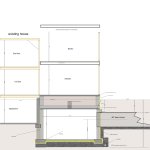
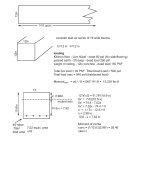
These drawings give some idea of what I'm working on. Existing house on left, new addition on right.
Includes "root cellar" as shown.
Pretty good with walls at 10in thick.
Ceiling should be ok at 12 in thick with the right rebar reinforcement.
Thinking about casting a beam as shown for additional support, since I have room in the packed earth area.
Would like to design ceiling to withstand dead load plus 1 atmosphere of shock loading.
New area is 16 ft x 22 ft OD.


kitchen plan v1.2.jpg


concrete design sketches_Page_2.jpgconcrete design sketches_Page_1.jpg
 
OP
B

Bryanbdp

Well-known member
Joined
Sep 17, 2022
Messages
135
Location
Avon CT
Here is a design example from Swiss guidelines.
 

Attachments

  • Swiss Construction-p46-47.pdf
    403.1 KB · Views: 11

wssix99

Well-known member
Joined
Mar 2, 2011
Messages
5,156
Location
Chicago, IL
This is what architects and engineers are for. For a project like this, you need to find local ones and pay them. You will save MANY times what you pay them in problems you'll avoid down the road.

For one, putting earth between a concrete cellar ceiling and a structure - this will eventually destroy everything around it. You'd have to find really exotic dirt that won't chemically react with steel/concrete when moisture inevitably gets in. If the aim is to have a bomb shelter, then maybe there is a case for dirt. If the aim is to insulate for temperature, then serviceable conventional insulation is the way to go.
 
OP
B

Bryanbdp

Well-known member
Joined
Sep 17, 2022
Messages
135
Location
Avon CT
The Swiss guidelines have formulas for most of what I need. I just have to figure out how to apply them.
I may well end up having to hire an engineer.
 
To avoid these ads, REGISTER NOW!
OP
B

Bryanbdp

Well-known member
Joined
Sep 17, 2022
Messages
135
Location
Avon CT
Here is the entire Swiss guideline. It is a design manual for approved shelter construction.
In other words, shelters have to be built to meet these guidelines.
The Swiss are considered the experts in this field, and they went to a whole lot of trouble to write these guidelines.
There are many other aspects to this project, but the structural ones are what I'm working on now.
Chapter three deals with the engineering requirements for resistance to fire, normal loading, and impact conditions.
Not surprisingly, impact/blast conditions control from a structural point of view.
1 atmosphere of overpressure design is good enough for me. If you're more than a couple miles from center of blast, you're probably OK. They state for a 1 MT event, you're OK at 1.6 miles or further. (page 5)

The engineering largely boils down to how much steel is needed for a given set of conditions and how to place it.
 

Attachments

  • Swiss Construction-of-Private-Air-Raid-Shelters.pdf
    12 MB · Views: 15

zimman

Well-known member
Joined
Mar 2, 2014
Messages
2,043
Location
Mark Twain National Forest
The Swiss guidelines have formulas for most of what I need. I just have to figure out how to apply them.
I may well end up having to hire an engineer.
I would imagine in the NE you couldn't park a contractors truck on the property without a full set of Engineered Stamped plans, permits and the Pope's blessing. Seriously. You should be talking to a structural engineer.
Zim
 

JWILLIE1977

Well-known member
Joined
Jan 8, 2020
Messages
142
Location
WNY
This is what architects and engineers are for. For a project like this, you need to find local ones and pay them. You will save MANY times what you pay them in problems you'll avoid down the road.
This. 1000%

Local engineer familiar with structural codes.
With any luck, he/she will be of Swiss descent.
 

C-S-H

Well-known member
Joined
Jan 18, 2024
Messages
144
Great project. With a ceiling load of about 3000psf and wall transverse load of 2000psf in various combinations plus earth forces, this is a 3D design. I would design this room as 6 slabs using plastic design like they are using in the Swiss guidebook. Some of the walls will have large openings requiring a different design.

The Swiss guidebook is quite good, but I do not how someone other than a structural engineer could interpret it correctly. For instance your calculation does not include the shock force, you are not doing plastic design, and your section property calculation is incorrect. Also, your corrugated pans eliminate the wall to ceiling moment connection, and tiny footings eliminate wall to floor slab moment connection. What are the soil and slope conditions?, etc... You should hire an engineer with a CT PE license. It is not a difficult or time consuming design.
 
OP
B

Bryanbdp

Well-known member
Joined
Sep 17, 2022
Messages
135
Location
Avon CT
Yah, thanks for the input. I was trying to work out the basics but I keep getting lost in the calcs.
Those prints aren't meant to be final but to explain the concept.
Culvert is shown for elevation, it will actually be on an end wall, with a sealed blast door.
 
To avoid these ads, REGISTER NOW!
Top Bottom