To avoid these ads, REGISTER NOW!

Need to know Alberta elec code

garagemahalpharoh

Active member
Joined
Jul 12, 2013
Messages
42
Location
Blackfalds, Alberta, Canada
Good day all I have finally reached the point that I can begin to wire "The Judge's Chambers". I am wanting to tackle this myself but I was wondering if anyone on here could give me a few pointers as far as doing it properly and to code. I have researched quite a bit on this but it is amazing how secretive it seems to be. I am needing to know how many repectacles I can run on 1 15 amp circuit using 14/2 wire? How many on a 20 amp circuit and can I use the same wire? Do I have to have a junction box in the roof where I will be connecting fluorescent lights of can I just run the wire to them? How far away from the receptacle boxes do staple the wire? How many staples are needed and what distance apart? I have a used breaker box that I got from work and am planning on using it because it has 10-15 amp breakers, 2-20amp, and 1-40 amp. I want to have a 220v outlet in case I purchase a welder or something down the road. I have provided a picture to show you what the box looks like. Am I way off base thinking I can use this? I apologize for all the questions but I am hoping there is someone on here that is willing to spend a little time to assist me. Thank you in advance.
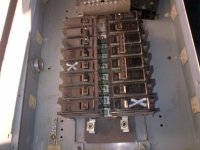
 

Attachments

  • breaker box small size.JPG
    breaker box small size.JPG
    94.4 KB · Views: 35
To avoid these ads, REGISTER NOW!

Charles (in GA)

Well-known member
Joined
Jan 11, 2006
Messages
12,489
Location
50 mi south of Atlanta
14 gauge wire is for 15 amp circuits.
12 gauge wire is for 20 amp circuits.

Not familiar with Canadian code. In the US for non-commercial installations, there is no limit on the number of receptacles per circuit. For certain installations, mainly commercial, there is a limit of 180va per strap, which translates to 13 receptacles for 20 amp and 10 receptacles max on 15 amp circuits.

You are best to keep lighting and receptacle circuits separate. I would limit the number of receptacles on a circuit to 3 or 4 in most cases.

Does your breaker panel have a disconnect in it? What brand is it? How old is is? Why was it removed at work? It isn't by chance a Zinsco/Sylvania/Pacific panel is it? If so, scrap it and buy a decent panel.

Charles
 

Rigpig

Well-known member
Joined
Feb 13, 2010
Messages
188
Location
Victoria,BC
Pharoh, get yourself an "electrical code for homeowners" book. Available at most hardware stores and even a nearby college bookstore. It'll give you the basics with illustrations and references to code rules if you want to look into it further should you want to pick up the code book which is a bit spendy.
That little book is interesting to read and shows most if not all of the answers to your questions.
Cheers!
 
OP
G

garagemahalpharoh

Active member
Joined
Jul 12, 2013
Messages
42
Location
Blackfalds, Alberta, Canada
Thanks for the replies guys, this breaker box I was going to use is a square D box that was a spare from a different project here at work. The only disconnect for it would be the 60amp breaker I have in the sub panel in the house where the feed is coming from.

I was hoping there would be a cheap alternative to buying a code book really like the college book store idea as there is a college here in Red Deer.

Thanks; James
 

nehog

Well-known member
Joined
Jan 2, 2010
Messages
7,935
Location
Jaffrey, NH
BTW, IMHO it is not a good move to use 15 amp circuits/14 AWG for outlets. For lighting, perhaps, but not outlets.
 

Charles (in GA)

Well-known member
Joined
Jan 11, 2006
Messages
12,489
Location
50 mi south of Atlanta
Is this a detached garage? In the US, a detached structure has to have a disconnect either outside (sometimes required to be outside by local code) or inside. This is necessary if you have (again in the US) more than six handles to throw to kill all circuits in the building.

On a attached garage, the subpanel does not have to have its own disconnect (though it is a good idea).

Charles
 

tfi racing

Well-known member
Joined
Apr 19, 2008
Messages
2,907
Location
Cedar,BC
Pharoh, get yourself an "electrical code for homeowners" book. Available at most hardware stores and even a nearby college bookstore. It'll give you the basics with illustrations and references to code rules if you want to look into it further should you want to pick up the code book which is a bit spendy.
That little book is interesting to read and shows most if not all of the answers to your questions.
Cheers!

Here is your answer,this little book will lay it all out for you,explains the CEC for homeowners.Pick it up,its cheap,have a read then bring your questions here,no shortage of good advice on this board.:thumbup:
 
OP
G

garagemahalpharoh

Active member
Joined
Jul 12, 2013
Messages
42
Location
Blackfalds, Alberta, Canada
Well noted about the 20amp circuits. I plan on putting all benchs on rollers so I can move them around to where I need them. I will then have a power bar that I plug into the wall to feed off benchs. I have 2-20 amp breakers on this panel so I will get some 12-2 wire and wire all the lower receptacles into those. I am going to wire the upper ones (for tv and stereo system) into 15A as I should have no issues with those. I will have a 60amp breaker inside the house will that be acceptable as a disconnect?

Teken PM sent, and thank you.
 

2ManyProjects

Well-known member
Joined
Jul 18, 2013
Messages
757
Well noted about the 20amp circuits. I plan on putting all benchs on rollers so I can move them around to where I need them. I will then have a power bar that I plug into the wall to feed off benchs. I have 2-20 amp breakers on this panel so I will get some 12-2 wire and wire all the lower receptacles into those. I am going to wire the upper ones (for tv and stereo system) into 15A as I should have no issues with those.

I'm not entirely certain that I'm following you here; but if you're talking about splitting duplex outlets, then wiring one socket for 20A and the other for 15A, that won't work. The outlet device itself will be EITHER a 20A type (NEMA 5-20R) OR a 15A (NEMA 5-15R) type; and whichever it is, BOTH sockets will be the same type. Compare:

Residential-Duplex-Receptacle-20A-125V-NEMA-5-20R-.jpg


NEMA_5-15_Outlet_120V-15A.jpg


You can't put a 20A socket on a 15A circuit. (Well, you can; but it would certainly not meet code and would constitute a fire waiting to happen.)

If you use 5-15R receptacles, it will be "safe"; but you obviate the possibility of plugging in anything with a 5-20P plug, thus potentially defeating your purpose.

Use at least 12-2 for BOTH circuits; if the runs are especially long, bump that up to 10-2.

I will have a 60amp breaker inside the house will that be acceptable as a disconnect?

Depends on your local codes. You MAY need to have a disconnect located closer to the sub-panel.

 
OP
G

garagemahalpharoh

Active member
Joined
Jul 12, 2013
Messages
42
Location
Blackfalds, Alberta, Canada
I originally bought 14-2 wire and receptacles to wire single receptacles for plugging in work bench. If I read this correctly all I need to do is buy new wire (12-2) and tie that into the same receptacles I was going to use correct? Do I need to buy a different receptacle? Originally I was going to put each wall (probably 3 single receptacles) on 1-15Amp breaker using 14-2 wire which I have already purchased. THe upper receptacles I was talking about are just above the windows for mounting a tv and a stereo system, low amperage stuff that I don't want to have on a circuit where a power drain or surge could cause damage.

I don't want to make this complicated I just want to do it right the first time and from what everyone is telling me I am better off having the main receptacles I plan on using electrical tools wired to the 20 amp breaker. Am I thinking correctly on this?
 

Nestor

Active member
Joined
Aug 13, 2013
Messages
31
Doesn't take much to trip a 15A breaker with shop equipment, hence the multiple recommendations for 20A. Take back the 14-2 and get 12-2 and use the 20 A receptacles.

If you go with the 15A receptacles with 12-2, you will be limited to a 15A breaker. Note that wiring 15A receptacles with 12-2 is a PITA.

You need to know what welder you will be using and its requirements so you can match the proper cct., otherwise you are just guessing.
 
Last edited:

Charles (in GA)

Well-known member
Joined
Jan 11, 2006
Messages
12,489
Location
50 mi south of Atlanta
Doesn't take much to trip a 15A breaker with shop equipment, hence the multiple recommendations for 20A. Take back the 14-2 and get 12-2 and use the 20 A receptacles.

If you go with the 15A receptacles with 12-2, you will be limited to a 15A breaker. Note that wiring 15A receptacles with 12-2 is a PITA.

Is this Canadian Code? Because it IS NOT a US NEC requirement. (I'd like to know so I might better advise our north of the border friends in the future, and not give out erroneous information.)

As far as wiring receptacles, wiring a 15 amp receptacle is not any more or less difficult that wiring a 20 amp one. If buying the same style, quality, brand, grade, of 20 amp vs 15 amp receptacle, they are identical on the sides and back, only the face plate will vary.

Charles
 
Last edited:

Charles (in GA)

Well-known member
Joined
Jan 11, 2006
Messages
12,489
Location
50 mi south of Atlanta
I have 2-20 amp breakers on this panel so I will get some 12-2 wire and wire all the lower receptacles into those. I am going to wire the upper ones (for tv and stereo system) into 15A as I should have no issues with those.


I'm not entirely certain that I'm following you here; but if you're talking about splitting duplex outlets, then wiring one socket for 20A and the other for 15A, that won't work. The outlet device itself will be EITHER a 20A type (NEMA 5-20R) OR a 15A (NEMA 5-15R) type; and whichever it is, BOTH sockets will be the same type.

He is referring to the receptacles he will mount either in the ceiling or up very high in the wall to power his TV and Stereo, which I presume would be mounted on a shelf up high out of the way and on a wall bracket up high.

Charles
 

Nestor

Active member
Joined
Aug 13, 2013
Messages
31
Is this Canadian Code? Because it IS NOT a US NEC requirement. (I'd like to know so I might better advise our north of the border friends in the future, and not give out erroneous information.)

As far as wiring receptacles, wiring a 15 amp receptacle is not any more or less difficult that wiring a 20 amp one. If buying the same style, quality, brand, grade, of 20 amp vs 15 amp receptacle, they are identical on the sides and back, only the face plate will vary.

Charles

As long as the branch feeds more than one receptacle. If it's a dedicated cct with a single receptacle, then a 20A is required.

If you look closely, they are different enough that wiring a 5-15R with #12 is a PITA.
 

Charles (in GA)

Well-known member
Joined
Jan 11, 2006
Messages
12,489
Location
50 mi south of Atlanta
As long as the branch feeds more than one receptacle. If it's a dedicated cct with a single receptacle, then a 20A is required.

If you look closely, they are different enough that wiring a 5-15R with #12 is a PITA.

That is a SINGLE receptacle. Even one DUPLEX receptacle counts as two with regard to this part of the code.

As I said, when looking at identical brand, grade, quality and such on receptacles, the ONLY difference in the receptacles is the face plate. Even the internals are identical, down to the contacts for the horizontal blade being inside of a 5-15R receptacle. I'm not talking cheap 59 cent ones here, I'm referring to commercial, industrial, spec grade. Leviton, Hubbell, and Cooper all do this.

Take a moment and peer inside the slots of a spec grade 5-15 receptacle and you will see what you see in the pic below, a 20 amp insides.

If you are wiring for a shop or garage, spend the money and buy good quality receptacles, DO NOT CHEAP OUT on these. Cheap ones get weak real quick and plugs start falling out of them. Good ones have strong spring tension and can take repeated plugging/unplugging without losing any of the contact tension. I highly advocate for the DIY type to use the spec/commercial/industrial back wire variety. It has a serrated plate inside and you loosen the screw, insert the wire, tighten up the screw and it clamps firmly onto the wire. No bending of wire, concerns over whether it will stay under the screw or any other problems.

Charles

attachment.php


Switch on top, receptacle below, both Hubbell.
attachment.php


These are 20 amp stuff I picked up at the flea, but 15 amp is identical, I used a bunch of 15 amp of Leviton, Cooper, and Hubbell in my shop. Note that on the switch, the front of the switch is color coded. 15 amp is blue, 20 amp red, and 30 amp is green.

attachment.php
 
Last edited:

Nestor

Active member
Joined
Aug 13, 2013
Messages
31
It's an unusual rule in the NEC. I'm not sure if it's the same for the CEC. If a person is going to go through the trouble of using 12-2, may as well use 20R and a 20A breaker.

20A and 15A receptacles are different. The 20R is more shallow around the terminals.

It's subtle but it's there.

Try it.
 

Charles (in GA)

Well-known member
Joined
Jan 11, 2006
Messages
12,489
Location
50 mi south of Atlanta
5-20 receptacles cost more than 5-15 receptacles of the same series/brand. I put my money in better quality receptacles of the 5-15 variety. I have NEVER encountered a 5-20 plug on any piece of equipment I use or own. I installed one (out of 27 receptacles in the shop) 5-20 for that "just in case" situation. Mine are all backwired. There may, or may not be a big difference in the cost, at somewhere like HD or Lowes, the cost difference is anywhere from $1 to $2 more for the spec/commercial grade 5-20R over a comparable 5-15R. In any case, it just don't make sense to spend money you don't need to.

HOWEVER, all of this discussion is moot since it appears that neither one of us is familiar with Canadian Electric Code C22.1-12.

Charles
 
To avoid these ads, REGISTER NOW!

Nestor

Active member
Joined
Aug 13, 2013
Messages
31
5-20 receptacles cost more than 5-15 receptacles of the same series/brand. I put my money in better quality receptacles of the 5-15 variety. I have NEVER encountered a 5-20 plug on any piece of equipment I use or own. I installed one (out of 27 receptacles in the shop) 5-20 for that "just in case" situation. Mine are all backwired. There may, or may not be a big difference in the cost, at somewhere like HD or Lowes, the cost difference is anywhere from $1 to $2 more for the spec/commercial grade 5-20R over a comparable 5-15R. In any case, it just don't make sense to spend money you don't need to.

HOWEVER, all of this discussion is moot since it appears that neither one of us is familiar with Canadian Electric Code C22.1-12.

Charles
Then why argue about it? :headscrat

Can I assume you wired the 5-20R on a dedicated cct?
 
Last edited:
OP
G

garagemahalpharoh

Active member
Joined
Jul 12, 2013
Messages
42
Location
Blackfalds, Alberta, Canada
Excellant advice, thank you fellows. I have a copy of the code now thanks to Teken, I will see what it says as well as consult with a friend of mine who is a commercial electrician. I will post what I find out so that if the question arises again there is a clear answer. I am going to put the main ones I plan on using on a 20amp and I want it done properly to code.
 

wyliesdiesels

Well-known member
Joined
Aug 14, 2012
Messages
19,994
Location
Modesto, CA
Of all my years in the trades, Ive only seen ONE tool that had a 20 plug on it. It was a wood planer. Dont waste money on 5-20 recepticles UNLESS unactually have tools and equipment that need it!
 

2ManyProjects

Well-known member
Joined
Jul 18, 2013
Messages
757
I have 2-20 amp breakers on this panel so I will get some 12-2 wire and wire all the lower receptacles into those. I am going to wire the upper ones (for tv and stereo system) into 15A as I should have no issues with those.
I'm not entirely certain that I'm following you here; but if you're talking about splitting duplex outlets, then wiring one socket for 20A and the other for 15A, that won't work. The outlet device itself will be EITHER a 20A type (NEMA 5-20R) OR a 15A (NEMA 5-15R) type; and whichever it is, BOTH sockets will be the same type.

He is referring to the receptacles he will mount either in the ceiling or up very high in the wall to power his TV and Stereo, which I presume would be mounted on a shelf up high out of the way and on a wall bracket up high.

Well, in THAT case...

emily-litella.jpg


Teken

Well-known member
Joined
Jan 2, 2010
Messages
8,214
Location
The Bad Lands
So do I need to buy 20amp receptacles or are my 15amp going to work?

If you're wiring for 12-2 with a 20 amp breaker at the main service panel. But, install a 15 amp outlet you will be fine. As others have mentioned you can not use a 20 amp outlet on a 14-2 wiring, with a 15 amp breaker.

As stated no matter what I say, or the 2009 CEC says. You need to follow the code for your City / Province.

I wired my entire garage with 12-2 Romex, with a 20 amp breaker. But, the outlets are only 15 amp receptacles. I did this because it allowed me future growth with out worry about current loads impacting plans I have in the not too distant future.

I didn't hurt that I received the wire free! Otherwise I would have wired it with 14-2 Romex. :lol_hitti

Teken . . .
 

2ManyProjects

Well-known member
Joined
Jul 18, 2013
Messages
757
As I said, when looking at identical brand, grade, quality and such on receptacles, the ONLY difference in the receptacles is the face plate. Even the internals are identical, down to the contacts for the horizontal blade being inside of a 5-15R receptacle. I'm not talking cheap 59 cent ones here, I'm referring to commercial, industrial, spec grade. Leviton, Hubbell, and Cooper all do this.

Take a moment and peer inside the slots of a spec grade 5-15 receptacle and you will see what you see in the pic below, a 20 amp insides.

attachment.php

That may well be so. And I'm more than willing to believe that it would actually work perfectly well.

But the fact remains that if an inspector were to see an outlet stamped "15A" (such as the one in your photo, above) hung off a 20A breaker, he could very easily have a problem with it, regardless of what gauge wire may be feeding that outlet.

I'd even go so far as to believe it MIGHT be possible to win the ensuing argument, based on strict interpretation of some of the finer and more obscure points of the NEC/CEC, such as have been raised in this thread. But the question you have to ask yourself is: Is it really worth having the argument in the first place -- and very possibly putting the inspector in a "less forgiving" mood with regard to whatever other "edge cases" might be in play -- for the sake of "saving" maybe $1?

Choose your battles.


Charles (in GA)

Well-known member
Joined
Jan 11, 2006
Messages
12,489
Location
50 mi south of Atlanta
That may well be so. And I'm more than willing to believe that it would actually work perfectly well.

But the fact remains that if an inspector were to see an outlet stamped "15A" (such as the one in your photo, above) hung off a 20A breaker, he could very easily have a problem with it, regardless of what gauge wire may be feeding that outlet.

I'd even go so far as to believe it MIGHT be possible to win the ensuing argument, based on strict interpretation of some of the finer and more obscure points of the NEC/CEC, such as have been raised in this thread. But the question you have to ask yourself is: Is it really worth having the argument in the first place -- and very possibly putting the inspector in a "less forgiving" mood with regard to whatever other "edge cases" might be in play -- for the sake of "saving" maybe $1?

Choose your battles.


Just walked in from pressure washing the mower, won't quit raining long enough to mow dry grass............

As far as the NEC in the US goes, there is no argument, its quite clear on the matter, nothing obscure about it...............

210.21 Outlet Devices. ..... snip.......

(A) Lampholders. ....... snip ........

(B) Receptacles.
(1) Single Receptacle on an Individual Branch Circuit.
A single receptacle installed on an individual branch circuit shall have an ampere rating not less than that of the branch circuit.

Exception No. 1: A receptacle installed in accordance
with 430.81(B).

Exception No. 2: A receptacle installed exclusively for the
use of a cord-and-plug-connected arc welder shall be permitted
to have an ampere rating not less than the minimum
branch-circuit conductor ampacity determined by 630.11(A)
for arc welders.

Informational Note: See the definition of receptacle in
Article 100.

(2) Total Cord-and-Plug-Connected Load. Where connected to a branch circuit supplying two or more receptacles or outlets, a receptacle shall not supply a total cord-and-plug connected load in excess of the maximum specified in Table 210.21(B)(2).

Table 210.21(B)(2) Maximum Cord-and-Plug-Connected
Load to Receptacle

Circuit Rating(Amperes)..Receptacle Rating(Amperes)..Maximum Load(Amperes)

15 or 20......................15....................................12
20..............................20....................................16
30..............................30....................................24

(3) Receptacle Ratings. Where connected to a branch circuit supplying two or more receptacles or outlets, receptacle ratings shall conform to the values listed in Table 210.21(B)(3), or, where rated higher than 50 amperes, the
receptacle rating shall not be less than the branch-circuit rating.

Exception No. 1: Receptacles for one or more cord-and plug-connected arc welders shall be permitted to have ampere ratings not less than the minimum branch-circuit conductor ampacity permitted by 630.11(A) or (B), as
applicable for arc welders.

Exception No. 2: The ampere rating of a receptacle installed for electric discharge lighting shall be permitted to be based on 410.62(C).


Table 210.21(B)(3) Receptacle Ratings for Various Size Circuits

Circuit Rating(Amperes).....Receptacle Rating(Amperes)

15.....................................not over 15
20....................................15 or 20

30....................................30
40....................................40 or 50
50....................................50

ARTICLE 100—DEFINITIONS

Receptacle. A receptacle is a contact device installed at the
outlet for the connection of an attachment plug. A single
receptacle is a single contact device with no other contact
device on the same yoke. A multiple receptacle is two or
more contact devices on the same yoke.

Charles
 

Nestor

Active member
Joined
Aug 13, 2013
Messages
31
Just walked in from pressure washing the mower, won't quit raining long enough to mow dry grass............

As far as the NEC in the US goes, there is no argument, its quite clear on the matter, nothing obscure about it...............


Charles

No one disagrees with what the NEC says, so why repeat the strawman?


HOWEVER, all of this discussion is moot since it appears that neither one of us is familiar with Canadian Electric Code C22.1-12.

Charles

:see:
 

theoldwizard1

Well-known member
Joined
Feb 22, 2011
Messages
43,106
Location
SE MI
You are best to keep lighting and receptacle circuits separate. I would limit the number of receptacles on a circuit to 3 or 4 in most cases.
I concur with the first statement, but I think the second is too restrictive. I can see no harm in doubling that when the main purpose is to have more receptacle in order to eliminate the use of extension cords or leave seldom used tools plugged in when not in use (bench grinder).

Of course, always follow all national and local codes.
 

theoldwizard1

Well-known member
Joined
Feb 22, 2011
Messages
43,106
Location
SE MI
In the 15A vs 20A receptacle war ...

Leviton "residential" 15A duplex outlets (#5320) are less than $1 a piece and frequently can be bought in 10 packs for less than $10.

Leviton "commercial" 15A and 20A duplex outlets (#BR15 and #BR20) are the exact same price on Amazon, $5.20US. If I was using 12 gauge wire and a 20A breaker and I could get them for the same price, I would go with the BR20, "just because".
 

Delta74

Well-known member
Joined
May 6, 2011
Messages
320
Location
Peachland B.C. Canada
if you use a 15 Amp receptacle, it don't matter if you can get a 500 MCM cable under it, its fused / breakered to 15 amp.

you can code legally use a larger sized ( ampacity ) wire such as a 12 gauge on a 15 amp receptacle and its recommended so later when you start popping circuits, you can replace the plug with a 20 amp, and upgrade the breaker to a 20, without re wiring.

if you are planning on heavy use of the plugs, maybe run 12/3 wire, and on the Gold screw side, ( some say black on receptacle ) that's the smaller slot side, break off the little copper tab between the screws, and can now run 2 circuits to the outlet, each half on its. and they can share the white wire.

for the record, did 3rd year schooling for Canadian electrical and 4th year back to back, for 4th year the 2012 CEC came into effect, what a screwed up code book, and what was correct on Friday ( 3rd year ) was suddenly incorrect Monday morning for 4th year.

so yes a Crazy canuk sparky is here lurking :) and its mostly Industrial 3 phase I am used too. and even I shake my head at some of the new rules and amp ratings for wire these days but that's a whole other thread to avoid mass confusion.
 
OP
G

garagemahalpharoh

Active member
Joined
Jul 12, 2013
Messages
42
Location
Blackfalds, Alberta, Canada
I went and purchased the 12-2 wiring to do the main plugs already, just haven't had any luck finding the black 20a rated receptacles yet. Basicly what you are telling me is the weakest link, in this case 15a receptacle, is what the circuit will be rated for even if I have 12-2 wiring going to a 20amp breaker? I kind of knew that in the back of my mind, I will put the 20a plugs in when I can find them in Black, when I have an inspector come in do I have to have all my receptacles connected or can I just have the wire there for them? In case I am waiting for a special order of 20a rated ones to come in?
 

Rigpig

Well-known member
Joined
Feb 13, 2010
Messages
188
Location
Victoria,BC
I went and purchased the 12-2 wiring to do the main plugs already, just haven't had any luck finding the black 20a rated receptacles yet. Basicly what you are telling me is the weakest link, in this case 15a receptacle, is what the circuit will be rated for even if I have 12-2 wiring going to a 20amp breaker? I kind of knew that in the back of my mind, I will put the 20a plugs in when I can find them in Black, when I have an inspector come in do I have to have all my receptacles connected or can I just have the wire there for them? In case I am waiting for a special order of 20a rated ones to come in?

At the end of the day, you want to protect that conductor with the appropriate breaker sizing-hence 20A brkr for #12 conductor etc... You can put a smaller brkr on that cct, but can't go bigger than what its rated for.
Check with your inspector, he might be ok with you having your receptacles on, or might want to see them pigtailed in the boxes, not landed in the panel for your first inspection and not covered with drywall if its new construction.

Cheers!
 

theoldwizard1

Well-known member
Joined
Feb 22, 2011
Messages
43,106
Location
SE MI
... just haven't had any luck finding the black 20a rated receptacles yet. Basicly what you are telling me is the weakest link, in this case 15a receptacle, ...

Somewhat correct. First, brown is a more popular color for receptacles than black. Second, if you buy commercial quality 15A rated receptacles made by a major manufacturer, there probably is no difference in any of the internal parts. Just the outer plastic (i.e. the "T" slot).

Check Amazon for Canadian delivery.
 
To avoid these ads, REGISTER NOW!
Top Bottom