

You are using an out of date browser. It may not display this or other websites correctly.
You should upgrade or use an alternative browser.
You should upgrade or use an alternative browser.
Need to shut water off for this? Packing nut
- Thread starter Sh40674
- Start date
Falcon67
Well-known member
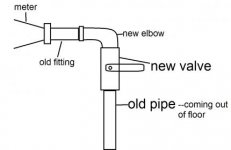
would it be better to cut the pipe below the old valve, solder a male threaded coupling on, and just install a straight ball valve going vertically? i could then just use a 90 degree elbow on top of the valve to attach it to the meter?
kinda like this.. my machine is down at work so i can use the paint program haha
Why, if replacing the valve is an idea then it looks like it has a female connection at the base of the existing valve. Just unscrew.
the gypsy
Well-known member
By God I think you are right!
pcmeiners
Well-known member
After reading all the posts it would be simpler to just knock the house down and rebuild rather then fix the leaking valve stem. I now know not to ask how to fix a worn faucet washer. So far 45 posts to fix a small leak. Sure hope some of you do not work on live ordinance.
Let the Lord have mercy, please let this thread fade into oblivion.
Let the Lord have mercy, please let this thread fade into oblivion.
Last edited:
Weird Tolkienish Figure
Well-known member
And as long as we're throwing around credentials:
Commonwealth of MA, unrestricted construction supervisors license CS-044337
Commonwealth of MA registered home improvement contractor registration 103463
In the trades for over 40 years now and spent a good portion of that working as a remodeler affiliated with a very successful local plumbing/heating/gas fitting company.
And I can read and comprehend questions and answer in a fashion that will lead to the resolution of rather than the creation of a problem.

LS6 Tommy
Well-known member
Nothing to add. Just wanted to be "in before the lock"...
Tommy
Tommy
the gypsy
Well-known member
After reading all the posts it would be simpler to just knock the house down and rebuild rather then fix the leaking valve stem. I now know not to ask how to fix a worn faucet washer. So far 45 posts to fix a small leak. Sure hope some of you do not work on live ordinance.
Let the Lord have mercy, please let this thread fade into oblivion.
It is not a worn faucet washer, you see just goes to show you did not read the post properly. LOL
It is leaking around the stem. I have repacked a stem without removing anything more than the nut right under the handle.
pcmeiners
Well-known member
"It is not a worn faucet washer, you see just goes to show you did not read the post properly."
I read the original post, you did not read my simple answer, which shows I did read it. Your just basically repeating my answer, so read before you make a comment, part of the problem around here, as is repeating someone's answer; cuts down on the embarrassment.
I read the original post, you did not read my simple answer, which shows I did read it. Your just basically repeating my answer, so read before you make a comment, part of the problem around here, as is repeating someone's answer; cuts down on the embarrassment.
Last edited:
Weird Tolkienish Figure
Well-known member

Robert Haas
Well-known member
- Joined
- Sep 30, 2010
- Messages
- 1,749
Well we have a glorified handyman shouting down everyone else.
Massholes crack me up.
Massholes crack me up.
ratdoggy
Well-known member
Have city shut off water. And replace with new ball valve!
This^^
justanengineer
Well-known member
This is the only correct or useful answer in this entire thread. The rest of you can file to the right and pick up your degrees as this weeks' graduating class of armchair plumbers. No one here but Holdover even has a clue as to how that valve really works and what to do to fix it.
After reading all the posts it would be simpler to just knock the house down and rebuild rather then fix the leaking valve stem. I now know not to ask how to fix a worn faucet washer. So far 45 posts to fix a small leak.
The OP didn't ask about fixing the leak, he knew it was rebuildable in the OP. He asked whether or not to trust an ancient gate valve to seal when he takes it apart, which has been answered several times over by others who contributed rather than simply talking ****.
JMO but no, I wouldn't trust a gate valve of unknown age, BTDT with my frugal father. As suggested, take the time to upgrade to a ball.
Sent from my iPhone using Tapatalk
Last edited:
Tim The Tool Man
Well-known member
First of all thank you very much for all the answers, and I do agree that I THINK I can pull the top nut off without leaking and long as the bottom section of the valve doesn't leak. it appears built that way. Still haven't had time to mess with it. As far as possibly giving me incorrect advice I'm not worried, I always plan on getting wet just in case hahaha.
I do have a question and it'd probably because I've never dealt with plumbing parts like this... why do I need a key to remove the large nut on the left side if I decide to replace it? Can't I just use a wrench?
I'll jump in this thread and I hope not to get flamed by the experts here. (By the way I am an expert though I am not going to list my credentials because it really doesn't matter)
Your original question was about repacking the stem of that valve without flooding out your cellar. Yes you can shut the valve, loosen the packing nut. remove all the old gunk with a dental pick if you have one, repack the thing and be done with it. Put a pan underneath as it will probably spit a little.
You other option, as was suggested, is to simply bulldoze your house and start over but make sure you use a fancy ball valve and a 1" copper feed line for better flow.
rburke65
Well-known member
Well after some of these cranky postings, I'm sure as hell keeping my opinions to my self.......
the gypsy
Well-known member
"It is not a worn faucet washer, you see just goes to show you did not read the post properly."
I read the original post, you did not read my simple answer, which shows I did read it. Your just basically repeating my answer, so read before you make a comment, part of the problem around here, as is repeating someone's answer; cuts down on the embarrassment.
I apologize for my response. But on the other hand if you have answered it in the previous post WHY stir the **** and state something that was obvious from your previous post. I believe there is a lot of stirring of the **** on many forums including this one. WITH ALL DUE RESPECT.
the gypsy
Well-known member
In my defense I do not necessarily check who says what, but look at the progression of the thread. So if someone says something in sarcasm, I will not go back and look to see if he or she answered it correctly before.
pcmeiners
Well-known member
" I believe there is a lot of stirring of the **** on many forums including this one. WITH ALL DUE RESPECT."
You are correct, I childishly stirred, it comes about due to my frustration with this forum in the last couple of years...and I will leave it at that.
You are correct, I childishly stirred, it comes about due to my frustration with this forum in the last couple of years...and I will leave it at that.
MikeF2316
Well-known member
....
Up above someone mentioned that this valve would be the municipality responsibility. Maybe so in your area but in every city I have worked the city responsibility ends at the main, both water and sewer. Service saddle, corp valve, service line, curb valve/box are always the homeowner responsibility. Give this some thought.... The leaking valve in your house decides to let loose while you are gone for the weekend.... Ruins the floors and some furniture. I know of no where that that is the cities responsibility and no city attorney would let it be.
Around here the city owns what is on their land. The homeowner owns what's on his land. So the pipe(s) transfers ownership at the property line.
And to the crankier responders: If GJ is that bad, why are you here torturing yourself?
shelteredV
Well-known member
I would pre sweat a 90 with a ball valve with a shoulder piece onto a sharkbite coupling. wrap the pipe up, cut it, and slap that bad boy on there. Wee bit of wawa aint gonna hurt nuthin'. work fast lad!
Or go get yerself a curb key so you don't have to work so fast!
Or go get yerself a curb key so you don't have to work so fast!
Falcon67
Well-known member
This thread

chris142
Well-known member
My house is fed by this 3/4 pipeI'm having a hard time believing that that is to supply valve to your house. It looks like a 90degree 1/2 in stop?
That size is good for a sink or something ....but a whole house ? You have any water pressure in there?
Is it bigger than it looks?
Replace with a full flow ball valve and you might like it.
Attachments

my apologies if any of you were annoyed at my questions, i've been getting alot of that lately that i never used to get here before.
i'll call the city this week and have them shut it off for me and just piece together whatever i think will work. thanks for the positive input to those of you that gave it.
i'll call the city this week and have them shut it off for me and just piece together whatever i think will work. thanks for the positive input to those of you that gave it.
csp
Well-known member
Of course it would work. Ball valves are inline, not 90 degree so you either install the ball valve previous to the 90 or downstream of it.
bczygan
Well-known member
I had a leaking main shut off valve like that.
Went to Home Depot and purchased a water key and went out to the sidewalk and shut off my water supply.
Took pipe wrenches and removed the valve and replaced it with a good quality ball valve.
Much better than those old valves with packing.
Bill
Went to Home Depot and purchased a water key and went out to the sidewalk and shut off my water supply.
Took pipe wrenches and removed the valve and replaced it with a good quality ball valve.
Much better than those old valves with packing.
Bill
my apologies if any of you were annoyed at my questions, i've been getting alot of that lately that i never used to get here before.
...
No need for apologies! You continue to ask and contribute. All the other stuff works itself out.
gregtwojeeps
Well-known member
i can get a Watts brass valve for 10 bucks or a Nibco bronze valve for 20... any preference to brass or bronze? don't know why the price difference is so much, assuming material and one is USA made and one isnt
At the two hospitals I worked for 12 years from 80'to 90's I always used Watts valves for repair/new installations. For the passed 15 years at the facility I maintained, I also had better luck with the Watts lasting longer than the Nibco's. So I always ended up buying Watts brass valves.
A pipefitter proved to me the best way to assure that a threaded joint does NOT leak, is to use Teflon tape and then put a pipe dope over it. (be sure the tape nor dope, hangs over the starter thread end) The tape assures good, slick thread make up and the dope backs up the Teflon tape even more, by filling in the microscopic "die cut" thread's, fissures or nicks.
I read where a meter is mentioned yet I see no meter in your pic. Could you take a side pic of a larger angle ? It appears you have 3/4 in. galvanized pipe leaving the left hand side of the valve. If it is old galvanized and 30 or 40 years old, when you unscrew it, there MAY be the possibility of the old threads on it breaking off. ...
While reading that you have a baby coming, you may just want to let this valve project ride until things calm down and put a old blanket under the drip. This plumbing of old valves and piping can be quick and easy and what one may think a one hour project.. and it may turn in to 4 hours and 5 trips to the store. Especially when there are two fixed points to get the fittings in between and not a lot of "give" to get things screwed on. Good luck. All JMO
Last edited:
benjamintmiller
Well-known member
Before you replace or repack this valve,
A plumber from my city came to replace the meter, the valve before it always leaked when touched. He first loosened the nut causing it to leak more, then tightened it and the leaks went away. He said it causes the packing to swell and seal better.
I always keep a sharkbite "oh ****" valve handy when working near the main shutoff. Worst case scenario, you cut the pipe really quick, jam the shutoff on there open and close it off.
A plumber from my city came to replace the meter, the valve before it always leaked when touched. He first loosened the nut causing it to leak more, then tightened it and the leaks went away. He said it causes the packing to swell and seal better.
I always keep a sharkbite "oh ****" valve handy when working near the main shutoff. Worst case scenario, you cut the pipe really quick, jam the shutoff on there open and close it off.
Greg.. not at home now but the left side of the valve is an adapter like this https://www.menards.com/main/plumbi...npsm-water-meter-coupling/p-1444446041895.htm
Feeds to the tail of the meter.
Great idea on the shark bite I'll buy one.. hopefully the street valve holds so I can return it haha
Feeds to the tail of the meter.
Great idea on the shark bite I'll buy one.. hopefully the street valve holds so I can return it haha
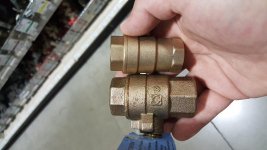
Well got everything I need... if I cut the nut off directly below the like on the bottom side of the valve I called solder an adapter on. The only 90 degree elbow I could find threaded on both ends was a red cast brass fitting rated at 125 psi... I doubt my home water will reach that high
Attachments

gregtwojeeps
Well-known member
Well got everything I need... if I cut the nut off directly below the like on the bottom side of the valve I called solder an adapter on. The only 90 degree elbow I could find threaded on both ends was a red cast brass fitting rated at 125 psi... I doubt my home water will reach that high
 ^^^^^ If your water pressure gets over 70 PSI, you will have problems. Normal is 50 -60 PSI in homes. Don't forget the sharksbite adapter as a backup just in case the city shutoff doesn't hold well. One drop of water...stops solder jobs and makes a mess to clean up behind and re-do.
Last edited: