To avoid these ads, REGISTER NOW!

Need Your Advice about Magnifier/Loupe

Joe Piro

Well-known member
Joined
Feb 26, 2021
Messages
164
Location
South Carolina
I'm not young anymore and I finally need glasses to read fine print. I guess I was lucky to be able to read without glasses as long as I have.
Anyway I'm shopping for magnifying devices, not for reading, but for examining parts, etc. ... seems like there's a lot of opinion out there that for lots of things 10X is just right.
When I start researching (like we all do when we need tools) I find that these folding 10X magnifiers can cost anywhere from $9.95 to over $400.
(See photos below. I think the Swiss Hawk is around $400. It must be the PB Swiss of loupes.) The first big improvement is going from a single lens device (maybe $10) to a compound lens (triplet) starting at around $35 to $75.
Unfortunately, just like shopping for tools, there isn't anyplace anymore to hold it yourself or try it out. With tools I find if I go cheap at first, I'm not happy until I've spent a little more for better quality.
I've read about a "Hastings" triplet lens and also a "Coddington" triplet lens.
Do you have any recommendations and opinions based on actual experience? What do you use?
Thanks in advance.

Loupe A for GJ.jpegLoupe B for GJ.jpegLoupe C for GJ.jpeg
 
To avoid these ads, REGISTER NOW!

Dave455

Well-known member
Joined
Mar 19, 2013
Messages
5,796
Location
Sussex, England
I’ve got one of the 10x “coddington”, and it’s great, but it’s worth understanding the purpose.

Most of these higher magnification lenses are really designed for folks with normal sight to examine really small stuff. I use mine for looking at edges on tool tips and so on, and even then it’s probably too powerful. There’s not much angle of view, the depth of field (area in focus) isn’t great, and you are so close that lighting can be a problem.

If you’re just a bit long sighted (most folks with normal vision get that way - I’m short sighted, which is an advantage in the workshop) you will probably find that a lower power lens works much better.

At lower power the quality is less of an issue. You don’t really need compound lenses to reduce distortion, or expensive glass to keep them bright. My Father used an old style magnifier of about 4 inch diameter for years to read drill sizes and it worked just fine.

Worth trying to find somewhere to try them if you can. I have an old style photographic shop locally, who sells everything optical. He has about 20 different hand lenses, so perhaps you could find similar.
 

seber

Well-known member
Joined
May 31, 2016
Messages
4,187
Location
Deep East Tx.
Over the years I've accumulated quite a few due to the type of work I did. Unless you are a jeweler looking for the tiniest flaw in a diamond, any cheap loupe will be as good as the very best. We paid $10 each for them and considered them throwaways. For that matter, many jewelers use the same ones. The very best one I have is the Triple lense eypiece from a microscope. List price on the eyepiece alone was several hundred, but since no one uses microscopes any more I got the whole thing for $10 at a flea market. Anyway, I don't use it. The extra weight is a drawback and the extra quality is worthless for home use.
 

RTM

Well-known member
Joined
May 13, 2019
Messages
13,053
Location
SF Bay Area
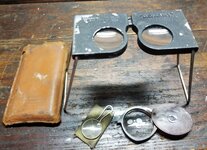
I use a linen tester, 6x, per the link below. I used to use a cheap photo one, but it was jokingly called a shot glass it was so bad. The linen tester is nice, because it’s pre focused at the bottom of the stand, and has a fairly wide field of view, with minimal distortion at the edges. Made for counting threads per inch or some stuff. I have two of those, and then other similar options.

these are nice, open on three sides, so lots of light, if you need to use it on an odd shape, unfold it and manually focus. If you want to look at a blade, just set it on top. A screw, set it around it. Based on someone else’s work, I’ve even took cell pix thru it, with great results.

someone gave me a pocket one as you showed, and I never use it, too small a field of view. Top right, silver case.

if you want to carry it, get the case, it folds to under 1/2” thick.


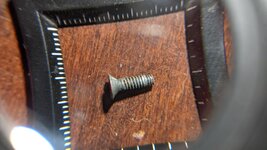
Here is a screw for a 1/4” ratchet, shot thru the lens, you yan see the 3-56 to 4-40 change

PXL_20210716_014316976-X3.jpg
 

rlitman

Well-known member
Joined
Oct 18, 2010
Messages
24,576
Location
Long Island
This is a GREAT example of the distortions you get in cheap singlet lenses. Look at both the pincussion curvature that's immediately obvious, and the less obvious color fringing around the white lines (they appear blue one one side and kind of orange on the other in this image).

These distortions are minimized at the center of the field of view in all lenses. But here's what you need to know. The overall FOV as well as that sweet central region shrinks with increasing magnification. At 2x, you'd hardly notice the issue. By 10x, singlet lenses have such a small useful FOV that you're effectively looking through a drinking straw.

On another note, Coddington lenses are singlets. There are also Steinheil triplets to consider, but they're more of an edge case for higher magnifications (20x and up), with a smaller sweet spot than the Hastings design.
 

Downwindtracker 2

Well-known member
Joined
Jun 13, 2019
Messages
1,715
Location
BC
I have an Optivisor for gunstock checkering, but to read mics and bearings I have bunch of hand held magnifying glasses laying around.
 

rlitman

Well-known member
Joined
Oct 18, 2010
Messages
24,576
Location
Long Island
I have an Optivisor for gunstock checkering, but to read mics and bearings I have bunch of hand held magnifying glasses laying around.
I bought a cheap 3.5x Galilean dental telescope type optivisor for some close up fine work. I don't require reading glasses, and with the long focal length, the 3.5x really isn't magnified from what I can see by moving the part 3.5x closer to my eyes, but it does allow me to use a rotary pencil or carving knife at a distance more comfortable from my nose.
 

WisJim

Well-known member
Joined
Dec 20, 2010
Messages
2,254
Location
Menomonie, WI
I use a 10x Bausch and Lomb Coddington that was my dad's and is older than me and works well for checking markings on old tools. I think that 10x is a good compromise between magnification, distance to object being viewed, and field of view.
 

Private Lugnutz

Well-known member
Joined
Mar 30, 2012
Messages
30,450
Location
The Authentic Jersey Shore
Do you have any recommendations and opinions based on actual experience? What do you use?
Hi Joe. I think the last time I replied to one of your threads (angle wrenches!) I went vintage on you and I hope you don't mind me doing it again. I'm a cheap-*** miser, so I prefer vintage flea market finds, but I also tend to believe there aren't too many things we can improve on from the middle of the last century when it comes to things like angle wrenches and loupes! :)

I use the tiny steel framed vintage jobbie and the wartime Army map reader around the shop. I keep the vintage ATCO in my flea market bag. I have no idea about magnification levels or distortion etc, I only know they make really small details legible from several inches away when my naked eye fails! :)
 

Attachments

  • 20210918_080210.jpg
    20210918_080210.jpg
    407.6 KB · Views: 35
  • 20210918_172518.jpg
    20210918_172518.jpg
    409.5 KB · Views: 27
  • 20210918_081408.jpg
    20210918_081408.jpg
    189.7 KB · Views: 25

LeonardY

Well-known member
Joined
Apr 16, 2011
Messages
5,020
Location
Southern California
I have several magnifier lamps with lights. I find that light is the bigger problem for my eyes. I used to be able to read the side of 2-56 tap. Now it's hard to read the #8 taps.
I have one linen tester from way back when I worked in a print shop. Hardly use it.
On my desk is a 4 inch single lens magnifier that was my grandfathers. I grab that all the time.

In a pinch. I use my phone and take a picture and zoom in on the detail I need to see.
 

timgunn1962

Well-known member
Joined
Mar 31, 2018
Messages
159
Location
Lancashire, England
Best bang for the buck I've found seems to be the Belomo 10x Triplet Loupe. Made in Belarus. Looks to be available from ebay or Amazon for under 40 bucks in the US. I paid around 25 GBP for mine a few years ago.

Mine mostly gets used on site and lives in a bag with the tools I take to make an initial assessment of breakdowns, etc. Though it does often get used for inspecting things, it mostly gets used for reading part numbers off relays, etc: since the onset of codgerhood, I find I can't read the fine print like I once could.

It's good enough that I don't think I'll ever need anything better and it's cheap enough that dropping it or losing it on site will not upset me too badly.

Pretty much every review or comparative test I have seen puts the Belomo 10x Triplet ahead of the Bausch & Lomb 10x Hastings Triplet. Over here, the Belomo tends to be considerably cheaper than the B&L, which clinched it for me.
 

cdods

Well-known member
Joined
May 7, 2009
Messages
159
I'm not young anymore and I finally need glasses to read fine print. I guess I was lucky to be able to read without glasses as long as I have.
Anyway I'm shopping for magnifying devices, not for reading, but for examining parts, etc. ... seems like there's a lot of opinion out there that for lots of things 10X is just right.
When I start researching (like we all do when we need tools) I find that these folding 10X magnifiers can cost anywhere from $9.95 to over $400.
(See photos below. I think the Swiss Hawk is around $400. It must be the PB Swiss of loupes.) The first big improvement is going from a single lens device (maybe $10) to a compound lens (triplet) starting at around $35 to $75.
Unfortunately, just like shopping for tools, there isn't anyplace anymore to hold it yourself or try it out. With tools I find if I go cheap at first, I'm not happy until I've spent a little more for better quality.
I've read about a "Hastings" triplet lens and also a "Coddington" triplet lens.
Do you have any recommendations and opinions based on actual experience? What do you use?
Thanks in advance.

Loupe A for GJ.jpegLoupe B for GJ.jpegLoupe C for GJ.jpeg
 

Git

Well-known member
Joined
May 18, 2008
Messages
6,894
Location
S Cal
I bought a cheap 3.5x Galilean dental telescope type optivisor for some close up fine work. I don't require reading glasses, and with the long focal length, the 3.5x really isn't magnified from what I can see by moving the part 3.5x closer to my eyes, but it does allow me to use a rotary pencil or carving knife at a distance more comfortable from my nose.

^ This. Picked a Rose MicroSolutions 3.5x loupe on a half-frame, (from what I understand commonly used by dentists/hygienists). I got a great deal on them from Amazon Warehouse ($65) and bought them to use when I am cutting on the band saw or scroll saw. They work great, but take a little getting used to. The 'working length' is about 16" so you have to keep your head that far away from the workpiece or it will get out of focus. I was using a Carson headband magnifyer before, but one day I realized I was getting pretty close to the bandsaw blade with my face, and decided I needed to get something a little safer. With this style, I can wear them over my regular glasses and they flip up out the way when not needed. They do come in handy but I also use a magnifying app on my smartphone for other things

Looks like this
T- 538.jpg
 
To avoid these ads, REGISTER NOW!

cdods

Well-known member
Joined
May 7, 2009
Messages
159
I work in a business where hand held magnifiers are common place. There's always one available, including very high end optics if required. 95% of the time when doing a quick examination we now use our phones to zoom in. It has a light built in and provides great magnification.

Just something to think about, if you are someone that has a phone handy.
 

RTM

Well-known member
Joined
May 13, 2019
Messages
13,053
Location
SF Bay Area
This is a GREAT example of the distortions you get in cheap singlet lenses. Look at both the pincussion curvature that's immediately obvious, and the less obvious color fringing around the white lines (they appear blue one one side and kind of orange on the other in this image).
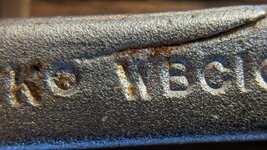
Oh, tough crowd. Didn't know I was going to get held to photographic quality here, combining cheap magnifiers and hand held cell phones. But he's right, that example is far from a good photographic image. I was using 1x magnification for that shot, thus seeing the edges. Here is a better set of images, all of the same thing, 3 of 4 taken within a few minutes of each other, with a bit of commentary. These are all straight out of the phone, no cropping, only rotating.

The first image was taken with the same linen tester loupe mentioned above, with the phone camera in 2x mode about 1-1/4" above the face of the loupe, the wrench resting on the frame, so above where it should be. Relatively easy to do, the part you want to see is plainly visible, but if you move the camera off axis, the pin cushion distortion shows up as rlitman noted. Also very easy to see most of the area of interest in focus.

PXL_20210914_010342242-XL.jpg

The second was taken with a 10x Ruper Japan loupe, pic at the bottom. The loupe is <3/4" above the tool, and the my eye was practically touching the loupe (eyelashes were), the camera <1/2" away, and it is a balancing act to find focus, instead of the fixed focus from above.

PXL_20210918_230302536-XL.jpg

The third image is from a cheap circle bulb magnifier, maybe 2x at best, at least 10 years old. I did clean it for the picture. I could get it to focus at many distances, but as I moved my head side to side, I lost focus. Several inches away from the wrench, and the lens, respectively.
PXL_20210918_230910300-XL.jpg


The last image was taken through a Donegan desktop magnifier, with a long working distance. I think its rated for 10" working distance, and I can hold my head back about that same distance, and get a great view. Unfortunately, all this is moving about, juggling the desk light etc to get a decent camera image. If I had to do work at higher magnification, over a wide area (like reading a map), this would be my preferred creature. Bit of a reflection off the glass, and I think a CD on the desk is giving the rainbow.
PXL_20210918_231050944-XL.jpg


And here is the wrench I was shooting, the 10x Ruper folding magnifier, and the Donegan. And a reflection of my phone.

And the point of all this? Some personal experience per cdods request. Find what is comfortable for you. I have had my 10x folding loupe for about 15 years, and rarely use it. The garage has a small loupe (filled a shipping minimum) that is better than the circle lamp, but a very narrow field of view. The office desk has both the linen tester and the big glass lens, and I try the glass first, then the linen tester if I can't decipher what I need.


PXL_20210918_231649617-XL.jpg

And yeah, I bought another cheap desk lamp with magnifier today. (Lights and magnifiers both seem to be growing in need lately. Must be all these energy efficient bulbs.) Apparently I didn't see a nice 9" square magnifier light at the first estate sale of the day, where most things were 2-3x what I would willingly pay. Passed on an old pair of binocular glasses too, will use my Optivisor for most close work

And the first pic will show up in the Vlchek thread to ask what the heck happened to my wrench to give it that greenstick fracture looking thing.
 
Last edited:

rlitman

Well-known member
Joined
Oct 18, 2010
Messages
24,576
Location
Long Island
Oh, tough crowd. Didn't know I was going to get held to photographic quality here, combining cheap magnifiers and hand held cell phones...
Sorry, I didn't mean to appear to pick on your magnifier or photos. For photography, edge-to-edge image quality is far more important than it is to the eye. My point was just that those sort of distortions that are still acceptable at your lower magnification singlet start to become real problems at 10x.

On another note, I've used my (very cheap) 10x triplet with a rubber band holding it over my cell phone camera lens to capture some great micro-photography.

9314AAE0-1389-40C5-B479-4CDD7D74E40D.jpeg

That there is a monarch butterfly egg developed to the point that the larvae is starting to become visible inside. Overall length around 1mm.
 

laser3kw

Well-known member
Joined
Nov 17, 2012
Messages
7,276
Location
northen IL
I wear magnifying headgear while out in the shop. I started using them while working tool and die and just got use to having them. I am so use to having them on, I forget to take them off when I go back to the house! I have 10x and can use them with or without my glasses.

Donegan-DA-2-OptiVISOR-Headband-Magnifier-1.5X-Magnification-Glass-Lens-Plate.jpg
 

Davefr

Well-known member
Joined
Jan 7, 2010
Messages
11,815
Location
OR
Here's what I use from weakest to strongest and longest focal range to shortest:

1. Search Ebay for "strong readers". You can get up to 6 Diopter pretty cheap.

2. Optivisor w/Warm/Floody Zebralight mounted on the brim. Get the Optivisor with glass lens. I like the 10x.

3. Leica A60F with flex arm stand. Mount it so it'll also extend past the edge of your workbench to inspect larger objects. The Leica has excellent depth of field with their Fusion Optics. (5X to 30X)

magnivisorzebra 002.JPGleica a60F.jpgleica a60F.jpg
 
Last edited:

Geezer

Well-known member
Joined
Sep 11, 2021
Messages
84
Location
Atlanta Ga.
Over the years I've accumulated quite a few due to the type of work I did. Unless you are a jeweler looking for the tiniest flaw in a diamond, any cheap loupe will be as good as the very best. We paid $10 each for them and considered them throwaways. For that matter, many jewelers use the same ones. The very best one I have is the Triple lense eypiece from a microscope. List price on the eyepiece alone was several hundred, but since no one uses microscopes any more I got the whole thing for $10 at a flea market. Anyway, I don't use it. The extra weight is a drawback and the extra quality is worthless for home use.
A 10x loupe was fine for me in contact lens manufacturing.
 

2oolhound

Well-known member
Joined
Dec 18, 2010
Messages
5,918
Location
BC Canada
I keep a variety of magnifying devices on hand.

My most commonly used ones are the cheap +1, +1.5, or +2 etc safety glasses you can get at princess auto/harbor freight stores fro $3 - $5. They are normal safety glasses with a small area in the lower area of the lens that is ground to give you a magnified view when you look downward. I use these for welding, sharpening lathe bits or just about any quick readings I need to make and keep them handy.

I also use 6X, 8X or 12X photographic loupes which I keep in a drawer.

I keep several regular magnifying glasses on hand as well that I pick up a flea markets when they are cheap.

I have several of those circular fluorescent bulb illuminated magnifying lamps I like to keep at one end of the bench. It's handy to just walk over turn it on and view whatever you're holding in your hand at the moment. These are my 2nd most commonly used magnifiers. Unfortunately I do a lot of grinding and the tiny particles of red hot steel tend to land on the glass lenses and burn into them which dulls their clarity over time.

If I'm working on something intricate that will take some time like a laptop for example I'll use an optivisor (that clamps on your head). I have one that has a basic 4 or 6x lens but you can flip a second lens down in front of it to increase the magnification and if that doesn't do it there is a swing down eye piece that really steps it up a notch.

As mentioned above, good strong lighting in your working area is essential. And I love my cell phone for recording a VIN number or crawling under a vehicle to snap a pic of an id tag on a transfer case etc.
 

magicrat

Well-known member
Joined
Jun 18, 2015
Messages
318
Start cheap buy two of the $10 ones. They work fine for my purposes. If you decide you need something more oh after using the budget version go for it.
 

Tools4Me

Well-known member
Joined
Jun 22, 2021
Messages
546
If anyone on GJ has a desire for a larger sized loupe for general use while at home, you can make excellent large loupes out of the projector lenses from older rear projection tv's. Each tv usually has three internal lenses (one for each color), so one tv teardown will often yield three really nice loupes. The ones I made have a circular viewing diameter of almost 3.5" (the original tv had a 65" screen if that matters). The view is definitely plan achro in my opinion. There's no distortion, blurriness, or color separation anywhere in the field of view when I look at the lens straight on. The original plastic housing of the lens was sized perfectly, so if I set my large loupe down on a piece of paper, set it over a coin, etc. the image will always be in focus automatically. I can also hold my head any distance from the loupe and still see a focused image. I don't have to hold my eye up close or hold the loupe in the air at the right distance from the object to get a clear image like I have to do with my other small store bought loupes.

The image I posted of the coins does show some visible distortion and light color separation, but that's because I took the picture at a bit of an angle to reduce light reflections on the loupe lens. When using the loupe in person, the entire lens image is perfect as long as I am looking at the lens straight on. I added the stainless screw clamp around the outside of the housing myself, it was not part of the original tv. I added it to prevent the two piece snapped together black plastic housing from breaking apart if I accidentally drop the loupe.

I'm not exactly sure what my magnification level is, but I find the magnification level perfect for reading small writing, seeing finer details like Snap-on stamped date codes, and for quickly reading the numbers on small electronics chips. It's the perfect bridge between bare human vision and using my 7x-40x stereo/inspection microscope.
 

Attachments

  • 100_9538.JPG
    100_9538.JPG
    206.5 KB · Views: 4
  • 100_9539.JPG
    100_9539.JPG
    155.5 KB · Views: 9
  • 100_9545.JPG
    100_9545.JPG
    315 KB · Views: 9

e36jon

Well-known member
Joined
May 2, 2013
Messages
237
Location
San Francisco CA
It never occurred to me that my iphone could be the tool I needed until a friend clued me in. I have since purchased a lens set from Amazon for $14 (I think) that included a 20X clip-on macro lens and have been totally impressed. I tried another lens set ($10 maybe?) that also had a 20X macro but with a very short focal length. That first lens had a frosted plastic cone extension that allowed you to just touch off on whatever you wanted to shoot and it would be in focus. That didn't always work geometry-wise, so the second lens set had a 2" focal length and has been much more useable.

Like some others above I need something I can wear when I am in my shop so this thread is really helpful.
 

Downwindtracker 2

Well-known member
Joined
Jun 13, 2019
Messages
1,715
Location
BC
I just spent $2000 at the optimist for three pairs of lenses, regular, safety , and polarized sunglasses for driving and fishing. Just the lenses. I just had cataract surgery and am looking forward to seeing,again. excuse the bad joke. Reading glasses with their short focal length, are just too much bother.This is going to cut into my tool budget, spending, for months.
 

rk_tek

Well-known member
Joined
Apr 12, 2015
Messages
153
Location
Bella Vista, AR
I picked up an ancient Dazor floor standing magnifier with a fluorescent light a while back for about $25. They also have desk versions. The depth of field isn't great, but the large lens helps when looking at parts that are larger than tiny. I have used it position over my vise for intricate file work. Being hands free is a great help. I also have an antique desk magnifier at work that I use for reading half size blueprints.
 

RoninB4

Well-known member
Joined
Jul 22, 2020
Messages
3,474
Location
Under My House
Not sure of your requirements for magnification or focal length, that's rather subjective. I use a loupe and Optivisor at work a lot and switch ** for different tasks. I will say that the plastic lenses do not gather as much light as the glass lens will. A glass lens will be more expensive but I prefer them. A plastic lens will also allow particles to embed, not a good thing when grinding precision components. Glass is less susceptible to flying particles and sparks. Hope this helps someone.
 
To avoid these ads, REGISTER NOW!
Top Bottom