To avoid these ads, REGISTER NOW!

Needing Help with Shop Duct Design

raceman17

Well-known member
Joined
Jul 3, 2012
Messages
118
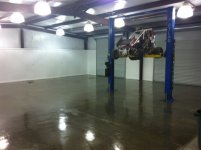
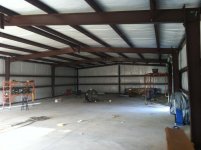
Hello Everyone. I have finally finished building my Shop. It is a 40x80 metal building with a 12' eve height and 1:12 roof Pitch. It has 3" of the standard metal building insulation on the roof and walls. The shop is located in Northwest Florida with daily temperatures in the high 90s and of course high humidity. On the inside of the building I covered the lower 7 feet of wall space with wood (to protect the insulation). I have attached a few pictures and a layout of how the shop is setup.

I have added two walls to divide the shop into 3 sections. One section is where we park the daily driver cars (no ac here) and then an area that is 16x30 which is where I have all my tools stored and then a 50x40 area where my racecars are parked.

It is approximately 2500 sq ft of area to cool. I am not too concerned with keeping the 16x30 area cool because I do not spend much time in there but I figured since I am running the duct line I should just go ahead and shoot some air into that room.

I need AC. This is what I would like to do. I would like to purchase a 5 ton package unit. Here is the link to the unit. I think it runs at 1800 CFM.

http://https://www.theacoutlet.com/GPC1460H41-5-Ton-14-Seer-Goodman-Package-Air-Conditioner.htm

I want to install the AC on one of the backwalls of the shop and then add a long duct hanging off of the 1st perlin and running a length of around 40 ft. The air would enter the main trunk line centered on the 40 ft section. Then I would like to add a 90 degree fitting and turn the line to go down the side of the interior wall so I can shoot a register into the smaller tool storage room. I do no want to add branch lines to the main truck line out into the open area. I figure I could just add the registers to the main line and shoot the air out into the open area.

The AC has a 14" supply and a 18" return.

I need help designing the duct sizes and how many registers do I need to have. I want to use sprial metal ducting. I am not going to keep the AC on all the time. I just need some help to make it cooler. I do not expect to hang meat in there either.

If any other info is needed let me know.

Thank for your time and this website is great!
 

Attachments
  • Duct Layout.pdf
    141.3 KB · Views: 96
  • Inside1.jpg
    Inside1.jpg
    98.5 KB · Views: 234
  • photo.JPG
    photo.JPG
    98.9 KB · Views: 305
Last edited:
To avoid these ads, REGISTER NOW!

sands35

Well-known member
Joined
May 29, 2012
Messages
936
Location
St. Joseph, MI
There is a lot of stuff on the web to design and size ducts. If you are going to DIY it, you'll need to do some basic math to get the air velocities right.

Duct area (sq ft) * air speed (ft / min) = air flow rate (Ft^3 / min - aka cfm)

The HVAC unit likely has a rated CFM.

Main ducts can be around 1000 ft/min, at the register around 300-500 ft/min.

It is a balance between the level of noise you want to tolerate vs. the amount of air "throw" you get out of the register.

The simple answer is that you get the diameter of the duct sized so that the internal air velocity is at your desired level. The size and count of the vents need to match so that the velocity coming out of them is acceptable. Higher velocities are louder. The return duct works basically the same.

http://www.engineeringtoolbox.com/sizing-ducts-d_207.html

There are friction losses for longer ducts. Your runs aren't that long and you are probably tolerant to slight system imbalances. You'll notice that in a house if one room has more or less air supply than an adjacent one, but likely not in a garage. Ignoring friction losses, the total CFM into a duct needs to match the expected CFM out of the duct. The simple way to compensate is have slightly bigger registers at the end of the run then at the start of the run.

If you are going to DIY it, it's likely simpler to install a slightly bigger main trunk line and slightly bigger registers. You can put a sheetmetal plate over the register hole and put in smaller ones if you need more velocity coming out of the register.

If you make the trunks too big, there won't be enough velocity to carry dust and suspended particles back to the HVAC filter. It will accumulate in the duct and make nasty smells after a few years.

You will also want to ensure some sort of cross flow so you don't have dead spots in the room. Personally, I'd run the supply down one wall and the return down the opposite wall with vents spaced evenly down the duct. But that depends on how much time you will spend in the garage or if it's just to keep the temps lower than outside ambient and control humidity a bit.
 
Last edited:
OP
R

raceman17

Well-known member
Joined
Jul 3, 2012
Messages
118
My unit has an 1800 CFM rating. So lets say I wanted to find the area of the main trunk line.

Area=CFM of unit/Air speed

Area=1800/1000

Area=1.8 ft^2

So an 18" duct would give me roughly 1.8 ft^2 of cross sectional area.

So my system would start out with a 14" (thats the size of the supply line) flex line running into the main truck line size of 18".

Now what happens next?

I would just like to cut holes for the registers in the main line and add grill boxes.

To start off with lets say out of my supply line "T" connection I add two registers spaced 5 foot on each side of the main truck connection...

How to I calulcate the grill size? My veloocities will be going down since I now have two holes in the main line. Do I set the velocity of the opening at lets say 400 FT/Min and caluclate the area? What CFM do I use now?

Also when do I start stepping down the truck size to keep my air speed at 1000 ft/Min?

Thanks for the help!
 

sands35

Well-known member
Joined
May 29, 2012
Messages
936
Location
St. Joseph, MI
You have 1800 CFM that needs to leave the duct at around 4-500 cfm. I'd build a simple spreadsheet to play with the number of registers and their size. The simple answer is that you need 4x the register area as you have duct area to drop the velocity by about a factor of 4.

To do the area step down, you need to re-calculate the available CFM after each register. You want to maintain 800-1000 ft / min all the way down the trunk to keep stuff suspended. You'll notice that in large public spaces or factories, they don't actually step the main trunk down at every register or branch line. Register balance and dampers takes care of that. You'll need to build the spreadsheet to do the math or just eye-ball it and go to 10-14" after 1/2 the registers and put in a damper or two.
 
Last edited:
OP
R

raceman17

Well-known member
Joined
Jul 3, 2012
Messages
118
So let me try to sum what your are telling me and how I am thinking about this in my mind. I am going to make an assumption that 1800 cfm are coming into the main trunk line by a "t" fitting. Half of the CFM is going one way and half the CFM is going the other way. So on one side of the system I make the turn and I am dealing with 900 CFM.

For calculation sake lets say I will add 4 registers on the right side of the "t" and 4 registers on the left side of the "t"

Each register will see:

1800 CFM/8 registers = 225 CFM Each

I will add two registers in the 18" main line first keeping a velocity out of the register of 450 FT/Min....

so the first one after the "t" will have the following area

A=225 CFM/450 Ft/Min = .5 Ft^2

So a 6x12 register will give me the area I need.

I now go down the line lets say 8 ft and add another one the same size. So now I have lost 450 CFM of the 900 CFM on that one side..

Now would probabaly be a good time to step the main size down.

I am now dealing with the remaining 450 CFM and I still want to keep 1000 Ft/Min velocity.

So now my new cross sectional area of duct becomes

A=450 CFM/1000 Ft/Min = .45 Ft^2 This isnt right!!!

What am i missing here?!?

If i understand you correctly your saying I need to have 4 times the main line area which is 1.8 ft^2 for my register openings so My total reqister opening area would need to be 1.8 x 4= 7.2 ft^2

Thanks for your time! I know I am missing something here and Im sure once I hear it this will all make sense!
 

sands35

Well-known member
Joined
May 29, 2012
Messages
936
Location
St. Joseph, MI
Hmm I'm not at my computer to think it through. I missed the part about the T. That splits flow in 2. They do make quick reference cards for about $10 or so that help with it. The 1000ft/m is a guideline not a rule. For woodworking duct 600 f/m is the min. There is also the practical problem of what parts you can get. The simple way is just to run one main duct size then manage airflow with register vents. Start with fewer vents then see what happens. Easy to add more.
 
OP
R

raceman17

Well-known member
Joined
Jul 3, 2012
Messages
118

Thanks!! I have a few questions. My unit has 14" and 18" supply and return. Your layout shows different. Do I just make a Sheetmetal converter for a 20 in supply line? Also the manual calls for qty 2 of a 20x25 filter grill return. This is different in the layout. What is the 10x10 transfer box in the lower left of the layout drawing? Can you explain this?

Thank you for your time as well. It is very much appreciated!
 

mrgm

Well-known member
Joined
Dec 13, 2010
Messages
199
Location
TX
Thanks!! I have a few questions. My unit has 14" and 18" supply and return. Your layout shows different. Do I just make a Sheetmetal converter for a 20 in supply line? Also the manual calls for qty 2 of a 20x25 filter grill return. This is different in the layout. What is the 10x10 transfer box in the lower left of the layout drawing? Can you explain this?

Thank you for your time as well. It is very much appreciated!

yes. you will have to have a transition from unit to duct. don't forget the flex in between

the 48x24 allows for a pair of filters that are 24x24. this size allow less static pressure in the return side

the 10x10 can just be a hole between rooms so air can return to unit. you can throw a transfer grille there if you want.
 
OP
R

raceman17

Well-known member
Joined
Jul 3, 2012
Messages
118
yes. you will have to have a transition from unit to duct. don't forget the flex in between

the 48x24 allows for a pair of filters that are 24x24. this size allow less static pressure in the return side

the 10x10 can just be a hole between rooms so air can return to unit. you can throw a transfer grille there if you want.


Ok,

I have a few more questions. I was looking at the registers you speced out and depending on their sizes, some will not work for the correct diameters of ducting you called out. Can I just drop down to the correct size as long as I keep the same openings in terms of square inches?

Also, is it possible to run a 14" flex line coming off the unit into a 20" duct as you suggested? This will allow me you use an off the shelf transition duct piece the connects directly to the unit.

I'm just courious on why the system has a 14" supply and your specing out a 20" connection. Can you explain this to me?

And last... How long from the end of the duct runs do the end of the registers need to be located? Also, how long does that 20" bump out in the "t" connection coming off the supply line need to be?

Once again thank you for your time.. It is very much appreciated. I formed up and poured the concrete pad today outside the building and I am planning on ordering the AC unit this week.

Thanks again :3gears:
 

mrgm

Well-known member
Joined
Dec 13, 2010
Messages
199
Location
TX
Ok,

I have a few more questions. I was looking at the registers you speced out and depending on their sizes, some will not work for the correct diameters of ducting you called out. Can I just drop down to the correct size as long as I keep the same openings in terms of square inches?

Also, is it possible to run a 14" flex line coming off the unit into a 20" duct as you suggested? This will allow me you use an off the shelf transition duct piece the connects directly to the unit.

I'm just courious on why the system has a 14" supply and your specing out a 20" connection. Can you explain this to me?

And last... How long from the end of the duct runs do the end of the registers need to be located? Also, how long does that 20" bump out in the "t" connection coming off the supply line need to be?

Once again thank you for your time.. It is very much appreciated. I formed up and poured the concrete pad today outside the building and I am planning on ordering the AC unit this week.

Thanks again :3gears:

yes

yes

the system will most of the time have a smaller supply opening. they directly dump fan supply right out of the unit at that opening. those opening are usually size per fan discharge (dimensionally). duct will need to be size per static pressure, friction per 100' etc etc. which can be different per application

I generally put the diffusers half of it length to the end of the duct run min. closer and you will start making noise from the air hitting the end cap and being forced out the diffusers. this way your are getting the air from the pressurized duct, not the damn at the end of the duct. they can be located further in if needed. for the extension of the 20 at the T, will do that one 16" past intersection. this cuts down turbulence out the T and make the connections stronger.

:thumbup:
 
OP
R

raceman17

Well-known member
Joined
Jul 3, 2012
Messages
118
Thanks for all the help..

I have ordered all the duct materials and the AC unit. I decided to go with the 5 ton heat pump as well. I should start seeing the materials arrive in less than 2 weeks. I will post pics of the final install when I get it finished.

Thanks again
 
OP
R

raceman17

Well-known member
Joined
Jul 3, 2012
Messages
118
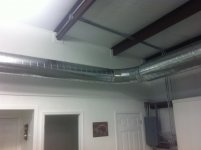
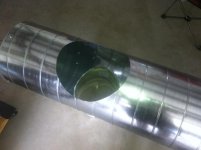
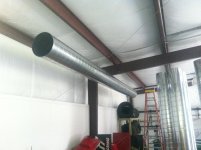
Here is an update on my project.

I was able to start hanging the duct yesterday. I have about 20' left to run and I still need to install 2 more registers. Hopefully my AC unit will be here this week! :willy_nil
 

Attachments

  • Duct5.jpg
    Duct5.jpg
    69.7 KB · Views: 189
  • Duct4.jpg
    Duct4.jpg
    106.2 KB · Views: 431
  • Duct3.jpg
    Duct3.jpg
    94.6 KB · Views: 190
  • Duct2.jpg
    Duct2.jpg
    88.3 KB · Views: 188
  • Duct1.jpg
    Duct1.jpg
    131.5 KB · Views: 199
  • Duct6.jpg
    Duct6.jpg
    101.4 KB · Views: 195
OP
R

raceman17

Well-known member
Joined
Jul 3, 2012
Messages
118
That looks great. still have all your fingers?

Yeah, I only ended up with two small cuts on my hands. I was using a deburring tool and slipped on the first cut! After that I decided it would be a good idea to wear some gloves. I ended up cutting all the duct with a jigsaw and it cut real easy. I think the hardest cut was the circle hole that goes through the building for the outside unit. I cut thouse with regular tin snips.
:beer:
 

Bill1031

Active member
Joined
Apr 8, 2013
Messages
29
Location
Virginia
I agree on the sweating. If it stayed cool in garage might not be bad but if you are moving cars in and out and it is hot outside it will sweat. Think of a glass of iced tea on a hot day. You need a coozy and some duct wrap. :)
 
OP
R

raceman17

Well-known member
Joined
Jul 3, 2012
Messages
118
Is any of that lined? Because I'm guessing you might end up with some sweating...

Its single wall spiral duct. I probabaly will sweat some but I'm ok with that. I will only open my garage door when I need to load my race car on the trailer saturday morning and once again Sunday morning when it get put back up.

I received the AC unit yesterday. I placed it on my concrete pad and hooked up the supply duct last night. I am hoping to get the electrial hooked up this afternoon and turn the unit on.

Thanks
:beer:
 
To avoid these ads, REGISTER NOW!

pseudorealityx

Well-known member
Joined
Nov 10, 2009
Messages
999
Location
USA
Its single wall spiral duct. I probabaly will sweat some but I'm ok with that. I will only open my garage door when I need to load my race car on the trailer saturday morning and once again Sunday morning when it get put back up.

I received the AC unit yesterday. I placed it on my concrete pad and hooked up the supply duct last night. I am hoping to get the electrial hooked up this afternoon and turn the unit on.

Thanks
:beer:

You located it directly over an electrical disconnect. You SURE you're cool with it sweating? :lol:
 
OP
R

raceman17

Well-known member
Joined
Jul 3, 2012
Messages
118
You located it directly over an electrical disconnect. You SURE you're cool with it sweating? :lol:

Actually the supply duct is not located directly over the disconnect. It is about 3 feet away from it. The main duct is about 4 feet off the wall.
 
Last edited:

pseudorealityx

Well-known member
Joined
Nov 10, 2009
Messages
999
Location
USA
attachment.php


Am I missing something?
 
OP
R

raceman17

Well-known member
Joined
Jul 3, 2012
Messages
118
Well I am going on having the AC up and running for a few days now. Everything is running great and it cools the building nicely. I had the AC running all day Saturday and Sunday and only had about 5 drops of condensation forming on one of the ducts. The were not big enough to even drip on the floor. I'm good with that.

Right now I am getting about a 21 degree temperature difference between the supply and return air temps. I still have to insulated the outside supply line though. We have been getting rain every afternoon for like 2 months! Its crazy!

I have cut and formed all the metal pieces for the doghouse outside the unit so it wont take long to get it all buttoned up when I get some good weather.
 

mrgm

Well-known member
Joined
Dec 13, 2010
Messages
199
Location
TX
sounds great! can you throw some pics of the outside unit on here?
 

Fueler

Well-known member
Joined
Jun 22, 2006
Messages
1,620
Location
Urbana, IL
Raceman17
I have been eyeballing the same AC unit.
I was wondering how this all worked out a couple of years later.
 
OP
R

raceman17

Well-known member
Joined
Jul 3, 2012
Messages
118
The unit has performed excellent without any issues to date. I usually run my system about 4 times a week when I'm out in my shop working. It takes about 10 minutes to bring the temperature down to a comfortable level after being off for a few days. It's was a very good investment for my shop.
 

Fueler

Well-known member
Joined
Jun 22, 2006
Messages
1,620
Location
Urbana, IL
Cool, Thanks
I was wondering what the spacing from the building would look like.
I take it that the tall one is the outlet and the inlet is down low and hidden in this pic.
Wonder if insulating the outlet duct is beneficial.
Oh, wait. The actual duct is hidden under the sheet metal?
 
Last edited:
OP
R

raceman17

Well-known member
Joined
Jul 3, 2012
Messages
118
Yes the high duct is from the output of the ac unit. If you are going to use sprial metal duct make sure u get the right 90 degree bends to come out of the unit. They have large sweeping bends or a street elbow style that doesn't have the big radius. You want the short radius bend so your unit is not too far from your shop. I insulated the outside duct before I covered it in sheet metal. If not you will lose some cooling. As soon as I had the system plumbed up I fired it up with out insulation on the outside duct and it sweated like crazy. You can buy special duct wrap made just for this purpose.
 

Fueler

Well-known member
Joined
Jun 22, 2006
Messages
1,620
Location
Urbana, IL
Gotcha.
Did you have to fab up something to hold those 2 24x24 filters or can something be found off the shelf that ties into the ductwork?
 
OP
R

raceman17

Well-known member
Joined
Jul 3, 2012
Messages
118
I made a filter box holder from aluminum. It was just an open box with a 2x4 opening that had a round flange on the backside to connect the short piece of return duct. I purchased 2 off the shelf 2x2 filter grills what had filter holders in them. They sit side by side.
 

dwegner

Member
Joined
Jan 21, 2010
Messages
20
Location
Broken Arrow OK
What is the normal price per month to operate this system?
Trying to decide between this and a mini split for my race shop. Really nice looking install by the way. Thanks for the info.
 
OP
R

raceman17

Well-known member
Joined
Jul 3, 2012
Messages
118
It's really hard to say with my install. All my electricity is tied into one meter for the house and shop. I built my house with insulated concrete form construction so the house is pretty efficient itself and my power bill averages around 140$ for a 3000 sqft house. With me installing the ac in the shop I really have not noticed much of an increase. It may add 10-20$ per month to my bill. It's worth it regardless of price not to sweat your *** off anymore.
 
To avoid these ads, REGISTER NOW!
Top Bottom