
You are using an out of date browser. It may not display this or other websites correctly.
You should upgrade or use an alternative browser.
You should upgrade or use an alternative browser.
needle scaler
- Thread starter PoorOwner
- Start date
nissan_crawler
Well-known member
No, they're used for removing rust, paint, and such from metal.
Merkava_4
Banned
They're for removing heavy rust from thick steel plate; they're widely used in ship yards for that very purpose. You can also use them for removing slag off of stick welds and flux cored wire welds, but they'll leave tiny dimples on an otherwise pretty weld; that's why some welders will opt for a chisel scaler instead.
billymade
Well-known member
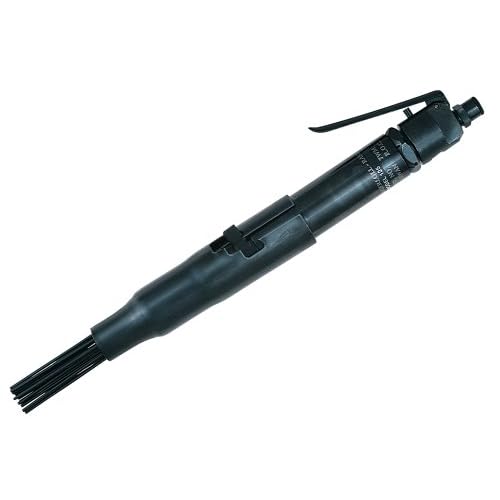
Ingersoll Rand 125 Standard Duty Needle Scaler $158.79
http://www.amazon.com/gp/product/B0002STTDE/?tag=atomicindus08-20
Merkava_4
Banned
Man....seeing that image brings back some sweet memories of the days down in the bilges aboard the USS Tripoli. 
mkdive
Well-known member
learn something new every day. Thanks
billymade
Well-known member
Merk, were stationed on this thing?

USS Tripoli (LPH-10), an Iwo Jima class amphibious assault ship
http://en.wikipedia.org/wiki/USS_Tripoli_(LPH-10)
You always surprise me with something about yourself that I haven't heard of; its like: not what have you done but what haven't you done in your life? LOL!
USS Tripoli (LPH-10), an Iwo Jima class amphibious assault ship
http://en.wikipedia.org/wiki/USS_Tripoli_(LPH-10)
You always surprise me with something about yourself that I haven't heard of; its like: not what have you done but what haven't you done in your life? LOL!
chammyman
Well-known member
I use them for cleaning brake caliper carriers, does the job lovely
Atlascycle
Well-known member
They're for removing heavy rust from thick steel plate; they're widely used in ship yards for that very purpose. You can also use them for removing slag off of stick welds and flux cored wire welds, but they'll leave tiny dimples on an otherwise pretty weld; that's why some welders will opt for a chisel scaler instead.
They can also be used to stress relieve welds between passes.
I use them for cleaning brake caliper carriers, does the job lovely
really? i may have to pick one up! i've been looking for the best way to do this.
They can also be used to stress relieve welds between passes.
I'm gonna throw up the BS flag, sorry
ZRX61
Well-known member
They can be used to disguise a bad weld bead before laying down the next pass
er, or so I was told...
er, or so I was told...
Atlascycle
Well-known member
Have you never heard of peening a weld to stress relieve it?
http://www.lincolnelectric.com/knowledge/articles/content/distortion.asp
Copied from the above Page:
the needle scaler that I have leaves the same affect as several hits with the ball side of the ball peen hammer.
http://www.lincolnelectric.com/knowledge/articles/content/distortion.asp
Copied from the above Page:
9. Remove shrinkage forces after welding
Peening is one way to counteract the shrinkage forces of a weld bead as it cools. Essentially, peening the bead stretches it and makes it thinner, thus relieving (by plastic deformation) the stresses induced by contraction as the metal cools. But this method must be used with care. For example, a root bead should never be peened, because of the danger of either concealing a crack or causing one. Generally, peening is not permitted on the final pass, because of the possibility of covering a crack and interfering with inspection, and because of the undesirable work-hardening effect. Thus, the utility of the technique is limited, even though there have been instances where between-pass peening proved to be the only solution for a distortion or cracking problem. Before peening is used on a job, engineering approval should be obtained.
Another method for removing shrinkage forces is by thermal stress relieving - controlled heating of the weldment to an elevated temperature, followed by controlled cooling. Sometimes two identical weldments are clamped back to back, welded, and then stress-relieved while being held in this straight condition. The residual stresses that would tend to distort the weldments are thus minimized.
the needle scaler that I have leaves the same affect as several hits with the ball side of the ball peen hammer.
Last edited:
SpiderGearsMan
Banned
I have an IR needle scaler that was used once
jtrace
Well-known member
When I was a mechanic at a rental store (16 years up to last sept.) I used my needle scaler all the time to remove mortar and cenment from the mixers nobody cleaned them when they were done when wet so it came to me to clean then 1/2 the time had to eplace he drum bearings cause they were all caked up... Ah the good ole days head in a metal drum 3-4 hours at a time playing with the scaler no wonder I cant hear anymore
John
John
Have you never heard of peening a weld to stress relieve it?
http://www.lincolnelectric.com/knowledge/articles/content/distortion.asp
Copied from the above Page:
the needle scaler that I have leaves the same affect as several hits with the ball side of the ball peen hammer.
if you need peen your welds to prevent cracking you should turn you helmet in now, im not trying to be an e-thug but old wives tails about welding really piss me off

the only true way to stress releve a weld is in a vacume chamber that is SLOWLY heated and cooled for aproxamatly 4-6 hours, its also unnecessary for most situations
Atlascycle
Well-known member
if you need peen your welds to prevent cracking you should turn you helmet in now, im not trying to be an e-thug but old wives tails about welding really piss me off
the only true way to stress releve a weld is in a vacume chamber that is SLOWLY heated and cooled for aproxamatly 4-6 hours, its also unnecessary for most situations
Ever done any welding on Hardened tool steel. repairing die sections and trying to keep things as flat as possible some times it is necessary because if you have to much warpage you will destroy the part trying to flatten it out.
Or how about large Cast Iron Repairs, peening may be necessary to keep the part from cracking as it cools.
kind of funny about a major welder manufacture would post old wives tails on their website.
trackwelder
Well-known member
Ever done any welding on Hardened tool steel. repairing die sections and trying to keep things as flat as possible some times it is necessary because if you have to much warpage you will destroy the part trying to flatten it out.
Or how about large Cast Iron Repairs, peening may be necessary to keep the part from cracking as it cools.
kind of funny about a major welder manufacture would post old wives tails on their website.
I agree totally with this statement because it is a FACT!
When repairing railroad diamonds, and frogs in switch sections the needle
scaler is always used between every pass. It cleans the slag off in a hurry and helps to work harden the repair. We have had rod that requires peening after every single pass and it states it on the can. I have also used a needle scaler when welding cracks on engine blocks.
nissan_crawler
Well-known member
I do it when welding on cast axle housings.
Merkava_4
Banned
Merk, were stationed on this thing?
Yeah....that's "the boat." That was my home for 3 years before getting sent to Miramar Air Station.