To avoid these ads, REGISTER NOW!

New Barn, Concrete, Heating, ROI Questions

ratfink65

Member
Joined
Nov 16, 2009
Messages
21
Hi Everyone,

I just finished up my 40 x 64 x 14 pole barn shell.

Now it is time to get the floor done which forces me to answer some questions.

For the record, I am in SE Wisconsin and my barn is a place to work on my car projects along with some light cnc machining work. I have natural gas service where I live. I plan on living here for at least 20 years..

I get that in floor radiant heat is the "hot setup", but I was wondering how does it compare price wise to operate vs GFA or overhead radiant tube.

Any idea what the return on investment would be vs the other two listed?

The other question I have is most concrete contractors around here want to tie my poles into the concrete pad with rebar. Is this acceptable? I thought it was a floating slab? I will not be able to heat it this winter and I am concerned that the frost will mess up my pad if it is rebared to the poles. Thoughts?
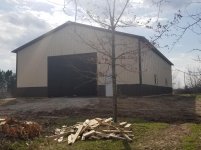
 

Attachments

  • barn.jpg
    barn.jpg
    152.1 KB · Views: 94
To avoid these ads, REGISTER NOW!

kj_mustang

Well-known member
Joined
Feb 9, 2011
Messages
1,213
Location
Harrisonburg, VA
Every comparison will be different. Depends on how warm they keep it, how insulated the building is, how good a design job that was done for the radiant system. Mine is very cheap to run, keep it around 60 F all the time, tools and equipment always warm, open a garage door to bring a car in and it doesn't really affect the internal temperature much. Regarding the slab- if you go with radiant floors, then you will need to insulate under and the sides of the slab so you should insulate around the poles too. It will be a floating slab then.
 

Dick in Wisconsin

Well-known member
Joined
Mar 3, 2012
Messages
3,048
Location
Shawano, Wisconsin
I'm in Grafton WI, just north of Milwaukee. When I was planning the race shop I wanted in-floor radiant ... because I wanted it.

Very happy with it. We're gone from Christmas to early April. I leave the thermostate at 50*F and it doesn't seem to cost much. Prior to the fancy race shop, I had unheated attached two car and unattached one car garages. Lots of rust on stuff. Often when I went into the various garages there was condensation on everything at the temps went up and down. Now with the new race shop, the temp never goes below 50*F. I can bump the temp to 60*F quickly.

The new shop has 10' ceiling, 6" walls plus Styrofoam on exterior, and R-40 in the ceiling ... so its pretty well insulated. I do have three garage doors.

What I really like about the in-floor hydronic is:

1. Almost silent. I can barely hear the pump or the burner. I have a fancy condensing boiler which is really efficient. I have friends who get by with regular water heaters, some with condensing water heaters. There are pro and cons. My plumber didn't like going the water heater route, he warned of corrosion. He found me a new boiler that had been damaged in transit, dented in back. Save a few hundred dollars.

2. Heat starts on the floor and rises. I don't have a lift so I jack the car up, get on a creeper, and slide under the car. In the other garages I'd leave the door to the house open with a fan blowing warm air into the garage and a couple of 1000watt electric heaters blowing under the car. Never warmed up.

With the in-floor hydronic as I said above it starts at the floor and moves up. After we get home and I'm going to work on the race cars I will bump the temps to 55*F. I've found that since its a dry heat I can work under the car with just a tee-shirt and as along as I keep moving I'm comfortable. I pick the tools up off the floor, they aren't cold!

With you're higher ceilings, your situation might be different. I've read on the GJF that guys working in truck shops with in-floor heat that as they go up on tall ladders it actually gets cooler. Never tried it, but makes sense.

Find someone with in-floor heat near you. Talk to them. Maybe you can visit before it gets warm.

Only downside is that if its really cold out and I have the thermostat set at 50*F and I bump it to 60*F, it takes a while to get there.

Regardless of what you do, you can't insulate enough and seal the building up enough.
 
OP
R

ratfink65

Member
Joined
Nov 16, 2009
Messages
21
Every comparison will be different. Depends on how warm they keep it, how insulated the building is, how good a design job that was done for the radiant system. Mine is very cheap to run, keep it around 60 F all the time, tools and equipment always warm, open a garage door to bring a car in and it doesn't really affect the internal temperature much. Regarding the slab- if you go with radiant floors, then you will need to insulate under and the sides of the slab so you should insulate around the poles too. It will be a floating slab then.

Thank you! How much would you guys put costs you to run?
 
OP
R

ratfink65

Member
Joined
Nov 16, 2009
Messages
21
I'm in Grafton WI, just north of Milwaukee. When I was planning the race shop I wanted in-floor radiant ... because I wanted it.

Very happy with it. We're gone from Christmas to early April. I leave the thermostate at 50*F and it doesn't seem to cost much. Prior to the fancy race shop, I had unheated attached two car and unattached one car garages. Lots of rust on stuff. Often when I went into the various garages there was condensation on everything at the temps went up and down. Now with the new race shop, the temp never goes below 50*F. I can bump the temp to 60*F quickly.

The new shop has 10' ceiling, 6" walls plus Styrofoam on exterior, and R-40 in the ceiling ... so its pretty well insulated. I do have three garage doors.

What I really like about the in-floor hydronic is:

1. Almost silent. I can barely hear the pump or the burner. I have a fancy condensing boiler which is really efficient. I have friends who get by with regular water heaters, some with condensing water heaters. There are pro and cons. My plumber didn't like going the water heater route, he warned of corrosion. He found me a new boiler that had been damaged in transit, dented in back. Save a few hundred dollars.

2. Heat starts on the floor and rises. I don't have a lift so I jack the car up, get on a creeper, and slide under the car. In the other garages I'd leave the door to the house open with a fan blowing warm air into the garage and a couple of 1000watt electric heaters blowing under the car. Never warmed up.

With the in-floor hydronic as I said above it starts at the floor and moves up. After we get home and I'm going to work on the race cars I will bump the temps to 55*F. I've found that since its a dry heat I can work under the car with just a tee-shirt and as along as I keep moving I'm comfortable. I pick the tools up off the floor, they aren't cold!

With you're higher ceilings, your situation might be different. I've read on the GJF that guys working in truck shops with in-floor heat that as they go up on tall ladders it actually gets cooler. Never tried it, but makes sense.

Find someone with in-floor heat near you. Talk to them. Maybe you can visit before it gets warm.

Only downside is that if its really cold out and I have the thermostat set at 50*F and I bump it to 60*F, it takes a while to get there.

Regardless of what you do, you can't insulate enough and seal the building up enough.


I will have to find someone who has it. That's a great idea. I never considered the condensation issue.
 

SwampCat

Well-known member
Joined
May 15, 2009
Messages
293
No matter the cost difference, DO IT. There is no better heat. If done RIGHT, you will NEVER regret it. My house, basement and garage all have floor heat. Can you say COMFORT. N.E. Wi. So I know a little about cold.
 
OP
R

ratfink65

Member
Joined
Nov 16, 2009
Messages
21
No matter the cost difference, DO IT. There is no better heat. If done RIGHT, you will NEVER regret it. My house, basement and garage all have floor heat. Can you say COMFORT. N.E. Wi. So I know a little about cold.

I get it. My main issue is that I'm a cheap SOB. Thanks!
 
OP
R

ratfink65

Member
Joined
Nov 16, 2009
Messages
21
If I decide against in floor radiant heat, does the slab still need 2" foam underlayment?
 

kj_mustang

Well-known member
Joined
Feb 9, 2011
Messages
1,213
Location
Harrisonburg, VA
The slab doesn't need it but it will make it more comfortable to be on. It is a very high expense though for a slight comfort bump.
To answer your question about my cost to heat, I can't tell you because my house and detached garage are all on the same propane service. It probably only runs a couple times a day though with it set at 60 deg. so it doesn't use much fuel.
 

gnpenning

Well-known member
Joined
Jan 25, 2015
Messages
2,754
Location
I have more questions than answers.
I get it. My main issue is that I'm a cheap SOB. Thanks!


This is why you want it. Use cheap sob's hate high heating bills. Properly done radiant with proper insulation is very cheap to run and the comfort level to work in is off the charts. Most of the benefits have already been mentioned.

I go on jobs all the time with poorly designed and insulated floors heating the great outdoors. Easy to see as the snow is always melted away from the building. I've built 2 homes with it and paid the price for my listening to the"experts" the first time, used common sense on the 2nd one. The investment in the time to do it right was worth every penny. The second place I heated 3300' of living space and 1200' of garage with 3 garage doors. My gas bill for the year was close to $550 for the year in Montana, very comfortable temps. Plus I had other gas appliances, plus my boiler heated my hot water, never ran out of hot water.

Radiant heats objects and works much better as a set and forget about it heat. When you crank it up it's not just heating the air up, but every item in the building temp is being raised and this takes time. I would fire up the boiler when temps started dropping in the fall. Takes less energy to bring the house to 65° from 50° than from 40°. Again common sense. Yes, you will have some days you will wonder why you didn't wait, don't 2nd guess. Or do it once and notice the difference in run time and gas bill.

Run your own PEX to save money, even build your own manifolds or buy them. Keep your runs the same length.
 
Last edited:

yeldogt

Well-known member
Joined
Jan 2, 2012
Messages
18,184
Radiant is really not about saving money ... BTU's are BTU's. There is no magic formula that makes Radiant cheaper. What radiant CAN do is make you feel as or more comfortable at a given temp. Since radiant is heating at your feet .. you feel more comfortable. Often people can keep the overall temp of the room lower. You can also control a space -- making one part warmer .. say where desk or bench is.

Another thing radiant can do if fool you --- it's going to make you think you did a good job insulating the slab .. even if you did not. You will just use more NG.

Most times when people spend for radiant they do other things to make for a better building ... all of those items save fuel and make a building.

Another item is hot air rises -- most times the ceiling of building are hot. Large heaters heating air .... radiant will typically have cool ceilings .... this saves some fuel.

The insulation in the slab is to make sure you don't drive the heat into the ground ... when you don't heat the slab it more of a thermal break one needs. Thicker insulation at the edges ...
 

ConCretin

Well-known member
Joined
Jan 20, 2011
Messages
3,379
Location
Central Maine
The other question I have is most concrete contractors around here want to tie my poles into the concrete pad with rebar. Is this acceptable? I thought it was a floating slab? I will not be able to heat it this winter and I am concerned that the frost will mess up my pad if it is rebared to the poles. Thoughts?

I'm not an expert on pole barns but in general, it's best to isolate slabs on grade from structural members of any kind. A slab wants to shrink after placement and allowing for it minimizes cracking. In addition, every structure experiences movement and it's best if these forces aren't transferred to a slab that isn't designed for them.

I wouldn't think the poles would need the slab for support and the slab definitely doesn't need the poles for anything. I'm not sure it's the end of the world if you did, but I wouldn't tie them together. Maybe others will weigh in.

Give my Guide to Floor Slabs in the link below a read for some additional thoughts. Good luck with the rest of your project.
 
OP
R

ratfink65

Member
Joined
Nov 16, 2009
Messages
21
I'm not an expert on pole barns but in general, it's best to isolate slabs on grade from structural members of any kind. A slab wants to shrink after placement and allowing for it minimizes cracking. In addition, every structure experiences movement and it's best if these forces aren't transferred to a slab that isn't designed for them.

I wouldn't think the poles would need the slab for support and the slab definitely doesn't need the poles for anything. I'm not sure it's the end of the world if you did, but I wouldn't tie them together. Maybe others will weigh in.

Give my Guide to Floor Slabs in the link below a read for some additional thoughts. Good luck with the rest of your project.

Thank you!
 
To avoid these ads, REGISTER NOW!

theoldwizard1

Well-known member
Joined
Feb 22, 2011
Messages
43,250
Location
SE MI
Forget asking about ROI, especially if you are going to be there for 20 years !

Cost of operation has a lot to do with insulation. For Radiant floor heating, under floor insulation is KEY ! You also want a trench around the perimeter of the slab down to the frost level to prevent cold from "creeping in".

My SWAG is that properly installed radiant heat is probably slightly cheaper to operate. Not that you would recover your cost even in 20 years, but the COMFORT factor is huge.

Is the building going to be completely open or will part of it be partitioned off for storage/office ? Storage probably need no heat and office needs heating and cooling. Perfect place for a mini-split !
 

matt_i

Well-known member
Joined
Mar 14, 2008
Messages
10,747
Location
SE Michigan
My opinion is the heating equipment other than the PEX loops is going to be more expensive up front. Not that this is bad, just something to plan with.

It would be nice to go into the shop where its always warm. I can warm mine with air pretty fast but the tons of steel are all cold and would take a good day or two to fully sink into all of that inertia.
 

JimR1998

Well-known member
Joined
Dec 17, 2013
Messages
81
Location
Southeastern PA
+1 on radiant. It should be a no-brainer for a new slab when you're heating the building.

If you go with a conventional boiler, the efficiency will likely be a few % higher than a gas garage heater. Maybe 84% vs 80%. To compound those savings, the heat calc for radiant usually has a reduction factor of at least 5% (could be 10%) because the heat is evenly spaced and at the floor instead of the ceiling. So you could be using 5-15% less gas every month with radiant. PLUS you have comfort.

Definitely do the radiant with good insulation under and around the slab. Figure out ways to tweak the boiler setup (# zones, outdoor reset, brand, hot water included, etc) and get bids until you have a price you can live with.
 

Mattlt

Well-known member
Joined
Nov 30, 2005
Messages
1,382
Location
MN
I have radiant floor heat in my small shop, heated by an outdoor wood boiler. Really didn't notice any extra wood usage after I brought it online. I keep it set about 55 and it's comfortable to work in. Definitely insulate under the slab. I talked myself into the higher PSI foam, not sure if that's needed, but I don't park anything heavy in this shop.

We have the overhead radiant tube heaters in our fire station. I really don't care for them. It never fails, once you're on top of a truck loading hose, the heaters kick in and if you weren't sweating before... Have to turn down the t-stat until the hose loading is finished.
 
OP
R

ratfink65

Member
Joined
Nov 16, 2009
Messages
21
Forget asking about ROI, especially if you are going to be there for 20 years !

Cost of operation has a lot to do with insulation. For Radiant floor heating, under floor insulation is KEY ! You also want a trench around the perimeter of the slab down to the frost level to prevent cold from "creeping in".

My SWAG is that properly installed radiant heat is probably slightly cheaper to operate. Not that you would recover your cost even in 20 years, but the COMFORT factor is huge.

Is the building going to be completely open or will part of it be partitioned off for storage/office ? Storage probably need no heat and office needs heating and cooling. Perfect place for a mini-split !

Thanks that does help. I know its unpopular but the comfort is not worth the extra cost to me. If it were drastically cheaper to run I would be all in.

I probably will partition it. Machine shop on one side and storage on the other.
 

purediesel

Well-known member
Joined
Apr 17, 2016
Messages
193
Location
Ada Oh
My view on this was that you only have one chance to put the heating coils in your slab so don't pass it up. My 50x80 only cost around $1500 for the coils with 2 manifolds from blueridge, which is pennies in the whole scheme of the barn. In my eyes the foam should be there anyways if your to do floor heat or not. Ill get to the boiler system eventually but in the mean time I will have a cheap hanging heater that'll get the job done for a few years.
 

joes169

Well-known member
Joined
Sep 19, 2011
Messages
663
Location
WI
Thanks that does help. I know its unpopular but the comfort is not worth the extra cost to me. If it were drastically cheaper to run I would be all in.

I probably will partition it. Machine shop on one side and storage on the other.

I'm a concrete contractor in SE WI (just a little North of "**** in Wisconsin") and I'll offer my opinion.

Pole barns are less than ideal for heated floors IMO, it's too hard to get enough insulation deep enough at the outside perimeter. Of course it can be done, and it's been done by folks on here, but it's not the same efficiency as placing foam down 4' on a frost wall.

For ROI, the only way I can see foam making sense is the first 2-4' horizontally inside the perimeter. I've seen this done here (not many jobs anymore) for 30 years with good results. I'm sure people will argue with me here, but i have 2 separate floors in my shop, one I replaced and has heated floor with 2"foam below, the other from the 70's with nothing other than a void under it. If I hit either either floor in the middle of the shop (the heated floor is off) with an IR thermometer, they're always within a degree or two of each other. At the perimeter though, the foam certainly makes a difference.

I replaced about 60% of my shop floor about 12-14 years ago and installed heated floor with 2"foam. I honestly wish I had the $6500 I invested back to use for propane to burn through the Reznor. Perhaps my system wasn't designed correctly or something, but I never appreciated it. It actually cost nearly twice as much to heat it with the in floor than with the Reznor (which cost $750 and is still working today). I really never appreciated a 50-55 degree floor, I never work in my socks or barefoot, and I never laid on the floor. I can see why people enjoy it in a warm shop, or basement floor, house, etc.... I just never saw it firsthand in my own shop.

I've seen a number of contractors drill through the wood posts and send a 1/2"rebar thru, and then bend it into a "U". I don't, as LLYfan mentioned it will just create restriction for the slab to shrink. I think the mindset of the rebar was to somehow counteract the fact that the soil around the posts always settles like crazy because they're backfilled with garbage soil. We have always wrapped all 3 sides of our posts with 1/2""R-board"ripped on a table saw to the thickness of the floor. We always put the same "R-board"on the entire bottom board to keep them separate, and it makes for a simple thermal break to boot. I've seen instances where the concrete is poured tight to the posts, and often one of the control joints gets far wider than the rest due to the restraint.
 

DYNO-DAVE

Active member
Joined
Feb 2, 2014
Messages
28
Location
Brownstown Mich
I installed radiant heat in my barn (36x64) 6 inch thick floor and 6 inch insulation in the walls, 14 to 16 inches in the ceiling blown in. I have no windows and 1 steel insulated door and 1 10x10 bay door insulated. I sealed every corner and moulding there are no air leaks. Now I did buy a complete system from menards 120,000 btu's but when we do the math I only require 80,000 so I have a little reserve. I keep it at 65 degrees ( I work out there every day) 2304 sq ft and it only cost about 120/month to heat it. I spend 40/month in electricity. I love mine very efficient, it cost over twice that to heat my house which approx. the same sq ft. but not so well insulated and lots of windows and forced air (93 percent efficent ) As long as I fire up the fireplace every winter in the house I don't ever notice an increase in ng useage. And yes its expensive up front almost 3 times what I would have spent on forced air but I wanted radiant so it was a no brainer for me.
 
OP
R

ratfink65

Member
Joined
Nov 16, 2009
Messages
21
I'm a concrete contractor in SE WI (just a little North of "**** in Wisconsin") and I'll offer my opinion.

Pole barns are less than ideal for heated floors IMO, it's too hard to get enough insulation deep enough at the outside perimeter. Of course it can be done, and it's been done by folks on here, but it's not the same efficiency as placing foam down 4' on a frost wall.

For ROI, the only way I can see foam making sense is the first 2-4' horizontally inside the perimeter. I've seen this done here (not many jobs anymore) for 30 years with good results. I'm sure people will argue with me here, but i have 2 separate floors in my shop, one I replaced and has heated floor with 2"foam below, the other from the 70's with nothing other than a void under it. If I hit either either floor in the middle of the shop (the heated floor is off) with an IR thermometer, they're always within a degree or two of each other. At the perimeter though, the foam certainly makes a difference.

I replaced about 60% of my shop floor about 12-14 years ago and installed heated floor with 2"foam. I honestly wish I had the $6500 I invested back to use for propane to burn through the Reznor. Perhaps my system wasn't designed correctly or something, but I never appreciated it. It actually cost nearly twice as much to heat it with the in floor than with the Reznor (which cost $750 and is still working today). I really never appreciated a 50-55 degree floor, I never work in my socks or barefoot, and I never laid on the floor. I can see why people enjoy it in a warm shop, or basement floor, house, etc.... I just never saw it firsthand in my own shop.

I've seen a number of contractors drill through the wood posts and send a 1/2"rebar thru, and then bend it into a "U". I don't, as LLYfan mentioned it will just create restriction for the slab to shrink. I think the mindset of the rebar was to somehow counteract the fact that the soil around the posts always settles like crazy because they're backfilled with garbage soil. We have always wrapped all 3 sides of our posts with 1/2""R-board"ripped on a table saw to the thickness of the floor. We always put the same "R-board"on the entire bottom board to keep them separate, and it makes for a simple thermal break to boot. I've seen instances where the concrete is poured tight to the posts, and often one of the control joints gets far wider than the rest due to the restraint.

Thanks! This is exactly what I needed to hear. I feel as though sometimes "forum" mentality can over take common sense.

If I had a pile of extra money I might consider in floor heat. It does not make sense in my current situation.

What town are you in? Want to quote my slab?
 
Last edited:

finn

Well-known member
Joined
Mar 27, 2005
Messages
16,370
Location
The UP, God's country
Thanks that does help. I know its unpopular but the comfort is not worth the extra cost to me. If it were drastically cheaper to run I would be all in.

I probably will partition it. Machine shop on one side and storage on the other.

I have radiant, and, although I do like the comfort, I can’t see how it is cheaper to operate. Insulation is what counts the most for operating cost.

Biggest problem with radiant is lack of flexibility. It’s not for you if the building is used sporadically.

Thermodynamics don’t play by different rules for radiant. Heat loss out the ceiling, walls, windows, and doors is the same no matter what the heat source is. You may be comfortable at a lower thermometer setting with radiant, so there is some savings there, but some people complain about hot feet with radiant, and the poor response rate makes setting back the thermostat ineffective.

Boiler cost plus pump costs, expansion tanks, system filters, mixing valves, and condensate pumps are much higher cost than other heat sources, and pumps cost money to run, which all of the proponents conveniently forget when looking at their utility bills..

It is comfortable, to me, though.
 

Bert_

Well-known member
Joined
Dec 24, 2016
Messages
9,776
Location
NW Iowa
I really like the radiant tube heaters. Not quite as cheap as a forced air unit but they tend to use less fuel to heat a space.
 
OP
R

ratfink65

Member
Joined
Nov 16, 2009
Messages
21
So you came on asked for opinions until you got the one you wanted. :beer:

Pretty much. LoL

I now feel confident about skipping radiant heat based on everyones else's experience. I'm just not that into spending extra up front for a more comfortable heat. Along the same reason why my daily is 15 year old ecno box with 220k miles. The AC hasn't worked in ten years...I'm good with the windows being down..

I believe that I will not have any regrets. I will update this Spring with my honest opinion.

Thanks!
 

joes169

Well-known member
Joined
Sep 19, 2011
Messages
663
Location
WI
Thanks! This is exactly what I needed to hear. I feel as though sometimes "forum" mentality can over take common sense.

If I had a pile of extra money I might consider in floor heat. It does not make sense in my current situation.

What town are you in? Want to quote my slab?

As much as I love pouring hard troweled floors, no, I'm afraid I don't want to quote it. It's too far away, I have plenty of work within 10-15 minutes of my shop, and I am not here to solicit work, merely help with advice. I can't even give you a referral, as I don't even know any contractors in that area. I would recommend calling Schmitz Ready Mix and see if they can help out with a referral (414-831-2400 is the main office) for your area. Suppliers such as them tend to know who does decent work of that scope, and who pays their bills.

Best of luck!
 
To avoid these ads, REGISTER NOW!
Top Bottom