To avoid these ads, REGISTER NOW!

New Construction-flooring problem.

Doug M

Member
Joined
Nov 10, 2010
Messages
9
Hi Everyone,

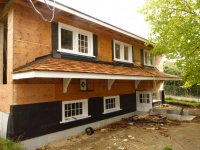
I've been enjoying this site for awhile now during the construction of my garage/shop. A problem has just come up with regards to my flooring system and I was wondering if any of you might have a solution. The building is 24x36 on the main floor with a 14x36 shop on the lower level.
I had an engineer design the main garage floor for me and he called for 2x10 spf on 12" centers overlaid with 3/4" plywood covered with 1 1/2" concrete. Instead of using the 2" material from the lumberyard I went to the local mill and had #2 and better full dimension dfir cut which I installed. Everything seemed fine until I had the concrete contractor take a look prior to pouring and he said there's no way the 1 1/2 concrete would work-he said I would need at least 3 1/2 inches which would add an extra 20000 pounds. He said the concrete would crack.
I went back to the engineer and asked him about it and after some thought he said yes it probably would crack.
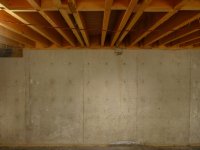
The garage is laid out so that I drive in level off the back alley. 10' into the garage there is a 8' high concrete wall downstairs for the back wall of the shop. There is a 14' clear span from that wall to the front of the garage which is also the front wall of the shop downstairs.
I was thinking of adding another layer of 3/4' plywood to the main floor and then tiling over that but I'm not sure how waterproof that would be with the shop downstairs. Just wondering if anybody might have some suggestions .
 
To avoid these ads, REGISTER NOW!

Daniel Dudley

Well-known member
Joined
Sep 4, 2009
Messages
3,546
I would think that a second layer of AC plywood primed with oil based primer and vinyl composition tiles would be very durable. You could also put a second layer of plywood down and run 1 1/2 '' of dry pack mortar with expanded wire lath in it, putting porcelain tile over that. You would need both the extra plywood and the expanded wire reinforcement to make this work I think. You would put it over 15 pound roofing felt.

2x10 seems a bit light for this application on the intuitive level. You don't want any flex. There was a recent post on this where applying a 2x4 to the bottom of the joists with glue and screws was recommended. At least with VCT, flex is not a worry. There are special sealers for VCT to keep them tight. This would be my inclination.


Very few people do dry pack mortar anymore, but is is a very good system.
 

Kevin54

MEMBER EMERITUS
Joined
Jan 12, 2005
Messages
29,341
Location
Urbana, Ohio
Could you put a membrane between the concrete and plywood? Like the type they put in showers? That is in regards to the waterproofing portion.
 
OP
D

Doug M

Member
Joined
Nov 10, 2010
Messages
9
Hi Daniel,

Thanks for the reply. I like the idea of a second layer of plywood used in conjunction with vct. That way there would be no worries with flex. I'm going to check with the tile supplier and see what they say about sealers.

I also thought the 2x10's seemed a little light and that's why I went to the mill and had the full dimension fir 2x10's milled. After that I didn't really think about it since the engineer had done the calculations.
 
OP
D

Doug M

Member
Joined
Nov 10, 2010
Messages
9
Hi Kevin,
Thanks for the suggestions. I used a Kerdi membrane in our shower which has worked great so I'm sure it could be applied here-probably quite expensive for the area. I think 6mil vapour barrier might also be used depending on the covering.
 
OP
D

Doug M

Member
Joined
Nov 10, 2010
Messages
9
I'm going to try to send the engineers drawing and a couple of pics of the shop to give you a better idea of the layout.
I hope they are attached:)
 

Attachments

  • Garage Floor.jpg
    Garage Floor.jpg
    120.8 KB · Views: 206
  • P1020621.jpg
    P1020621.jpg
    146.5 KB · Views: 149
  • P1020642.jpg
    P1020642.jpg
    145.1 KB · Views: 171

sneezer41

Well-known member
Joined
Oct 8, 2007
Messages
407
Location
People's Republic of Mass
Engineer is a ****

Make sure the blocking called out is full solid maybe glued and screwed. maybe another set of blocking about where the front wheels will sit

2nd layer of 3/4 glued and screwed and vct ought to work. I am afraid of ceramic tile since failure mode is ugly, vct will move a bit.

What about gypcrete? still would need a finish floor.

check code, you may need a non flammable floor, maybe they don't care with detached

If you manage water I would not think leakage would be a big problem. No washing inside, no snowy cars inside, keep a squeegee handy for puddles. No badly planned floor penetrations

Man, a real concrete floor could have been done with the right planning[kinda the reason you hire someone]

you've done good upgrading the 2x10
 

creativecars

Well-known member
Joined
Nov 15, 2010
Messages
4,300
Location
Indiana- where horse and buggies still roam
Maybe you can use 10" channel on edge where the tires run for extra strength.

I did a similar thing with the bi-level except for where the vehicle tires run out over the lower areas, I welded 2 pieces of 2X6 3/16 wall metal tubing together to make a beam for each tire ramp. These weigh about 100 pounds each, but hold the weight of the vehicles. I’m not an engineer, but I have had to fix a lot of things an engineer designed.
 

51rider

Well-known member
Joined
Dec 21, 2009
Messages
502
Location
London, England.
Instead of using a second layer of ply, why not use hardiboard? Dimensinally very stable, gighly moisture resistand and a great subfloor for ceramic tiles. You might have to use a sealer for VCT adhesive but I'm sure any floor pro could give you a tip on the correct product.
 

little d

Well-known member
Joined
Nov 13, 2009
Messages
815
Location
NW Oklahoma
For the life of me i dont understand why he would have put 2by10's under the floor to begin with?

What you are wanting to do is done all the time; high rises, parking garages, ect... Go back to him or find someone else and ask them if you can pull out the 2 bys and plywood, put down steel roofing and re-bar and block it up untill the 4" to 6" of concrete sets up and then remove? Then watch the expretion on their faces.
 

compresdcaddy

Member
Joined
Dec 30, 2009
Messages
13
I have seen this done in a bunch of house we have plumbed. What they do is use a galvanized corrugated steel that are 8-10 feet long by 4 feet wide. they overlap the seams of the corrugated materal and install a steel beam underneath the center of the span with posts at were ever spec'd. you would need a brick ledge or some sort of support at the edges where it meets the wall. anything other the pressure treated wood will dry out and rot away. I would call the local and inspector and have him give you a suggestion, Do have pics of the inside and basement ceiling for a visual aid.
 

mobetta

Well-known member
Joined
Feb 10, 2010
Messages
370
Location
twin cities, mn
what vehicles do you park in there?


you need another course of solid blocking at midspan- where the "strapping" is and at least 2 layers of 3/4 plwood, seams staggered. i think I'd go 3x on the plywood and then maybe 1/4 underlayment and vct.

but i agree the engineer ws not on the right track this time- pre-stressed concrete or a formed in place slab would have been a better option.
 

BMS

Well-known member
Joined
May 5, 2007
Messages
48
Location
Northern Virginia
find a new/better engineer. 1-1/2 concrete isn't thick enough even as a topping slab on top of concrete unless it is lightweight fill, even then it is iffy. That 2x10 plywood deck is gonna flex and crack the concrete. Agree with the other poster, use corrugated steel deck but have another engineer look at the structure you're using to support it. yikes.
 

dlenkewich

Well-known member
Joined
Jan 27, 2011
Messages
1,409
Location
Saskatoon, Sk, Canada
I'm no engineer, but a 3 spot parking bay above an inhabited shop plus a wood floor doesn't mix. Gives me the creeps, actually.

Just thinking about my truck, an 08 F250, a heavy SOB weighing in at 9,000lbs with the driver and a tank of fuel. I hope you or any other owner of that garages lifetime doesn't own a heavy vehicle... Or three.

I wouldn't move any further without a lot of second opinions, you're talking about a potential for loss of life here. Frankly, let's just say my 9,000lbs truck is the heaviest vehicle you could fit in that space. 3 bays times 9,000 equals 27,000lbs. To me, a safe max load on that floor should double that at 54,000lbs. Call me crazy but when people are going to be below it, that floor should be bomb proof as far as im concerned. Good luck.
 
Last edited:

katmat

Well-known member
Joined
Jan 10, 2007
Messages
91
Why didn't the engineer tell you to use Flexicore & then the 1-1/2" of concrete?
 

jkeyser14

Well-known member
Joined
Dec 19, 2008
Messages
1,819
Location
(rural) Maryland
You need to make this the engineer's problem. He messed up and is going to cost you a lot of money to fix it properly. I agree that a wood floor under concrete is a bad idea. The concrete should be reinforced and self supporting, maybe with a steel beam underneath.
 
To avoid these ads, REGISTER NOW!

hidollartoys

Well-known member
Joined
Jul 15, 2008
Messages
594
Location
K. C. Metro area
Deflection (flex) is going to be your main concern. Tile is NOT the way to go here. By the time you install a backer board material, thinset and tile you will have almost as much "per sg ft" weight as 1.5" of concrete and yes I would expect your concrete to crack. The engineer should (would) use a "per sq ft" design rating as a basis for the structure calcs. He should (would) use this to determine the max deflection of the floor deck based on his design. I would not want any deflection in this floor. What he may not have done is calculate the "point" loads where the tires come to rest and he would have to specify (estimate) the total floor load.

I would have to question the design as a whole. I would not have designed the joists to run parallel to the side walls and I would have included additional beams to shorten the joist length. Hindsight is 20/20. I would have someone else review the original design and calcs to confirm the design. Then I would consider flooring options.
 

KELLHAMMER

Well-known member
Joined
Nov 20, 2006
Messages
222
Location
south eastern pennsylvania
There is nothing wrong with a wood framed floor for a garage. Assuming the engineer designed to the proper intended design loads and max allowable deflection it should be fine. Not sure what the 1 1/2" of concrete is for. Must be for durability. I have designed wood floors for garages before. Usually using heavy timbers 3X10 joist @12"O.C. with 2" t&g decking, all doug fir. We have many barns around us that are similar design and have 20,000lb tractors parked on them. It can be done. The timber decking takes a beating but works fine. In your design having a waterproof membrane between the conc. and the plywood deck is a real good idea( probably even a code requirement). I would go back to the engineer with your concerns. If you alter his design without his consent and it fails (meaning it even just deflects too much) or worse it's on you. Lastly, a wood framed floor is going to be a hell of alot cheaper than a corrugated steel/ concrete version. And possibly there could be code issues with supporting that type of floor deck with wood framed bearing walls. By the way it's a very nice looking building.
 
Last edited:

jkeyser14

Well-known member
Joined
Dec 19, 2008
Messages
1,819
Location
(rural) Maryland
There is nothing wrong with a wood framed floor for a garage.

I don't think anyone is saying that the wood framed floor is wrong. The problem everyone is having is the concrete on top of a wood frame.

More specifically 1.5" of concrete on top of the wood frame and the fact that the design load can't support a proper 3" pour. That's a very thin layer of concrete on top of a flexible wood surface that will be driven on.
 
OP
D

Doug M

Member
Joined
Nov 10, 2010
Messages
9
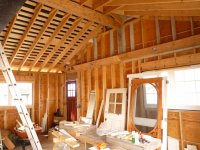
Just want to say thanks to everyone for your thoughts on my flooring problem. I wish I would have known about this site before starting on the project. I've added a couple of pics. to give you a better idea of the floor joist situation.
I was thinking the weight in the 3 bays would be 10-12000 lbs with 2 vehicles and a couple of teardrop trailers that weigh around 1000 lbs apiece. I want to install a 4 post hoist in the one bay with the vaulted ceiling which will add a fair amount of weight. I doubled up on the joists in that bay in the original construction just in case.
When the concrete guy told me that the 1 1/2" concrete would crack and the engineer verified it my reaction was why would you design it that way. After that I just went on to some of the other things that needed doing thinking that an answer would come up sooner or later. The electrical has been keeping me busy since then. I'm running 200 amp into the shop and then going underground to the house with a new 100 amp panel with more circuits than the old panel. The inspector was here Friday and passed the rough in so that's good.
The distance between the floor joist works out to 7 1/2" over the middle wall because of the overlap of the joists. I could possibly put some 6x9 or 7x9 I-beams inbetween if need be. I talked to the building inspector and he's not concerned with whether or not there's concrete on the floor.
 

Kevin54

MEMBER EMERITUS
Joined
Jan 12, 2005
Messages
29,341
Location
Urbana, Ohio
I would be leery about a 4 post lift UNLESS the weight of it is carried all the way down to the basement floor. Given the square footage of the feet of the lift, you would be looking at some very serious pressure under each leg. The lift would sit by itself, but with a car on it, you would be talking some serious deflection without carrying that weight all the way down.
 
OP
D

Doug M

Member
Joined
Nov 10, 2010
Messages
9
I tried to attach these photos with my last post but for some reason it didn't work. This gives you an idea of the support joists under the floor.
 

Attachments

  • P1020999.jpg
    P1020999.jpg
    137 KB · Views: 85
  • P1020996.jpg
    P1020996.jpg
    129.4 KB · Views: 82
  • P1030003.jpg
    P1030003.jpg
    137.7 KB · Views: 71
  • P1030008.jpg
    P1030008.jpg
    145.5 KB · Views: 80

creativecars

Well-known member
Joined
Nov 15, 2010
Messages
4,300
Location
Indiana- where horse and buggies still roam
Am I missing something? Wouldn’t metal beams be relatively easy to install and have the strength to hold a vehicle. Especially if they are put under the areas where the tires roll, like the ramps of a 4 post lift, but under the floor that is already installed.
 

KMR Construction

Well-known member
Joined
Oct 20, 2008
Messages
162
Location
Newport RI
Simple upgrades would be to add 2-3 more rows of blocking between the joists. This will tie them together. Also add a second layer of plywood preferably Advantech glued and nailed into the 2x's with ring shank nails. Run the plywood opposite to the existing and stagger seams. This is just my street engineering talking
 

Orangestang

Well-known member
Joined
Dec 22, 2010
Messages
525
Location
Glendale ,AZ
Just to add to this with the windows in the lower level I believe you would want some kind of lentel (steel angle) above the windows. From what I see in the pic you/won't have enough support there.The window frames will bow/break.
 

little d

Well-known member
Joined
Nov 13, 2009
Messages
815
Location
NW Oklahoma
Doug, sorry, didn't realise it was built already. Your enginer is a bone head! I know you didn't ask but, I'd be asking for a refund. I think you have a damn good case if it has to go to cort.
KMR has the idea if you don't put up a lift.
If you do, i agree with Kevin, ya need to carry the load to the foundation. Creative has a good idea with the i-beams, you could tie into them and have them carry the load to the foundation via posts.
 

gasgas17

Well-known member
Joined
Nov 7, 2009
Messages
443
Location
Nova Scotia, Canada
Simple upgrades would be to add 2-3 more rows of blocking between the joists. This will tie them together. Also add a second layer of plywood preferably Advantech glued and nailed into the 2x's with ring shank nails. Run the plywood opposite to the existing and stagger seams. This is just my street engineering talking


This is not a bad idea with the exception that the plywood should run the same direction of the existing plywood. The strength axis in any sheet of structural plywood runs over the 8 foot length of the sheet. There for you would want it installed perpendicular to the floor joists. It's only half as strong installed the other way. I would stagger the joints 4 feet from the existing plywood joints though. The lift should be doable but you will probably need to have it engineered. Preferably by someone else unless your existing guy will do it for free.
 

MoonRise

Well-known member
Joined
Nov 5, 2010
Messages
4,028
Location
NJ
In general, floor span tables for 'regular' floors say to use 2x lumber of section Z height for the distance Z spanned.

Spanning 10 ft? Use 2x10 lumber.

Spanning 16 ft? Use 2x16 lumber.

etc.

That's in general. For a 'regular' floor. NOT a shop/garage/'industrial' floor.

Forget installing a lift on that floor without some detailed analysis by a -competent- PE.

Point loading of the tires on that floor could be a problem. Because a vehicle is NOT an evenly distributed load.

Forget about using a jack or jack stands. Again, point loads instead of distibuted loads.

As well as the jack wheels/rollers and the jack stands 'digging in' to or punching through the plywood.

Note: Current span table for floor joists of 2x10 #2 Southern Doug-Fir (E=1.2 x 10^6 psi) indicate that those joists are adequate for a 14' 4" span with a 60 psf live load and a 20 psf dead load with a L/360 deflection limit. Which matches the deck/corridor 'codes' for no more than 1-1/2 inch LIGHTWEIGHT concrete floor fill.

So on the one hand it seems at first glance from current span tables that the floor is 'adequate'. For uniformly distibuted loads.

But without some more detailed engineering analysis, I'd be pretty leary of putting vehicles on that floor. And no WAY would I put jacks or jack stands or a vehicle lift without the more detailed engineering analysis and even then you'll probably still need some 'spread' plates underneath to keep from punching right through the plywood flooring.

Oh, btw, going from a dimensioned 2x10 to a 'true' 2x10 is not a great 'strength' increase. Slight, but not really a lot there. (about 10%)

And a 'nominal' 10,000 lb vehicle of 20 ft x 8 ft 'footprint' gives a load of 62.5 psf. That is IF the load were spread evenly over that 160 ft^2.

For a 'general' floor, you seem fine. For a garage/shop floor, I think that is inadequate. As the engineer acknowledged when you went back.

Personally, I think that you are probably in the range where engineered lumber joists or steel beams should have been used. For a 'garage', steel beams with the steel floor pans and concrete (think parking garage) would probably been the way to go. You'd still need some detailed engineering analysis for point loads (jacks and jack stands) and definitely need detailed engineering analysis for having a vehicle lift.

IMHO. :beer:
 
OP
D

Doug M

Member
Joined
Nov 10, 2010
Messages
9
Hi MoonRise,

Thanks for all the time spent doing the span calculations. I recall the engineer saying he was using a 60 psf live load as the basis for his design. I just went and remeasured my clear span which is 14' 3 1/2" which is just under what you said.
The engineer called for dimensional spf 2x10. My thinking was that full size 2x10 fir would be much stronger than the spruce or pine but not so much with the fir. Interesting that full size is only 10% stronger.

Kellhammer:
The concrete on the floor was just for waterproofing and fire prevention. I asked the engineer whether it provided any strengh and he said no. I talked to the inspector to see if they required it and he said no. Thanks for the comments on the shop.

KMR Construction:
I wasn't thinking of more blocking between the joists but it seems like a good idea and an easy upgrade. I'm thinking of installing I-beams under the deck which some other members mentioned where the weight of the wheels will be so will install blocking after. I haven't heard of Advantech. I live in a small town
on the west coast of B.C. so we're limited in the products that are available elsewhere.
 
OP
D

Doug M

Member
Joined
Nov 10, 2010
Messages
9
Hi Orangestang,
Regarding the lentel above the windows-I have 6x6 steel I beams which I haven't got around to installing yet but will soon.
 
OP
D

Doug M

Member
Joined
Nov 10, 2010
Messages
9
gasgas 17
Your idea of running the plywood the same as the first layer but staggered 4' seems right to me. I would also stagger it 2' the other way so none of the seams are above each other. Thanks for the info.
 

dlenkewich

Well-known member
Joined
Jan 27, 2011
Messages
1,409
Location
Saskatoon, Sk, Canada
...I recall the engineer saying he was using a 60 psf live load as the basis for his design...

The foot print of the tire sitting on the ground of a typical car would be about 6" x 6" and would be point loading thousands of pounds.

By the sounds of it you're going ahead with that design. Hate to say it but the idea of cars on that floor sends shivers up my spine.
 
To avoid these ads, REGISTER NOW!
Top Bottom