To avoid these ads, REGISTER NOW!

New Construction Garage - Heating/Insulation Advice Needed

Nick_M

Member
Joined
Jan 17, 2012
Messages
11
Location
Pewaukee, WI
I have been reading this forum for a while now and I really appreciate all the valuable information here. This is my first post so be nice!

We have just broken ground on building a new home in southeastern WI with a 3 car attached garage that I plan on having it be insulated and heated. Looking to just heat the garage so it isn't so cold in our frigid winters and also make it comfortable when I do work in there on occasion. Below are the details of what our plans are so far. Please review and provide any feedback on what I have provided or what I may be missing:

- 23'x34' (784sqft) 3 car attached garage
- 2x4 construction 16" OC with R13 insulation in the walls (kraft faced or no kraft faced?
- Ceiling inulated with either R38 fiberglass batts or R38+ blown-in insulation. Depends on if an access door will be added to use space above ceiling for extra storage.
- Either Modine, Beacon Morris, or Mr Heater 60k-75k NG heater (which is best for price?) with wall mounted programmable thermostat.
- Insulated 16'x8' & 9'x8 garage doors, 3'x6'8" service door and 2 vinyl 3'x5' single hung windows.
- Roof ridge vent along entire length of garage.

Thanks,
Nick
 
To avoid these ads, REGISTER NOW!

Steevo

Well-known member
Joined
Aug 18, 2009
Messages
8,738
Location
43.49600, -112.04300
I think a 75k heater is probably overkill for the space you wish to heat.
A Mr Heater 45k sould be plenty for that if you have enough insulation.
 
OP
N

Nick_M

Member
Joined
Jan 17, 2012
Messages
11
Location
Pewaukee, WI
Is there any disadvantage to oversizing other than initial cost and size of the unit? The Beacon Morris units are on sale at Mendards right now for $378 for the 45k and $448 for the 75k. MR Heater 75k is on sale at Northern Tool for $495.

Another question - is there a preferred location in the garage to mount it. I have a 3 car side entry gargage with almost the entire back wall is the fire wall between the garage and the house. Should it be in one of the corners by the house wall or in the middle by the house wall or somewhere else?
 

jvitez

Well-known member
Joined
Nov 30, 2009
Messages
2,429
Location
Big Sky Country, Canada
Oversizing a NG heater is a no no. It will give short bursts of high heat, then the fan is off. Hot air rises, so the heat stratifies. Also, the heater may never run long enough to get into its maximum efficiency temperature.

Now, if you want to keep it unheated and only heat on the weekends, etc, you may want to oversize to have a rapid temp rise, but you'll sacrifice comfort and efficiency if you're out there for a longer period. The most efficient size in NG heaters is one that runs 100% of the time on the coldest day of the year.

45,000 btu/h heater at 80% efficiency is 36,000 net btu input, or 46 btu/sq ft which should be lots, again unless you want fast heating of an unheated space, or you're opening and closing the garage door many times while heating. For a well insulated garage your size, 45,000 btu should be fine.
 

dirttracker18

Well-known member
Joined
Aug 10, 2009
Messages
3,191
Location
Slate River, ON
I see no mention of a vapour barrier in your post. Perhaps it is just a given that it is included but in your area it is essential. Seal up all VB to each other and use an accoustic sealent along the bottom of the wall. Seal it up well around all electrical boxes with plastic boxes taped to the VP. If you are heating at all it is a must and will make a bigger difference than high R value insulation.
 

phbsales

Banned
Joined
Aug 5, 2011
Messages
1,721
Location
Cincinnati, Ohio
I see no mention of a vapour barrier in your post. Perhaps it is just a given that it is included but in your area it is essential. Seal up all VB to each other and use an accoustic sealent along the bottom of the wall. Seal it up well around all electrical boxes with plastic boxes taped to the VP. If you are heating at all it is a must and will make a bigger difference than high R value insulation.

He asked about Kraft faced or unfaced batts in the walls.

- 2x4 construction 16" OC with R13 insulation in the walls (kraft faced or no kraft faced?
 

regguy1

Well-known member
Joined
Dec 15, 2009
Messages
4,053
Location
On Mount Olympus with Zeus
I have a 45K NG Mr. Heater in my 780SF / 8' 10" ceiling garage and it heats it just fine. R13 in walls and ceiling. You can see it in the signature video below
 

Fastback

Well-known member
Joined
Oct 5, 2010
Messages
518
Location
Indy
IS the slab poured yet? I would insulate under that slab if it were me...OK, if it were me I would use radiant but I'm weird like that.
 

ketas47

Well-known member
Joined
Jan 19, 2010
Messages
90
Location
Beaver Dam Wis
I agree to insulate under concrete (garage and house) and around perimeter of building down at least 2-3 feet.This will also help to keep floor from sweating. Also consider 2x6 walls ,garage and house, so you are able to insulate better.
Insulation is the best way to keep your heating bills low!
Just my 2 cents
 
OP
N

Nick_M

Member
Joined
Jan 17, 2012
Messages
11
Location
Pewaukee, WI
Thanks for all the great responses. Got a few more questions.

Regarding the heater, is there any significant advantages/disadvantages between the Modine, Mr. Heater & Beacon Morris units? I saw some disappointing reviews on the Mr Heater with reliability issues. The BM is the cheapest $378 at Menards, then Mr Heater $470 at Norther Tool and finally Modine $567 online. The builder wants $1400 to put in a 60k BTU Modine.

Regarding insulation, I will definitely be doing a vapor barrier over all the walls and ceiling. As for the ceiling, what would be the best way to be able to utilize the space above the rafters for storage. Would it be best to put OSB for a flooring up there and some R38 Batts between the joists? The ceiling will be drywalled.

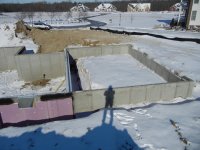
Regarding insulating under the slab. So far we have the footings and foundation in but no slabs have been poured (see attached picture with garage on far right), so I think it is still possible to insulate under the slab before they pour it. Would there be much advantage of putting insulation under the poured slab if I am not doing radiant heating? I would imagine that I would need to use something like the Owens Formular 250 insulation and thus, it would cost about $270 to put 3/4" (R4) sheets underneath it, or $420 for 1" (R5) or $460 for 1.5" (R7.5) or $620 for 2" (R10). What would you recommend?
 

Attachments

  • 2012 - 1-18-2012 1-12-11 PM.jpg
    2012 - 1-18-2012 1-12-11 PM.jpg
    141.6 KB · Views: 48

Teken

Well-known member
Joined
Jan 2, 2010
Messages
8,214
Location
The Bad Lands
Please keep in mind unless your garage was specifically designed to hold extra weight besides the snow load in the rafters.

Do not attempt to store anything up there with out spreading out the weight evenly with OSB boards.

Having said this, having one or more access doors on either side of the ceiling is just plain smart! Gives you a chance to make wiring changes, HVAC, storage, in the future.

Teken . . .
 
To avoid these ads, REGISTER NOW!

Dave28

Well-known member
Joined
Nov 2, 2011
Messages
64
Location
Baden, PA
I used 2" Owens Formular 250 insulation under my slab and even before the slab was pour I could feel a big difference in the temp before and after I laid the insulation. I think I paid $22.96 a sheet at Homedepot.
 

ketas47

Well-known member
Joined
Jan 19, 2010
Messages
90
Location
Beaver Dam Wis
Insulation(2 inch) under the floor and also around foundation(1 inch) is being done alot of new constructions here in Wi. It is a big plus even if you dont have infloor heat. I know people that installed it and think the money was a great investment no matter what kind of heat you use. Did you think about installing the tubing for infloor heat even if you dont use it, it is there in case someday you decide to go to radiant heat,and a plus if you ever decide to sell the house? Radiant heat is very economical once installed.(Tubing not that expensive).
I built my detached garage 3 years ago (26x38x10 2x6 walls fully insulated) and insulated under the floor and around the sides(except driveway side) and only heated with a turbo heater occasional weekends and it never froze inside.(Never sweats in the spring) This year I hooked up my infloor heat and love it. Only thing I didnt do was insulate along the side where my garage meets my concrete driveway and am noticing my heat radiating into my driveway. *Heat lost* So the insulation along the outside helps alot
So I recommend insulation as much as you can, IT IS WORTH IT!
 
Last edited:

powpow

Well-known member
Joined
Jan 21, 2010
Messages
213
Location
le center, mn
yep

I did 2 inch on the inside of mine, 4 ft down, 1 inch on the outside from the footing to the sill.

I am also insulating the inside of the 6 inch block as well that the floor is up againts to stop heat loss
 

dirttracker18

Well-known member
Joined
Aug 10, 2009
Messages
3,191
Location
Slate River, ON
Would it be best to put OSB for a flooring up there and some R38 Batts between the joists?

No as OSB is meant for lateral loads. OSB will bend like crazy laying flat with a load on it. If you really want storage up there then use plywood and as Teken mention make sure your trusses are up to it.
 

MarkrunsLTL

Member
Joined
Jan 2, 2012
Messages
18
Location
appleton wi.
Thanks for all the great responses. Got a few more questions.

Regarding the heater, is there any significant advantages/disadvantages between the Modine, Mr. Heater & Beacon Morris units? I saw some disappointing reviews on the Mr Heater with reliability issues. The BM is the cheapest $378 at Menards, then Mr Heater $470 at Norther Tool and finally Modine $567 online. The builder wants $1400 to put in a 60k BTU Modine.

Regarding insulation, I will definitely be doing a vapor barrier over all the walls and ceiling. As for the ceiling, what would be the best way to be able to utilize the space above the rafters for storage. Would it be best to put OSB for a flooring up there and some R38 Batts between the joists? The ceiling will be drywalled.

Regarding insulating under the slab. So far we have the footings and foundation in but no slabs have been poured (see attached picture with garage on far right), so I think it is still possible to insulate under the slab before they pour it. Would there be much advantage of putting insulation under the poured slab if I am not doing radiant heating? I would imagine that I would need to use something like the Owens Formular 250 insulation and thus, it would cost about $270 to put 3/4" (R4) sheets underneath it, or $420 for 1" (R5) or $460 for 1.5" (R7.5) or $620 for 2" (R10). What would you recommend?

Nick if its any help, i'm up here in appleton. i looked at the Beacon and morris and decided on the Modine Hot Dawg. I have a 3 year old 2 1/2 car garage and the HVAC person i used told me the 45,ooo btu model would be enough. He's charging me $1500.00 for the heater, install as well as 50ft. of gas line and the thermostat.
 
OP
N

Nick_M

Member
Joined
Jan 17, 2012
Messages
11
Location
Pewaukee, WI
Thanks for the additional feedback. Couple more questions:

1) Currently there is no vapor barrier spec'd out under the garage floor. Should that be added? Is there any drawback to adding it (i.e., more water will accumlate on top and not soak through)?

2) With just the foootings and foundation poured so far, I am assuming it is not too late to have them add a drain. Any idea what to expect as far as cost goes to add this now? Any suggestions for the type of drain?
 

rsa

Well-known member
Joined
Mar 3, 2011
Messages
300
Location
Between Raleigh and Fayetteville, NC, USA
Regarding insulation, I will definitely be doing a vapor barrier over all the walls and ceiling.
You don't live in an Arctic, Sub-Arctic or Very Cold climate. You don't need a vapor barrier (defined as a Class I vapor retarder). Waukesha County is in IECC Climate Zone 6. From Building Science Corporation:
A Class I or Class II vapor control layer is required by the IRC on the interior side of framed walls in Zones 4c, 5, 6, 7, and 8, with the exceptions of basement walls, below grade portion of any wall, and wall construction that is not sensitive to moisture or freezing (e.g. concrete block wall). However, BSC recommends avoiding Class I vapor control layers in general in wall assemblies, except in special use occupancies in cold climates such as indoor pools and spas.
More from BSC, Understanding Vapor Barriers:
The recommendations are based on the following principles:
  • Avoidance of using vapor barriers where vapor retarders will provide satisfactory performance. Avoidance of using vapor retarders where vapor permeable materials will provide satisfactory performance. Thereby encouraging drying mechanisms over wetting prevention mechanisms.
  • Avoidance of the installation of vapor barriers on both sides of assemblies – i.e. “double vapor barriers” in order to facilitate assembly drying in at least one direction.
  • Avoidance of the installation of vapor barriers such as polyethylene vapor barriers, foil faced batt insulation and reflective radiant barrier foil insulation on the interior of air-conditioned assemblies – a practice that has been linked with moldy buildings (Lstiburek, 2002).


Three classes of vapor control are defined depending on the vapor permeance of the vapor control layer.
  • Class I . <0.1 perms e.g. polyethylene sheet, sheet metal, or aluminum facing.
  • Class II. 0.1 - 1.0 perms e.g., kraft faced fibreglass batts, and some vapor control paints.
  • Class III. 1.0 - 10 perms e.g. latex or enamel paints.
Don't confuse air barriers with vapor barriers. One can't emphasize the importance of air control in an energy efficient building. Look at the Airtight Drywall Approach. You can also place the air barrier on the exterior.

As far as the ceiling in a vented roof application goes, quoting BSC again,
In addition to an air barrier at the ceiling line, a Class II vapor retarder should be installed in Climate Zone 6 and Climate Zone 7. A Class III vapor retarder is acceptable in Climate Zone 5.
Class I vapor retarders (i.e. vapor barriers) can be installed in vented roof assemblies in Climate Zone 6 and Climate Zone 7 but should be avoided in Climate Zone 5 as top side condensation may occur in the summer months during air conditioning periods.
No interior roof assembly-side vapor control is required or recommended in climate zones other than cold or very cold.
Finally, two good reads/listens re: roof venting. Lstiburek’s Rules for Venting Roofs and a Crash Course in Roof Venting

I know that's a lot to digest, but now is the time to worry about the details, and they're fun and interesting reads (IMO). I hope you have designers and builders that are interested in helping you save on future energy bills up there in cold Wisconsin. It's a lot cheaper to do it now than after the house is built.
 

Fastback

Well-known member
Joined
Oct 5, 2010
Messages
518
Location
Indy
I was going to do a drain, but I found that many circular drains can stink and I did not want that pitch to the center.
I considered a channel drain but did not want pitch since I knew I was getting a lift that moves.
So I vote no on the drain unless you plan on washing cars down, if you are going to be using a bunch of water I guess you could do a channel drain down the center or along the door edge without much pitch and get a broom or squeegee to push to it, that would be cool?

I would at the lest use a vapor barrier, if you dont want to spend the money on the 2" foam board get some of that foil backed bubble insulation at the big box store and use it to do both, its cheap and if you tape it together at the overlapped joints, it will help with condensation and believe it or not it can insulate.

I would do the foil insulation and pull three or four loops of PEX if it were me, it cant hurt resale!
 

rsa

Well-known member
Joined
Mar 3, 2011
Messages
300
Location
Between Raleigh and Fayetteville, NC, USA
1) Currently there is no vapor barrier spec'd out under the garage floor. Should that be added?
Do it. A recent article I read on garage floors in the Journal of Lightweight Construction recommended 10+ mil vapor barriers specifically designed for under slab use. Example, StegoWrap. Why?
Moisture in the ground can wick up via capillary action, and water vapor is always present beneath slabs; any air in the subbase is almost always at 100 percent relative humidity. Without a vapor barrier, moisture will move through the concrete and condense beneath anything stored on the slab surface, leaving telltale dark spots. In extreme cases, the slab will even "sweat." If the slab is ever covered with flooring or a finish coating, the moisture could cause delamination. A vapor barrier is cheap insurance.
They also said 6-mil poly will meet code when required. Speaking of codes, more recent codes require a vapor retarder under an attached garage slab. IRC 2009:
R506.2.3 Vapor retarder. A 6 mil (0.006 inch; 152 μm) polyethylene or approved vapor retarder with joints lapped not less than 6 inches (152 mm) shall be placed between the concrete floor slab and the base course or the prepared subgrade where no base course exists.
Exception: The vapor retarder may be omitted:
  1. From detached garages, utility buildings and other unheated accessory structures.
  2. For unheated storage rooms having an area of less than 70 square feet (6.5 m2) and carports.
  3. From driveways, walks, patios and other flatwork not likely to be enclosed and heated at a later date.
  4. Where approved by the building official, based on local site conditions.
 

Bent Valve

Member
Joined
Feb 9, 2012
Messages
6
Location
Kansas City
For insulation you may want to look at blown in cellulose. Kills bugs, actually works as insulation unlike bats(R16 bats test to R16 but in a house it may only be R5 or R6 where cellulose test R16 and in a house would be R16). Next best would be foam board caulked in or foamed in. And if your tub is on an outside wall, blow insulation all around it to super insulate it to keep the water hot in the tub. Good Luck!
 
To avoid these ads, REGISTER NOW!
Top Bottom