To avoid these ads, REGISTER NOW!

New construction insulation and interior wall finishing help

absentx

Member
Joined
Sep 29, 2024
Messages
8
Hello! Long time reader first time poster. My wife and I are finally into our new construction home and we love it. I have a 1450 square foot attached garage that is everything I have ever wanted in a garage! It has two insulated 16 foot front doors, and one insulated 16 foot door out the rear. The Section with the rear door is roughly 30x30 and the rest of the garage is canted at an angle off the house.

  • The common wall to the house is insulated and dry walled.
  • The ceiling is blown insulation and finished dry wall.
  • The walls are ten feet high, 2x6 construction, 16" OC
  • This has left roughly 650 SQF of un-insulated walls.
  • We are located in Southeastern Wisconsin - so, while we have some misses, most of the time winter is pretty damn cold.
This weekend I begun insulating with Rockwool R23 2x6 comfort batts. Its going great and the install is nice and smooth.

  • The garage is piped for in floor heat, but, the boiler and supported plumbing however has not yet been installed.
  • Even when I do get that installed, I don't think I will keep it on all week during the winter. I mainly see this as a turn the heat up Friday afternoon so I can work all weekend out in the garage, or perhaps if I do keep it on it would be at like fifty so the wife has a warm car during the week when she drives to work.
  • Until the in floor heat is completed (which could be one to three years yet) I have two propane salamander style heaters that work great and will meet my weekend/project needs just fine.
  • Moral of the story is for the foreseeable future the garage will be heated on an as needed basis for one to ten hours at a time on the weekends or when I need to be out there to work on something.
Given the information on my garage, and the heating habits I have presented, I have one question:

When I am done insulating, but before I put up whatever I choose for my wall material (I won't be using drywall, but I also haven't decided what I will indeed choose) do I need a vapor barrier? The outside of the home has Tyvek.

I have floor drains plus hot and cold running water in the garage, so I kind of want to do something on the lower half that could handle a little over spray better than drywall.

Thanks in advance for any input!
 
To avoid these ads, REGISTER NOW!

Ak Jim

Well-known member
Joined
Jan 5, 2012
Messages
532
Location
Interior AK
Just my opinion. Get the radiant heat done asap. The salamander heaters are going to put a lot of moisture in the air. The way you are insulating the place there’s no reason to not heat it all winter. You’re in your dream garage.
 
OP
A

absentx

Member
Joined
Sep 29, 2024
Messages
8
I appreciate the feedback.

I mean I probably will be able to finish the radiant for next winter, but I just don't think its in the cards for this winter. We don't have a yard yet and still need about 80 quad axles of fill to be able to get to a yard and I need to have that done next spring, and all that stuff is quite expensive, so I just think the garage has to wait.

Maybe I'll just insulate for this winter and then do walls plus finish radiant next season.
 

slimcake

Well-known member
Joined
Sep 27, 2016
Messages
929
The only way floor heat works well is efficiency is consistency. Pick a temp and leave it. That is why I didn't do floor heat. That and the rumored increase in corrosion from it. I have a 1650 sq ft so we are similar. I heat with a heat pump alot of winter and when it gets brutal (se MN) I run the hanging forced air furnace. I spray foamed and bought the best R rated doors I could 2 doors face east and one faces west out the back. Best part about the heat pump is I got AC in the summer. 70 degrees and 50% humidity is GLORIOUS!!! Drywall for me. Just built a new shop though and did "smart siding" in that. Worth a look. Still wood to absorb noise but it can handle moisture and heavy use.
 

Attachments

  • garage 2.jpg
    garage 2.jpg
    678.2 KB · Views: 65
OP
A

absentx

Member
Joined
Sep 29, 2024
Messages
8
Okay so @slimcake did you do a moisture barrier in the garage in between insulation and drywall? I'll definitely check out smart siding!

EDIT - are you talking about LP Smartside? definitely worked with that before.

I looked into that trusscore stuff but jeez just playing around with the cost estimator had me spinning in disgust of expense so I quite looking at it. I may not have been calculating my needs correctly though.

Heat pump idea is nice too, but I have paid for the tubing so I will probably roll with that in due time.
 
Last edited:

slimcake

Well-known member
Joined
Sep 27, 2016
Messages
929
@absentx I did on the house walls. The exterior walls being I used 2.5 inches (roughly) of closed cell spray foam I did not. The house wall got three inches of foam but still used a vapor barrier. Closed cell is consider a moisture/vapor barrier is my reasoning. You said this is your dream garage correct? Don't discount the AC factor. The first year I lived here it was unbearable in the garage from the humidity. I ran a de humidifier that first summer. The next summer the mini split went in. I figure if all else was equal the dehumidifier cost me around 35 bucks a month to run and the mini split AC was right around $20. So comfort and less energy! Dry mode did what the dehumidifier did and the AC kicks *** when its dog days of summer!!!
 
OP
A

absentx

Member
Joined
Sep 29, 2024
Messages
8
I am definitely intrigued by AC as well. We just had our first summer here and I was in the garage a lot! With all three doors open there is quite the wind tunnel effect in there, but trust me there were plenty of days where I was really working hard out and around the garage that 70 and no humidity in the respite of the garage would have been amazing. First step obviously the insulation so looking to continue that this weekend. I have about 500 of 650 SQF to go yet...waiting for a nicer knife to arrive to cut that rockwool. Turns out I didn't have an extra bread knife laying around.

Nice Expedition in there, I have a 2022 General with full doors, heat and a plow.
 

slimcake

Well-known member
Joined
Sep 27, 2016
Messages
929
Yep. Also got the plow. Electric right and left is sweet. love the AC part. Notice a trend with me? Comfortable always. Had a general before this and this thing is everybit as capable as the general! oh and the loudest, cleanest stereo system I have owned. Amazing.
 

Attachments

  • IMG_20231112_141419765.jpg
    IMG_20231112_141419765.jpg
    526.9 KB · Views: 57
To avoid these ads, REGISTER NOW!
OP
A

absentx

Member
Joined
Sep 29, 2024
Messages
8
Yeah it seems to be headed towards consensus. I tell you though, there may not be a more polarizing topic on the internet.

I have Tyvek on the outside, which I realize is a weather block, not a vapor block. You start running into confusion because of the rockwool. Some people on reddit insist that you DO NOT USE a vapor barrier with rockwool. Then you get others who install in professionally and insist that you do!

Regardless, given that I will be using a salamander for awhile, and maybe a couple years on and off, I am leaning towards trying Certainteed MemBrane.
 

racecougar

Well-known member
Joined
Jan 26, 2021
Messages
5,174
Location
Missouri
You start running into confusion because of the rockwool. Some people on reddit insist that you DO NOT USE a vapor barrier with rockwool. Then you get others who install in professionally and insist that you do!
I can't say that I've ever heard that argument made. Then again, I don't hang out on reddit.
 

duneslider

Well-known member
Joined
Jan 20, 2013
Messages
2,267
Location
Riverton, Utah
In your cold climate, where do you want the moisture to stop? It moves from the hot side to the cold side. If you don't have a vapor barrier over the rockwool the heated garage air carrying moisture will move towards the cold and ultimately condense on the sheeting on the exterior wall. If you have a vapor barrier over the rockwool less moisture will make it to the sheathing where it will condense. So, in cold climates like yours you want the vapor barrier.

In warmer climates you don't need the interior vapor barrier.
 
OP
A

absentx

Member
Joined
Sep 29, 2024
Messages
8
Thanks again for all the replies. Continued on with the Rockwool installation tonight. Will definitely add the vapor barrier before I get to finished inside walls, but in the meantime this stuff installs nice and easy for my application.

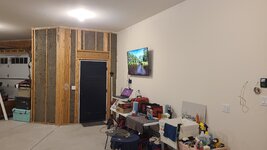
Given all the solid advice I figured I should share a few pics.

The pic with the Polaris General is the 30 Plus foot unfinished wall that remains....but I should be able to get that all handled by November:
 

Attachments

  • 20241005_003917.jpg
    20241005_003917.jpg
    550.7 KB · Views: 40
  • 20241005_003950.jpg
    20241005_003950.jpg
    465.5 KB · Views: 40
  • 20241005_003908.jpg
    20241005_003908.jpg
    622.3 KB · Views: 42

67CarGuy

Well-known member
Joined
Feb 6, 2008
Messages
764
Location
Outside Boston, MA
In your cold climate, where do you want the moisture to stop? It moves from the hot side to the cold side. If you don't have a vapor barrier over the rockwool the heated garage air carrying moisture will move towards the cold and ultimately condense on the sheeting on the exterior wall. If you have a vapor barrier over the rockwool less moisture will make it to the sheathing where it will condense. So, in cold climates like yours you want the vapor barrier.

In warmer climates you don't need the interior vapor barrier.
To be specific, heat moves from hot to cold. The air carrying vapor moves from high pressure to low. Yes, those are often the same direction, but not always.

OP, I'd personally stay away from any interior plastic, especially if you're thinking of air conditioning the garage. Drywall (or plywood, OSB, etc.) covered with vapor permeable latex paint will still allow the wall to dry to the interior. Plastic sheeting will prevent any moisture that does accumulate in the wall cavity from drying to the inside. Unless you have vapor permeable exterior sheathing, you'll just be creating a moisture sandwich that can rot your wall(s). *Side note: OSB is much more temperamental about water than plywood is.
 
OP
A

absentx

Member
Joined
Sep 29, 2024
Messages
8
@67CarGuy - I lived in Somerville MA for about 8 months twenty five years ago right out of college. Haven't been back but cant wait to drive back out to MA someday, loved my time out there.

Okay how about this - for now, meaning this coming winter, am I okay to just put the Rockwool in (Now about 400 of 650 SQF completed!!, not ripping it all out!), leave it unfaced/unfinished and just heat my garage in peace with my propane salamander? Bottom line the walls can breathe, and I can retain more heat when I choose to heat on weekends.

Then next spring/summer, I'll move forward with finished walls, vapor barrier (or not) etc...
 

67CarGuy

Well-known member
Joined
Feb 6, 2008
Messages
764
Location
Outside Boston, MA
@absentx small world! I'm in Somerville at least once a week these days.

Yes, absolutely OK to leave the mineral wool as-is for the winter, as long as your building inspector doesn't mind (if that's even an issue for you), and you're careful to not damage it. As you may have already found out, once a bit is separated from its brethren it can be quite difficult to reunite it.

Just be aware that without the benefit of drywall / plywood / etc. on the inside, it won't restrict heat movement as well as it would otherwise (because it can't stop air movement), but it's certainly better than just bare walls.
 

billconner

Well-known member
Joined
Jul 20, 2021
Messages
6,971
Location
Thousand Islands NYS
I'm guessing stick frame with sheathing. With just the insulation, warm moist air, especially moist with salamanders, will pass through the rockwoll and condense on the sheathing. But try it and after a few hours of maintaing a comfortable temperature, lift on batt and look and feel for moisture, especially at floor plate. Also next morning and see if there isn't a kind of icy film on sheathing. You might get away with it if only heating a day or two a week.

Fiberous insulation is good at reducing conductive heat transfer but less good at convection. Fibreglass being worst and sensed packed cellulose not bad, with rockwool between them. Fibreglass batts are a pound and under PCF, rockwool batts 2 PCF, and dense packed cellulose 3 PCF minimum so not surprising.
 
To avoid these ads, REGISTER NOW!
Top Bottom