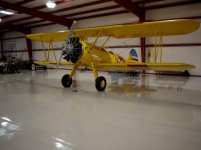
Spent a great deal of time looking (almost a year) and decided on a system I just finished putting down. Shop is a large metal building (aircraft hangar) and doing the floor in stages. There are 4x4 squares that are 19' x 19' and did the first row this weekend (see pics). I cannot say enough about the final product and the customer service (answering my questions over the last 12 months). Went with Legacy Industrial HD 100% solids (Extra Hide White) and the HD 322 Urethane for a top coat.
I am no expert, but will walk thru the process I used. Maybe it will help someone. I spent a great deal of time reading everyone else's experience and figure I should give something back. First and foremost, I wanted a 100% solids and white. Was concerned about it yellowing with UV so I top coated it with Urethane (also for the Aviation Gas etc). I really like the shine from the top coat, could use it to brush your hair in the morning. Go with a company that will answer your questions. I could not be happier with the service and product I received from Legacy Industrial. Excellent product (no blushes on the epoxy), and exceptional service.
1) Prep, Prep, Prep as everyone else says. I did an acid etch on a relatively stain free floor that was laid 18 months ago. Taped Plastic down on 4 sides first to check for moisture. Passed, Etched. Just buy Muriatic acid from hardware store (about $7 a gallon) and mixed about a ratio of 1:5 or 1:10 with water. As I applied (used a garden sprinkler), I used an acid brush to scrub the areas that were a little more stubborn than others (you will know because the bubbling will be less intense or not present on these areas). I had no oil stains, but everywhere I read said to use a degreaser (detergent) to get the stains up first before acid etch. I read a pound of baking soda per 5 gallon water as a rinse afterwards, and did this for the first bit, but quickly thought it was a waist of time. The acid was reduced pretty quickly by the lime in the concrete and what I got off the floor was pretty neutral based on pH paper. Triple rinse and let completely dry (2 days). Floor felt like 150 grit sandpaper (Passed).
2) First coat: White epoxy, mixed with a Jiffy mixer for at least 2 minutes and applied with 9" 1/4 nap roller. Since it was white the first coat did not look all that great. There were obvious areas of poor coverage and felt first coat was going to be similar to a primer coat. I do not think it would be easy to get the floor done in one coat of the white and make it look perfect. Went rather thin on this coat with two kits (1.5 gallons each) covering about 1200 sq ft (600 per kit as opposed to the 300 per kit recommended). Knowing I was going to put down a second coat, figured that was going to be fine. Temperature was 60 degrees, floor was laid about noon and night temps dropped to 40's. By am, the floor was more than ready for the second coat, with great adhesion and no blushes noted.
3) Second coat: After picking a few bugs out of it, second coat went down 4 pm (yea 30 hours after the first). Followed the same process only used an 18" 3/8 nap roller and back rolled everything I spread. Did not use a squeegee, only a roller and a brush to cut in the edges. Did not use spikes shoes. Mixed only one kit at a time and given the pot time of 30 minutes to an hour, although you could tell a difference in the paint in the hour and a half by the end, it was still very manageable. Temps outside were high 50's. Night time dropped to the 40's and high 30's. Next day, actually within 14 hours, was ready for top coat, even with the low temperatures. Top coat was laid 25 hours after the application of the second coat.
4) Top Coat: by far the most difficult. Used 18" 3/8 nap roller. After mixing, the urethane was much thiner than the 100% solids epoxy. My lighting was pretty good, but it was still hard to determine where you had painted and where you had not. Happily, I stayed within a system of floor coverage, pouring a narrow stream of urethane and smoothing it out with a large floor roller. Went on very fast and again only mixed on kit at a time. Two kits were used for 1200 sq ft. was dry enough to walk on within 12 hours. Still had a little tack to it at 8 hours.
I am no expert, but will walk thru the process I used. Maybe it will help someone. I spent a great deal of time reading everyone else's experience and figure I should give something back. First and foremost, I wanted a 100% solids and white. Was concerned about it yellowing with UV so I top coated it with Urethane (also for the Aviation Gas etc). I really like the shine from the top coat, could use it to brush your hair in the morning. Go with a company that will answer your questions. I could not be happier with the service and product I received from Legacy Industrial. Excellent product (no blushes on the epoxy), and exceptional service.
1) Prep, Prep, Prep as everyone else says. I did an acid etch on a relatively stain free floor that was laid 18 months ago. Taped Plastic down on 4 sides first to check for moisture. Passed, Etched. Just buy Muriatic acid from hardware store (about $7 a gallon) and mixed about a ratio of 1:5 or 1:10 with water. As I applied (used a garden sprinkler), I used an acid brush to scrub the areas that were a little more stubborn than others (you will know because the bubbling will be less intense or not present on these areas). I had no oil stains, but everywhere I read said to use a degreaser (detergent) to get the stains up first before acid etch. I read a pound of baking soda per 5 gallon water as a rinse afterwards, and did this for the first bit, but quickly thought it was a waist of time. The acid was reduced pretty quickly by the lime in the concrete and what I got off the floor was pretty neutral based on pH paper. Triple rinse and let completely dry (2 days). Floor felt like 150 grit sandpaper (Passed).
2) First coat: White epoxy, mixed with a Jiffy mixer for at least 2 minutes and applied with 9" 1/4 nap roller. Since it was white the first coat did not look all that great. There were obvious areas of poor coverage and felt first coat was going to be similar to a primer coat. I do not think it would be easy to get the floor done in one coat of the white and make it look perfect. Went rather thin on this coat with two kits (1.5 gallons each) covering about 1200 sq ft (600 per kit as opposed to the 300 per kit recommended). Knowing I was going to put down a second coat, figured that was going to be fine. Temperature was 60 degrees, floor was laid about noon and night temps dropped to 40's. By am, the floor was more than ready for the second coat, with great adhesion and no blushes noted.
3) Second coat: After picking a few bugs out of it, second coat went down 4 pm (yea 30 hours after the first). Followed the same process only used an 18" 3/8 nap roller and back rolled everything I spread. Did not use a squeegee, only a roller and a brush to cut in the edges. Did not use spikes shoes. Mixed only one kit at a time and given the pot time of 30 minutes to an hour, although you could tell a difference in the paint in the hour and a half by the end, it was still very manageable. Temps outside were high 50's. Night time dropped to the 40's and high 30's. Next day, actually within 14 hours, was ready for top coat, even with the low temperatures. Top coat was laid 25 hours after the application of the second coat.
4) Top Coat: by far the most difficult. Used 18" 3/8 nap roller. After mixing, the urethane was much thiner than the 100% solids epoxy. My lighting was pretty good, but it was still hard to determine where you had painted and where you had not. Happily, I stayed within a system of floor coverage, pouring a narrow stream of urethane and smoothing it out with a large floor roller. Went on very fast and again only mixed on kit at a time. Two kits were used for 1200 sq ft. was dry enough to walk on within 12 hours. Still had a little tack to it at 8 hours.
Attachments

Last edited: