To avoid these ads, REGISTER NOW!

New garage needs power

Maxtork

Well-known member
Joined
Sep 12, 2013
Messages
140
Location
Huntsville AL
Well I wasn't planning on doing my electrical for awhile but the inspector said they wanted to see the electrical stuff when they come out to do the first rough in inspection so I need to knock it out now so I can finish the rest of the garage.. I was planning on doing everything surface mount but if I have to do it now I might as well run it through the walls. So here is my plan and a few questions. Please help point out any areas I am going to have trouble as electrical is not my specialty.

1. I will use a 100 amp breaker from the panel in the house and run power from there through the attic to the corner of the house where it will go into PVC conduit at the soffit. The conduit and feeder wire will run down the exterior wall and into the ground to a 90 street elbow and across to the garage. The garage is about 35 ft from the corner of the house so it is about a 75ft run from house panel to garage panel. I would also like to run a coax cable for TV and a cat 5 cable for internet while I am at it.

What size wire should I use for the feeder?
Can I run the feeder, cat 5 and coax all in the same conduit or might I have trouble with that idea?
I have heard the conduit must be buried at least 18 inches deep which is fine but I have also heard 36 inches deep which seems excessive. I will confirm with the inspector but is 18 inches usually the standard? Also is it normal to run the feeder and cover it back up or do the inspectors usually want to see the trench to confirm the depth?

So then the feeder comes up from the trench to a PVC 90 degree fitting (with the access panel on the back) through the garage wall and up into the 100 amp panel. From the panel I will have two circuits for the outlets spaced around the perimeter of the garage. I will run the 12 gauge cable through holes in the studs to get to each double gang outlet.

Is there a minimum height distance off the floor for the wire runs through the studs? Also is there a minimum height for the outlets in a garage? Any specific size hole for the wire runs through the studs?

I will be using the blue plastic boxes attached to the studs for the outlets and as I understand it I have to have a GFI outlet on each circuit. I will run a 220 circuit for my compressor which will live in the back corner of the garage. I don't have the big compressor yet (I'm living with my 30 gallon 110 unit for now) but I want to have provisions for it when I am ready. I would like to have another 220 outlet at the front of the garage right under the panel for a welder. This way I can plug the welder in and weld just outside the shop if needed.

I will also run two circuits for the overhead lights. I would like to run eight 4 ft fluorescent lights in two rows along the ceiling. I will also have one light outside at the entry door ( I think this is a code requirement) and one outside light on either side of the big garage door. Obviously these will be on switches which I will mount just inside the entry door.

Sorry for the long post and tons of questions. I want to have a good plan together so I don't get too far out of line. I will run all this past the inspector but I want to do it once and not 10 times so I don't become the pain in the *** DIYer and piss them off. Any help, guidance , answers you guys can provide is greatly appreciated.


Max
 
To avoid these ads, REGISTER NOW!

MixManSC

Well-known member
Joined
Jan 6, 2014
Messages
154
Location
South Carolina
Similar to what I did. I used a big 4" conduit in ground and it was at least 18" down. The inspector did want to see, and he measured the depth of the trench. One suggestion, run an additional 12/3 line back to the house, put the exterior shop lights on a 3 way switch.... Nice cutting the last lights out there on after dark before you walk out there. I used such a big pipe for possible wire pulls, left a 3/16" nylon line pulled in the pipe. I also ran rg6 quad shield and shielded cat 6 in the same pipe and also ran a water line in the trench. Cannot remember what size main wire is offhand but also ran it for 100a with main breakers at both ends. Grounding at the shop comes from the house as well.
 
OP
M

Maxtork

Well-known member
Joined
Sep 12, 2013
Messages
140
Location
Huntsville AL
Thanks MixMan...I like the idea of the 3 way switch for the exterior lights. I could even wire it together with the one exterior light on the back porch of the house.

I was going to run a big size PVC as well but I don't want the giant sewer pipe running down the wall of the house from the eaves. Is there a nicer looking way to get the feeder down from the attic to ground level?

Thanks
Max
 

Bmwsyc

Well-known member
Joined
Dec 1, 2013
Messages
49
You can do as you wish, but power and low voltage systems (other than class 1 power wiring) are not allowed in the same raceway.

Edit, forgot to mention, PVC direct buried is 18 inches deep.
 
Last edited:
OP
M

Maxtork

Well-known member
Joined
Sep 12, 2013
Messages
140
Location
Huntsville AL
Bmwsyc,

Do you mean that I shouldn't run more than one circuit through the same hole in the studs? Thats fine if I need to run more than one. I don't want to do something that will cause me trouble later.

Thanks
Max
 

Bmwsyc

Well-known member
Joined
Dec 1, 2013
Messages
49
No minimum heights for cable or outlets in the garage, but I would keep them some distance above the floor, no requirement though. Keep holes in the studs a minimum of 1.25 inches from the inside or outside face, otherwise nail protection will be needed. I would drill a hole as small as practical.
 

MixManSC

Well-known member
Joined
Jan 6, 2014
Messages
154
Location
South Carolina
Actually I believe he means you are not supposed the have anything but ac in the conduit in ground. The coax and Ethernet should not be run in it. I did pull those in the in ground pipe at my place after the final inspections and I did use shielded and grounded the shields to eliminate interference. Still not proper I guess but everything works great. In my television, both high and low voltage stuff is fine so why not in the pipe in my yard? Regardless, forgot about that, you might want to either do what I did and pull those later or plan on a second pipe for them. As far as the pipe up the wall, box it in or dig under the wall, bring it up inside, its gotta come up somewhere....
 

Bmwsyc

Well-known member
Joined
Dec 1, 2013
Messages
49
If the walls are insulated or holes in the studs are sealed, you can run up to 9 current carrying conductors through each hole...that equates to 4 - 12/2 cables, or 4 - 12/3 cables where one conductor (the neutral) only carries the unbalanced load of the two current carrying conductors.

Edit: sorry, above statement based on #12 wire for 20 amp circuits. I would have to do the math for circuits of other ratings. I checked for 15 amp circuits and that also works (14 gauge)
 
Last edited:
OP
M

Maxtork

Well-known member
Joined
Sep 12, 2013
Messages
140
Location
Huntsville AL
Ah I see what you mean. I can handle running the ethernet and TV lines later. I was going to run a length of 550 cord for just such an emergency. Even running a second conduit wouldn't be bad if I did it at the same time.

I would rather not dig under the house a bring it in through the slab but you are right it has to come in somewhere. I wonder if I can run a smaller diameter conduit up the wall so it isn't as obvious and then open it up at ground level so I have plenty of room for additional cables or if repairs are needed.

Thanks for all the info. I was pretty nervous about this part of the build but nice to hear I'm not TOO far out in left field.

Max
 
OP
M

Maxtork

Well-known member
Joined
Sep 12, 2013
Messages
140
Location
Huntsville AL
If the walls are insulated or holes in the studs are sealed, you can run up to 9 current carrying conductors through each hole...that equates to 4 - 12/2 cables, or 4 - 12/3 cables where one conductor (the neutral) only carries the unbalanced load of the two current carrying conductors.

Edit: sorry, above statement based on #12 wire for 20 amp circuits. I would have to do the math for circuits of other ratings.

Ok got it sorry...I miss understood the first time.

Thanks
Max
 

Jefe

Well-known member
Joined
Oct 11, 2011
Messages
59
Location
OH-IO
Couple of things: You might be required to have expansion joints in the PVC run - something i didn't know about until I called the city building office. They needed one on each vertical portion of conduit. If you have a straight line from the house to garage, you might need another in this section as well (if the conduit is rigidly fixed at two points, the stuff in between needs to be able to expand and contract).

http://www.lowes.com/pd_195885-5391...rentURL=?Ntt=pvc+conduit+expansion&facetInfo=

As for wire size, everyone here recommends (and I went with) Al 2-2-2-4 "Mobile home feeder". There is much discussion around whether the maximum allowed protection for this cable is 90 or 100a. Many agree that it's actually only 90, but my inspector told me I could go ahead and use a 100a breaker.

http://www.southwire.com/ProductCat...view=true&token=15&desc=AL-Mobile Home Feeder

You can usually find it at big box stores. Make a list of everything you need, go to the "Pro" desk and as for a discount!
 
OP
M

Maxtork

Well-known member
Joined
Sep 12, 2013
Messages
140
Location
Huntsville AL
Couple of things: You might be required to have expansion joints in the PVC run - something i didn't know about until I called the city building office. They needed one on each vertical portion of conduit. If you have a straight line from the house to garage, you might need another in this section as well (if the conduit is rigidly fixed at two points, the stuff in between needs to be able to expand and contract).

http://www.lowes.com/pd_195885-5391...rentURL=?Ntt=pvc+conduit+expansion&facetInfo=

As for wire size, everyone here recommends (and I went with) Al 2-2-2-4 "Mobile home feeder". There is much discussion around whether the maximum allowed protection for this cable is 90 or 100a. Many agree that it's actually only 90, but my inspector told me I could go ahead and use a 100a breaker.

http://www.southwire.com/ProductCat...view=true&token=15&desc=AL-Mobile Home Feeder

You can usually find it at big box stores. Make a list of everything you need, go to the "Pro" desk and as for a discount!

Thanks Jefe! I'll ask the inspector about the expansion joints.
 
OP
M

Maxtork

Well-known member
Joined
Sep 12, 2013
Messages
140
Location
Huntsville AL
You don't use Street Ells in wiring. You want wide sweep 90° ells for the turns and transitions from vertical to horizontal.

Charles,

What you described is what I meant. I am probably just using the wrong name for it. I thought the street elbows were the large radius jobs and a regular 90 was the small ones like are used in plumbing. Either way I get the jist..use the easy turns for dragging wire through.

Thanks
Max
 

pattenp

Well-known member
Joined
Jun 4, 2008
Messages
10,175
Location
Virginia - USA
To clarify, the 18 inches for buried PVC conduit is 18 inches of cover, not 18 inches to the bottom of the trench.
 
OP
M

Maxtork

Well-known member
Joined
Sep 12, 2013
Messages
140
Location
Huntsville AL
To clarify, the 18 inches for buried PVC conduit is 18 inches of cover, not 18 inches to the bottom of the trench.

Wow thats good to know. I would have screwed that up for sure. I will probably overshoot by a good margin as I have some landscaping that I need to deal with in that area. Good info for sure as I have another friend locally who is building a shop as well and he is going to be digging his trench the same time I am so we can split the cost of the machine rental.

Thanks for all the info guys!

Max
 

2ManyProjects

Well-known member
Joined
Jul 18, 2013
Messages
757
Well I wasn't planning on doing my electrical for awhile but the inspector said they wanted to see the electrical stuff when they come out to do the first rough in inspection so I need to knock it out now so I can finish the rest of the garage.. I was planning on doing everything surface mount but if I have to do it now I might as well run it through the walls. So here is my plan and a few questions. Please help point out any areas I am going to have trouble as electrical is not my specialty.

1. I will use a 100 amp breaker from the panel in the house and run power from there through the attic to the corner of the house where it will go into PVC conduit at the soffit. The conduit and feeder wire will run down the exterior wall and into the ground to a 90 street elbow and across to the garage. The garage is about 35 ft from the corner of the house so it is about a 75ft run from house panel to garage panel. I would also like to run a coax cable for TV and a cat 5 cable for internet while I am at it.

What size wire should I use for the feeder?

Most everything else was covered, to at least some extent; but I didn't see an answer to this question. So...

To feed 100 Amps to the garage, you're going to need a minimum of AWG 3 copper; so for practical purposes, that means AWG 2 ("odd" AWG sizes do exist; but they can be tough to find). If you go with aluminum cable, you'll need at least AWG 1 (maybe even AWG 0, if for any reason you need to use the 60°C column in NEC Table 301-16).

HOWEVER... More cost-effective than either of these would be to step back to a 90A breaker in the main panel, and use 2-2-2-4 aluminum Mobile Home Feeder ("MHF"):

http://www.southwire.com/products/MobileHmFeeder.htm
mh_feeder.gif


It can also be direct-buried, if you like, needing to be in (SCH 80, minimum) PVC only where it is "subject to damage" (which would be anywhere above ground), or inside a building.

Is there a minimum height distance off the floor for the wire runs through the studs?

Not as far as I know; and I DO know that in various places I've seen everything from barely a foot off the floor to nearly at the ceiling.

Also is there a minimum height for the outlets in a garage?

Keep the bottoms of the boxes at least 50 inches or so off the floor. You'll understand (and appreciate) the "why" the first time you try to store a sheet of plywood or drywall.

Any specific size hole for the wire runs through the studs?

There IS a formal spec for what percentage of the stud's width may be removed, but I don't recall offhand what it is. That said, for routine running of, for example, 12/2 NM-B, a 3/4-inch hole is more than adequate; and if that hole is kept centered in the stud, it will not be a structural problem even in a 2x4.

I will be using the blue plastic boxes attached to the studs for the outlets and as I understand it I have to have a GFI outlet on each circuit.

Only on the OUTLET circuits. Your lighting circuits do not need to be GFCI-protected, as long as you hard-wire the lights (which you SHOULD, for this reason among others).

I will run a 220 circuit for my compressor which will live in the back corner of the garage. I don't have the big compressor yet (I'm living with my 30 gallon 110 unit for now) but I want to have provisions for it when I am ready.

Sounds reasonable. But as long as you are still to some extent in the planning stages, see what it would take to build a real "mechanical room" in that corner, even if it turns out to only be a glorified closet. Then insulate the walls forming that room, on ALL sides. Anything you can do to cut down the racket from the compressor will seem like manna from Heaven in the long run. You can then "pipe" the rest of the garage for air, putting female quick-connect fittings at all convenient locations. Don't forget to include an air dryer in the system.

I would like to have another 220 outlet at the front of the garage right under the panel for a welder. This way I can plug the welder in and weld just outside the shop if needed.

That's fine, in principle. But do note that welders often have "special" wiring & breaker requirements; so it will pay to know just WHAT sort of welder you're planning on before carving this in granite.

I will also run two circuits for the overhead lights. I would like to run eight 4 ft fluorescent lights in two rows along the ceiling.

Without knowing more about the shop, and especially what you plan to do WHERE within the space, it is impossible to predict whether this is reasonable or not.

I will also have one light outside at the entry door ( I think this is a code requirement) and one outside light on either side of the big garage door. Obviously these will be on switches which I will mount just inside the entry door.

Not just there. You want switches at EVERY possible entry point to the building. That includes both sides of the overhead door (tho' in this case, given that the service door is so close to the left side of the OH door, you can probably make one switch location serve for both).

 
OP
M

Maxtork

Well-known member
Joined
Sep 12, 2013
Messages
140
Location
Huntsville AL
Thanks 2Many,

I like the MHF wire idea. I looked at Lowes and HD and so far I only see it sold in huge rolls for big dollars. Is this something an electrical supply house would sell by the foot?

I was actually just talking about putting the compressor in a closet to kill the noise with some friends at work. I still have to figure out the best location for that though.

Thanks for the info!

Max
 

pattenp

Well-known member
Joined
Jun 4, 2008
Messages
10,175
Location
Virginia - USA
Lowe's and HD should sell the MHF by the foot. They do here. Lowes 2-2-2-4 is $1.47 ft and HD 2-2-4-6 is $1.69 ft. I don't know why the HD wire cost more but yet it has smaller neutral and ground.
 
To avoid these ads, REGISTER NOW!
OP
M

Maxtork

Well-known member
Joined
Sep 12, 2013
Messages
140
Location
Huntsville AL
Cool that isn't terribly expensive. I have to figure out exactly how much I need to get all the way from one panel to another.

Just curious...if I do use the MHF and a 90 amp am I going to be very limited on power? I know it is only 10 amps difference but if I run the overhead lights a TV/radio and fire up the table saw and the compressor happens to kick on, am I going to pop a breaker? I don't want to waste money way over building stuff but I don't want to finish it and find out I have to do it gain because I cheaped out.

Thanks
Max
 

pattenp

Well-known member
Joined
Jun 4, 2008
Messages
10,175
Location
Virginia - USA
You'll be fine with 90 amps. I run lights, table saw, dust collection, 4000w heater, TV on 60 amps and never tripped the main 60A breaker.
 
OP
M

Maxtork

Well-known member
Joined
Sep 12, 2013
Messages
140
Location
Huntsville AL
Thats good to know. I don't have any high powered stuff other than the table saw and I am rarely working with anyone else so I can only use one tool at a time.

Thanks
Max
 
OP
M

Maxtork

Well-known member
Joined
Sep 12, 2013
Messages
140
Location
Huntsville AL
Well,

I am starting the electrical stuff now. I bought a sub panel and I was going to put it in this weekend. I asked the inspector about my mounting location and he said it was ok however...

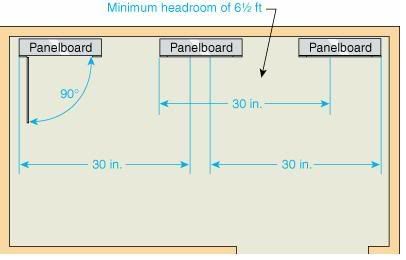
I have a 29" wall between the front wall and the entry door. Code says I have to have 30 x 36" of clearance in front of the panel. The inspector said it was ok in that spot but to mount it close to the door. The problem is I have one stud that is in the way. The stud is closer to the door than the wall so that would put the panel closer to the wall not the door like the inspector asked for. Here is a picture so you can see what I am talking about.


The space on the right (between door frame and stud) is only about 8" and the space on the left is 14 1/2". So here is the question...what should I do?

a) mount it on the left and hope the inspector doesn't complain
b) move the stud and mount it on the right
c) cut the stud and frame around it with a header and a sill like a window just without cutting the sheathing.

Any thoughts?

Max
 
OP
M

Maxtork

Well-known member
Joined
Sep 12, 2013
Messages
140
Location
Huntsville AL
Thanks CoopVA...Do I need to use a double 2x6 header like I did for a window since it is on the eave side of the garage(ie load bearing wall) or can I use 2x4?

Thanks
Max
 

CoopVA

Well-known member
Joined
Jan 20, 2014
Messages
2,144
Location
Virginia
Thanks CoopVA...Do I need to use a double 2x6 header like I did for a window since it is on the eave side of the garage(ie load bearing wall) or can I use 2x4?

Thanks
Max

hat would depend on what your local Code requires. Here I think they could get away with a double 2x4 header at that location. Honestly, I'd ask the Authority. I'm not a carpenter... I do know you can box it out as long as you abide by the Building Code.

Looking at the pic again, you will probably have to extend the header at the door all the way to the corner...
 

pattenp

Well-known member
Joined
Jun 4, 2008
Messages
10,175
Location
Virginia - USA
You should be able to mount the panel to the left of the stud you are talking about cutting out. The panel doesn't need to be centered within the 30 inch space.

30inches-1.jpg
 

CoopVA

Well-known member
Joined
Jan 20, 2014
Messages
2,144
Location
Virginia
This is another one of those "interpretation" issues... pattenp is correct and there does appear to be no issue with the panel being in the space available between the studs. Problem is, the Inspector told him it needs to be closer to the door, not the wall...

So, what do you do?

1. You put it were the Inspector told you to.
2. You put it were you think it could go based upon your logical interpretation of the Code and deal with it after the Inspection when he fails you.
3. You call the Inspector back and ask him (nicely...) why you can't put it were you want and maybe convince him it should be ok.

You're call.
 
OP
M

Maxtork

Well-known member
Joined
Sep 12, 2013
Messages
140
Location
Huntsville AL
Thanks Guys,

I may take option 3 and screw the panel up to the left of the stud and send the inspector a picture. So far they have been really good about working with me so hopefully it will fly. I really didn't want to do any more framing and I certainly don't want to mess with the door header if I don't have to. Thanks for the advice. I'll let you know how it goes.

Max
 

pattenp

Well-known member
Joined
Jun 4, 2008
Messages
10,175
Location
Virginia - USA
You don't need to mess with the door header. Cut out the stud, put in a jack stud next to the door king stud put in a double 2X4 header and add a new king and jack stud on the left side at the width needed for the panel. Frame it like a window opening.
 
Last edited:

Keister

Active member
Joined
May 22, 2011
Messages
29
minimum height on outlet boxes I believe is 18 inches in a garage because of gas vapors. My code book is at work but I can provide code reference later
 
OP
M

Maxtork

Well-known member
Joined
Sep 12, 2013
Messages
140
Location
Huntsville AL
I asked the inspector if I could mount them at 48" and he said that was fine. No reference to any requirements though. I thought there was one somewhere for the reason Keister mentioned but as pattenp said that may be for commercial stuff.

Max
 

Bib Overalls

Well-known member
Joined
Dec 4, 2006
Messages
3,318
Location
Jonesboro, Arkansas
Header complicates pulling wires out of the top of the panel. Panel should be sized to fit between studs that are 16" on center. My solution; add a stud to the left and move the existing stud to the right. With a little forethought, this should not complicate dry walling. If you are not adept at toe nailing pre-drill the studs.
 
OP
M

Maxtork

Well-known member
Joined
Sep 12, 2013
Messages
140
Location
Huntsville AL
I may be able to move that stud and make that plan work but I was hoping to not do any more framing work. If that is what I have to do then it isn't a big deal. I was just hoping to be further along. I didn't think about the header being in the way of the romex going out the top of the panel. I will stick the panel up there on the left and see if they will buy off on it. If not I guess I get out the wood tools again.

Thanks for all the advice

Max
 

pattenp

Well-known member
Joined
Jun 4, 2008
Messages
10,175
Location
Virginia - USA
That's a very good solution because the header does create a problem for running the wires out the top of the panel. I don't know why I followed along with the header suggestion. Sometimes you can't see the trees for the forest. In the end I surely would think the inspector will allow the panel to be mounted to the left of the existing stud. The OP would maybe need to at least add a stud to the left side of the panel to secure the panel on both sides.

Header complicates pulling wires out of the top of the panel. Panel should be sized to fit between studs that are 16" on center. My solution; add a stud to the left and move the existing stud to the right. With a little forethought, this should not complicate dry walling. If you are not adept at toe nailing pre-drill the studs.
 

CoopVA

Well-known member
Joined
Jan 20, 2014
Messages
2,144
Location
Virginia
That's a very good solution because the header does create a problem for running the wires out the top of the panel. I don't know why I followed along with the header suggestion. Sometimes you can't see the trees for the forest. In the end I surely would think the inspector will allow the panel to be mounted to the left of the existing stud. The OP would maybe need to at least add a stud to the left side of the panel to secure the panel on both sides.


That's why I'm not a carpenter... I shoulda known that too...


Sent from my iPad using Tapatalk
 
To avoid these ads, REGISTER NOW!
Top Bottom