To avoid these ads, REGISTER NOW!

New guy with framing questions

Maxtork

Well-known member
Joined
Sep 12, 2013
Messages
140
Location
Huntsville AL
Hi All,

I'm getting ready to build a new garage in the backyard and found this site while searching for some answers. I didn't find exactly what I was hunting for so I thought I would join and see if anyone could steer me in the right direction.

I'm building a 20 x 40 ft garage with 10 ft walls on a concrete slab with a 4 inch curb for the walls to set on. I know there are several ways to skin a cat and that is fine. I am more concerned here with doing something that is going to get me in trouble with the inspector or be poor build technique. So here are my questions:

1. Would you frame the entire 40 ft side walls and stand them up or split it into sections that might be more manageable. I do have friends that I can ask to come help but 40 ft seems like a big wall at 10 ft high. I know it will make a difference with the sheathing if it is put on while flat and I would prefer to do it that way unless there is a good reason not to.

2. If you split the wall into sections do you frame it with a double stud at the split ?

3. I know how to overlap the double top plates on longer walls but on a single bottom plate does the split have to fall at a stud to tie the two pieces together? Also what length bottom plates do you use? I know you would use an 8 ft board for an 8 ft long wall but for a 40 ft wall would you use four 10 ft boards or five 8 footers?

That's about it for now. I'm sure I will have a bunch more questions as the build starts. Thanks in advance for any guidance you guys can provide.

Max
 
To avoid these ads, REGISTER NOW!

pattenp

Well-known member
Joined
Jun 4, 2008
Messages
10,175
Location
Virginia - USA
I'd break it up into shorter sections. For the plates you can do 16-16-8 and reverse direction for the final top plate.
 

sophijo

Well-known member
Joined
Apr 7, 2012
Messages
131
Location
SE Michigan
I'd suggest that you go to your local full service lumber yard and ask them. They should sell 2x4 "sill" in long lengths and will advise you how to build it. They may generate a plan on their computer.
 
OP
M

Maxtork

Well-known member
Joined
Sep 12, 2013
Messages
140
Location
Huntsville AL
Thanks guys,

If you split that wall do you need to run a double stud where they come together? Seems like it would be a good idea but wasn't sure if that is normally what is done.

I would ask the local lumber yard guys but around here I haven't been super impressed with the ones I've talked to so I wanted to get some other opinions. They may be right about stuff but I was leery of just taking their word for it.

Thanks for help

Max
 

premierplayer

Well-known member
Joined
Jan 30, 2010
Messages
869
Location
Maryland, USA
double 2x at the split is fine, make sure you keep your 16"o.c. spacing from section to section
sheathing spanning across the wall sections would be better than breaking sheets at the wall sections (hope that makes sense)
 
OP
M

Maxtork

Well-known member
Joined
Sep 12, 2013
Messages
140
Location
Huntsville AL
Actually that does make sense. I guess you would be using the sheathing to help strengthen the split between wall sections. I guess that is good reason to install sheathing after standing the wall sections instead of doing it on the ground before hand.

Thanks
 

bczygan

Well-known member
Joined
Nov 4, 2009
Messages
22,002
Location
DETROIT! Arsenal of Scrappers
Wall jacks. Rent them.
Sheathe and trim on the flat including house wrap and even windows.
Do gable end walls complete with gable end truss, sheathing, overhang and trim.

DSC04425.jpg
 
Last edited:
OP
M

Maxtork

Well-known member
Joined
Sep 12, 2013
Messages
140
Location
Huntsville AL
I have heard of the wall jack idea but I haven't looked into renting them yet. Once you get the walls stood up do they help at all with getting the wall properly set on the threaded rods sticking out of the concrete? I actually considered renting a all terrain fork lift for a weekend to lift walls and trusses but thats gonna get spendy.

Also, do the wall jacks still work on a concrete slab? What does the bottom end push against?

Max
 

longlivepunk

Well-known member
Joined
Feb 22, 2013
Messages
377
Location
Edmonton, AB, Canada
If you're going to split the wall up into smaller sections that's fine, but build them like you would build a normal wall, so each section has a 2x4 at each end of the plate. When you stand and square the walls you will be nailing the two end 2x4s together to make a solid joint.

Also, as was said above me, watch your spacing to make sure that you keep the 16" on center spacing through the entire wall, you can't start a new 16"OC for each section. What I would reccomend is laying out your full top and bottom plating for the entire 40' wall and marking the entire thing at once, then wherever you decide to put a split you can just add a stud onto the side that is missing one. Nice and simple, ensures you don't mess up your spacing, and you can make the sections whatever length you want (I would make them as long as you're comfortable with though, 3 guys can lift a sheeted 10' section of wall with no issue) Good luck with it!
 

longlivepunk

Well-known member
Joined
Feb 22, 2013
Messages
377
Location
Edmonton, AB, Canada
DEFINITELY sheet the walls on the ground though! Square them up and sheet them so they stay square when you stand them. you do NOT want to be sheeting stood walls. Also make sure you leave a small gap between sheets (only about 1/16", I always shoved my square between them) so that there is room for them to swell and expand. And of course, make sure to stagger the sheets so that the seams do not line up with each other.
 

Thumper68

Well-known member
Joined
May 16, 2013
Messages
5,134
Location
Duluth MN
Split them up and as the others have said keep your spacing on the studs correct, sheet everything but where the sections come together and sheet that after its all up.

If it were me I would do it in 2 20 foot sections.
 
OP
M

Maxtork

Well-known member
Joined
Sep 12, 2013
Messages
140
Location
Huntsville AL
Yeah this is sounding like the best plan. I can use a 12 ft and an 8 ft plate to get a 20 ft section and build a wall from that. I'll double stud the seam between the sections keeping 16" spacing. I'll have to lay out the sheeting and do what I can on the ground then finish up the middle sections once the wall is up.

I was going to try to find 4 x 10 OSB and run them vertically so I don't have to put any blocking in at the seams. The cost will be higher but less work. If not I will use normal 4 x 8 sheets and run them horizontal with a split 2 ft section at the top.
 

Falcon67

Well-known member
Joined
Jun 11, 2009
Messages
18,371
Location
Merkel, TX
You can look though my build on the link in my sig - I did mine single handed. I can set a 16' x 8' wall section single haded, but it's right at my limit. I had help with the 1st section, then ripped it after that. Starts at the bottom of page 2. I did not double stud mostly - just planned the joints. However, I had to go back and double a bunch after reading the instructions for the 4x8 sheets of Hardi. :lol:
 
Last edited:

longlivepunk

Well-known member
Joined
Feb 22, 2013
Messages
377
Location
Edmonton, AB, Canada
I was going to try to find 4 x 10 OSB and run them vertically so I don't have to put any blocking in at the seams. The cost will be higher but less work. If not I will use normal 4 x 8 sheets and run them horizontal with a split 2 ft section at the top.

I wouldn't reccomend that just because the strength of the OSB is in it's horizontal axis, so if you want strong walls that will stand the test of time it has to be used horizontally.
 

sands35

Well-known member
Joined
May 29, 2012
Messages
936
Location
St. Joseph, MI
Also, do the wall jacks still work on a concrete slab? What does the bottom end push against?

Max
Run 2xs from the base of the jack to the other side of the slab. Temporarily bolt down a sill to the opposite side to give you a brace. You will want to triangulate the brace on the slab so it doesn't move.
 

mbatarga

Well-known member
Joined
Sep 14, 2005
Messages
883
Location
GA
I'm at the very beginning of framing my new 38x60 (10' walls) shop - so this is a very timely thread!
I'd like clarification for question 3 asked by the OP. I've already laid out the sill plate 2x4s and drilled for the j-bolts. I didn't pay attention to where they fell end to end.

I've laid out on paper how the top plates will be laid out - but again - I didn't pay attention to whether the studs would align with the ends. I can still revise the layout to cut the top plates so that they meet at the stud placements - but it's not as easy to do that with the sill plates.

Is it important for the sill plate abutments to occur at a stud location? I can always just add a stud there if so, but that would also make the install of roll insulation more effort. I was thinking it wouldn't be critical - am I wrong? Aside from framing the walls in sections to ease raising them - what is correct?
 

pattenp

Well-known member
Joined
Jun 4, 2008
Messages
10,175
Location
Virginia - USA
There is 4 X 10 OSB and installing vertically is fine. Manufacture install instructions I've seen say to install it vertically or horizontally with no preference of one direction over another.

I was going to try to find 4 x 10 OSB and run them vertically so I don't have to put any blocking in at the seams. The cost will be higher but less work. If not I will use normal 4 x 8 sheets and run them horizontal with a split 2 ft section at the top.
 

sands35

Well-known member
Joined
May 29, 2012
Messages
936
Location
St. Joseph, MI
I'm at the very beginning of framing my new 38x60 (10' walls) shop - so this is a very timely thread!
I'd like clarification for question 3 asked by the OP. I've already laid out the sill plate 2x4s and drilled for the j-bolts. I didn't pay attention to where they fell end to end.

I've laid out on paper how the top plates will be laid out - but again - I didn't pay attention to whether the studs would align with the ends. I can still revise the layout to cut the top plates so that they meet at the stud placements - but it's not as easy to do that with the sill plates.

Is it important for the sill plate abutments to occur at a stud location? I can always just add a stud there if so, but that would also make the install of roll insulation more effort. I was thinking it wouldn't be critical - am I wrong? Aside from framing the walls in sections to ease raising them - what is correct?
You'll want to lay our your walls so that the studs provide properly spaced attachment points for the outside sheeting and the interior wall board. So typically either 16" oc or 24" oc. It's up to you how you do that. If doubling up the "joint" between wall sections, then one stud will have an odd center spacing. (pay attention to the double top plates - there are code requirements on how those are laid out.)

You need to pick where you want the compromise. Either the outside sheeting will be cut off at the ends or the inside wall board will need to be trimmed. The corners add in some length that needs to be dealt with.

There is also a consideration about the truss spacing and location. Ideally, they should be lined up on the wall studs. Care needs to by put into thinking all this through.

Suggest an "energy" corner stud construction - or stuff the voids with insulation.

http://www.performancewalls.org/?content=app_pf_afadvantages

and

http://www.nrel.gov/docs/fy01osti/26449.pdf
 
Last edited:
To avoid these ads, REGISTER NOW!

jimp

Well-known member
Joined
Nov 20, 2010
Messages
561
Location
oo
I read the first few responses, I vote for wall jacks

My first build I did a 52 foot wall 10 feet tall in two sections, then added sheathing. The second build, I made wall jacks, and raised all my walls sheathed, longest one was 48 feet long, 12 feet tall.

I will never raise a wall without wall jacks again. It's faster and a lot easier.

I have had people tell me that you can't do it square, I did not have any problems squaring the walls.

Again use wall jacks, I made mine using 2" square tubing, hand winches heavy duty hinges for mounting brackes.
 

Attachments

  • 2001-08-24img (02).jpg
    2001-08-24img (02).jpg
    150.6 KB · Views: 184
Last edited:

CNGsaves

Well-known member
Joined
Sep 26, 2012
Messages
13,233
Location
KS and OK
. . . I would ask the local lumber yard guys but around here I haven't been super impressed with the ones I've talked to so I wanted to get some other opinions. They may be right about stuff but I was leery of just taking their word for it.

So the question is . . . . WHERE is "round here" . . ???

Building codes vary by Country, state and city.

Now would be good time to Update GJ Profile with Country / State / City.

Best advice from GJer's when details are known. Post up some pics as well.
 

Bsj04

Well-known member
Joined
May 28, 2012
Messages
194
Location
Aledo, TX
I read the first few responses, I vote for wall jacks

My first build I did a 52 foot wall 10 feet tall in two sections, then added sheathing. The second build, I made wall jacks, and raised all my walls sheathed, longest one was 48 feet long, 12 feet tall.

I will never raise a wall without wall jacks again. It's faster and a lot easier.

I have had people tell me that you can't do it square, I did not have any problems squaring the walls.

Again use wall jacks, I made mine using 2" square tubing, hand winches heavy duty hinges for mounting brackes.

Do you have any pictures of your wall jack design? I'm about to start framing 40' walls also.
 

scarpozzi

Well-known member
Joined
Apr 25, 2013
Messages
70
Location
Tennessee
I did double top plates and double bottom plates on mine....with treated lumber on the extreme bottom plate. I used a sill sealer gasket (foam) and aluminum flashing under that.
 

ddawg16

Well-known member
Joined
Jul 11, 2008
Messages
21,005
Location
S. California
Welcome....it helps to put your location in your profile.....it helps to give proper answers.

Personally....I wouldn't attach sheathing (shear wall) while it's on the ground. 2 Reasons.....
1. Unless you get your top and bottom plates tight....your shear wall ends up holding too much of the load.
2. If you need to make any adjustments...it's hard.

Put the bare walls up...get everything square and plumb...toss in a couple of temp cross braces...get your trusses up for some weight..then roof it....THEN toss on the sheathing. It is also a lot easier to do all of your electrical when you have access from both sides...

Next...on that stem wall....I would go 8" high...actually....7 1/2" high....or, the height of one 2x8 board. If your doing 2x4 walls...make the stem wall 4 1/2" high....that gives you a 1/2" inside for drywall and the 1/2" outside for sheathing.

Personally, I would do 2x6 walls....especially with 10' high walls....otherwise, expect the walls to not be straight....the added cost is minimal....maybe $100 more in studs? But it also allows you to go with a wider stem wall.....and wider walls mean more room for insulation (one of the reasons we need to know where you are).

When your doing the walls...your going to want a bottom plate of PT wood....I would suggest laying down the PT wood with your foundation anchors on that...then when you build up your wall, you tilt it up and nail it to the PT plate.

Also remember that 16" is the most important number. Make sure your studs are on 16" centers.....you will appreciate it when you do sheathing and drywall.

Look at the garage build in my signature....like Falcon67, we have actually done it and have the pictures to prove it....
 

rustynutts

Well-known member
Joined
Nov 13, 2009
Messages
54
For a first time framer it would be wise to stand the wall unsheathed, then plumb it, then sheath it. If you don't get the wall square & straight or if the foundation is not level, it is a real pain to rack the wall plumb after it is sheathed. If you are determined to sheath the wall on the ground, I would bolt down my PT sill plate to the foundation, then use a second bottom plate. You can temporary attach the second plate to the PT plate, this will hold the bottom of the wall straight and it will be easier to square the wall this way. I would cut my studs so my wall height is 1/2" higher than 10' to allow for any irregularity in the foundation. And secure the two plates together from the bottom so you can get to the screws after the wall is sheathed.
Just my 16d
Have Fun
 
OP
M

Maxtork

Well-known member
Joined
Sep 12, 2013
Messages
140
Location
Huntsville AL
Thanks Guys,

All good information. Sorry I hadn't updated my profile stuff yet. I have it filed out now. I live in Huntsville AL. As for the 4x10 OSB I guess I don't have to worry about it as nobody local seems to carry it. I'm sure it could be ordered but that would probably be a bunch more money. If I have to do it with 4 x 8 sheets then horizontal is the best way to go as I can run to sheets along the bottom and one split sheet at the top to get 10 ft.


I'm curious about the idea of the double bottom plate. If I do that and bolt it down first how will the second plate (I assume this one is built and attached to the wall) sit flush as the bolts will be in the way? Do you have to counterbore the second plate to make room?This was part of my concern for sheeting before standing. Even if I could stand it up, would it be too heavy to lift up and get it on the j bolts sticking out of the concrete slab?

Also curious about installing the sheeting on the ground. I've read lots of arguments for both ways. I do understand the issue of not getting the wall square if it is already on before standing it up. As I understand it the benefit to putting it on first is to avoid having to manhandle big sheets into position vertically. So I'm wondering about a hybrid method. If a guy was to frame the wall and attach the sheeting along the bottom edge and just temp nail it at the top and then stand up the wall. Once it was up the sheet would already be in position so no need to carry it around and hold it up to nail it off. But since you only nailed it permanent along one edge it should be easy enough to adjust before you finish nailing it on. I know it probably isn't the traditional method (either one of them) but might it work? Hey I'm all about swimming up stream if it is a better way to go.

Good idea on the book as well. I am going to be at the mall this weekend so I can look for one there. If not I can always go online to Amazon etc.

I like the idea of the wall jacks too. I will have to see if I can rent them down here. If so I think I can make them work as suggested by bracing the bottoms with 2x4s over to the curb for the opposite wall.

Thanks again for all the advice...good stuff!

Max
 

sophijo

Well-known member
Joined
Apr 7, 2012
Messages
131
Location
SE Michigan
......you might check out the local scrap yard for steel I beam, and while you're at it look at the "Fitch" plate option.
 

NUTTSGT

Super Moderator
Staff member
Joined
Sep 14, 2009
Messages
50,902
Location
Northern Central Ohio
When I built the house, I used 10 footers for the top/bottom plate. Doing that made the walls a ten foot section that I put in place myself. I tried to keep the spacing correct and doubled up the joints. Once I had a section squared up, I nailed one sheet of OSB on the studs, keeping spacing in mind.

This kept it from racking and made it easy to move and set myself.
 

jimp

Well-known member
Joined
Nov 20, 2010
Messages
561
Location
oo
Do you have any pictures of your wall jack design? I'm about to start framing 40' walls also.

I keep getting errors when I try to download, try again in the morning.

But they are simple, pulley on one end, hinged base plate with holes to nail to the subfloor and I used a 1000 pound cable come- along attached to welded brackets on the 20 ft long square tubing.
 
OP
M

Maxtork

Well-known member
Joined
Sep 12, 2013
Messages
140
Location
Huntsville AL
Hi All,

I got my slab put in and that has led me to some further questions that I was hoping you all could help with. First is the anchor bolts. My concrete guy turned out not to be the greatest so when it came time to install the J bolts into the concrete I decided he would likely put them all in the wrong place so I told him not to. He suggested using metal straps to attach the sill plates to the slab. I figured this would work, but I understood it at the time to be something that was attached after the slab was done. Instead he went and got the straps that are poured in place just like the bolts would be. They aren't the ones I have seen online but instead that sit outside the wall and are bent over the sill plate. Once I got home after it was all said and done they are not evenly spaced and not really what I was looking for. So..now that I screwed that up (with his help) what are my options? I am happy to cut them all off and drill for new anchor bolts but what type is best? I have ready about the Titen HD type that just screw in with an impact gun. I have also heard of using epoxy to glue in some all thread. Or third is the expandable type anchor bolts. What do you guys think would be my best option? Any choice I make, I will have to run it by the inspector to make sure I don't have to do it a third time.

Second question is for nails for the framing. I bought a nail gun and found a good deal on 3 1/4" .120 nails. Are those adequate or should I return them and get 3 1/4" .131 nails? I did a bunch of reading online about it and everyone seems to have a different opinion so I figured I would ask here and see if anyone could guide me based on my particular project. I looked at the plans and it seems there is a ton of nail info for the paneling but I don't see anything that I can attribute to the actual framing. If someone would like to look at the plans I would be happy to email them so you can see if I am just misreading them.

Here is a picture of the slab. You can see the straps that he installed. If I need a better picture I can get one in the morning.


Thanks for any help you guys can provide.

Max
 

rustynutts

Well-known member
Joined
Nov 13, 2009
Messages
54
The nails are ok, Just a word of warning with the nail gun, DO NOT hold the stud at the top near the plate as you are nailing. Some times the nail curls out the side of the stud. Hold the stud at least 6" back from the plate.
I would strike lines on the foundation that represent the inside of the wall. Being sure they are parallel and square to each other. Measure from the line to the center of the strap and transfer that measurement to your bottom plate. If it is in the center of the plate (that's good) drill a 3/4" hole through the plate and fish the strap through the hole. Do Not secure the strap to the plate until the wall is standing. Hope this helps.
 
OP
M

Maxtork

Well-known member
Joined
Sep 12, 2013
Messages
140
Location
Huntsville AL
Thanks for the info Rusty,

I spoke to the inspector today and he said no problem using the straps that the concrete guy installed. If they don't fall in the proper places he said I could use the Titen HD anchors or equivalent. In fact he even gave me the PN for the ones I need. I have to say after all the horror stories I have heard about dealing with the permit offices and inspectors, I am really impressed by these guys. They are very easy to deal with.

Anyways I think I have all my quotes for materials now and I should be ordering lumber this week and if Mother nature allows I should be framing this weekend. More pictures to come!

Max
 
OP
M

Maxtork

Well-known member
Joined
Sep 12, 2013
Messages
140
Location
Huntsville AL
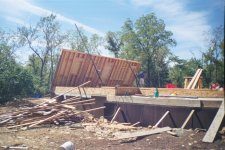
Well Here is where I ended today. I got the last section of will built this evening but Mother Nature said that was enough so it didn't get stood up. I do have a question for you carpenter types. What do you all use for entry door headers? I have two windows and one entry door (32" wide) that I need to make holes for. My buddy came over and helped me with the first window opening and he said just use two 2x4s on edge with plywood in between for both the header and the sill for the window. I looked in my framing book and if I am reading it right 2x4s should be sufficient but I would rather go with what is good and not just sufficient. Any thoughts would be appreciated.


Max
 
Last edited:
OP
M

Maxtork

Well-known member
Joined
Sep 12, 2013
Messages
140
Location
Huntsville AL
I would go bigger on the header.

Thanks Oilslick,

Do you think a double 2x6 is good enough or would you recommend 2x8?

Also for the windows would you use just 2x4 for the bottom of the rough opening or go bigger there too? My book shows just a single 2x4 which seems a bit light to me.

Thanks

Max
 

mbatarga

Well-known member
Joined
Sep 14, 2005
Messages
883
Location
GA
2x6 or 2x8 would be standard for the header - double'd up of coarse to fill the 4" wall thickness. 2x4 won't cut an inspection.

single 2x4 for window bottoms is standard - that is just a nailing ledge for the bottom window frame/ledge.
 

CTyankee

Well-known member
Joined
Jan 13, 2013
Messages
3,792
Location
CT
I would use at least 2x8 material for the doorway on a load bearing wall. On a larger opening this might not even be large enough. 1/2 ply wood sandwiched in between. Single sills may be standard, but we always double them up. Nice to have the extra material come trimming time.
 
To avoid these ads, REGISTER NOW!
Top Bottom