

You are using an out of date browser. It may not display this or other websites correctly.
You should upgrade or use an alternative browser.
You should upgrade or use an alternative browser.
New ICON Master General Service Socket Sets
- Thread starter Jtels85
- Start date
Fedwrench
ALLIANCE MEMBER
Under the Icon brand, I think a three drawer set would have a hefty price tag. 
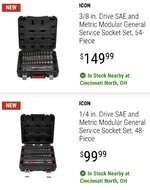
A few initial thoughts about the modular sets pictured above:
I'd like to see dedicated metric or SAE sets.
I like that you can remove the foam sections from the carrying case.
The carrying case appears to be well made.
I'm disappointed that in the 1/4 drive set there isn't a spinner handle and they stopped at 14 mm.
I'm not sure the Icon sets are worth double what a similar Quinn set costs.
A few initial thoughts about the modular sets pictured above:
I'd like to see dedicated metric or SAE sets.
I like that you can remove the foam sections from the carrying case.
The carrying case appears to be well made.
I'm disappointed that in the 1/4 drive set there isn't a spinner handle and they stopped at 14 mm.
I'm not sure the Icon sets are worth double what a similar Quinn set costs.
nicks78camaro
Well-known member
Good idea, decent deal with a coupon, but I wish these types of sets came with a flex ratchet instead as that's my go to 99.9% of the time.
Also a note, the Snap On set similar to the 1/4" Icon set is $1,199 (12 times more than the Icon). So I don't think pricing is too high on these especially with a coupon.
(I'm not trying to start a war or comparison between the two brands)
Also a note, the Snap On set similar to the 1/4" Icon set is $1,199 (12 times more than the Icon). So I don't think pricing is too high on these especially with a coupon.
(I'm not trying to start a war or comparison between the two brands)
These look good, and well thought out with the modular design on storage choices- if you want that option; they're priced somewhat comparable to Tekton. I would go with Tekton for a dedicated case set as I like the open stock option on their website to easily order a replacement item if necessary. The Icon case does look high quality; I have an Icon torque wrench, and the case is fantastic with metal latches. But yeah, if you just want something low cost, then the Quinn set looks like a winner.
2ndGearRubber
Well-known member
Those are pretty neat. Good idea on their part. Would be nice if they included semi deep
toolenthusiast
Well-known member
- Joined
- Jan 21, 2017
- Messages
- 723
Yeah, echoing multiple comments above… would be better to have fewer sizes and more depths, e.g. a metric set with deep / semi-deep / standard / low profile
I'd also prefer a set in metric only/ sae only and more sizes included. I will wait to see what the 1/2" set looks like if/ when it comes out before ordering a tekton setup. really dont need any more ratchets but if the set looks good.... lol.
KnurledNut
Well-known member
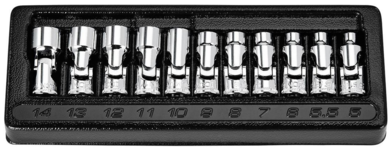
Yep. They also just released 1/4 chrome universal sockets:

yeah and at $120 for the metric set they can keep em too....Yep. They also just released 1/4 chrome universal sockets:
Agree.Yeah, echoing multiple comments above… would be better to have fewer sizes and more depths, e.g. a metric set with deep / semi-deep / standard / low profile
The u-joint set is a bit odd - pricey, and I have no idea what I'd ever use 5mm and 5.5mm for...
Fedwrench
ALLIANCE MEMBER
5.5 mm is quite common in the world of Ford & GM HVAC actuator fasteners along with all sorts of under dash fasteners.Agree.
The u-joint set is a bit odd - pricey, and I have no idea what I'd ever use 5mm and 5.5mm for...
I'm just not sure it's worth more than double the price of this Capri set
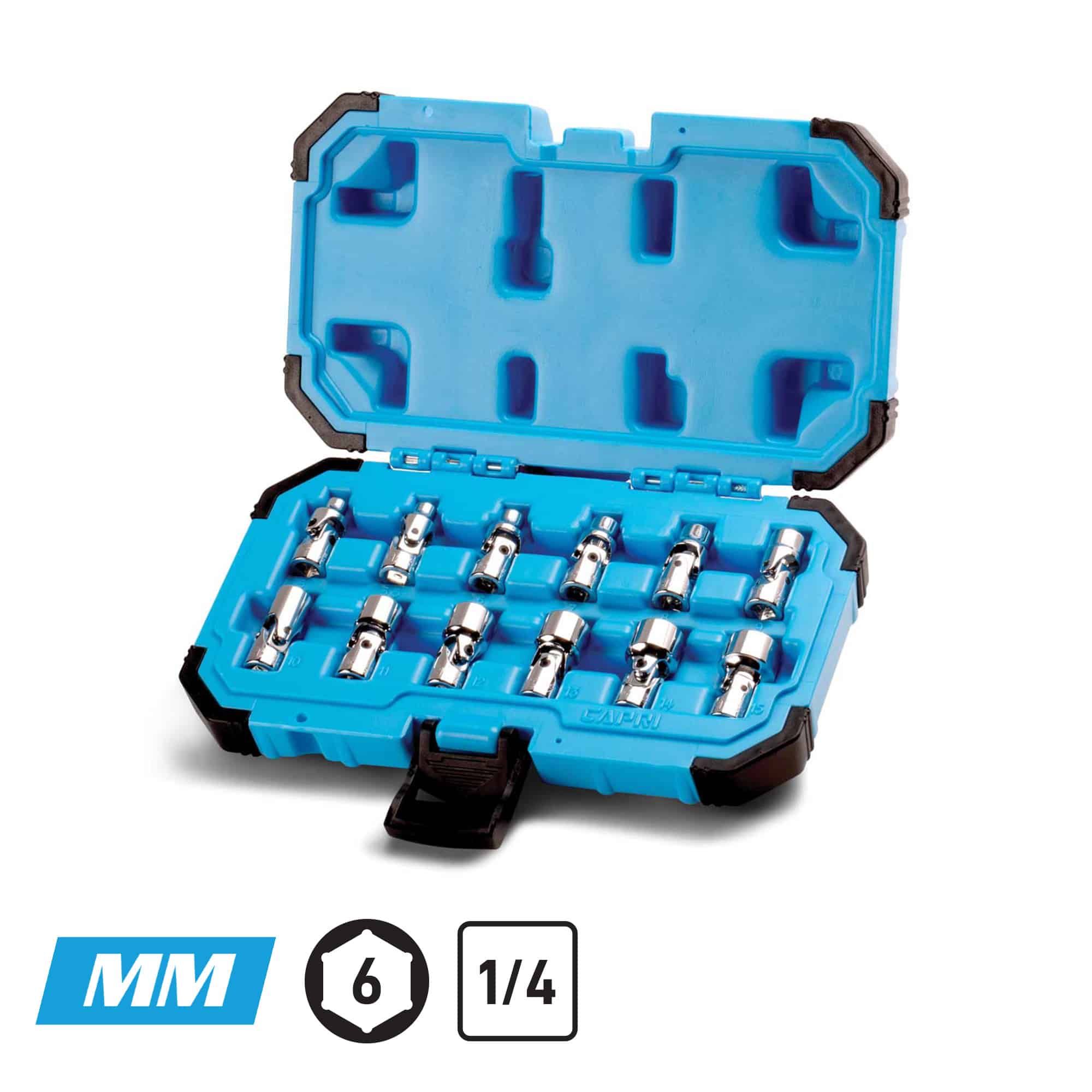
1/4" Drive Universal Socket Set, 5 - 15mm, 6-Point, Low Profile, Metric
The Capri Tools 1/4 in. Drive Universal Sockets have a 40-degree working angle and rotate smoothly in 360 degrees. 12 piece set 5 to 15 mm.
 capritools.com
2ndGearRubber
Well-known member
Agree.
The u-joint set is a bit odd - pricey, and I have no idea what I'd ever use 5mm and 5.5mm for...
5.5 is pretty common. Body/plastic fasteners, I know some hose clamps are 6mm.
nicks78camaro
Well-known member
5.5 mm is quite common in the world of Ford & GM HVAC actuator fasteners along with all sorts of under dash fasteners.
I'm just not sure it's worth more than double the price of this Capri set
1/4" Drive Universal Socket Set, 5 - 15mm, 6-Point, Low Profile, Metric
The Capri Tools 1/4 in. Drive Universal Sockets have a 40-degree working angle and rotate smoothly in 360 degrees. 12 piece set 5 to 15 mm.
Or the metric/SAE master set in foam $89.99

1/4 in. Drive Master Universal Socket Set, Metric and SAE, 19-Piece
Upgrade your toolkit with the Capri Tools 1/4 in. Drive Master Universal Socket Set, Metric and SAE. Precision and versatility for every project.
 capritools.com
nicks78camaro
Well-known member
Agree.
The u-joint set is a bit odd - pricey, and I have no idea what I'd ever use 5mm and 5.5mm for...
They're just pricing it as a deal compared to Snap On's $600 set
KnurledNut
Well-known member
There are plenty of budget priced sets on the market but none that I know of that are finished like these.
The bigger consideration is how they actually perform, which is yet TBD.
Snap-on makes some of the best 1/4 universals available, but at a premium of $637 for their metric set.
If these ICON's actually use a pivot design similar to Snap-on, I feel they are a competitive option. Most others use exposed pins or screws. And HF does coupons and sales which softens the blow considerably.
Love 'em or hate 'em, being able to walk in and grab a set right when you need 'em provides an advantage few offer.
The bigger consideration is how they actually perform, which is yet TBD.
Snap-on makes some of the best 1/4 universals available, but at a premium of $637 for their metric set.
If these ICON's actually use a pivot design similar to Snap-on, I feel they are a competitive option. Most others use exposed pins or screws. And HF does coupons and sales which softens the blow considerably.
Love 'em or hate 'em, being able to walk in and grab a set right when you need 'em provides an advantage few offer.
toolenthusiast
Well-known member
- Joined
- Jan 21, 2017
- Messages
- 723
I swear this comes up just about every week. You ain’t gonna get a bumper or a door panel off a Ford or a Chevy without a 5.5Agree.
The u-joint set is a bit odd - pricey, and I have no idea what I'd ever use 5mm and 5.5mm for...
yeah and at $120 for the metric set they can keep em too....
I'm just not sure it's worth more than double the price of this Capri set
1/4" Drive Universal Socket Set, 5 - 15mm, 6-Point, Low Profile, Metric
The Capri Tools 1/4 in. Drive Universal Sockets have a 40-degree working angle and rotate smoothly in 360 degrees. 12 piece set 5 to 15 mm.
People always seem to point at pinned vs. pinless when comparing this kind of thing. I don't know if there is a strength difference or some other negative in that approach, but it seems like there's a premium for the implementation Icon (and Snap On) used...
I swear this comes up just about every week. You ain’t gonna get a bumper or a door panel off a Ford or a Chevy without a 5.5
I guess that's it, and confirms I'll never need it.
6mm band clamps are certainly part of my wrenching life, a few 7mm here and there (old BMW fuel pump mounts) and lots of 8mm, but 5mm/5.5mm isn't likely to ever be useful to me.
Or Astro!5.5 mm is quite common in the world of Ford & GM HVAC actuator fasteners along with all sorts of under dash fasteners.
I'm just not sure it's worth more than double the price of this Capri set
1/4" Drive Universal Socket Set, 5 - 15mm, 6-Point, Low Profile, Metric
The Capri Tools 1/4 in. Drive Universal Sockets have a 40-degree working angle and rotate smoothly in 360 degrees. 12 piece set 5 to 15 mm.
toolenthusiast
Well-known member
- Joined
- Jan 21, 2017
- Messages
- 723
I work at a Euro shop and I’ve used the 5.5 recently. I think it was Porsche thoughI guess that's it, and confirms I'll never need it.
6mm band clamps are certainly part of my wrenching life, a few 7mm here and there (old BMW fuel pump mounts) and lots of 8mm, but 5mm/5.5mm isn't likely to ever be useful to me.
scooby074
Well-known member
The foam is kinda nice. Too bad they didnt offer a set that was $20 less, minus the hard plastic case. I HATE plastic cases lol.
thool
Well-known member
I believe my old Buick Century needed a 5.5mm to remove the internal blower housing. And a 6mm in the same area. Why not just pick one!Agree.
The u-joint set is a bit odd - pricey, and I have no idea what I'd ever use 5mm and 5.5mm for...
Model A Fan
Well-known member
Have you never heard of Channellocks or Vise Grips? 

I enjoy looking at these different sets in their nice blow mold cases. They make for nice tool chest fillers.
I enjoy looking at these different sets in their nice blow mold cases. They make for nice tool chest fillers.
oldschoolcraft
Well-known member
There's diminishing marginal returns on everything at the high end. If you're manufacturing something to tolerances of 0.01" and want to go to 0.005" that's a 2x improvement in tolerances but it might cost 10x more to increase tolerances by a factor of 2.I'm not sure the Icon sets are worth double what a similar Quinn set costs.
If you have a socket set like Quinn that is allegedly a reasonable entry level socket according to reviews, if you want to make the socket 20% better you might be doubling the cost.
I wouldn't expect a socket like Icon that costs 2x as much to be 2x better.
Similarly if you jump from Icon to Snap On that might be 4x (400%) more expensive but might only be 50% better.
There's going to a sweet spot in most things with respect to a cost-value curve. If you take some no-name Walmart Chinese socket set for $50 and 2x the price to $100 for Quinn, you might 10x the quality in that case. Because there's going to be a fixed cost to making the blow molded case, to creating tooling (even if it's **** tooling, there's still some base cost), it's going to cost the same to put the socket set on a boat from China to the port of Los Angeles and ship it to a distribution center.
Those costs are fixed and set regardless of how good of a tool it is, and those costs might make up $40 of the $50 price of the Walmart Socket set. 80% of the price might be non-tool related factors. Only $10 is related to to the tool quality, tool steel, tolerances, etc.
So if you jump to $100 Quinn, which also has a $40 base price built in, now $60 of the price is related to the tool itself. So by doubling the price of the tool from $50 to $100, you 6x the budget allocated to the underlying tool. Better tool steel, better QC, etc.
Doubling the price in this case, 6x the tool quality. Because that's on the low end.
The Value-Cost curve is an inverted U-shape where something like Quinn might be at the very top, and then as you move to the left, you get some Walmart **** that costs half as much but is only 1/10 as good, and if you move to the right you get stuff that's 10x as expensive and only 2x as good.
Which isn't to say we should all be using Quinn tools, just like we all shouldn't be driving Honda Civics. If you can afford a Porsche and like a Porsche then buy a Porsche but you're paying 10x the cost of a Honda Civic for a car that isn't 10x as good. Non-linear returns.
Last edited:
(I can already feel myself getting easily offended if you are referring to Hyper Tough and/or Hart!)If you take some no-name Walmart Chinese socket set for $50...
Which isn't to say we should all be using Quinn tools, just like we all shouldn't be driving Honda Civics. If you can afford a Porsche and like a Porsche then buy a Porsche but you're paying 10x the cost of a Honda Civic for a car that isn't 10x as good. Non-linear returns.
I never thought we would be comparing Icon to Porsche, yet here we are....
oldschoolcraft
Well-known member
That's what happens when you send enough free tools to Tik Tok influencers.I never thought we would be comparing Icon to Porsche, yet here we are....
That's what happens when you send enough free tools to Tik Tok influencers.
 are you a Tik Tok influencer?
There's diminishing marginal returns on everything at the high end. If you're manufacturing something to tolerances of 0.01" and want to go to 0.005" that's a 2x improvement in tolerances but it might cost 10x more to increase tolerances by a factor of 2.
If you have a socket set like Quinn that is allegedly a reasonable entry level socket according to reviews, if you want to make the socket 20% better you might be doubling the cost.
I wouldn't expect a socket like Icon that costs 2x as much to be 2x better.
Similarly if you jump from Icon to Snap On that might be 4x (400%) more expensive but might only be 50% better.
There's going to a sweet spot in most things with respect to a cost-value curve. If you take some no-name Walmart Chinese socket set for $50 and 2x the price to $100 for Quinn, you might 10x the quality in that case. Because there's going to be a fixed cost to making the blow molded case, to creating tooling (even if it's **** tooling, there's still some base cost), it's going to cost the same to put the socket set on a boat from China to the port of Los Angeles and ship it to a distribution center.
Those costs are fixed and set regardless of how good of a tool it is, and those costs might make up $40 of the $50 price of the Walmart Socket set. 80% of the price might be non-tool related factors. Only $10 is related to to the tool quality, tool steel, tolerances, etc.
So if you jump to $100 Quinn, which also has a $40 base price built in, now $60 of the price is related to the tool itself. So by doubling the price of the tool from $50 to $100, you 6x the budget allocated to the underlying tool. Better tool steel, better QC, etc.
Doubling the price in this case, 6x the tool quality. Because that's on the low end.
The Value-Cost curve is an inverted U-shape where something like Quinn might be at the very top, and then as you move to the left, you get some Walmart **** that costs half as much but is only 1/10 as good, and if you move to the right you get stuff that's 10x as expensive and only 2x as good.
Which isn't to say we should all be using Quinn tools, just like we all shouldn't be driving Honda Civics. If you can afford a Porsche and like a Porsche then buy a Porsche but you're paying 10x the cost of a Honda Civic for a car that isn't 10x as good. Non-linear returns.
While I don't disagree with what you're saying as a general machining rule, we're talking about broaching a socket, not precision machining a hole or cylinder round to the difference of .0001 or .0005" tolerance. Broaching is done in one or two seconds on a socket and is mostly dependent on the quality of the tooling, the broach. This isn't rocket science and a small increase in tolerance, like to go from .010 to .005 isn't going to cost 10X as much over tens of thousands of sockets for the tolerance alone, it's dependent primarily on the initial tooling and that tolerance cost is going to average out to pennies a socket over time.
Edit- the difference in cost between a Pittsburg socket set and an Icon is probably 90% the higher profit margin on the Icon and 10% because of better steel, tolerances, etc. Because, "compare to Snap On."
Wamsutta
Well-known member
When it comes to universal sockets, there is no equal. No other universal socket gives you more angle without locking up. I've had them at an almost full 90 and they still turn. When it comes to universal sockets, it's about getting yourself access to a fastener that you otherwise would have no access to. There are some situations where price goes out the window. When you're at your wits end and a tool gets your car fixed so that you can drive to work on Monday, that's where the term "worth its weight in gold" comes from.Similarly if you jump from Icon to Snap On that might be 4x (400%) more expensive but might only be 50% better.
oldschoolcraft
Well-known member
What drive sizes do you have the SnapOns in? I started off with a full set of 1/4" drive up to 14mm. I read at the time that was the most useful for these style. But now I'm also thinking of going 3/8" drive. Maybe 8mm to 19mm which will give me some overlap in the 8mm to 14mm range. Maybe the fastener is torqued on tighter and needs the 3/8 drive. Or maybe the fastener is restricted access and needs 1/4 drive.When it comes to universal sockets, there is no equal. No other universal socket gives you more angle without locking up.
Jeez I'm going to wind up also getting them in both 3/8 and 1/2 drive aren't I?
In all seriousness, which ones do you have and do you do any overlaps? They're kind of expensive to overlap. But like you said, can be gold.
Wamsutta
Well-known member
I have a full set in 1/4 drive SAE that I got at a student discount about 5 million years ago. They have saved my life several times over. I would like to have a full set of metric, but can't afford them right now. So what I do is bide my time until I can afford them. I never compromise by buying fake tools that are aggravating to use; I'm stubborn that way.What drive sizes do you have the SnapOns in? I started off with a full set of 1/4" drive up to 14mm. I read at the time that was the most useful for these style. But now I'm also thinking of going 3/8" drive. Maybe 8mm to 19mm which will give me some overlap in the 8mm to 14mm range. Maybe the fastener is torqued on tighter and needs the 3/8 drive. Or maybe the fastener is restricted access and needs 1/4 drive.
Jeez I'm going to wind up also getting them in both 3/8 and 1/2 drive aren't I?
In all seriousness, which ones do you have and do you do any overlaps? They're kind of expensive to overlap. But like you said, can be gold.
oldschoolcraft
Well-known member
Once you can afford it, are you going to just get metric in 1/4 drive or you getting any 3/8 or 1/2 drive?I have a full set in 1/4 drive SAE that I got at a student discount about 5 million years ago. They have saved my life several times over. I would like to have a full set of metric, but can't afford them right now. So what I do is bide my time until I can afford them. I never compromise by buying fake tools that are aggravating to use; I'm stubborn that way.
Wamsutta
Well-known member
It seems as though whenever I'm in a real tight situation and clearance is an issue, it's 1/4 drive that I need. In the meantime, I have 1/4 drive and 3/8 drive universal joint. They are almost as good. The added length of adding on a socket to the universal joint usually kills the advantage of having a universal, but not always.Once you can afford it, are you going to just get metric in 1/4 drive or you getting any 3/8 or 1/2 drive?
neophyte
Well-known member
Most square drive sockets aren’t actually “broached” nowadays.While I don't disagree with what you're saying as a general machining rule, we're talking about broaching a socket, not precision machining a hole or cylinder round to the difference of .0001 or .0005" tolerance. Broaching is done in one or two seconds on a socket and is mostly dependent on the quality of the tooling, the broach. This isn't rocket science and a small increase in tolerance, like to go from .010 to .005 isn't going to cost 10X as much over tens of thousands of sockets for the tolerance alone, it's dependent primarily on the initial tooling and that tolerance cost is going to average out to pennies a socket over time.
Edit- the difference in cost between a Pittsburg socket set and an Icon is probably 90% the higher profit margin on the Icon and 10% because of better steel, tolerances, etc. Because, "compare to Snap On."
The only cutting and grinding on the sockets was to bevel the opening on the hex end, and to thin and smooth the outside profile of the socket.
Up until maybe 20 years ago, there were some socket manufacturers that still might have hot forged the sockets instead of cold forging the sockets. (I think one was mentioned years ago in the Tools From the Old World thread).
There were also some German manufacturers that did broach sockets in nut drivers, but the insides of those sockets looked awful, and there used to be a routine threads on GJ on why “x” brand socket had metal burrs on the inside, and silver paint.
Weirdly, the Snap-On socket extensions were actually broached on the inside of the internal square drive, using an insert cutter on a CNC lathe that could cut a square opening at high speed.
Supposedly Williams sockets are made on the same production line as Snap-On, maybe with the same forming dies, which would mean the tolerance differences between the two brands are based on differences in plating thickness.
Wamsutta
Well-known member
Most square drive sockets aren’t actually “broached” nowadays.
The sockets are cold forged from annealed tool steel.
The only cutting and grinding on the sockets was to bevel the opening on the hex end, and to thin and smooth the outside profile of the socket.
Up until maybe 20 years ago, there were some socket manufacturers that still might have hot forged the sockets instead of cold forging the sockets. (I think one was mentioned years ago in the Tools From the Old World thread).
There were also some German manufacturers that did broach sockets in nut drivers, but the insides of those sockets looked awful, and there used to be a routine threads on GJ on why “x” brand socket had metal burrs on the inside, and silver paint.
Weirdly, the Snap-On socket extensions were actually broached on the inside of the internal square drive, using an insert cutter on a CNC lathe that could cut a square opening at high speed.
Supposedly Williams sockets are made on the same production line as Snap-On, maybe with the same forming dies, which would mean the tolerance differences between the two brands are based on differences in plating thickness.
Another advantage of Snap-on sockets is that when they are placed on the end of an extension, they actually stop and don't move around. They are dead nuts solid in their placement. They don't spring back and forth within their detents like Taiwan sockets do. With Snap-on sockets, the placement of the detents and the stop at the end of the socket are in the exact precise location where they need to be. Every time I use them they put a smile on my face. When I hold a Snap-on tool in my hand, I'm holding all the people that made that tool in my hand along with it. I can go on Google maps and see the building where my tools were made. That means a lot to me.